
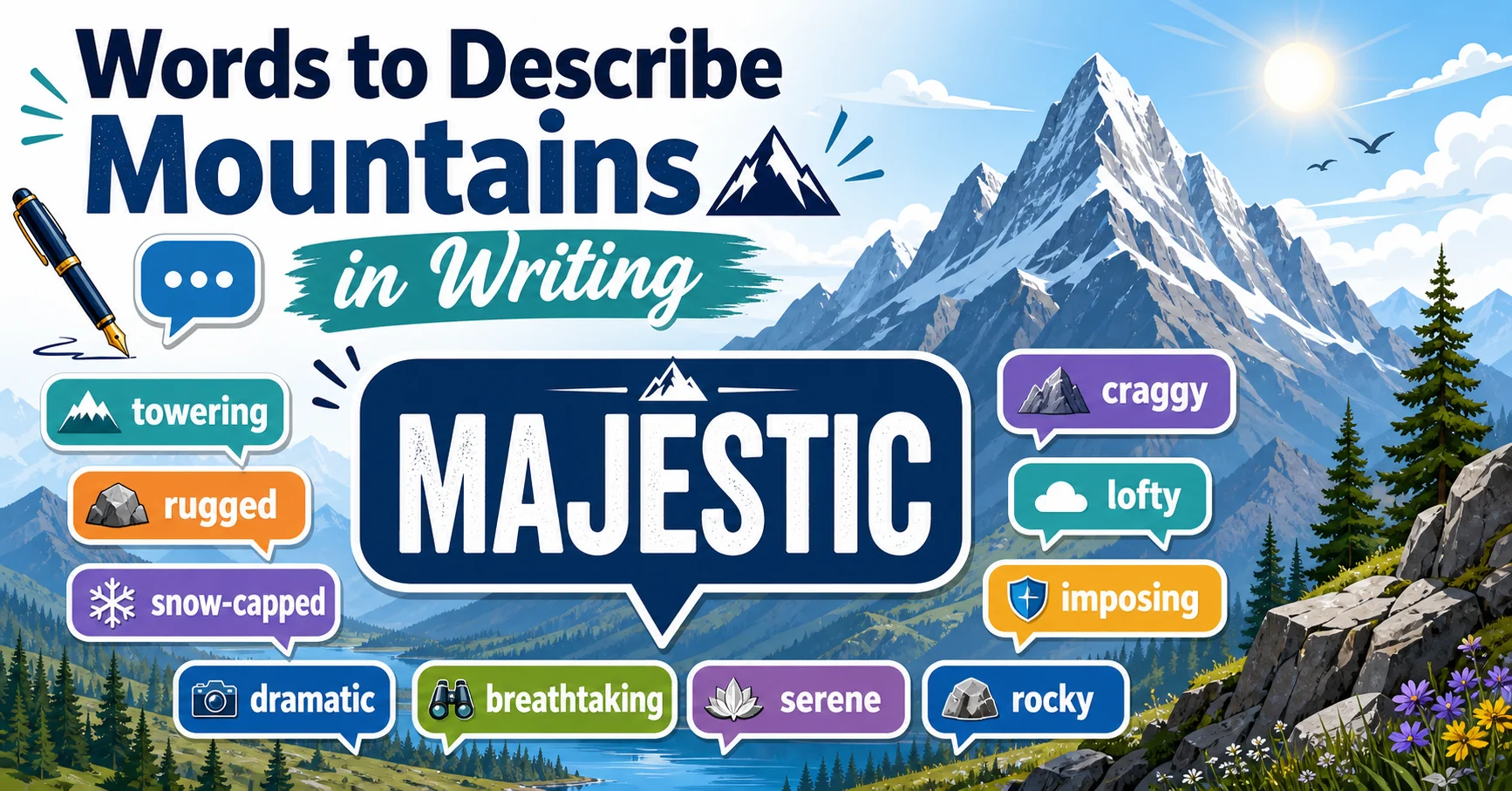
You know the scene clearly: a mountain rises in front of you, but the only words that come to mind are “big,” “beautiful,” or “high.” That is the problem many writers face. Choosing the right words to describe mountains in writing helps you turn a plain sentence into a vivid image your reader can feel, see, and remember.
This guide gives you a complete vocabulary toolkit for describing mountains in travel writing, nature essays, academic descriptions, and creative scenes. You will learn precise adjectives, useful synonyms, formal and informal options, comparison tables, and real example sentences.
As Andrew Powell, a travel writer with 13 years of travel writing experience, I have seen how one strong word can change the tone of a landscape description. A “jagged” mountain feels dangerous. A “mist-covered” mountain feels mysterious. A “towering” mountain feels powerful. By the end, you will know how to choose mountain vocabulary with confidence.
Quick Answer:
Quick Answer: The best words to describe mountains in writing include towering, rugged, snow-capped, jagged, majestic, misty, rocky, imposing, remote, windswept, dramatic, and breathtaking. Use these words based on mood, shape, weather, and scale. For essays, choose precise terms. For travel writing, add sensory detail.
What does “words to describe mountains in writing” mean?
The phrase words to describe mountains in writing refers to adjectives, phrases, and descriptive vocabulary that help you explain how mountains look, feel, and affect the reader. These words can describe height, shape, color, texture, weather, atmosphere, or emotional impact.
In Nature & Travel writing, mountain description matters because readers often want more than geography. They want atmosphere. They want to imagine the climb, the cold air, the shadowed valley, or the sharp ridge against the sky.
According to academic writing conventions, strong description should be specific, controlled, and relevant. You should not use decorative words just to sound impressive. In IELTS-style writing, vocabulary range and accuracy are both important. A varied word such as “rugged” helps only when it fits the scene.
Why mountain vocabulary matters
Good mountain description helps you:
- Create a clear visual image.
- Show mood and atmosphere.
- Avoid repeated words like “beautiful.”
- Match your tone to the purpose.
- Improve descriptive essays and travel writing.
Travel Writer’s Tip: In our experience helping writers improve travel descriptions, the strongest mountain sentences usually combine one physical detail with one sensory detail. For example: “The jagged peaks cut into a pale morning sky, while cold wind moved through the pines.”
Complete Synonyms List
Here are useful words to describe mountains in writing, grouped by meaning and mood.
Words for size and height
- Towering — extremely tall and impressive
- Lofty — high, grand, and often formal
- Soaring — rising high in a graceful way
- Colossal — huge in size
- Massive — very large and solid
- Imposing — large and powerful in appearance
Words for shape and surface
- Jagged — sharp and uneven
- Rugged — rough, wild, and rocky
- Craggy — full of steep rocks and rough edges
- Rocky — covered with rocks
- Sheer — very steep and almost vertical
- Serrated — shaped like a saw edge
For weather and atmosphere
- Snow-capped — covered with snow at the top
- Mist-covered — partly hidden by mist
- Cloud-wrapped — surrounded by clouds
- Windswept — shaped or exposed by strong wind
- Storm-darkened — made dark by storm clouds
- Sunlit — bright with sunlight
For mood and beauty
- Majestic — grand, beautiful, and impressive
- Breathtaking — extremely beautiful or surprising
- Dramatic — striking and full of visual power
- Remote — far from cities or people
- Silent — quiet and still
- Ancient — very old, often with a timeless feeling
Nature Writing Example:
“The remote, snow-capped mountains rose beyond the valley, their silent slopes glowing blue in the last light of evening.”
Comparison Table
| Word | Simple Meaning | Best Used When | Avoid When |
| Towering | Very tall | You want to show height and scale | The mountain is low or gentle |
| Rugged | Rough and wild | Describing rocks, cliffs, or hard terrain | You mean smooth or peaceful |
| Jagged | Sharp-edged | Peaks look pointed or dangerous | The mountain has rounded slopes |
| Majestic | Grand and beautiful | You want an impressive tone | You need neutral academic detail |
| Snow-capped | Snow on the top | Describing cold, high mountains | There is no visible snow |
| Misty | Covered with mist | Creating mystery or softness | The scene is clear and dry |
| Imposing | Powerful in appearance | Showing dominance or awe | You want a warm, gentle mood |
| Craggy | Rocky and uneven | Describing rough cliffs or peaks | The mountain is grassy or smooth |
| Remote | Far away and isolated | Travel or wilderness writing | The area is crowded or urban |
| Windswept | Exposed to strong wind | Describing harsh open slopes | The scene is calm and sheltered |
| Serene | Peaceful and calm | Describing quiet mountain views | The scene is wild or threatening |
| Dramatic | Visually striking | Writing travel descriptions | You need plain scientific detail |
Formal vs Informal Synonyms
Some mountain words sound more academic or polished. Others feel more conversational. Choose based on your audience.
| Formal Synonym | Informal Alternative | Best Context | Example Use |
| Lofty | High | Essays, reports, formal travel writing | Lofty peaks dominated the horizon. |
| Formidable | Scary-looking | Academic or serious description | A formidable ridge blocked the route. |
| Majestic | Amazing | Travel articles and essays | The majestic mountains framed the lake. |
| Rugged | Rough | Nature writing and geography | Rugged slopes made the climb difficult. |
| Remote | Far away | Travel guides and essays | Remote mountains attract experienced hikers. |
| Precipitous | Very steep | Academic geography or advanced writing | The trail crossed a precipitous cliff face. |
| Panoramic | Wide-view | Travel writing | The pass offered panoramic mountain views. |
| Barren | Empty-looking | Landscape analysis | Barren mountains stretched toward the desert. |
Formal context
In academic essays, your mountain vocabulary should be accurate and restrained. For example, “precipitous slopes” is stronger than “really steep sides.” It sounds precise.
Informal context
In blogs, journals, and travel notes, you can use warmer words such as “amazing,” “wild,” “peaceful,” or “huge.” These words feel natural, but they need detail around them.
Travel Writer’s Tip: Writers we work with often use “beautiful” too often. Replace it with a specific feature. Say “sunlit,” “pine-covered,” “glacier-cut,” or “misty” so your reader knows what kind of beauty you mean.
Real Example Sentences
Here are real examples showing how to use words to describe mountains in writing naturally.
- The towering mountains rose behind the village like a wall of stone.
- A line of jagged peaks cut across the orange evening sky.
- The snow-capped summit shone silver under the winter sun.
- We followed a narrow path along the rugged mountain slope.
- The mist-covered hills gave the valley a quiet, dreamlike mood.
- From the pass, the panoramic view stretched across forests, rivers, and distant ridges.
- The craggy cliffs looked harsh, but wildflowers grew between the rocks.
- At dawn, the majestic mountains turned pink in the first light.
- The windswept ridge felt cold and empty, even in summer.
- The remote mountain range seemed untouched by roads or noise.
- The sheer rock face dropped suddenly into a shadowed gorge.
- The serene mountain lake reflected every peak with perfect calm.
Nature Writing Example:
“Beyond the cedar forest, the mountains stood silent and blue. Their jagged ridges held the last snow of spring, and a clean mineral smell rose from the cold stones.”
This example works because it uses sight, texture, and smell. That mix makes your description richer.
When to Use vs When NOT to Use
Choosing words to describe mountains in writing is not only about variety. It is about accuracy.
When to use strong mountain adjectives
Use vivid mountain words when:
- You are writing a travel article.
- You need to describe a natural setting.
- You want to create mood in a story.
- You are writing a descriptive essay.
- You need to compare landscapes.
- You want your reader to imagine scale, shape, and atmosphere.
For example, “rugged mountains” fits a difficult hiking route. “Serene mountains” fits a calm lake view. “Formidable mountains” fits danger or challenge.
NOT to use certain words
Do not use a word if it gives the wrong image.
- Do not use jagged for smooth, rounded hills.
- Do not use snow-capped if there is no snow.
- Do not use serene during a storm scene.
- Do not use barren for forested mountains.
- Do not use towering for low hills.
- Do not use majestic in every sentence.
Also avoid too many adjectives together. “The majestic, towering, rugged, dramatic, breathtaking mountains” feels crowded. Choose one or two strong details instead.
Common Mistakes Writers Make
1. Using “beautiful” too often
“Beautiful” is not wrong, but it is general. Your reader needs evidence. Try:
- Beautiful mountain → sunlit mountain
- Beautiful view → panoramic view
- Beautiful peak → snow-capped peak
2. Mixing moods by accident
A mountain cannot feel peaceful and threatening in the same sentence unless you create that contrast with care. “The serene, terrifying mountain” confuses the reader. Use “serene” for calm scenes and “formidable” for danger.
3. Choosing words only because they sound advanced
Advanced vocabulary helps only when it fits. “Precipitous” means very steep. It should not describe a wide, gentle valley.
4. Forgetting the senses
Many writers describe only what they see. Add sound, touch, temperature, and smell:
- Cold wind
- Thin air
- Loose stones
- Pine scent
- Echoing silence
5. Overloading one sentence
Do not stack too many descriptive words. One precise adjective is better than five weak ones.
Weak: “The very big, nice, amazing mountain was beautiful.”
Better: “The towering mountain rose above the valley, its snow-capped peak glowing in the sun.”
Tips and Best Practices
Use these practical steps when choosing words to describe mountains in writing.
1. Start with the mountain’s shape
Ask yourself: Is it sharp, rounded, steep, rocky, smooth, or broken?
Good choices:
- Sharp peak → jagged
- Rough slope → rugged
- Rock face → sheer
- Uneven cliff → craggy
2. Add weather or light
Weather changes mood fast.
- Morning light → sunlit
- Fog → mist-covered
- Storm clouds → storm-darkened
- Snow → snow-capped
3. Match word choice to genre
In academic writing, use accurate words like precipitous, barren, glacial, or remote. In travel writing, use vivid but clear words like breathtaking, windswept, silent, or majestic.
4. Use contrast
Contrast makes landscapes memorable.
Example: “The valley was warm and green, but the mountains above it looked cold, jagged, and blue.”
5. Use one main impression
Before you write, decide what the mountain should feel like:
- Awe → majestic, towering, imposing
- Danger → jagged, sheer, formidable
- Peace → serene, silent, misty
- Isolation → remote, barren, windswept
6. Avoid empty exaggeration
Words like “incredible” and “amazing” are common, but they do not show much. Support them with detail.
Weak: “The mountains were amazing.”
Strong: “The mountains rose in dark blue layers, their snow-bright summits fading into cloud.”
Travel Writer’s Tip: When I draft mountain descriptions, I often write the plain version first. Then I replace only the weakest noun or adjective. This keeps the sentence natural and prevents overwriting.
Frequently Asked Questions
Q: What are the best words to describe mountains in writing?
A: The best words include towering, rugged, jagged, majestic, snow-capped, misty, craggy, remote, imposing, windswept, serene, and dramatic. Choose the word that matches the mountain’s shape, weather, mood, and role in your scene.
Q: How do you describe a beautiful mountain view?
A: Describe the view with exact details. Mention light, color, distance, and atmosphere. For example, say “snow-capped peaks glowing in golden light” instead of only saying “beautiful mountains.” Specific images make your writing stronger.
Q: What is a good word for a tall mountain?
A: Good words for a tall mountain include towering, lofty, soaring, colossal, and imposing. “Towering” is common and vivid. “Lofty” sounds more formal. “Soaring” works well when the mountain appears graceful or dramatic.
Q: How do you describe mountains in creative writing?
A: In creative writing, describe mountains through mood and senses. Show the cold air, rough stone, sharp ridge, or deep silence. Use words like jagged, ancient, mist-covered, or windswept to create atmosphere without overloading the sentence.
Q: What words describe rocky mountains?
A: Useful words for rocky mountains include rugged, craggy, jagged, stony, sheer, serrated, and barren. “Rugged” describes rough land in general, while “craggy” focuses more on broken rocks, cliffs, and uneven surfaces.
Q: How can I describe mountains in an essay?
A: In an essay, choose clear and formal vocabulary. Use words such as remote, rugged, glacial, precipitous, or panoramic when they fit. Avoid emotional exaggeration unless the task asks for personal or descriptive writing.
Conclusion
The right words to describe mountains in writing help you move beyond plain description and create a clear, memorable scene. Use words such as towering, rugged, jagged, snow-capped, and mist-covered with care.
Match each word to shape, mood, weather, and purpose. For stronger writing, add sensory detail and avoid empty repetition. You might also want to read our guide on landscape. Keep practicing, and your mountain descriptions will become sharper, richer, and more natural.

Andrew Powell is a travel writer and nature journalist who has spent over a decade writing about places, landscapes, and the natural world — and thinking carefully about the words that do those subjects justice ( Biography ).