
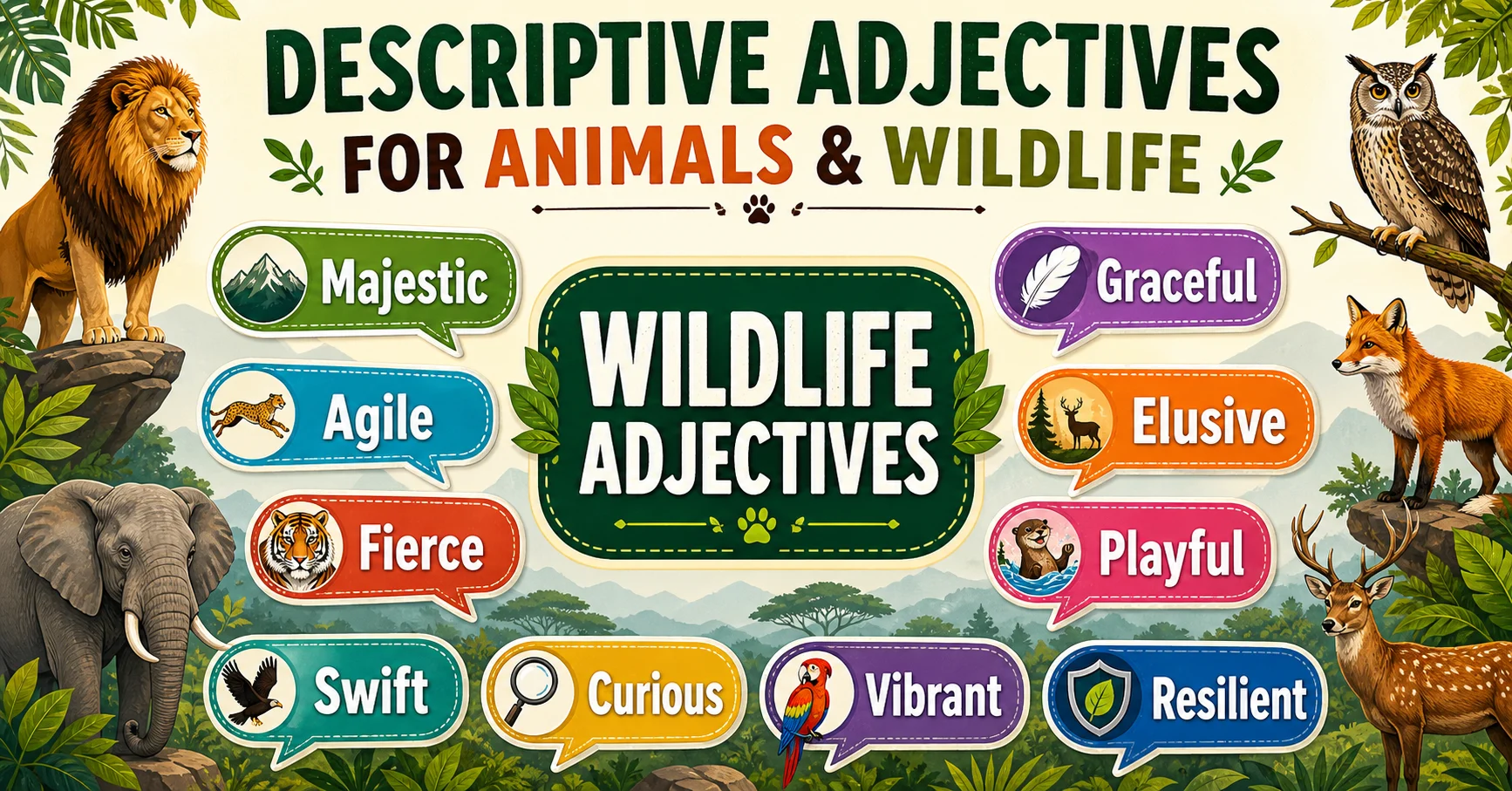
Do your animal descriptions sound too plain, even when the scene in your mind is vivid? You may picture a fox slipping through golden grass or an eagle circling above a cliff, but the words “nice,” “big,” or “beautiful” do not carry enough detail. That is where descriptive adjectives for animals wildlife become useful.
In nature writing, travel essays, academic descriptions, and IELTS-style responses, your adjective choice shapes how readers imagine movement, mood, size, texture, and behavior. A “large bird” gives basic information. A “majestic eagle” creates height, power, and grace. A “skittish deer” tells the reader about fear and movement.
This guide gives you a complete list of animal and wildlife adjectives, clear meanings, formal and informal options, comparison tables, real example sentences, and practical tips from travel writing experience. You will learn how to choose words that are accurate, sensory, and suitable for both essay writing and descriptive nature writing.
Author: Andrew Powell, Travel Writer with 13 years travel writing experience
Quick Answer:
Quick Answer: Descriptive adjectives for animals wildlife are words that describe an animal’s appearance, behavior, movement, mood, habitat, or effect on the viewer. Common examples include majestic, agile, ferocious, timid, nocturnal, graceful, elusive, wild, venomous, and endangered. Use them to make your writing more precise, vivid, and natural.
What does “descriptive adjectives for animals wildlife” mean?
The phrase descriptive adjectives for animals wildlife refers to words that help you describe animals in natural settings. These adjectives do more than say what an animal is. They show how it looks, moves, behaves, sounds, or survives.
For example:
- Furry describes texture.
- Agile describes movement.
- Predatory describes behavior.
- Nocturnal describes activity time.
- Endangered describes conservation status.
- Majestic describes the impression an animal creates.
In Nature & Travel writing, this matters because readers need more than facts. They need atmosphere. You are not only naming a leopard, whale, stag, or heron. You are helping the reader see it, hear it, and feel the scene.
According to academic writing conventions, strong vocabulary should be precise, not decorative for its own sake. IELTS Writing band descriptors also reward lexical range and accurate word choice. That means “the animal was aggressive” is stronger than “the animal was bad,” but “the snarling, territorial animal” is stronger when the context supports it.
Complete Synonyms List
Below are useful descriptive adjectives for animals wildlife, grouped by meaning so you can choose the right word for your sentence.
Appearance adjectives
- Majestic — grand, impressive, noble
- Striped — marked with long lines
- Spotted — covered with small round marks
- Furry — covered with soft hair
- Sleek — smooth and glossy
- Rugged — rough, strong, and tough-looking
- Massive — very large and heavy
- Tiny — very small
- Colorful — full of bright colors
- Camouflaged — hidden by natural coloring
Behavior adjectives
- Ferocious — fierce and violent
- Timid — shy and easily frightened
- Playful — lively and fun-loving
- Territorial — protective of its area
- Predatory — hunting other animals
- Gentle — calm and not harmful
- Curious — eager to explore
- Skittish — nervous and quick to run
- Solitary — living or moving alone
- Social — living in groups
Movement adjectives
- Agile — able to move quickly and easily
- Graceful — smooth and elegant in movement
- Lumbering — moving slowly and heavily
- Swift — very fast
- Soaring — flying high and smoothly
- Slithering — moving with a smooth sliding motion
- Bounding — jumping forward with energy
- Creeping — moving slowly and quietly
- Darting — moving suddenly and quickly
- Prowling — moving quietly while hunting
Habitat and survival adjectives
- Wild — living freely in nature
- Nocturnal — active at night
- Aquatic — living in water
- Arboreal — living in trees
- Migratory — moving seasonally from place to place
- Endangered — at risk of extinction
- Venomous — able to inject poison
- Poisonous — harmful when touched or eaten
- Adaptable — able to survive in different conditions
- Elusive — hard to find or see
Travel Writer’s Tip: In our experience helping writers improve wildlife descriptions, the best adjective is rarely the most dramatic one. It is the most accurate one. A “ferocious rabbit” sounds false. A “skittish rabbit” feels real.
Comparison Table
| Word | Simple Meaning | Best Used When | Avoid When |
| Majestic | Grand and impressive | Describing eagles, lions, whales, stags | The animal is small, ordinary, or comic |
| Agile | Quick and flexible | Describing monkeys, cats, squirrels | The animal moves slowly or heavily |
| Ferocious | Fierce and violent | Describing attacks, predators, threats | You only mean “wild” or “large” |
| Timid | Shy and nervous | Describing deer, rabbits, small birds | The animal is bold or aggressive |
| Nocturnal | Active at night | Describing owls, bats, foxes | The animal is active by day |
| Elusive | Hard to see or find | Describing rare wildlife | The animal is common and easy to observe |
| Endangered | At risk of extinction | Writing about conservation | You only mean “dangerous” |
| Venomous | Injects poison | Describing snakes, spiders, scorpions | The animal is harmful when eaten |
| Graceful | Elegant in movement | Describing swans, deer, dolphins | The movement is clumsy or heavy |
| Lumbering | Slow and heavy | Describing bears, elephants, rhinos | You want a positive, elegant tone |
Formal vs Informal Synonyms
The same animal can be described in formal or informal language. Academic essays, reports, and IELTS answers need clear, controlled vocabulary. Travel blogs and personal stories can sound warmer and more expressive.
| Formal Adjective | Informal Alternative | Best Context | Example Use |
| Nocturnal | Night-loving | Academic, nature report | Nocturnal animals avoid daytime heat. |
| Predatory | Hunting | Wildlife essay | Predatory birds control small mammal populations. |
| Endangered | At risk | Conservation writing | Endangered species need protected habitats. |
| Agile | Quick-moving | Descriptive essay | Agile monkeys moved through the canopy. |
| Territorial | Protective | Biology, observation | Territorial males defended the riverbank. |
| Elusive | Hard to spot | Travel writing | The elusive snow leopard stayed above the ridge. |
| Aquatic | Water-based | Academic description | Aquatic mammals depend on clean marine habitats. |
| Solitary | Alone | General description | A solitary wolf crossed the frozen plain. |
| Camouflaged | Hidden | Nature writing | The camouflaged lizard blended with the bark. |
| Migratory | Seasonal-moving | Geography, ecology | Migratory birds returned each spring. |
Nature Writing Example:
A formal sentence says, “The region supports several nocturnal mammals.”
A travel sentence says, “At night, the forest came alive with shy, night-loving creatures.”
Both work. The right choice depends on your purpose.
Real Example Sentences
Use these examples to see how adjectives change tone and detail.
- The majestic eagle circled above the valley, its wings steady in the cold mountain air.
- A skittish deer stepped from the trees, then vanished at the snap of a twig.
- The nocturnal fox moved silently along the edge of the campsite.
- We watched a graceful dolphin rise from the silver water and disappear again.
- The camouflaged gecko was almost invisible against the sun-baked wall.
- A ferocious tiger growled from the shadows, warning us to keep our distance.
- The lumbering elephant crossed the dusty road with slow, patient steps.
- A venomous snake rested beneath the warm rock, hidden from careless feet.
- The elusive leopard left only paw prints in the soft mud.
- Tiny migratory birds filled the wetland with sharp, restless calls.
- The territorial seal barked loudly when another male came too close.
- A sleek otter slid through the river like a dark ribbon.
These sentences use sensory language, wildlife vocabulary, animal behavior words, and habitat descriptions. That mix makes your writing stronger than a plain list of facts.
When to Use vs When NOT to Use
When to use descriptive adjectives
Use descriptive adjectives for animals wildlife when you want to:
- Create a vivid nature scene.
- Explain animal behavior clearly.
- Improve essay vocabulary.
- Add sensory detail to travel writing.
- Compare animals in a report or article.
- Describe conservation issues with accuracy.
For example, “endangered turtle” is more useful than “special turtle” because it gives the reader exact information.
NOT to use descriptive adjectives
Do not use too many adjectives in one sentence. Overloaded description weakens your writing.
Weak:
“The beautiful, amazing, graceful, stunning, lovely bird flew across the sky.”
Better:
“The graceful bird flew across the pale evening sky.”
Also avoid adjectives that are inaccurate. A shark is not always “ferocious.” A snake is not always “venomous.” A bear is not always “aggressive.” In travel and nature writing, false drama damages trust.
Use formal adjectives in essays and reports. Use warmer, more emotional adjectives in personal travel stories. For academic vocabulary, accuracy comes first.
Common Mistakes Writers Make
Writers we work with often make the same errors when describing wildlife. The good news is that these errors are easy to fix.
1. Using “dangerous” for every wild animal
Not all wild animals are dangerous. Some are shy, elusive, gentle, or curious. “Dangerous” should describe real risk, not just unfamiliar wildlife.
2. Confusing venomous and poisonous
Venomous animals inject toxins through bites or stings. Snakes, spiders, and scorpions can be venomous.
Poisonous animals harm you when touched or eaten. Some frogs are poisonous.
3. Choosing beautiful but vague words
“Beautiful” is useful, but it is broad. Try sleek, graceful, colorful, majestic, or delicate when you need sharper detail.
4. Using human emotions too strongly
Calling an animal “evil,” “cruel,” or “wicked” sounds emotional, not accurate. In essays, describe behavior instead: predatory, territorial, aggressive, or defensive.
5. Repeating the same adjective
If every animal is “amazing,” your writing becomes flat. Build a wider vocabulary bank for wildlife description.
6. Ignoring the habitat
A good animal description connects the creature to its place. A “snow-dusted wolf,” “reef-dwelling fish,” or “desert-adapted fox” gives more context.
Tips and Best Practices
1. Match the adjective to the animal
Ask yourself: Am I describing size, color, movement, sound, behavior, or habitat? Choose one clear focus.
2. Use one strong adjective instead of three weak ones
Strong: “The elusive lynx crossed the trail.”
Weak: “The very interesting and hard-to-see lynx crossed the trail.”
3. Add sensory detail
A strong wildlife sentence often includes sound, texture, light, or movement.
Nature Writing Example:
“The shaggy bison breathed clouds into the icy morning air.”
Here, “shaggy” gives texture. “Icy morning air” builds atmosphere.
4. Keep academic writing precise
For essays, choose words like endangered, migratory, nocturnal, predatory, and aquatic. These words sound natural in reports and exams.
5. Avoid exaggeration
A “massive ant” may sound comic unless you are writing from a child’s view or using humor. Scale matters.
6. Build adjective pairs carefully
Good pairs:
- elusive nocturnal fox
- graceful migratory bird
- territorial male seal
- camouflaged desert lizard
Poor pairs:
- gentle ferocious tiger
- tiny massive whale
- nocturnal daytime eagle
7. Read your sentence aloud
If the sentence sounds crowded, remove one adjective. Clear writing feels natural when spoken.
8. Use adjectives to support, not replace, observation
Instead of only writing “a majestic whale,” show why it feels majestic:
“The whale rose slowly, its dark back lifting like an island from the blue water.”
That sentence gives the reader evidence.
Frequently Asked Questions
Q: What are good descriptive adjectives for animals?
A: Good descriptive adjectives for animals include majestic, agile, furry, sleek, timid, ferocious, graceful, nocturnal, wild, playful, territorial, and elusive. Choose the adjective based on what you want to describe: appearance, movement, behavior, habitat, or mood.
Q: What are the best adjectives to describe wildlife in essays?
A: The best adjectives for essays are precise and formal, such as endangered, migratory, nocturnal, aquatic, predatory, territorial, and adaptable. These words help you describe wildlife in a clear academic style without sounding too emotional or exaggerated.
Q: How do you describe a wild animal beautifully?
A: Describe a wild animal beautifully by combining one accurate adjective with sensory detail. For example, write “the graceful heron stood in the mist” instead of “the bird was beautiful.” This gives your reader shape, mood, and setting.
Q: What adjectives describe animal behavior?
A: Useful behavior adjectives include playful, aggressive, timid, curious, territorial, predatory, social, solitary, defensive, and skittish. These words explain how an animal acts, which is often more powerful than only describing its size or color.
Q: What is the difference between venomous and poisonous animals?
A: Venomous animals inject toxins through bites or stings, such as some snakes and scorpions. Poisonous animals are harmful when touched or eaten, such as certain frogs. The difference matters in accurate nature and academic writing.
Q: How many adjectives should I use in one animal description?
A: Use one or two strong adjectives in most animal descriptions. Too many adjectives can make your sentence heavy. A phrase like “the elusive snow leopard” is stronger than a long chain of vague words before the noun.
Conclusion
The best descriptive adjectives for animals wildlife help you write with accuracy, color, and confidence. Use words like majestic, agile, nocturnal, elusive, territorial, and endangered when they truly fit the animal and scene.
For essays, stay precise. For travel writing, add sensory detail and atmosphere. You might also want to read our guide on nature vocabulary. Keep practicing, and your wildlife descriptions will become clearer, richer, and far more memorable.

Andrew Powell is a travel writer and nature journalist who has spent over a decade writing about places, landscapes, and the natural world — and thinking carefully about the words that do those subjects justice ( Biography ).