
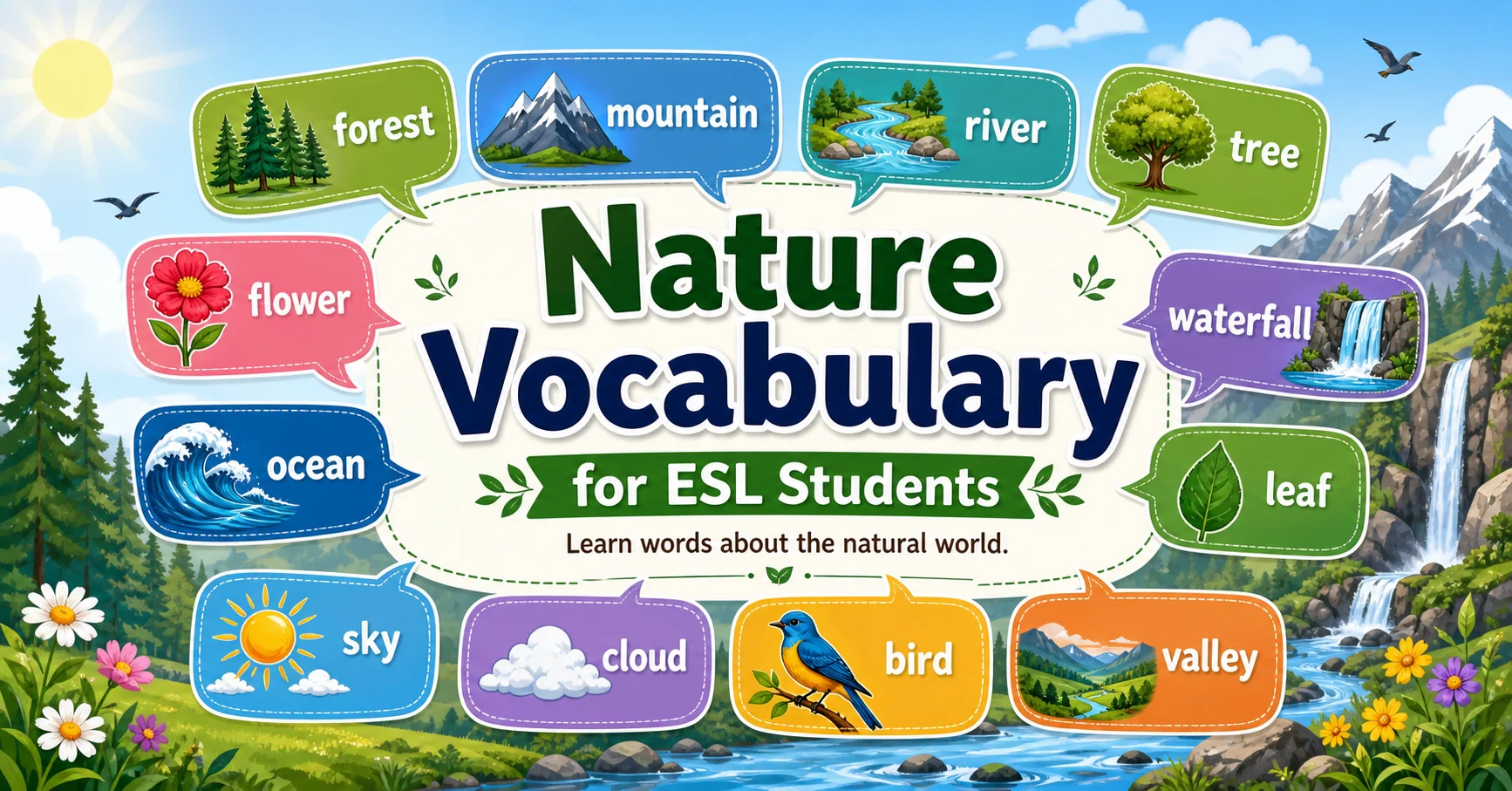
Do you know words like tree, river, and mountain, but still find it hard to describe nature clearly in English? You are not alone. Many learners can name natural things, yet they struggle when writing essays, travel descriptions, IELTS answers, or short stories about the outdoors. That is why nature vocabulary for ESL students is so useful.
In this guide, you will learn practical words for landscapes, weather, plants, animals, and natural scenes. You will also see which words sound formal, which sound casual, and which ones work best in travel or academic writing. As Andrew Powell, a travel writer with 13 years of travel writing experience, I have seen how one accurate word can turn a flat sentence into a vivid image.
Instead of writing “The place was nice,” you can write, “The valley was peaceful, green, and surrounded by misty hills.” This article will help you choose words with confidence.
Quick Answer:
Nature vocabulary for ESL students means English words used to describe the natural world, including landscapes, weather, plants, animals, and scenery. Useful words include forest, coast, meadow, valley, wildlife, climate, breeze, stream, mountain range, and habitat. These words help you write better essays, travel descriptions, and speaking answers.
What Does Nature Vocabulary Mean?
Nature vocabulary means the group of English words you use to talk about the natural world. It includes places, living things, weather, landforms, and sensory details.
For ESL learners, this vocabulary matters because nature appears in many writing and speaking tasks. You may need it for:
- IELTS Speaking Part 2 descriptions
- Academic essays about climate, tourism, or the environment
- Travel blogs and personal narratives
- Descriptive writing in school
- Conversations about parks, holidays, or outdoor activities
In academic writing conventions, precise vocabulary is valued because it shows control of meaning. For example, forest, woods, and jungle are similar, but they are not the same. A forest is a large area of trees. Woods usually sounds smaller and more informal. A jungle suggests thick tropical plants and heat.
That difference matters. Good vocabulary is not about using difficult words. It is about using the right word.
Complete Synonyms List
Below is a useful list of nature-related words and near-synonyms. Some are not perfect synonyms, but they belong to the same vocabulary family. This helps you avoid repetition in essays and descriptions.
Common Nature Words and Synonyms
- Nature — the natural world, the environment, the outdoors
- Landscape — scenery, view, terrain, countryside
- Forest — woods, woodland, jungle, rainforest
- River — stream, creek, waterway, brook
- Mountain — peak, hill, summit, highland
- Sea — ocean, coast, shoreline, waters
- Field — meadow, grassland, pasture, plain
- Weather — climate, conditions, atmosphere
- Animal life — wildlife, fauna, creatures
- Plant life — vegetation, flora, greenery
- Beautiful view — scenery, vista, panorama
- Natural home — habitat, ecosystem, environment
Travel Writer’s Tip: In our experience helping writers describe places, the best nature descriptions use a mix of nouns, adjectives, and sensory verbs. Do not only name the place. Show what you saw, heard, or felt.
Example:
Weak: “There was a forest.”
Better: “A quiet pine forest stretched behind the lake, filling the air with a clean, woody smell.”
Comparison Table
| Word | Simple Meaning | Best Used When | Avoid When |
| Nature | The natural world | Speaking generally about plants, animals, land, and weather | You need a specific place word |
| Landscape | The visible land area | Describing views, travel, geography, or art | Talking only about animals |
| Scenery | Attractive natural views | Describing beautiful places | Writing very technical academic text |
| Environment | Surroundings or natural conditions | Essays about climate, pollution, or society | You mean only a pretty view |
| Wildlife | Wild animals | Discussing animals in nature | Talking about plants only |
| Flora | Plant life | Formal essays or scientific descriptions | Casual conversation with beginners |
| Fauna | Animal life | Formal essays or biology topics | General travel writing for simple readers |
| Meadow | Open grassy area | Describing peaceful rural scenes | Referring to mountains or forests |
| Coast | Land beside the sea | Travel writing or geography | Describing inland places |
| Habitat | Natural home of a species | Academic or environmental writing | Describing a holiday view |
Formal vs Informal Synonyms
Some nature words sound academic. Others sound natural in speech. You should match the word to your purpose.
| Formal Word | Informal Word | Best Context | Example |
| Environment | Nature | Essays, reports, IELTS Writing Task 2 | Tourism can damage the local environment. |
| Vegetation | Plants | Academic or scientific writing | Dense vegetation covered the hillside. |
| Fauna | Animals | Biology, ecology, formal essays | The island has rare fauna. |
| Flora | Flowers and plants | Botanical or formal contexts | The region is known for its alpine flora. |
| Precipitation | Rain | Weather reports, academic writing | Annual precipitation has increased. |
| Terrain | Land | Geography, hiking, travel writing | The terrain became rocky near the summit. |
| Habitat | Home | Environmental essays | Wetlands are an important bird habitat. |
| Scenic | Pretty | Travel writing, reviews | The train follows a scenic coastal route. |
IELTS Tip: In IELTS-style writing, vocabulary range and accuracy are part of lexical resource. This means you should not use a “big” word just to impress. Use habitat when you mean a species’ natural home. Use view when you simply mean what someone can see.
Real Example Sentences
Here are practical sentences using nature vocabulary for ESL students in travel, essay, and speaking contexts.
- The valley was covered in soft morning mist.
- We followed a narrow stream through the forest.
- The island is famous for its rich wildlife and clear blue water.
- Heavy rain has damaged the local environment.
- The hotel offers a beautiful view of the mountains.
- Many birds lose their habitat when wetlands are destroyed.
- The path crossed a quiet meadow full of yellow flowers.
- The rocky coastline looked dramatic at sunset.
- Dense vegetation made the jungle difficult to enter.
- The desert landscape felt silent, dry, and endless.
Nature Writing Example:
“The trail climbed above the coast, where sharp cliffs dropped into silver water. A cool breeze moved through the grass, and gulls circled over the waves.”
Notice how this example uses place words, movement, sound, and color. That is how you make nature writing feel alive.
When to Use vs When NOT to Use
When to Use Nature Vocabulary
Use nature vocabulary for ESL students when you want to describe outdoor places with accuracy and detail.
You should use it when:
- You describe a holiday, hike, beach, park, or countryside scene
- You write about climate change, pollution, tourism, or conservation
- You compare urban and rural life
- You discuss animals, plants, land, or weather
- You want your English to sound more vivid and natural
For example, instead of writing, “The place had many trees,” write, “The area was covered with thick woodland.” This sounds more exact.
NOT to Use Nature Vocabulary
Do not use advanced nature words when they make your writing unclear. A simple word is better than a wrong word.
Avoid formal words when:
- You are speaking with beginner-level learners
- You are writing casual messages
- You are unsure of the exact meaning
- The word sounds too scientific for the context
For example, do not write, “The fauna smelled fresh after the rain.” Fauna means animals, so this sentence is wrong. You can write, “The forest smelled fresh after the rain.”
Also, do not use scenery for one object. A tree is not scenery by itself. Scenery means the overall natural view.
Common Mistakes Writers Make
Writers we work with often know many English words, but they use them too generally. Here are the most common mistakes.
1. Using “nature” for every outdoor place
Weak: “I visited a beautiful nature.”
Correct: “I visited a beautiful natural area.”
Better: “I visited a peaceful forest near the lake.”
You cannot usually say “a nature” in this way. Use nature as an uncountable noun.
2. Confusing scenery and landscape
Scenery often means a beautiful view. Landscape means the land and its visible features.
Example:
“The mountain scenery was stunning.”
“The desert landscape was dry and rocky.”
They are similar, but scenery focuses more on beauty. Landscape focuses more on physical features.
3. Overusing “beautiful”
“Beautiful” is useful, but too much repetition weakens your writing. Try:
- peaceful
- dramatic
- rugged
- lush
- wild
- scenic
- misty
- remote
Instead of “a beautiful mountain,” write “a rugged mountain peak” or “a misty mountain range.”
4. Using scientific words in casual writing
Words like flora, fauna, ecosystem, and biodiversity are useful. But they sound formal. In casual travel writing, plants, animals, and wildlife often sound more natural.
5. Forgetting sensory details
Nature is not only something you see. You can describe sound, smell, touch, and movement.
Example:
“The leaves rustled in the wind.”
“The air smelled of salt and wet stone.”
Tips and Best Practices
1. Learn vocabulary in groups
Do not memorize random words. Group them by topic:
- Land: mountain, valley, hill, plain, cliff
- Water: river, lake, stream, ocean, waterfall
- Plants: forest, meadow, grass, vegetation, woodland
- Weather: breeze, storm, mist, sunshine, rainfall
- Animals: wildlife, species, birds, insects, mammals
This makes the words easier to remember.
2. Use adjective + noun combinations
Natural English often uses word pairs. Try these:
- dense forest
- rocky coast
- gentle breeze
- clear stream
- steep hill
- sandy beach
- peaceful valley
- dramatic landscape
These combinations help your writing sound fluent.
3. Choose specific words
Specific words are stronger than general words.
General: “There was water.”
Specific: “A clear stream ran beside the path.”
General: “There were animals.”
Specific: “Deer moved quietly between the trees.”
4. Match tone to task
For essays, use formal words like environment, habitat, climate, and biodiversity. For travel writing, use sensory words like golden, misty, wild, fresh, and silent.
5. Read real descriptions
Read travel articles, nature essays, and park guides. Notice how writers describe light, movement, and sound. Then copy the structure with your own ideas.
Travel Writer’s Tip: Keep a small vocabulary notebook with three columns: word, meaning, example sentence. From my own field notes, I can tell you this habit works. A word becomes useful only when you can place it in a real sentence.
Frequently Asked Questions
Q: What is basic nature vocabulary in English?
A: Basic nature vocabulary includes words such as tree, river, mountain, lake, beach, forest, flower, animal, sky, and rain. ESL students should learn these first, then add descriptive words like peaceful, rocky, green, wild, and misty.
Q: How can ESL students learn nature vocabulary fast?
A: The fastest way is to learn words in topic groups and use each word in a sentence. Study land, water, weather, plants, and animals separately. Then describe real photos or places using three to five new words.
Q: What nature words are useful for IELTS writing?
A: Useful IELTS nature words include environment, climate, pollution, habitat, wildlife, biodiversity, conservation, ecosystem, natural resources, and landscape. These words help you discuss tourism, cities, climate change, and environmental problems with more precision.
Q: What is the difference between scenery and landscape?
A: Scenery usually means a beautiful natural view, especially from a visitor’s point of view. Landscape means the visible features of land, such as hills, fields, rivers, and mountains. The two words overlap, but they are not identical.
Q: What are good adjectives to describe nature?
A: Good adjectives for nature include peaceful, lush, dry, rocky, steep, green, wild, remote, scenic, fresh, calm, and dramatic. Choose the adjective that matches the place. For example, use “lush” for thick green plants, not deserts.
Q: Why is nature vocabulary important for ESL students?
A: Nature vocabulary helps ESL students describe places, discuss environmental topics, and write stronger essays. It also improves speaking fluency because travel, weather, parks, and outdoor activities are common conversation topics in English.
Conclusion
Nature vocabulary for ESL students helps you move from basic English to clear, vivid, and accurate description. You now have useful words for landscapes, weather, plants, wildlife, and environmental topics. You also know which words sound formal, which suit travel writing, and which mistakes to avoid.
Keep practicing with real sentences, photos, and outdoor scenes. You might also want to read our guide on scenery. With steady practice, your nature descriptions will become more confident, natural, and memorable.

Andrew Powell is a travel writer and nature journalist who has spent over a decade writing about places, landscapes, and the natural world — and thinking carefully about the words that do those subjects justice ( Biography ).