Learning synonyms for mediation gives you precise words to describe peaceful problem-solving, teamwork, and conflict resolution. Exploring synonyms for mediation helps you explain how people settle arguments without fighting. Utilizing these synonyms for mediation allows you to choose the exact right word whether you are writing a school paper, drafting a blog post, or talking with friends.
Bringing People Together in Everyday Life
Two classmates disagree on how to design a poster for the science fair. Instead of arguing, they ask their teacher to help them talk through their ideas. The teacher listens to both sides, asks guiding questions, and helps them build a plan that makes everyone happy.
In very simple English, mediation means bringing in a neutral person to help two people agree when they have a disagreement.
Why Word Choice Matters for Communicators
Expanding your vocabulary with these helpful terms offers distinct advantages across many situations:
- For Students: It helps you write clear social studies papers, analyze history lessons, and discuss team projects thoughtfully.
- For Bloggers: It makes your articles about teamwork, relationships, and leadership engaging and clear.
- For Content Writers: It allows you to write professional guides about workplace policies, customer service, and community guidelines.
- For Daily English Users: It gives you polite, friendly words to help solve everyday disagreements and support fairness.
“Peaceful solutions begin when we choose words that bring people together.”
“Listening with an open heart turns arguments into opportunities for teamwork.”
Linguistic Breakdown: Etymology, Connotation, and Structure
Connotative Meaning of “Mediation”
The word mediation carries a warm, positive, constructive, and professional connotation. It implies fairness, calm communication, neutral support, and a commitment to reaching a peaceful solution.
Short Etymology
- Origin: Late Middle English (late 14th century).
- Root: Derived from Late Latin mediatio, coming from the verb mediare (meaning “to be in the middle”), from Latin medius (“middle”).
Pronunciation
- US IPA: /ˌmiː.diˈeɪ.ʃən/
- UK IPA: /ˌmiː.diˈeɪ.ʃən/
Syllables & Structure
- Syllables: 4 (me – di – a – tion)
- Primary Stress: Third syllable (a)
- Affixation Pattern: Root medi- (middle) + Suffix -ate (verb form) + Suffix -ion (noun forming action/process).
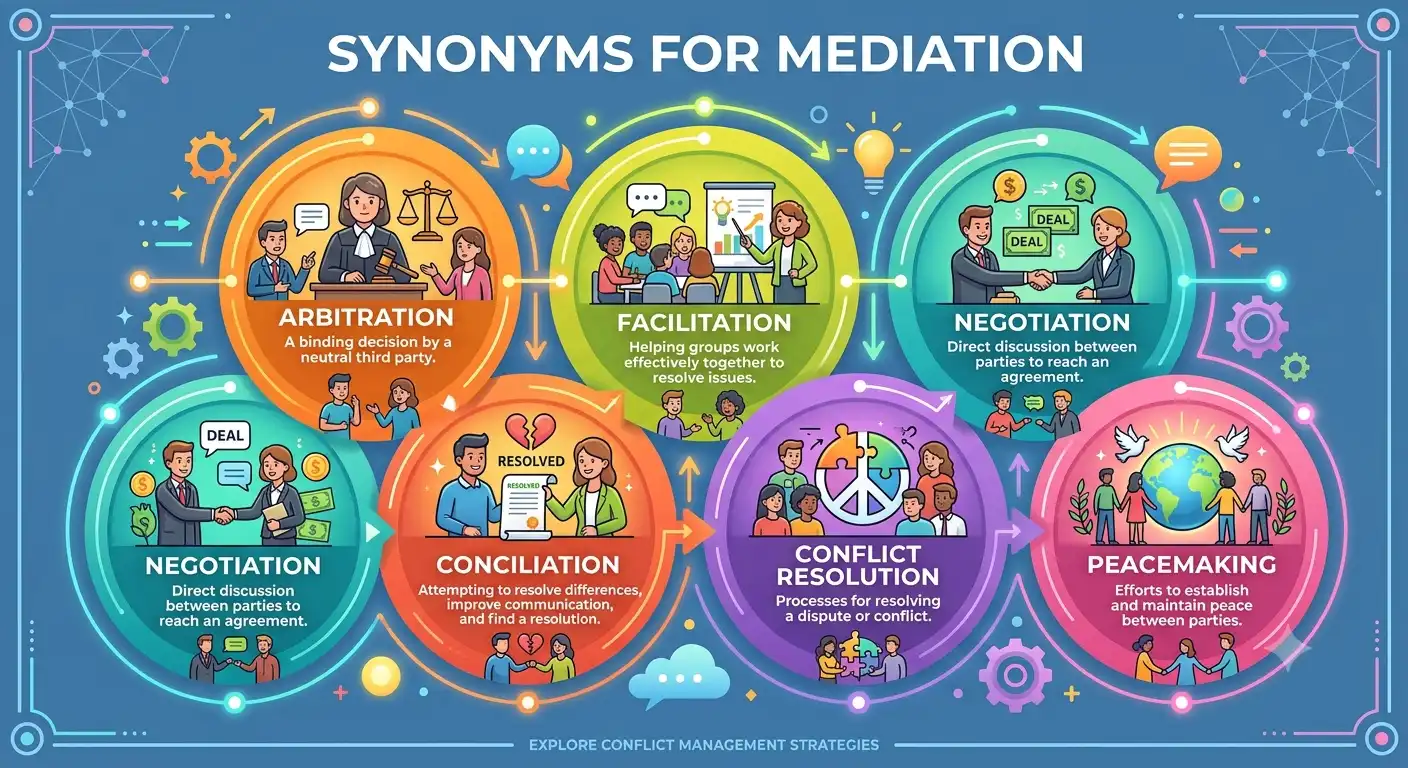
Comparison Table: Choosing the Right Synonym for Mediation
| Keyword | Meaning | Usage Type | Context |
| Mediation | Bringing a neutral person to help two sides agree | Formal / General | Workplace, school, community |
| Arbitration | Having an official choose a solution for two sides | Formal / Legal | Legal disputes, contracts, rules |
| Negotiation | Direct talks between two sides to make a deal | Professional / Casual | Business, shopping, daily plans |
| Conciliation | Helping opposing sides stop being angry and talk | Calm / Diplomatic | Family disputes, diplomacy |
| Facilitation | Guiding a group discussion to make it easy | Professional | Meetings, workshops, classrooms |
| Intercession | Stepping in to help or speak on someone’s behalf | Caring / Formal | Personal support, advocacy |
| Intervention | Stepping into a situation to change the outcome | Direct / Urgent | Health, family, teamwork |
| Peacemaking | Actions taken to stop conflict and create peace | Positive / Warm | Community, international, school |
| Moderation | Guiding a discussion so it stays fair and quiet | General | Online forums, debates, panels |
| Reconciliation | Restoring friendly relations between people | Emotional / Personal | Friendships, family, partnerships |
50 Synonyms for Mediation
1. Arbitration
- Pronunciation: US /ˌɑːr.bəˈtreɪ.ʃən/ | UK /ˌɑː.bɪˈtreɪ.ʃən/
- Meaning: Having a neutral third party listen to both sides and make a final decision.
- Examples:
- The sports league used arbitration to settle the contract question.
- Both team leaders agreed to follow the rules set during arbitration.
2. Negotiation
- Pronunciation: US /nəˌɡoʊ.ʃiˈeɪ.ʃən/ | UK /nɪˌɡəʊ.ʃiˈeɪ.ʃən/
- Meaning: Discussion aimed at reaching an agreement between two or more groups.
- Examples:
- Honest negotiation helped the two friends trade their toys fairly.
- The class spent twenty minutes in negotiation about recess times.
3. Conciliation
- Pronunciation: US /kənˌsɪl.iˈeɪ.ʃən/ | UK /kənˌsɪl.iˈeɪ.ʃən/
- Meaning: The act of making people feel friendly and ready to agree.
- Examples:
- A smile can be a great first step toward conciliation.
- The counselor offered words of conciliation during the meeting.
4. Intervention
- Pronunciation: US /ˌɪn.t̬ɚˈven.ʃən/ | UK /ˌɪn.təˈven.ʃən/
- Meaning: Stepping into a situation to help stop trouble or solve a problem.
- Examples:
- Quick intervention by the coach prevented a heated debate on the field.
- Her thoughtful intervention helped her brother finish his assignment.
5. Peacemaking
- Pronunciation: US /ˈpiːsˌmeɪ.kɪŋ/ | UK /ˈpiːsˌmeɪ.kɪŋ/
- Meaning: The process of bringing peace and stopping arguments.
- Examples:
- The student council received praise for their peacemaking efforts.
- Kindness plays a major role in everyday peacemaking.
6. Moderation
- Pronunciation: US /ˌmɑː.dəˈreɪ.ʃən/ | UK /ˌmɒd.ərˈeɪ.ʃən/
- Meaning: Guiding a debate or talk to keep it polite and organized.
- Examples:
- Good moderation kept the online chat clean and friendly.
- The teacher provided gentle moderation during the science debate.
7. Reconciliation
- Pronunciation: US /ˌrek.ənˌsɪl.iˈeɪ.ʃən/ | UK /ˌrek.ənˌsɪl.iˈeɪ.ʃən/
- Meaning: Restoring a friendly relationship after a period of disagreement.
- Examples:
- The two old friends celebrated their reconciliation with a warm hug.
- Shared memories paved the way for a quick reconciliation.
8. Intercession
- Pronunciation: US /ˌɪn.t̬ɚˈseʃ.ən/ | UK /ˌɪn.təˈseʃ.ən/
- Meaning: Asking for help or speaking up on behalf of someone else.
- Examples:
- Thanks to her mother’s intercession, she got a second chance to try out.
- He made a quiet intercession to clear up the confusion.
9. Compromise
- Pronunciation: US /ˈkɑːm.prə.maɪz/ | UK /ˈkɒm.prə.maɪz/
- Meaning: An agreement where each side gives up a small demand to agree.
- Examples:
- Choosing a movie required a fair compromise among all family members.
- They reached a smart compromise on who would walk the dog.
10. Settlement
- Pronunciation: US /ˈset̬.əl.mənt/ | UK /ˈset.əl.mənt/
- Meaning: An official agreement that resolves an argument or dispute.
- Examples:
- Both parties were happy with the peaceful settlement.
- They signed the paper to make the settlement official.
11. Dialogue
- Pronunciation: US /ˈdaɪ.ə.lɑːɡ/ | UK /ˈdaɪ.ə.lɒɡ/
- Meaning: A formal or friendly conversation between people to share ideas.
- Examples:
- Open dialogue helps teammates solve tricky problems quickly.
- The book encourages positive dialogue between parents and children.
12. Discussion
- Pronunciation: US /dɪˈskʌʃ.ən/ | UK /dɪˈskʌʃ.ən/
- Meaning: Talking about something in order to reach a decision.
- Examples:
- Our class had a great discussion about saving natural habitats.
- We held a family discussion to plan our weekend trip.
13. Adjustment
- Pronunciation: US /əˈdʒʌst.mənt/ | UK /əˈdʒʌst.mənt/
- Meaning: Making small changes so that different things work together well.
- Examples:
- A slight adjustment to the schedule made time for everyone to speak.
- Making a small adjustment helped the two gears fit together.
14. Pacification
- Pronunciation: US /ˌpæs.ə.fəˈkeɪ.ʃən/ | UK /ˌpæs.ɪ.fɪˈkeɪ.ʃən/
- Meaning: Bringing calm and quiet to a noisy or tense situation.
- Examples:
- Gentle rain aided in the pacification of the dry summer heat.
- Soft music helped in the pacification of the fussy toddler.
15. Arrangement
- Pronunciation: US /əˈreɪndʒ.mənt/ | UK /əˈreɪndʒ.mənt/
- Meaning: A plan or agreement made between people.
- Examples:
- We made a fair arrangement to share the computer taking turns.
- The group agreed on an arrangement for sharing project supplies.
16. Agreement
- Pronunciation: US /əˈɡriː.mənt/ | UK /əˈɡriː.mənt/
- Meaning: A decision shared by two or more people.
- Examples:
- The partners shook hands after reaching a complete agreement.
- Everyone was in full agreement about the game rules.
17. Good offices
- Pronunciation: US /ɡʊd ˈɑː.fɪs.ɪz/ | UK /ɡʊd ˈɒf.ɪs.ɪz/
- Meaning: Helpful actions taken by a third party to aid two agreeing sides.
- Examples:
- Through the good offices of the principal, the clubs joined forces.
- The counselor used her good offices to restore peace.
18. Facilitation
- Pronunciation: US /fəˌsɪl.əˈteɪ.ʃən/ | UK /fəˌsɪl.ɪˈteɪ.ʃən/
- Meaning: The act of making a process or meeting run smoothly.
- Examples:
- Expert facilitation ensured that every student shared an idea.
- The workshop succeeded due to clear facilitation.
19. Diplomacy
- Pronunciation: US /dɪˈploʊ.mə.si/ | UK /dɪˈpləʊ.mə.si/
- Meaning: The skill of managing international or personal relationships peacefully.
- Examples:
- It takes great diplomacy to solve conflicts without raising voices.
- She used diplomacy when telling her friend about the error.
20. Resolution
- Pronunciation: US /ˌrez.əˈluː.ʃən/ | UK /ˌrez.əˈluː.ʃən/
- Meaning: Finding a clear solution to a problem or conflict.
- Examples:
- Reaching a fast resolution allowed the game to continue safely.
- They worked together toward a peaceful resolution.
“A fair bridge built between two sides leads to lasting peace.”
21. Harmonization
- Pronunciation: US /ˌhɑːr.mə.nəˈzeɪ.ʃən/ | UK /ˌhɑː.mə.naɪˈzeɪ.ʃən/
- Meaning: Bringing different elements or opinions into a pleasing agreement.
- Examples:
- The harmonization of school rules made things fair for all grades.
- Careful harmonization of colors made the artwork pop.
22. Intermediary role
- Pronunciation: US /ˌɪn.t̬ɚˈmiː.di.er.i roʊl/ | UK /ˌɪn.təˈmiː.di.ə.ri rəʊl/
- Meaning: Acting as a middle connector between two parties.
- Examples:
- She took an intermediary role to help her cousins make peace.
- The captain played an intermediary role between players and coach.
23. Deliberation
- Pronunciation: US /dɪˌlɪb.əˈreɪ.ʃən/ | UK /dɪˌlɪb.ərˈeɪ.ʃən/
- Meaning: Careful thought and discussion before making a choice.
- Examples:
- After long deliberation, the judges picked the winning essay.
- The committee spent hours in thoughtful deliberation.
24. Consultation
- Pronunciation: US /ˌkɑːn.səlˈteɪ.ʃən/ | UK /ˌkɒn.sʌlˈteɪ.ʃən/
- Meaning: Meeting with an expert or group to get advice or consensus.
- Examples:
- A quick consultation with the doctor put his mind at ease.
- We made the final design choice after consultation with the team.
25. Refereeing
- Pronunciation: US /ˌref.əˈriː.ɪŋ/ | UK /ˌref.əˈriː.ɪŋ/
- Meaning: Watching a contest closely to enforce fairness and solve claims.
- Examples:
- Fair refereeing ensured that the match was fun for both sides.
- He took on the job of refereeing the backyard soccer game.
26. Judging
- Pronunciation: US /ˈdʒʌdʒ.ɪŋ/ | UK /ˈdʒʌdʒ.ɪŋ/
- Meaning: Forming an official opinion or choosing a winner fairly.
- Examples:
- The fair judging made every contestant feel appreciated.
- Careful judging was needed to select the best bakery cake.
27. Bargaining
- Pronunciation: US /ˈbɑːr.ɡɪ.nɪŋ/ | UK /ˈbɑː.ɡɪ.nɪŋ/
- Meaning: Discussing terms to come to a fair trade or agreement.
- Examples:
- Friendly bargaining took place at the local farmers market.
- The children engaged in fun bargaining over game tokens.
28. Parley
- Pronunciation: US /ˈpɑːr.li/ | UK /ˈpɑː.li/
- Meaning: A conference between opposing sides to discuss terms.
- Examples:
- The leaders held a brief parley to pause the snowball fight.
- In the adventure story, the two sides met for a parley.
29. Peacebuilding
- Pronunciation: US /ˈpiːsˌbɪl.dɪŋ/ | UK /ˈpiːsˌbɪl.dɪŋ/
- Meaning: Building long-term understanding and trust to prevent arguments.
- Examples:
- Community service is a great form of local peacebuilding.
- School clubs focus on peacebuilding through joint events.
30. Accommodating
- Pronunciation: US /əˈkɑː.mə.deɪ.t̬ɪŋ/ | UK /əˈkɒm.ə.deɪ.tɪŋ/
- Meaning: Changing plans willingly to fit the needs of another person.
- Examples:
- Being accommodating helped us find a study time that worked for all.
- She showed an accommodating spirit when sharing her art space.
31. Neutral assistance
- Pronunciation: US /ˈnuː.trəl əˈsɪs.təns/ | UK /ˈnjuː.trəl əˈsɪs.təns/
- Meaning: Unbiased help given to resolve a two-sided question.
- Examples:
- The librarian offered neutral assistance to both debate teams.
- Thanks to neutral assistance, both brothers agreed on a game.
32. Intermediation
- Pronunciation: US /ˌɪn.t̬ɚˌmiː.diˈeɪ.ʃən/ | UK /ˌɪn.təˌmiː.diˈeɪ.ʃən/
- Meaning: Serving as an intermediate link or messenger between groups.
- Examples:
- Financial intermediation helps banks connect savers with borrowers.
- Effective intermediation brought two distant groups together.
33. Reconcilement
- Pronunciation: US /ˌrek.ənˈsaɪl.mənt/ | UK /ˌrek.ənˈsaɪl.mənt/
- Meaning: The act or state of getting along after a disagreement.
- Examples:
- Warm laughter marked their complete reconcilement.
- The poem spoke of love and quiet reconcilement.
34. Finding common ground
- Pronunciation: US /ˈfaɪn.dɪŋ ˈkɑː.mən ɡraʊnd/ | UK /ˈfaɪn.dɪŋ ˈkɒm.ən ɡraʊnd/
- Meaning: Discovering shared beliefs or interests despite differences.
- Examples:
- Finding common ground helped the group pick a project topic.
- They focused on finding common ground during team practice.
35. Advisory meeting
- Pronunciation: US /ədˈvaɪ.zɚ.i ˈmiː.t̬ɪŋ/ | UK /ədˈvaɪ.zər.i ˈmiː.tɪŋ/
- Meaning: A gathering designed to give helpful advice and clear guidance.
- Examples:
- The counselor hosted an advisory meeting for new students.
- We gathered for an advisory meeting before starting the project.
36. Conflict resolution
- Pronunciation: US /ˈkɑːn.flɪkt ˌrez.əˈluː.ʃən/ | UK /ˈkɒn.flɪkt ˌrez.əˈluː.ʃən/
- Meaning: Peaceful methods used to end a dispute or fight.
- Examples:
- Learning conflict resolution helps everyone stay calm under pressure.
- The workshop taught practical conflict resolution skills.
37. Dispute resolution
- Pronunciation: US /dɪˈspjuːt ˌrez.əˈluː.ʃən/ | UK /dɪˈspjuːt ˌrez.əˈluː.ʃən/
- Meaning: Settling arguments through discussion or formal channels.
- Examples:
- The company has a clear procedure for dispute resolution.
- Modern courts promote dispute resolution outside the courtroom.
38. Teamwork meeting
- Pronunciation: US /ˈtiːm.wɝːk ˈmiː.t̬ɪŋ/ | UK /ˈtiːm.wɜːk ˈmiː.tɪŋ/
- Meaning: A cooperative gathering aimed at uniting group efforts.
- Examples:
- We held a teamwork meeting to assign responsibilities.
- The teamwork meeting boosted morale before the big game.
39. Bridging
- Pronunciation: US /ˈbrɪdʒ.ɪŋ/ | UK /ˈbrɪdʒ.ɪŋ/
- Meaning: Connecting two different viewpoints or groups smoothly.
- Examples:
- Bridging the gap between opinions took patience and care.
- Her speech succeeded in bridging diverse community ideas.
40. Smoothing over
- Pronunciation: US /ˈsmuː.ðɪŋ ˈoʊ.vɚ/ | UK /ˈsmuː.ðɪŋ ˈəʊ.və/
- Meaning: Making a problem seem smaller or reducing hurt feelings.
- Examples:
- She was great at smoothing over awkward moments with humor.
- Smoothing over minor mistakes kept the project moving forward.
41. Fact-finding
- Pronunciation: US /ˈfæktˌfaɪn.dɪŋ/ | UK /ˈfæktˌfaɪn.dɪŋ/
- Meaning: Gathering accurate truth to help solve a question.
- Examples:
- A fact-finding mission was launched to learn what went wrong.
- The team completed their fact-finding phase before taking action.
42. Conciliatory effort
- Pronunciation: US /kənˈsɪl.i.ə.tɔːr.i ˈef.ɚt/ | UK /kənˈsɪl.i.ə.tər.i ˈef.ət/
- Meaning: An action taken to reduce anger and show good intent.
- Examples:
- Sending a thank-you note was a warm conciliatory effort.
- Her conciliatory effort helped rebuild trust in the club.
43. Third-party help
- Pronunciation: US /θɝːd ˈpɑːr.ti help/ | UK /θɜːd ˈpɑː.ti help/
- Meaning: Assistance given by someone not directly involved in an argument.
- Examples:
- Seeking third-party help made it easy to split chores fairly.
- The group welcomed third-party help to organize the schedule.
44. Neutral guidance
- Pronunciation: US /ˈnuː.trəl ˈɡaɪ.dəns/ | UK /ˈnjuː.trəl ˈɡaɪ.dəns/
- Meaning: Direction offered without picking sides.
- Examples:
- Students relied on neutral guidance from the librarian during research.
- Her neutral guidance brought clarity to the discussion.
45. Accord-making
- Pronunciation: US /əˈkɔːrd ˈmeɪ.kɪŋ/ | UK /əˈkɔːd ˈmeɪ.kɪŋ/
- Meaning: The process of reaching a formal or informal treaty or deal.
- Examples:
- Skillful accord-making helped neighboring communities share resources.
- The accord-making session ended with smiles and handshakes.
46. Umpirage
- Pronunciation: US /ˈʌm.paɪ.rɪdʒ/ | UK /ˈʌm.paɪ.ər.ɪdʒ/
- Meaning: The decision or authority of an umpire in a game or contest.
- Examples:
- Respecting the umpirage ensures that games stay fun for everyone.
- The match went smoothly under firm umpirage.
47. Co-mediation
- Pronunciation: US /koʊˌmiː.diˈeɪ.ʃən/ | UK /kəʊˌmiː.diˈeɪ.ʃən/
- Meaning: Two neutral people working together as mediators.
- Examples:
- Co-mediation allowed two teachers to help the large class easily.
- The complex issue benefited from careful co-mediation.
48. Reconcilement effort
- Pronunciation: US /ˌrek.ənˈsaɪl.mənt ˈef.ɚt/ | UK /ˌrek.ənˈsaɪl.mənt ˈef.ət/
- Meaning: An active attempt to bring agreement back to a relationship.
- Examples:
- His reconcilement effort brought peace back to the club.
- A thoughtful letter was her primary reconcilement effort.
49. Goodwill building
- Pronunciation: US /ɡʊdˈwɪl ˈbɪl.dɪŋ/ | UK /ɡʊdˈwɪl ˈbɪl.dɪŋ/
- Meaning: Creating positive feelings and friendly trust among people.
- Examples:
- Community cleanups serve as wonderful goodwill building events.
- Playing games together is great for goodwill building.
50. Harmony-seeking
- Pronunciation: US /ˈhɑːr.mə.ni ˈsiː.kɪŋ/ | UK /ˈhɑː.mə.ni ˈsiː.kɪŋ/
- Meaning: Actively trying to keep things peaceful and cooperative.
- Examples:
- Her harmony-seeking attitude made her a beloved team leader.
- We appreciated his harmony-seeking suggestions during the talk.
Antonyms of Mediation
To understand a word completely, it helps to examine its direct opposites. Where mediation brings peace, balance, and agreement, its antonyms describe conflict, division, and standing apart:
- Conflict: A serious disagreement or argument between people.
- Dispute: A sharp disagreement or contest over an issue.
- Quarrel: An angry argument or disagreement between friends or family.
- Division: Separation of a group into disagreeing parts.
- Antagonism: Active hostility or opposition toward someone.
- Clash: A sudden, noisy disagreement or conflict of ideas.
Prototype Meaning and Categorization of Mediation
In cognitive linguistics, a prototype represents the central, most typical example of a concept. The core prototype of mediation is a peaceful, structured process where a neutral person sits down with two disagreeing parties to help them listen, understand each other, and agree on a fair solution together.
Depending on the context and situation, synonyms for mediation fall naturally into three primary written categories:
1. Formal and Legal Resolution This category includes official terms used when laws, strict contracts, or formal institutions govern how a decision is made. Words such as arbitration, settlement, adjudication, accord-making, and umpirage are primary choices when writing legal papers, business reports, or news articles about structured disputes.
2. Professional and Administrative Guidance This group focuses on words used in workplaces, schools, and community organizations to keep discussions productive and smooth. Synonyms like facilitation, negotiation, moderation, consultation, fact-finding, and dialogue describe organized teamwork where leaders guide participants toward smart outcomes.
3. Personal and Relational Harmony This category consists of warm, caring words used in friendships, family settings, and everyday interactions. Descriptors such as peacemaking, reconciliation, intercession, bridging, smoothing over, and finding common ground are perfect for stories, essays, and personal conversations about caring for others and building strong relationships.
Frequently Asked Questions (FAQ)
1. What is the main difference between mediation and arbitration?
In mediation, the neutral person helps both sides talk and agree on their own solution. In arbitration, the neutral person listens to both sides and makes the final decision for them.
2. What is a casual or everyday synonym for mediation?
In daily conversations, simple phrases like peacemaking, helping people agree, smoothing things over, or finding common ground work wonderfully.
3. Which synonym for mediation is best for school essays?
Great academic terms include conflict resolution, facilitation, dialogue, reconciliation, and conciliation.
4. Is “negotiation” the exact same thing as “mediation”?
Not quite. In negotiation, two sides talk directly to each other to make a deal. In mediation, a neutral third person comes in to help guide the conversation.
5. Can “intervention” be used as a synonym for mediation?
Yes! Intervention means stepping in to help, which is often the first step in starting a mediation process during a disagreement.
Conclusion
Expanding your vocabulary with this rich collection of synonyms for mediation is a wonderful way to boost your writing, speaking, and social awareness. Whether you choose formal words like arbitration and settlement, professional terms like facilitation and dialogue, or warm phrases like peacemaking and finding common ground, selecting the precise word makes your communication far clearer and more effective.
For students writing social studies papers or literature essays, using diverse synonyms for mediation prevents repetitive phrasing and shows a strong command of English, bloggers and content writers, replacing basic words with exact alternatives keeps your readers engaged and enhances your article flow, everyday speakers, having a broad choice of vocabulary helps you express ideas about fairness, teamwork, and peace with confidence and care.
Try using two or three of these helpful new words this week in your class discussions, school essays, or everyday conversations!
“A rich vocabulary provides the exact tools needed to build understanding and peace.”
“Choosing the right words turns everyday conversations into bridges of cooperation.”

Andrew Powell is a travel writer and nature journalist who has spent over a decade writing about places, landscapes, and the natural world — and thinking carefully about the words that do those subjects justice ( Biography ).