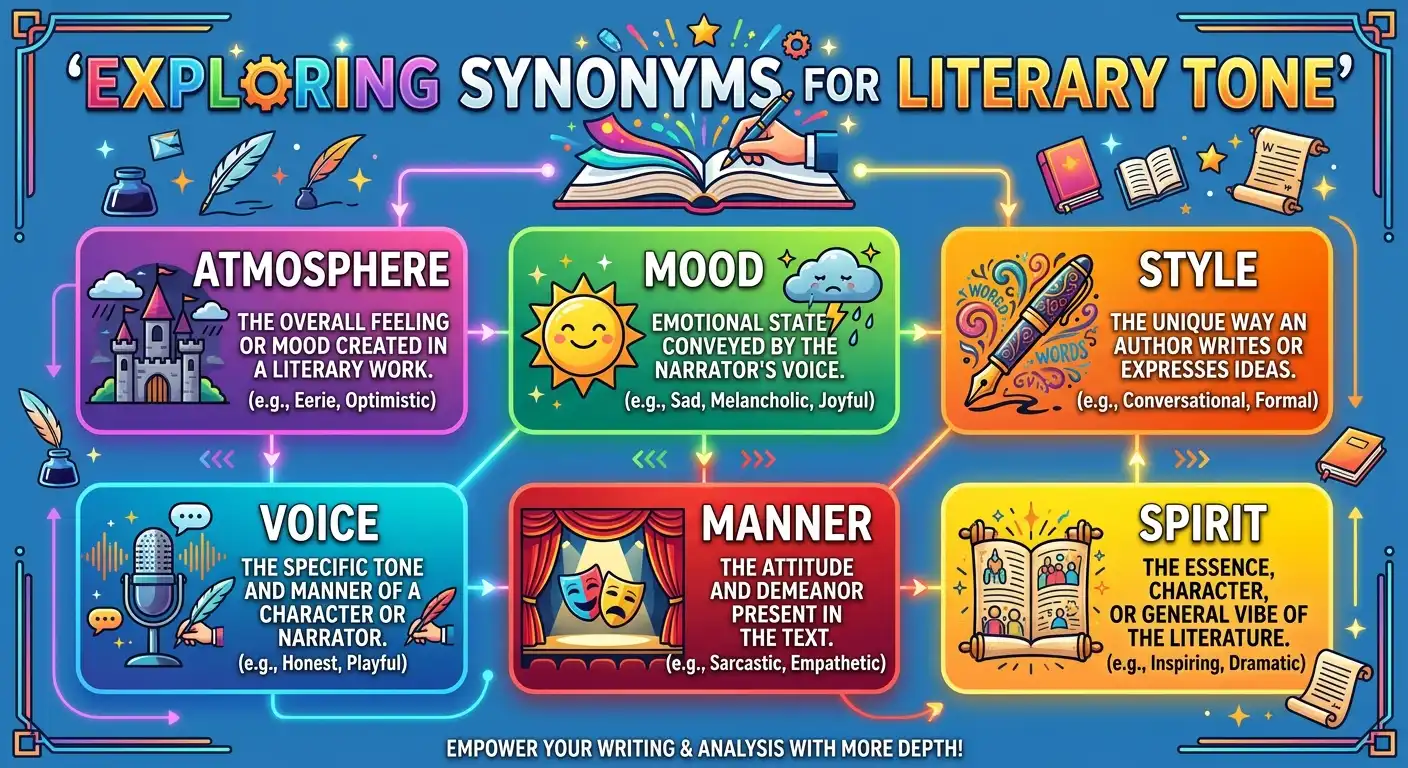
Finding the right synonyms for tone in literature helps readers understand an author’s attitude, emotion, and underlying message. When you analyze creative writing, exploring synonyms for tone in literature allows you to describe how a story feels. Learning these synonyms for tone in literature transforms simple book reviews into rich literary analyses.
Imagine reading a spooky story where every single sentence feels cold, mysterious, and tense. That feeling comes directly from the author’s choices. For example, when a character speaks sarcastically, the author creates a playful or mocking feel. Tone in literature simply means how a writer shows emotion or perspective through words.
“Words are, in my not-so-humble opinion, our most inexhaustible source of magic.” — J.K. Rowling
This concept is essential across many areas of communication:
- Students can write deeper essays and score higher on literature exams.
- Bloggers can craft vivid reviews that keep readers hooked.
- Content Writers can match brand voices effortlessly.
- Daily English Users can describe movies, stories, and conversations with precision.
“Tone is the secret voice of the author that whispers between the lines.” — Anonymous
Linguistic Analysis of Tone in Literature
Connotative Meaning
In literary study, “tone” carries a analytical and creative connotation. It implies the author’s personal stance, mood, or emotional perspective toward the subject matter or audience.
Etymology
- Origin: Derived from Old French ton, which came from Latin tonus (“a sound, tone, accent”).
- Root Meaning: Traces back to Greek tonos (“stretching, pitch, accent of the voice”), originating from the Proto-Indo-European root *ten- (“to stretch”).
- Literary Evolution: Shifted from musical pitch in the 14th century to emotional expression and literary style by the 18th century.
Pronunciation
- US IPA: /toʊn/
- UK IPA: /təʊn/
Syllables and Affixation
- Syllables: 1 syllable (monosyllabic)
- Affixation Pattern: Base word (unaffixed). Related forms include tonal (adjective) and tonality (noun).
Comparison Table of Synonyms for Tone in Literature
| Keyword | Meaning | Usage Type | Context |
| Tone | The author’s attitude toward a subject | Formal / Academic | Literary analysis and critical writing |
| Atmosphere | The general feeling created by a setting | Descriptive | Novels, poetry, and scene setting |
| Mood | The emotional atmosphere felt by the reader | Emotional / Casual | Fiction, film reviews, daily talk |
| Attitude | A writer’s position or viewpoint | Analytical | Persuasive essays and opinion pieces |
| Voice | The unique style and personality of a writer | Creative / Professional | Creative writing and narrative prose |
| Tenor | The general meaning or prevailing drift | Formal / Professional | Academic discourse and legal texts |
| Stance | An expressed stance on a specific topic | Formal / Professional | Rhetoric, essays, and debates |
| Vibe | The informal emotional energy of a piece | Casual | Social media, informal blogs |
| Nuance | A subtle shade of meaning or feeling | Formal / Academic | High-level literary criticism |
| Undertone | A hidden or implicit emotional quality | Analytical | Drama, satire, subtext analysis |
34 Essential Synonyms for Tone in Literature
1. Atmosphere
- Pronunciation: US: /ˈæt.mə.sfɪr/ | UK: /ˈæt.mə.sfɪə/
- Meaning: Atmosphere is the overall feeling or mood that a story creates.
- Examples:
- The author built a spooky atmosphere in the old haunted house chapter.
- Light word choices created a cheerful atmosphere throughout the poem.
2. Mood
- Pronunciation: US: /muːd/ | UK: /muːd/
- Meaning: Mood is the primary feeling a reader gets while reading a story.
- Examples:
- The rainy background setting gave the opening chapter a lonely mood.
- Her playful writing style set a bright and joyful mood.
3. Attitude
- Pronunciation: US: /ˈæt.ə.tuːd/ | UK: /ˈæt.ɪ.tʃuːd/
- Meaning: Attitude shows how an author feels about their subject or characters.
- Examples:
- The reporter wrote with a critical attitude toward the government policy.
- His respectful attitude made the biography inspiring to read.
4. Pitch
- Pronunciation: US: /pɪtʃ/ | UK: /pɪtʃ/
- Meaning: Pitch refers to the emotional intensity or slant of a piece of writing.
- Examples:
- The speaker kept a high pitch of excitement in the narrative.
- She adjusted the pitch of her story to sound more serious.
5. Voice
- Pronunciation: US: /vɔɪs/ | UK: /vɔɪs/
- Meaning: Voice is the special style that makes a writer sound unique.
- Examples:
- The novel has a distinct voice that feels personal and warm.
- Writers develop their own voice through years of practice.
6. Temper
- Pronunciation: US: /ˈtem.pɚ/ | UK: /ˈtem.pə/
- Meaning: Temper describes the emotional state or mood behind the writing.
- Examples:
- An angry temper was clear in the main character’s speech.
- The story maintained a calm temper despite the danger.
7. Cadence
- Pronunciation: US: /ˈkeɪ.dəns/ | UK: /ˈkeɪ.dəns/
- Meaning: Cadence is the rhythm and flow of words in a story.
- Examples:
- The gentle cadence of the sentence helped the reader relax.
- Poetry relies heavily on cadence to create musical tone.
8. Feeling
- Pronunciation: US: /ˈfiː.lɪŋ/ | UK: /ˈfiː.lɪŋ/
- Meaning: Feeling is the emotional reaction that a text produces.
- Examples:
- A feeling of hope ran through the final chapter.
- The sad scene brought a strong feeling of loss.
9. Inflection
- Pronunciation: US: /ɪnˈflek.ʃən/ | UK: /ɪnˈflek.ʃən/
- Meaning: Inflection is a change in style that reveals emotion.
- Examples:
- A subtle inflection of irony changed the sentence meaning.
- The author used regional inflection to make dialogues realistic.
10. Tenor
- Pronunciation: US: /ˈten.ɚ/ | UK: /ˈten.ə/
- Meaning: Tenor means the general theme or emotional drift of a written piece.
- Examples:
- The main tenor of the essay was peaceful and hopeful.
- Official documents usually maintain a formal tenor.
“The right word may be effective, but no word was ever as effective as the rightly timed pause.” — Mark Twain
11. Stance
- Pronunciation: US: /stæns/ | UK: /stɑːns/
- Meaning: Stance is the writer’s formal opinion or position on a topic.
- Examples:
- The author took a strong moral stance in the debate article.
- Her neutral stance helped present both sides fairly.
12. Spirit
- Pronunciation: US: /ˈspɪr.ət/ | UK: /ˈspɪr.ɪt/
- Meaning: Spirit is the lively energy or mood inside a story.
- Examples:
- The adventurous spirit of the novel kept children reading all night.
- Her poetry shows a brave and free spirit.
13. Air
- Pronunciation: US: /er/ | UK: /eə/
- Meaning: Air is the general impression or quality given by a story.
- Examples:
- The ancient house had an air of mystery around it.
- His essay carried an air of calm confidence.
14. Vibe
- Pronunciation: US: /vaɪb/ | UK: /vaɪb/
- Meaning: Vibe is the informal mood or feeling of a story.
- Examples:
- The book has a cozy autumn vibe that readers love.
- Dark colors on the cover gave off a scary vibe.
15. Key
- Pronunciation: US: /kiː/ | UK: /kiː/
- Meaning: Key is the primary emotional style or scale used in writing.
- Examples:
- The play was written in a minor key of sadness.
- She kept her narration in a light key throughout.
16. Style
- Pronunciation: US: /staɪl/ | UK: /staɪl/
- Meaning: Style is the way a writer uses words to create a mood.
- Examples:
- Short sentences gave the action scene a fast style.
- Descriptive style made the forest seem magical.
17. Note
- Pronunciation: US: /noʊt/ | UK: /nəʊt/
- Meaning: Note is a particular feeling or tone struck by a passage.
- Examples:
- The story ended on a positive note of hope.
- A note of sadness appeared in the character’s letter.
18. Flavor
- Pronunciation: US: /ˈfleɪ.vɚ/ | UK: /ˈfleɪ.və/
- Meaning: Flavor is the distinctive character or quality in a text.
- Examples:
- Historical words gave the story an ancient flavor.
- The mystery novel had a dark comic flavor.
19. Manner
- Pronunciation: US: /ˈmæn.ɚ/ | UK: /ˈmæn.ə/
- Meaning: Manner is the personal behavior or way a story is told.
- Examples:
- He wrote about his childhood in a gentle manner.
- Her blunt manner made the article very direct.
20. Aura
- Pronunciation: US: /ˈɔːr.ə/ | UK: /ˈɔː.rə/
- Meaning: Aura is a surrounding atmosphere or feeling around a text.
- Examples:
- The old fairy tale had a magical aura.
- A mysterious aura surrounded the main character’s past.
21. Character
- Pronunciation: US: /ˈkær.ək.tɚ/ | UK: /ˈkær.ək.tə/
- Meaning: Character is the distinctive emotional nature of a written piece.
- Examples:
- The quiet village gave the narrative a calm character.
- Bold action scenes gave the book an exciting character.
22. Timbre
- Pronunciation: US: /ˈtæm.bɚ/ | UK: /ˈtæm.bə/
- Meaning: Timbre refers to the unique quality or tone of a narrative voice.
- Examples:
- The poem had a rich narrative timbre that held our attention.
- Her prose maintained a soft timber throughout the book.
23. Outlook
- Pronunciation: US: /ˈaʊt.lʊk/ | UK: /ˈaʊt.lʊk/
- Meaning: Outlook is the worldview or mental perspective shown in writing.
- Examples:
- The author expressed an optimistic outlook on human nature.
- A cynical outlook made the story feel gloomy.
24. Disposition
- Pronunciation: US: /ˌdɪs.pəˈzɪʃ.ən/ | UK: /ˌdɪs.pəˈzɪʃ.ən/
- Meaning: Disposition means the inherent emotional mood of a text.
- Examples:
- The novel had a cheerful disposition despite hard themes.
- His writing reflected a serious, thoughtful disposition.
25. Strain
- Pronunciation: US: /streɪn/ | UK: /streɪn/
- Meaning: Strain is a subtle streak or trace of emotion in writing.
- Examples:
- A strain of sadness ran through his funny stories.
- You could feel a strain of hope in her poem.
26. Undertone
- Pronunciation: US: /ˈʌn.dɚ.toʊn/ | UK: /ˈʌn.də.təʊn/
- Meaning: Undertone is a quiet or hidden feeling under the main story.
- Examples:
- The polite conversation had a tense undertone.
- A playful undertone made the lesson easy to enjoy.
27. Overtone
- Pronunciation: US: /ˈoʊ.vɚ.toʊn/ | UK: /ˈəʊ.və.təʊn/
- Meaning: Overtone is a subtle extra meaning or emotion added to a text.
- Examples:
- The speech had strong political overtones.
- Religious overtones were clear throughout the myth.
28. Accent
- Pronunciation: US: /ˈæk.sent/ | UK: /ˈæk.sənt/
- Meaning: Accent is a special emphasis or stylistic flavor in writing.
- Examples:
- The story featured a regional accent in its word choices.
- She placed a tragic accent on the hero’s choices.
29. Color
- Pronunciation: US: /ˈkʌl.ɚ/ | UK: /ˈkʌl.ə/
- Meaning: Color means the vivid emotional detail that enlivens a text.
- Examples:
- Local words added great color to the narrative.
- Rich imagery gave the poem bright emotional color.
30. Sentiment
- Pronunciation: US: /ˈsen.tə.mənt/ | UK: /ˈsen.tɪ.mənt/
- Meaning: Sentiment is an expressed feeling or emotion in writing.
- Examples:
- Romantic sentiment filled the character’s love letter.
- The essay expressed strong patriotic sentiment.
31. Nuance
- Pronunciation: US: /ˈnuː.ɑːns/ | UK: /ˈnjuː.ɑːns/
- Meaning: Nuance is a small, subtle difference in meaning or emotion.
- Examples:
- Good writers add nuance to make characters feel real.
- She noticed a tiny nuance of anger in his words.
32. Quality
- Pronunciation: US: /ˈkwɑː.lə.ti/ | UK: /ˈkwɒl.ə.ti/
- Meaning: Quality is a characteristic feature or mood of a passage.
- Examples:
- The scene had a dreamlike quality that felt magical.
- His prose retained a sharp, intelligent quality.
33. Expression
- Pronunciation: US: /ɪkˈspreʃ.ən/ | UK: /ɪkˈspreʃ.ən/
- Meaning: Expression is the act of showing feelings through chosen words.
- Examples:
- Her poem was a clear expression of deep joy.
- Dramatic expression made the story thrilling.
34. Resonance
- Pronunciation: US: /ˈrez.ən.əns/ | UK: /ˈrez.ən.əns/
- Meaning: Resonance is the deep emotional power that stays with a reader.
- Examples:
- The tragic ending gave the book lasting emotional resonance.
- Her speech had a powerful moral resonance.
Antonyms of Tone in Literature
Understanding opposites helps clarify what tone is not in creative writing:
- Apathy: Complete lack of emotion, perspective, or feeling in text.
- Flatness: Writing that lacks variation, emotion, or stylistic direction.
- Neutrality: Complete absence of author bias, feeling, or personal perspective.
- Monotony: Unchanging repetition without emotional rhythm or vocal shift.
- Inexpressiveness: Inability or failure to convey emotion through written words.
Prototype Meaning and Categorization of Tone in Literature
Core Prototype Meaning
At its core, tone in literature acts as the emotional bridge between the writer and the reader. It represents the writer’s attitude toward the subject matter, communicated subtly through word choice (diction), sentence structure (syntax), and figurative language.
Categorization Framework
- Emotional Tone: Joyful, somber, anxious, melancholy, hopeful.
- Attitudinal Tone: Sarcastic, critical, respectful, objective, cynical.
- Formal Tone: Academic, majestic, ceremonial, authoritative.
- Informal Tone: Conversational, intimate, humorous, casual.
Frequently Asked Questions (FAQ)
1. What is the difference between tone and mood in literature?
Tone refers to the author’s attitude toward the subject, while mood refers to the emotional feeling created inside the reader.
2. How can I identify the tone of a poem or story?
Look closely at the author’s word choices (diction), sentence length (syntax), and descriptive details to uncover hidden attitudes.
3. Why are synonyms for tone in literature useful in literary analysis?
Using varied synonyms helps you avoid repeating the word “tone” in essays and allows for precise analysis of subtle textual details.
4. Can a story have more than one tone?
Yes. A story can shift tone across chapters—moving from playful at the start to serious or tragic near the climax.
5. What are common examples of words that describe literary tone?
Common tone words include humorous, sarcastic, solemn, nostalgic, critical, optimistic, and dark.
6. How does word choice directly affect literary tone?
Positive, gentle words create a warm tone, while harsh, sharp words create a tense or hostile tone.
Conclusion
Mastering synonyms for tone in literature significantly expands your vocabulary and sharpens your critical thinking skills. When you understand terms like atmosphere, tenor, nuance, and undertone, you can express your thoughts with clarity and confidence. Whether you are analyzing a classic novel or crafting a compelling essay, precise vocabulary turns simple observations into powerful writing.
“To write well is to think clearly and express emotion with precision.” — Unknown
Developing a rich vocabulary allows you to communicate effectively across every medium. Practice using these synonyms in your everyday emails, school essays, blog posts, and book discussions. As you experiment with different words, you will notice your ability to describe stories and feelings improving dramatically.
“Vocabulary is the palette from which a writer paints the world.” — Anonymous
Start incorporating these 34 synonyms into your daily reading and writing habits today. The more you analyze tone in stories, the more engaging and persuasive your own writing will become.