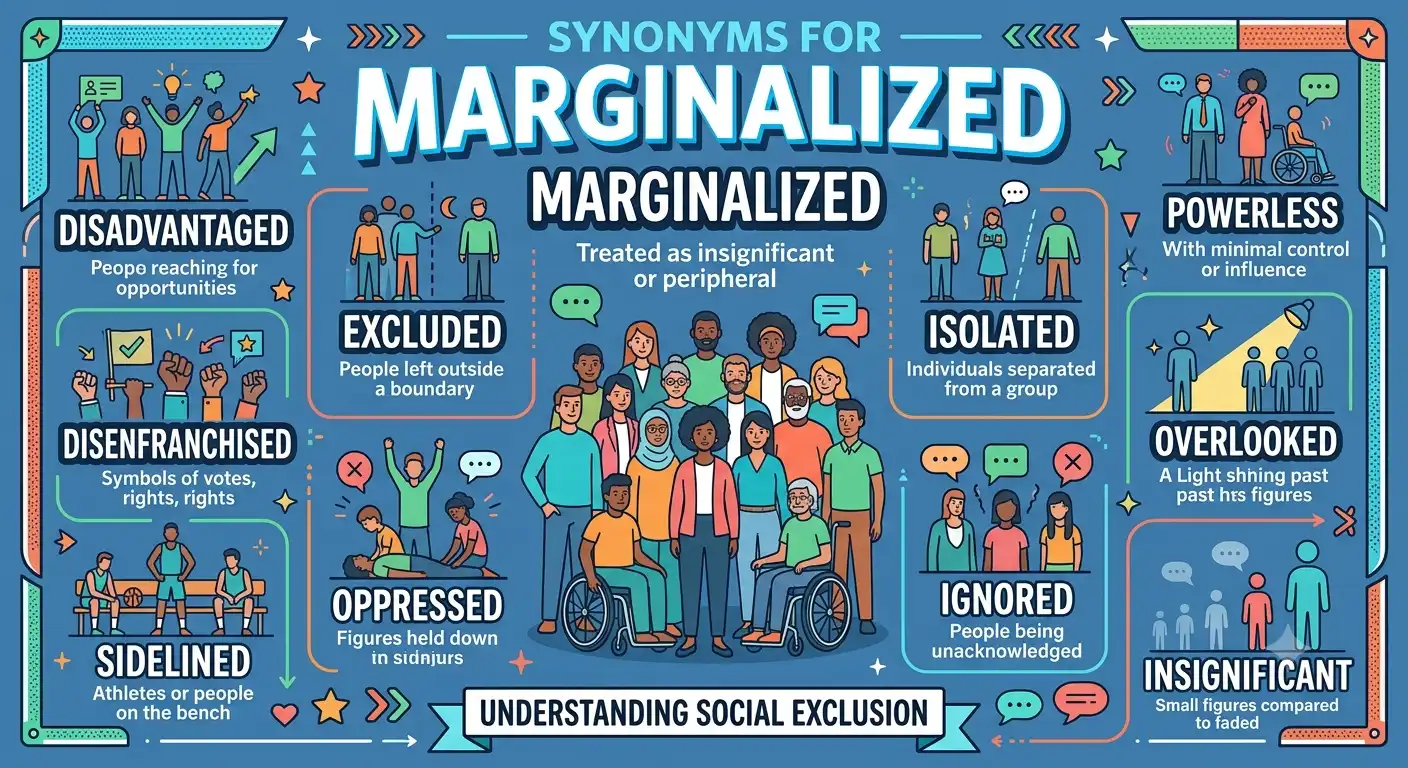
When you explore synonyms for marginalized, you discover words that describe people, groups, or ideas pushed to the edges of society or ignored by the mainstream. Understanding various synonyms for marginalized helps you talk about social inclusion, fairness, and history with exact vocabulary. Learning these synonyms for marginalized allows you to express different levels of exclusion, from feeling left out of a team to systemic social disadvantages, with clarity and care.
Understanding Social Inclusion and Exclusion in Real Life
Imagine a new student standing alone during lunch while everyone else sits in established groups. While saying they feel left out is accurate, describing them as sidelined, disadvantaged, or overlooked gives a much clearer picture of their situation. Exploring synonyms for marginalized helps you discuss fairness, community support, and human experiences with empathy and accuracy.
In very simple English, to be marginalized means to be pushed to the side or treated as unimportant by a larger group.
Why Word Choice Matters for Communicators
Expanding your vocabulary with these alternative terms offers distinct advantages across many settings:
- For Students: It helps you write thoughtful social studies papers, analyze history lessons, and express empathy in essays.
- For Bloggers: It creates meaningful, inclusive content that connects deeply with readers on social topics.
- For Content Writers: It allows you to discuss diversity, community outreach, and accessibility policies accurately.
- For Daily English Users: It gives you respectful, clear words to advocate for fairness and include everyone in daily life.
“Inclusion begins when we give voice to those who have been pushed to the edges of our conversation.”
“Words shape our empathy, allowing us to see and support every member of our community.”
Linguistic Breakdown: Etymology, Connotation, and Structure
Connotative Meaning of “Marginalized”
The word marginalized carries a serious, empathetic, and socially conscious connotation. It highlights a state of being unfairly excluded, ignored, or placed in a position of lesser power within a community or system.
Short Etymology
- Origin: Late 19th to mid-20th century.
- Root: Derived from margin (from Latin margo, meaning “edge” or “border”) + suffix -ize (to make or treat as). Originally referred to notes written in the margins of a book page, away from the main text.
Pronunciation
- US IPA: /ˈmɑːr.dʒɪ.nə.laɪzd/
- UK IPA: /ˈmɑː.dʒɪ.nə.laɪzd/
Syllables & Structure
- Syllables: 4 (mar – gi – na – lized)
- Primary Stress: First syllable (mar)
- Affixation Pattern: Root margin + suffix -al (pertaining to) + suffix -ize (verb-forming) + suffix -ed (past participle/adjective).
Comparison Table: Choosing the Right Synonym for Marginalized
| Keyword | Meaning | Usage Type | Context |
| Marginalized | Pushed to the edge or treated as unimportant | Formal / Social | Sociology, history, advocacy |
| Sidelined | Removed from active participation or main attention | General / Casual | Sports, workplace, group projects |
| Overlooked | Passed over or not noticed | Everyday / General | Job hiring, school activities, team choices |
| Excluded | Kept out of a group or activity | Direct / Clear | Social groups, events, memberships |
| Disadvantaged | Lacking normal resources or opportunities | Professional / Formal | Education, community aid, policy |
| Neglected | Not given proper care or attention | Emotional / General | Relationships, caregiving, tasks |
| Ignored | Intentionally not noticed or paid attention to | Direct / Casual | Conversations, suggestions, presence |
| Ostracized | Excluded from a group by common consent | Strong / Formal | Social circles, history, communities |
| Isolated | Separated from others or kept alone | Descriptive | Remote areas, solo tasks, feelings |
| Underrepresented | Given less representation than is fair | Professional / Formal | Committees, media, government |
50 Synonyms for Marginalized
1. Sidelined
- Pronunciation: US /ˈsaɪd.laɪnd/ | UK /ˈsaɪd.laɪnd/
- Meaning: Pushed away from the main action or center of attention.
- Examples:
- The injured player felt sidelined during the championship game.
- She was sidelined during the group project discussions.
2. Overlooked
- Pronunciation: US /ˌoʊ.vɚˈlʊkt/ | UK /ˌəʊ.vəˈlʊkt/
- Meaning: Not noticed, chosen, or given proper credit.
- Examples:
- A quiet student can easily be overlooked in a busy classroom.
- His creative painting was overlooked during the art contest.
3. Excluded
- Pronunciation: US /ɪkˈskluː.dɪd/ | UK /ɪkˈskluː.dɪd/
- Meaning: Kept out of a group, place, or activity.
- Examples:
- No child should feel excluded during game time at recess.
- They felt excluded when they were not invited to the meeting.
4. Disadvantaged
- Pronunciation: US /ˌdɪs.ədˈvæn.t̬ɪdʒd/ | UK /ˌdɪs.ədˈvɑːn.tɪdʒd/
- Meaning: Lacking normal resources, support, or opportunities.
- Examples:
- The new library offers free internet to help disadvantaged students.
- Community centers provide extra tutors for disadvantaged youth.
5. Neglected
- Pronunciation: US /nɪˈɡlek.tɪd/ | UK /nɪˈɡlek.tɪd/
- Meaning: Not cared for or given enough attention.
- Examples:
- The old garden looked neglected after months without rain.
- He felt neglected when his friends forgot to call back.
6. Ignored
- Pronunciation: US /ɪɡˈnɔːrd/ | UK /ɪɡˈnɔːd/
- Meaning: Not noticed or paid attention to on purpose.
- Examples:
- She felt ignored when nobody responded to her idea.
- The warning sign was ignored by the passing hikers.
7. Ostracized
- Pronunciation: US /ˈɑː.strə.saɪzd/ | UK /ˈɒs.trə.saɪzd/
- Meaning: Cast out or completely avoided by a group.
- Examples:
- In the fable, the main character was ostracized before finding true friends.
- She was ostracized by her teammates after switching sides.
8. Isolated
- Pronunciation: US /ˈaɪ.sə.leɪ.t̬ɪd/ | UK /ˈaɪ.sə.leɪ.tɪd/
- Meaning: Placed far away from others or kept alone.
- Examples:
- The cabin felt isolated deep in the snowy pine forest.
- Moving to a new town made him feel isolated at first.
9. Underrepresented
- Pronunciation: US /ˌʌn.dɚˌrep.rɪˈzen.t̬ɪd/ | UK /ˌʌn.dəˌrep.rɪˈzen.tɪd/
- Meaning: Having fewer representatives than expected or fair.
- Examples:
- Young scientists were underrepresented at the international conference.
- The board worked to include underrepresented voices in the council.
10. Disregarded
- Pronunciation: US /ˌdɪs.rɪˈɡɑːr.dɪd/ | UK /ˌdɪs.rɪˈɡɑː.dɪd/
- Meaning: Treated as unimportant or unworthy of attention.
- Examples:
- His polite suggestion was disregarded by the committee.
- The safety rules were disregarded during the rushed setup.
11. Bypassed
- Pronunciation: US /ˈbaɪ.pæst/ | UK /ˈbaɪ.pɑːst/
- Meaning: Skipped or passed over in favor of others.
- Examples:
- She was bypassed for the team captain role this year.
- Small towns were bypassed when the new highway was built.
12. Forgotten
- Pronunciation: US /fɚˈɡɑː.tən/ | UK /fəˈɡɒt.ən/
- Meaning: Not remembered or left behind by time.
- Examples:
- The forgotten book rested quietly on the top shelf.
- He felt forgotten when his group walked ahead without him.
13. Slighted
- Pronunciation: US /ˈslaɪ.t̬ɪd/ | UK /ˈslaɪ.tɪd/
- Meaning: Treated with a lack of respect or proper attention.
- Examples:
- She felt slighted when her name was left off the thanks list.
- He was slighted by the cool reception at the door.
14. Deprived
- Pronunciation: US /dɪˈpraɪvd/ | UK /dɪˈpraɪvd/
- Meaning: Suffering from a lack of necessary resources or rights.
- Examples:
- Sleep-deprived students find it hard to focus on morning tests.
- The charity provided winter coats to deprived families.
15. Disowned
- Pronunciation: US /dɪsˈoʊnd/ | UK /dɪsˈəʊnd/
- Meaning: Refused connection or support from a family or group.
- Examples:
- The hero refused to be disowned by his home town.
- The club disowned members who broke safety rules.
16. Rejected
- Pronunciation: US /rɪˈdʒek.tɪd/ | UK /rɪˈdʒek.tɪd/
- Meaning: Turned down, refused, or not accepted into a group.
- Examples:
- His first story draft was rejected, but he kept writing.
- She felt rejected when the team picked another player.
17. Alienated
- Pronunciation: US /ˈeɪ.li.ə.neɪ.t̬ɪd/ | UK /ˈeɪ.li.ə.neɪ.tɪd/
- Meaning: Feeling unwelcome or separated from surroundings.
- Examples:
- Loud music made her feel alienated from the rest of the gathering.
- The new rule alienated many longtime club members.
18. Displaced
- Pronunciation: US /dɪsˈpleɪst/ | UK /dɪsˈpleɪst/
- Meaning: Forced away from one’s usual position or home.
- Examples:
- The storm left many forest animals displaced for weeks.
- Her desk was displaced during the classroom cleanup.
19. Segregated
- Pronunciation: US /ˈseɡ.rə.ɡeɪ.t̬ɪd/ | UK /ˈseɡ.rɪ.ɡeɪ.tɪd/
- Meaning: Kept apart from others based on difference or group.
- Examples:
- History lessons teach us why segregated spaces were unjust.
- Trash and recycling should be segregated into separate bins.
20. Suppressed
- Pronunciation: US /səˈprest/ | UK /səˈprest/
- Meaning: Prevented from expressing thoughts or gaining power.
- Examples:
- She suppressed a smile while waiting for the surprise party.
- Important questions were suppressed during the short debate.
“True justice is measured by how well we uplift every overlooked voice.”
21. Subjugated
- Pronunciation: US /ˈsʌb.dʒə.ɡeɪ.t̬ɪd/ | UK /ˈsʌb.dʒə.ɡeɪ.tɪd/
- Meaning: Placed under total control or power of another group.
- Examples:
- Ancient empires often subjugated neighboring lands in history tales.
- The villagers refused to remain subjugated by the tyrannical ruler.
22. Underprivileged
- Pronunciation: US /ˌʌn.dɚˈprɪv.əl.ɪdʒd/ | UK /ˌʌn.dəˈprɪv.əl.ɪdʒd/
- Meaning: Having fewer financial or social advantages than others.
- Examples:
- Free sports camps give opportunities to underprivileged kids.
- The donation drive gathered books for underprivileged schools.
23. Disempowered
- Pronunciation: US /ˌdɪs.ɪmˈpaʊ.ɚd/ | UK /ˌdɪs.ɪmˈpaʊ.əd/
- Meaning: Stripped of power, influence, or confidence to act.
- Examples:
- Strict policies made the student committee feel disempowered.
- Encouraging words help students who feel disempowered speak up.
24. Unseen
- Pronunciation: US /ʌnˈsiːn/ | UK /ʌnˈsiːn/
- Meaning: Not observed or noticed by surrounding people.
- Examples:
- The helpful volunteer worked behind the scenes, completely unseen.
- She felt like an unseen member of the large chorus.
25. Unheard
- Pronunciation: US /ʌnˈhɝːd/ | UK /ʌnˈhɜːd/
- Meaning: Not listened to or given a chance to speak.
- Examples:
- Her polite complaint went unheard in the noisy cafeteria.
- A good leader makes sure no opinion goes unheard.
26. Abandoned
- Pronunciation: US /əˈbæn.dənd/ | UK /əˈbæn.dənd/
- Meaning: Left behind without support, help, or care.
- Examples:
- They found an abandoned kitten behind the community shed.
- The old playground looked abandoned after the school moved.
27. Stranded
- Pronunciation: US /ˈstræn.dɪd/ | UK /ˈstræn.dɪd/
- Meaning: Left helpless in a difficult or distant place.
- Examples:
- The flat tire left them stranded near the park entrance.
- He felt stranded when his group walked away without a word.
28. Uncounted
- Pronunciation: US /ʌnˈkaʊn.t̬ɪd/ | UK /ʌnˈkaʊn.tɪd/
- Meaning: Not included in a total sum or official list.
- Examples:
- Many small donations remained uncounted until the final total.
- Her extra volunteer hours went uncounted on the school chart.
29. Down-and-out
- Pronunciation: US /ˌdaʊn.ənˈaʊt/ | UK /ˌdaʊn.ənˈaʊt/
- Meaning: Lacking resources, support, or good fortune in life.
- Examples:
- The shelter offers warm meals to anyone who is down-and-out.
- A kind neighbor offered work to the down-and-out traveler.
30. Outcast
- Pronunciation: US /ˈaʊt.kæst/ | UK /ˈaʊt.kɑːst/
- Meaning: Rejected or cast out by society or a home group.
- Examples:
- The friendly dragon felt like an outcast in the storybook village.
- She helped the outcast student feel welcome in the art club.
31. Shunned
- Pronunciation: US /ʃʌnd/ | UK /ʃʌnd/
- Meaning: Persistently avoided, rejected, or ignored by others.
- Examples:
- He was shunned by the group after breaking his promise.
- The quiet newcomer felt shunned during playground games.
32. Discounted
- Pronunciation: US /dɪsˈkaʊn.t̬ɪd/ | UK /dɪsˈkaʊn.tɪd/
- Meaning: Regarded as untrustworthy, unimportant, or worthless.
- Examples:
- Her valid concern was discounted as a simple misunderstanding.
- The team’s victory was discounted because of bad weather.
33. Set aside
- Pronunciation: US /set əˈsaɪd/ | UK /set əˈsaɪd/
- Meaning: Placed to one side or saved for later attention.
- Examples:
- His proposal was set aside while the committee discussed budget.
- Important papers were set aside for evening review.
34. Pushed aside
- Pronunciation: US /pʊʃt əˈsaɪd/ | UK /pʊʃt əˈsaɪd/
- Meaning: Forcefully moved out of the way or ignored.
- Examples:
- She felt pushed aside when the older kids took over the game.
- His ideas were pushed aside during the hasty meeting.
35. Devalued
- Pronunciation: US /ˌdiːˈvæl.juːd/ | UK /ˌdiːˈvæl.juːd/
- Meaning: Considered to be worth less than true value.
- Examples:
- Hard work should never be devalued by low praise.
- Old coins can become devalued over long periods.
36. Disfavored
- Pronunciation: US /dɪsˈfeɪ.vɚd/ | UK /dɪsˈfeɪ.vəd/
- Meaning: Lacking approval, support, or special preference.
- Examples:
- The old rules became disfavored as new methods arrived.
- He felt like the disfavored contestant after the harsh judge review.
37. Unappreciated
- Pronunciation: US /ˌʌn.əˈpriː.ʃi.eɪ.t̬ɪd/ | UK /ˌʌn.əˈpriː.ʃi.eɪ.tɪd/
- Meaning: Not given proper gratitude or recognition for effort.
- Examples:
- The quiet volunteer felt unappreciated after working all day.
- Good deeds can go unappreciated if no one notices them.
38. Off the radar
- Pronunciation: US /ɑːf ðə ˈreɪ.dɑːr/ | UK /ɒf ðə ˈreɪ.dɑː/
- Meaning: Not noticed or tracked by mainstream groups.
- Examples:
- The quiet park remains off the radar for most city tourists.
- Her hidden talent was off the radar until the talent show.
39. Forgotten about
- Pronunciation: US /fɚˈɡɑː.tən əˈbaʊt/ | UK /fəˈɡɒt.ən əˈbaʊt/
- Meaning: Left out of mind or care completely.
- Examples:
- The old toy was forgotten about under the bedroom bed.
- Small details can be forgotten about during large moves.
40. Minimization
- Pronunciation: US /ˌmɪn.ə.məˈzeɪ.ʃən/ | UK /ˌmɪn.ɪ.maɪˈzeɪ.ʃən/
- Meaning: The act of reducing importance or scale.
- Examples:
- The minimization of her contribution made her feel sad.
- Careful planning led to the minimization of project errors.
41. Excluded from
- Pronunciation: US /ɪkˈskluː.dɪd frʌm/ | UK /ɪkˈskluː.dɪd frɒm/
- Meaning: Kept away from a specific group or privilege.
- Examples:
- Late arrivals were excluded from entering the concert hall.
- He was excluded from the finals due to missing paperwork.
42. Unnoticed
- Pronunciation: US /ʌnˈnoʊ.t̬ɪst/ | UK /ʌnˈnəʊ.tɪst/
- Meaning: Not seen, heard, or recognized by others.
- Examples:
- She slipped into the classroom quietly, completely unnoticed.
- His act of kindness went unnoticed by the busy crowd.
43. Secondary
- Pronunciation: US /ˈsek.ən.der.i/ | UK /ˈsek.ən.dr.i/
- Meaning: Less important than the main or primary topic.
- Examples:
- Decor was a secondary goal compared to building safety.
- Her main focus was math, while art remained a secondary hobby.
44. Left out
- Pronunciation: US /left aʊt/ | UK /left aʊt/
- Meaning: Not included in a group activity or event.
- Examples:
- He felt left out when everyone went for ice cream without him.
- Make sure no team member is left out of the relay.
45. On the sidelines
- Pronunciation: US /ɑːn ðə ˈsaɪd.laɪnz/ | UK /ɒn ðə ˈsaɪd.laɪnz/
- Meaning: Watching from the side instead of participating directly.
- Examples:
- She waited on the sidelines while her friends tried out for track.
- Staying on the sidelines keeps you from experiencing team fun.
46. Displaced from
- Pronunciation: US /dɪsˈpleɪst frʌm/ | UK /dɪsˈpleɪst frɒm/
- Meaning: Moved away from a normal or rightful position.
- Examples:
- The birds are displace from their nesting tree by the storm.
- Furniture is displace from the hall for the school dance.
47. Sighted away
- Pronunciation: US /ˈsaɪ.t̬ɪd əˈweɪ/ | UK /ˈsaɪ.tɪd əˈweɪ/
- Meaning: Directed away from central vision or core attention.
- Examples:
- His gaze is sight away from the bright stage lights.
- Attention is sight away from the main issue by distractions.
48. Left behind
- Pronunciation: US /left bɪˈhaɪnd/ | UK /left bɪˈhaɪnd/
- Meaning: Remaining behind while others move forward.
- Examples:
- No student should be left behind in reading progress.
- His old bicycle was left behind when the family moved.
49. Cold-shouldered
- Pronunciation: US /ˌkoʊldˈʃoʊl.dɚd/ | UK /ˌkəʊldˈʃəʊl.dəd/
- Meaning: Intentionally treated with coldness and distance.
- Examples:
- He feel cold-shoulder after missing the group practice.
- She is cold-shoulder by former friends after the argument.
50. Passed over
- Pronunciation: US /pæst ˈoʊ.vɚ/ | UK /pɑːst ˈəʊ.və/
- Meaning: Not selected for a position, honor, or task.
- Examples:
- She is pass over for the lead role in the play.
- His suggestion is pass over in favor of an older idea.
Antonyms of Marginalized
To understand a concept fully, it is helpful to examine its direct opposites. Where marginalized means being push to the side, its antonyms describe being include, value, and empower:
- Included: Brought into a group, activity, or community as an equal member.
- Empowered: Given the power, authority, or confidence to act and lead.
- Mainstream: Belonging to the central, widely accepted trend or community.
- Integrated: Merged smoothly into a larger group or system.
- Privileged: Having special rights, advantages, or support.
- Cherished: Held dear, protected, and treated with deep care and respect.
Prototype Meaning and Categorization of Marginalized
In cognitive linguistics, a prototype represents the central, most typical example of a category. The central prototype of the word marginalized is an individual or group pushed to the edges of a community, lacking equal power, visibility, or access to central opportunities. Depending on the context, synonyms for marginalized naturally fall into three primary written categories:
1. Social and Societal Disadvantage This category includes formal terms used when historical, legal, or social systems limit a group’s access or rights. Words such as disadvantaged, underrepresented, underprivileged, subjugated, disempowered, and segregated represent prototype choices in academic essays, news reporting, sociology studies, and community policy discussions.
2. Personal and Interpersonal Exclusion This group focuses on words describing emotional feelings or personal situations where someone is left out by friends, classmates, or coworkers. Synonyms like ostracize, alienate, slight, cold-shoulder, and reject are typically used in literature, personal reflections, and stories about social dynamics and relationships.
3. General Invisibility and Lack of Attention This category consists of everyday words used when someone or something is simply skip, not notice, or not give proper attention. Descriptors such as sidelined, overlooked, bypassed, unseen, unheard, forgotten, and left out allow speakers to describe daily situations smoothly across school, sports, and workplace environments.
Frequently Asked Questions (FAQ)
1. What is the most common synonym for marginalized in school essays?
The most common academic synonyms for marginalize are disadvantage, underrepresent, sideline, and overlook. These terms work well in social studies, history papers, and literary analysis.
2. Is there a difference between “marginalized” and “excluded”?
Yes. Excluded means simply kept out of a specific event or group. Marginalized implies a broader, ongoing condition where a group is consistently push to the edges of society with less power or influence.
3. What is a casual synonym for marginalized?
Casual or everyday synonyms for marginalized include left out, sidelined, overlooked, and passed over. These phrases are easy to use in friendly conversations and casual writing.
4. How can I use these synonyms respectfully?
Choose words that fit the exact context. For formal social issues, use disadvantaged or underrepresented. For personal playground or team situations, use left out or sidelined.
5. Can “isolated” be used as a synonym for marginalized?
Yes, but with a slight difference. Isolated means physically or socially separated from others, whereas marginalized specifically emphasizes a lack of power or inclusion within a larger system.
Conclusion
Expanding your vocabulary with this rich collection of synonyms for marginalized is a powerful way to improve your writing, social awareness, and communication skills. Whether you choose formal academic terms like disadvantaged and underrepresented, personal descriptors like ostracized and alienated, or casual phrases like sidelined and left out, selecting the exact right word helps you express complex human experiences with clarity and empathy.
For students writing history reports or analyzing literature, using diverse synonyms for marginalized prevents repetitive phrasing and shows a mature understanding of social themes, bloggers and content creators, replacing basic terms with precise alternatives creates meaningful, engaging stories that resonate with readers, everyday speakers, having a broad vocabulary empowers you to advocate for fairness and build inclusive communities where everyone feels valued.
Try practicing two or three of these new words this week in your class discussions, essays, or personal writing!
“Every word of inclusion we choose helps build a more welcoming community.”
“A precise vocabulary allows us to name injustices and champion equal respect for all.”
“Empathy grows when we learn the words that describe every human experience.”

Andrew Powell is a travel writer and nature journalist who has spent over a decade writing about places, landscapes, and the natural world — and thinking carefully about the words that do those subjects justice ( Biography ).