Discovering synonyms for simply helps you express clarity, ease, directness, and modesty without repeating the same word over and over. When you explore synonyms for simply, you unlock precise vocabulary that makes your sentences clean, engaging, and easy to understand. Using varied synonyms for simply allows you to explain complex ideas with smooth confidence across all types of writing and daily conversations.
Bringing Clarity and Ease to Everyday Writing
Picture explaining a math solution or baking recipe to a friend. Saying “You simply mix the ingredients” works fine, but changing it to “You easily mix the ingredients” or “You just mix the ingredients” brings fresh clarity to your explanation. Exploring synonyms for simply gives you versatile adverbs that clarify your thoughts and keep your audience focused on your message.
In very simple English, simply means doing or saying something in an easy, plain, or direct way without unnecessary fluff or difficulty.
Why Word Choice Matters for Communicators
Expanding your vocabulary with these terms provides great benefits across all areas of learning and writing:
- For Students: It helps you state arguments clearly and avoid repetitive language in school essays and research papers.
- For Bloggers: It keeps your writing conversational, scannable, and pleasant for readers to enjoy online.
- For Content Writers: It allows you to write crisp instructions, marketing copy, and user guides with total precision.
- For Daily English Users: It gives you natural ways to explain tasks, share ideas, and talk comfortably with peers.
“Simplicity is the ultimate sophistication, and choosing clear words makes every idea shine.”
“When you communicate directly, your thoughts move smoothly from your mind to the reader’s heart.”
Linguistic Breakdown: Etymology, Connotation, and Structure
Connotative Meaning of “Simply”
The word simply carries a clear, positive, and direct connotation. It suggests ease, honesty, plainness, and uncomplicated quality. Depending on context, its tone can range from gentle emphasis (e.g., simply wonderful) to straightforward logic (e.g., stated simply).
Short Etymology
- Origin: Middle English simply or symply.
- Root: Derived from Old French simple and Latin simplex (sim- “same/one” + -plex “fold”, meaning “single-fold” or uncompounded) + adverbial suffix -ly.
Pronunciation
- US IPA: /ˈsɪm.pli/
- UK IPA: /ˈsɪm.pli/
Syllables & Structure
- Syllables: 2 (sim – ply)
- Primary Stress: First syllable (sim)
- Affixation Pattern: Root simple + Adverb suffix -ly (dropping the final -e).
Comparison Table: Choosing the Right Synonym for Simply
| Keyword | Meaning | Usage Type | Context |
| Simply | In an easy, plain, or direct manner | General / Common | Daily life, school, business |
| Just | Merely, only, or directly without extra additions | Casual / Friendly | Conversations, emails, chats |
| Merely | Nothing more than; only | Formal / Precise | Essays, speeches, reports |
| Easily | Without difficulty or effort | Practical / Clear | Guides, tutorials, daily tasks |
| Plainly | Clearly and without decoration or confusion | Direct / Clear | Explanations, teaching, debates |
| Directly | Straightforwardly without detours | Formal / Professional | Instructions, directions, work |
| Clearly | In a way that is easy to see or understand | Academic / General | Writing, arguments, lessons |
| Solely | Exclusively or only for one purpose | Formal / Precise | Contracts, rules, research |
| Purely | Entirely and completely without other motives | Warm / Thoughtful | Personal reasons, art, goals |
| Frankly | Honestly and directly from the heart | Emotional / Candid | Friendships, opinions, discussions |
50 Synonyms for Simply
1. Just
- Pronunciation: US /dʒʌst/ | UK /dʒʌst/
- Meaning: Only or merely without extra difficulty.
- Examples:
- I just need five minutes to finish my homework.
- She wanted to say just one quick hello before leaving.
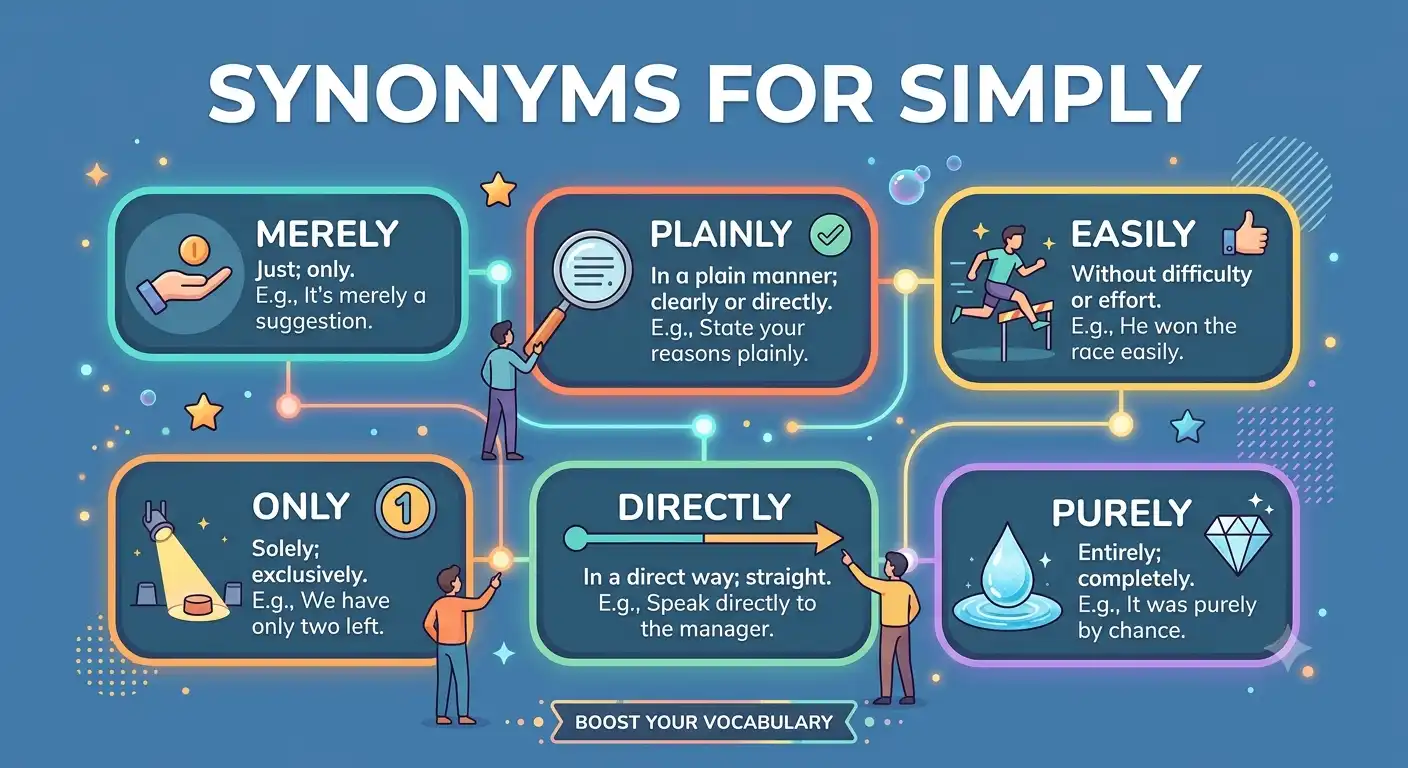
2. Merely
- Pronunciation: US /ˈmɪr.li/ | UK /ˈmɪə.li/
- Meaning: Nothing more than or only.
- Examples:
- The noise was merely a dry leaf hitting the window.
- He stated merely the facts without adding personal views.
3. Easily
- Pronunciation: US /ˈiː.zəl.i/ | UK /ˈiː.zəl.i/
- Meaning: Without trouble, effort, or difficulty.
- Examples:
- You can easily solve this puzzle with practice.
- She easily carried her lightweight backpack to school.
4. Plainly
- Pronunciation: US /ˈpleɪn.li/ | UK /ˈpleɪn.li/
- Meaning: In a simple and clear way.
- Examples:
- The teacher plainly explained the rules of the science game.
- She dressed plainly for the quiet neighborhood walk.
5. Directly
- Pronunciation: US /dəˈrekt.li/ | UK /daɪˈrekt.li/
- Meaning: In a straight and clear manner.
- Examples:
- Please answer the question directly during your presentation.
- The trail leads directly to the community garden.
6. Clearly
- Pronunciation: US /ˈklɪr.li/ | UK /ˈklɪə.li/
- Meaning: In a way that is easy to see or understand.
- Examples:
- He spoke clearly into the microphone so all could hear.
- The diagram clearly shows how plants absorb rainwater.
7. Purely
- Pronunciation: US /ˈpjʊr.li/ | UK /ˈpjʊə.li/
- Meaning: Entirely and completely without other factors.
- Examples:
- She joined the art club purely for fun.
- His decision was made purely out of goodwill.
8. Solely
- Pronunciation: US /ˈsoʊl.li/ | UK /ˈsəʊl.li/
- Meaning: Only and exclusively for one purpose.
- Examples:
- This computer is used solely for editing school videos.
- She relies solely on her alarm clock to wake up on time.
9. Frankly
- Pronunciation: US /ˈfræŋk.li/ | UK /ˈfræŋk.li/
- Meaning: In an honest, direct, and open way.
- Examples:
- She frankly shared her thoughts about the team project.
- Frankly, I think reading daily makes writing much easier.
10. Smoothly
- Pronunciation: US /ˈsmuːð.li/ | UK /ˈsmuːð.li/
- Meaning: Without bumps, interruptions, or hard steps.
- Examples:
- The morning school assembly ran smoothly from start to finish.
- The transition to our new classroom went smoothly.
11. Briefly
- Pronunciation: US /ˈbriːf.li/ | UK /ˈbriːf.li/
- Meaning: Using few words or lasting a short time.
- Examples:
- He briefly summarized the story before we read the chapter.
- She stopped briefly to tie her running shoes.
12. Simply put
- Pronunciation: US /ˈsɪm.pli pʊt/ | UK /ˈsɪm.pli pʊt/
- Meaning: Stated in very easy and short words.
- Examples:
- Simply put, practice helps you build strong skills.
- The lesson, simply put, taught us to recycle daily.
13. Unpretentiously
- Pronunciation: US /ˌʌn.prɪˈten.ʃəs.li/ | UK /ˌʌn.prɪˈten.ʃəs.li/
- Meaning: Without trying to show off or act fancy.
- Examples:
- She welcomed her guests unpretentiously into her cozy home.
- The author wrote unpretentiously about his childhood adventures.
14. Modestly
- Pronunciation: US /ˈmɑː.dɪst.li/ | UK /ˈmɒd.ɪst.li/
- Meaning: In a humble and simple way.
- Examples:
- She modestly accepted the trophy after winning the race.
- The cottage was modestly decorated with fresh wildflowers.
15. Cleanly
- Pronunciation: US /ˈkliːn.li/ | UK /ˈkliːn.li/
- Meaning: In a neat, clear, and uncomplicated way.
- Examples:
- The paper cutter sliced cleanly through the art board.
- His essay was structured cleanly with short paragraphs.
16. Naturally
- Pronunciation: US /ˈnætʃ.ɚ.əl.i/ | UK /ˈnætʃ.ər.əl.i/
- Meaning: In a normal, easy, and unforced manner.
- Examples:
- Good habits develop naturally when you practice daily.
- She smiled naturally when her friends entered the room.
17. Openly
- Pronunciation: US /ˈoʊ.pən.li/ | UK /ˈəʊ.pən.li/
- Meaning: Without hiding thoughts, secrets, or feelings.
- Examples:
- They discussed their study plans openly during group work.
- She openly expressed her appreciation for their help.
18. Honestly
- Pronunciation: US /ˈɑː.nɪst.li/ | UK /ˈɒn.ɪst.li/
- Meaning: Truthfully and without trickery.
- Examples:
- He honestly admitted that he forgot his notebook.
- She answered every question honestly during the interview.
19. Unfamiliarly-free
- Pronunciation: US /ʌn.fəˈmɪl.i.ɚ.li friː/ | UK /ʌn.fəˈmɪl.i.ə.li friː/
- Meaning: In a simple manner without tricky or confusing parts.
- Examples:
- The guide was unfamiliarly-free of complex tech terms.
- She kept the instructions unfamiliarly-free for young readers.
20. Barely
- Pronunciation: US /ˈber.li/ | UK /ˈbeə.li/
- Meaning: Only just; by the smallest amount.
- Examples:
- We barely made it to the theater before the movie started.
- Her voice was barely above a whisper in the quiet room.
“True understanding allows us to speak plainly and teach others effortlessly.”
21. Strictly
- Pronunciation: US /ˈstrɪkt.li/ | UK /ˈstrɪkt.li/
- Meaning: Exactly according to rules or limits.
- Examples:
- The room is strictly reserved for quiet reading time.
- Follow the recipe strictly for the best baking results.
22. Unambiguously
- Pronunciation: US /ˌʌn.æmˈbɪɡ.ju.əs.li/ | UK /ˌʌn.æmˈbɪɡ.ju.əs.li/
- Meaning: So clearly that there is only one meaning.
- Examples:
- The sign unambiguously pointed toward the main exit.
- Her instructions were unambiguously stated in the manual.
23. Effortlessly
- Pronunciation: US /ˈef.ɚt.ləs.li/ | UK /ˈef.ət.ləs.li/
- Meaning: Done with such ease that it requires no visible work.
- Examples:
- The gymnast jumped effortlessly across the practice mat.
- She effortlessly memorized the lyrics to her favorite song.
24. Simply and purely
- Pronunciation: US /ˈsɪm.pli ænd ˈpjʊr.li/ | UK /ˈsɪm.pli ænd ˈpjʊə.li/
- Meaning: In a completely uncombined and clear way.
- Examples:
- The story was written simply and purely for children.
- He helped simply and purely because he cared.
25. Lightly
- Pronunciation: US /ˈlaɪt.li/ | UK /ˈlaɪt.li/
- Meaning: Gentle and without heavy burden or force.
- Examples:
- Tap the screen lightly to select your favorite option.
- She stepped lightly across the shiny wood floor.
26. Straightforwardly
- Pronunciation: US /ˌstreɪtˈfɔːr.wɚd.li/ | UK /ˌstreɪtˈfɔː.wəd.li/
- Meaning: In a direct, easy, and honest way.
- Examples:
- The coach talked straightforwardly about our team goals.
- He answered every question straightforwardly in class.
27. Candidly
- Pronunciation: US /ˈkæn.dɪd.li/ | UK /ˈkæn.dɪd.li/
- Meaning: Truthfully, openly, and without holding back.
- Examples:
- She spoke candidly about her journey as a young writer.
- The review discussed candidly both the pros and cons.
28. Naively
- Pronunciation: US /naɪˈiːv.li/ | UK /naɪˈiːv.li/
- Meaning: In a simple, innocent, or trusting manner.
- Examples:
- The puppy naively trusted every visitor at the park.
- He naively thought the task would take only two minutes.
29. Plainly stated
- Pronunciation: US /ˈpleɪn.li ˈsteɪ.t̬ɪd/ | UK /ˈpleɪn.li ˈsteɪ.tɪd/
- Meaning: Expressed in easy and understandable words.
- Examples:
- The safety rules were plainly stated near the entrance.
- Her main point was plainly stated in the introduction.
30. Unmistakably
- Pronunciation: US /ˌʌn.mɪˈsteɪ.kə.bli/ | UK /ˌʌn.mɪˈsteɪ.kə.bli/
- Meaning: In a way that cannot be confused for anything else.
- Examples:
- The bright yellow bird was unmistakably a finch.
- Her joyful laughter was unmistakably heard across the yard.
31. Exclusively
- Pronunciation: US /ɪkˈskluː.sɪv.li/ | UK /ɪkˈskluː.sɪv.li/
- Meaning: Reserved only for one specific person or purpose.
- Examples:
- The front row seats were exclusively set for performers.
- This channel broadcasts exclusively educational shows.
32. Simply spoken
- Pronunciation: US /ˈsɪm.pli ˈspoʊ.kən/ | UK /ˈsɪm.pli ˈspəʊ.kən/
- Meaning: Said in a clear and uncluttered manner.
- Examples:
- His simply spoken words comforted the whole team.
- The leader gave a simply spoken message of encouragement.
33. Unfussy
- Pronunciation: US /ʌnˈfʌs.i/ | UK /ʌnˈfʌs.i/
- Meaning: Simple, practical, and without extra decoration.
- Examples:
- She chose an unfussy desk design for her bedroom.
- The restaurant serves fresh, unfussy food every day.
34. Basic
- Pronunciation: US /ˈbeɪ.sɪk/ | UK /ˈbeɪ.sɪk/
- Meaning: Forming the essential foundation of something.
- Examples:
- Learning basic grammar helps you build great sentences.
- Clean water is a basic need for all people.
35. Elementary
- Pronunciation: US /ˌel.əˈmen.t̬ɚ.i/ | UK /ˌel.ɪˈmen.tər.i/
- Meaning: Simple, primary, and easy to grasp.
- Examples:
- Solving this addition problem is elementary for her.
- He explained the elementary rules of chess to his sister.
36. Uncomplicated
- Pronunciation: US /ˌʌnˈkɑːm.plə.keɪ.t̬ɪd/ | UK /ˌʌnˈkɒm.plɪ.keɪ.tɪd/
- Meaning: Easy to understand without confusing parts.
- Examples:
- We followed an uncomplicated route to the new park.
- Her schedule for Saturday was refreshingly uncomplicated.
37. Direct
- Pronunciation: US /dəˈrekt/ | UK /daɪˈrekt/
- Meaning: Going straight to the point without detours.
- Examples:
- She gave a direct answer to my question.
- A direct path led us straight to the lake shore.
38. Plain
- Pronunciation: US /pleɪn/ | UK /pleɪn/
- Meaning: Simple, clear, and without fancy additions.
- Examples:
- He wore a plain blue t-shirt to basketball practice.
- She writes in plain English so everyone understands.
39. Neat
- Pronunciation: US /niːt/ | UK /niːt/
- Meaning: Well-arranged, simple, and tidy.
- Examples:
- She kept her desk neat and organized all semester.
- His summary offered a neat explanation of the book.
40. Intelligibly
- Pronunciation: US /ɪnˈtel.ə.dʒə.bli/ | UK /ɪnˈtel.ɪ.dʒə.bli/
- Meaning: In a way that can be easily understood.
- Examples:
- The speaker pronounced every word intelligibly.
- She organized the data intelligibly in a clean table.
41. Unadornedly
- Pronunciation: US /ˌʌn.əˈdɔːr.nɪd.li/ | UK /ˌʌn.əˈdɔː.nɪd.li/
- Meaning: Without extra decoration or unnecessary embellishment.
- Examples:
- The room was furnished unadornedly with wooden chairs.
- He presented his story unadornedly and truthfully.
42. Without fuss
- Pronunciation: US /wɪˈðaʊt fʌs/ | UK /wɪˈðaʊt fʌs/
- Meaning: Quickly, easily, and without causing trouble.
- Examples:
- The dog jumped into the car without fuss.
- She fixed the printer glitch without fuss.
43. Smoothly stated
- Pronunciation: US /ˈsmuːð.li ˈsteɪ.t̬ɪd/ | UK /ˈsmuːð.li ˈsteɪ.tɪd/
- Meaning: Delivered in an easy, flowing, and clear manner.
- Examples:
- Her presentation was smoothly stated and well received.
- The morning announcements were smoothly stated.
44. Accessible
- Pronunciation: US /əkˈses.ə.bəl/ | UK /əkˈses.ə.bəl/
- Meaning: Easy for anyone to reach, use, or understand.
- Examples:
- The museum made its art exhibits accessible to all.
- She wrote an accessible guide to learning guitar.
45. Lucidly
- Pronunciation: US /ˈluː.sɪd.li/ | UK /ˈluː.sɪd.li/
- Meaning: Expressed clearly and with great mental clarity.
- Examples:
- The scientist lucidly described how stars are formed.
- She lucidly laid out her plan for the school fair.
46. Easily understood
- Pronunciation: US /ˈiː.zəl.i ˌʌn.dɚˈstʊd/ | UK /ˈiː.zəl.i ˌʌn.dəˈstʊd/
- Meaning: Simple enough for anyone to grasp right away.
- Examples:
- The diagram made the physics concept easily understood.
- Her speech was easily understood by the entire audience.
47. Unelaborately
- Pronunciation: US /ˌʌn.iˈlæb.ɚ.ət.li/ | UK /ˌʌn.iˈlæb.ər.ət.li/
- Meaning: Simple and without complex or intricate details.
- Examples:
- The cake was decorated unelaborately with strawberry slices.
- He lived unelaborately in a small sunlit room.
48. Plain-spoken
- Pronunciation: US /ˈpleɪn.spoʊ.kən/ | UK /ˈpleɪn.spəʊ.kən/
- Meaning: Frank, direct, and straightforward in speech.
- Examples:
- The leader was admired for his plain-spoken wisdom.
- She gave a plain-spoken review of the new storybook.
49. Unfancifully
- Pronunciation: US /ʌnˈfæn.sɪ.fəl.i/ | UK /ʌnˈfæn.sɪ.fəl.i/
- Meaning: Realistic, plain, and without wild imagination or exaggeration.
- Examples:
- The reporter described the event unfancifully.
- He stated the facts unfancifully during his science presentation.
50. Cleanly stated
- Pronunciation: US /ˈkliːn.li ˈsteɪ.t̬ɪd/ | UK /ˈkliːn.li ˈsteɪ.tɪd/
- Meaning: Expressed neatly and without clutter or confusion.
- Examples:
- The conclusion was cleanly stated at the end of her essay.
- Her main argument was cleanly stated in the article.
Antonyms of Simply
To understand a word completely, it is equally helpful to look at its direct opposites. Where simply means doing something easily and plainly, its antonyms describe complexity, difficulty, and elaborate detail:
- Complicatedly: In a tangled, confusing, or hard-to-understand way.
- Elaborately: With lots of intricate detail, fancy decoration, or extra work.
- Confusingly: In a manner that causes uncertainty, disorder, or doubt.
- Difficultly: With great effort, strain, or hardship.
- Arduously: Requiring severe effort, strength, or hard labor.
- Indirectly: In a roundabout, circuitous way that strays from the main point.
Prototype Meaning and Categorization of Simply
In cognitive linguistics, a prototype represents the central, most typical example of a category. The central prototype of the word simply is an action or statement carried out in an easy, plain, and direct manner without extra difficulty. Depending on the speaker’s tone, context, and intention, synonyms for simply naturally fall into three primary written categories:
1. Directness and Exclusivity This category includes words used when narrowing focus or stating an exact condition. Words such as just, merely, solely, purely, exclusively, and strictly represent prototype choices in rules, arguments, and formal instructions where precise limits matter.
2. Clarity and Ease of Understanding This group focuses on adverbs that describe how easily an idea or action is grasped. Synonyms like easily, plainly, clearly, straightforwardly, effortlessly, and lucidly are typically used in teaching, blogging, essays, and educational guides to highlight clear thinking.
3. Honesty and Plain Style This category consists of words suited for open, unpretentious, and humble communication. Descriptors such as frankly, candidly, modestly, unpretentiously, honestly, and plain-spoken allow writers and speakers to share thoughts openly and warmly without sounding fake or overly fancy.
Frequently Asked Questions (FAQ)
1. What is the difference between “simply” and “just”?
While simply and just are often interchangeable, “simply” highlights ease, plainness, or direct quality, whereas “just” frequently emphasizes limits (e.g., just one minute) or recent action (e.g., I just arrived).
2. What is a good formal synonym for simply in school essays?
In formal academic writing, effective synonyms for simply include merely, plainly, clearly, solely, directly, and straightforwardly.
3. Can “easily” be used as a replacement for “simply”?
Yes! “Easily” works as a great substitute when “simply” is used to mean doing something without trouble or difficulty (e.g., You can simply follow this guide -> You can easily follow this guide).
4. What does “simply put” mean?
“Simply put” is a common phrase used to introduce a short, clear summary of an idea using simple words that anyone can understand.
5. What are gentle, casual synonyms for simply in everyday conversation?
Great casual choices for daily speech include just, plainly, honestly, frankly, and easily.
Conclusion
Expanding your vocabulary with this rich collection of synonyms for simply is a fantastic way to elevate your writing, reading comprehension, and daily communication skills. Whether you select direct words like just and merely, clarity-focused terms like plainly and easily, or honest descriptors like frankly and candidly, picking the exact right word makes your message shine with clarity.
For students writing essays and school assignments, using varied synonyms for simply prevents word repetition and demonstrates strong control over English adverbs, bloggers and content writers, replacing generic words with precise terms keeps your posts energetic, crisp, and readable, daily English speakers, having a broad choice of vocabulary allows you to explain ideas, give directions, and converse with confidence.
Try using two or three of these clear new terms this week in your class notes, daily emails, or casual conversations!
“Clear words unlock simple communication, building bridges of understanding for everyone.”
“When you choose precise vocabulary, every sentence becomes a pleasure to read.”
“Expanding your word choice turns everyday writing into clean, compelling art.”

Andrew Powell is a travel writer and nature journalist who has spent over a decade writing about places, landscapes, and the natural world — and thinking carefully about the words that do those subjects justice ( Biography ).