Do you keep using “beautiful landscape” or “amazing scenery” in every travel essay, nature paragraph, or descriptive article? If so, your writing can start to sound flat, even when the place you describe is rich, dramatic, and full of life.
Choosing better synonyms for landscape and scenery helps you show readers what a place feels like, not just what it looks like. In this guide, you will learn the best words to replace landscape and scenery in nature, travel, academic, and descriptive writing. You will see how words like terrain, vista, view, countryside, panorama, and surroundings differ in meaning.
You will also get comparison tables, formal and informal options, real example sentences, and practical advice from 13 years of travel writing experience. As Andrew Powell, a travel writer, I focus on words that help your writing feel accurate, vivid, and natural. The goal is simple: help you choose the right word for the right scene.
Quick Answer:
The best synonyms for landscape and scenery include view, vista, panorama, terrain, countryside, surroundings, setting, outlook, natural beauty, environment, topography, and backdrop. Use landscape for the physical shape of land, scenery for visual beauty, terrain for land surface, and vista or panorama for wide, impressive views.
What do landscape and scenery mean?
Landscape means the visible features of an area of land. It includes mountains, rivers, forests, valleys, fields, coastlines, buildings, and roads. In academic and travel writing, landscape often describes the physical environment or how land is shaped.
Scenery means the attractive natural features you see in a place. It focuses more on beauty, pleasure, and visual effect. When you say “the scenery was breathtaking,” you are praising what the view looked like.
The main difference
Use landscape when you want to describe the land itself. Use scenery when you want to describe the beauty of what you see.
For example:
- “The desert landscape was dry and rocky.”
- “The mountain scenery was peaceful and dramatic.”
Both words are similar, but they are not always interchangeable. According to academic writing conventions, precise vocabulary improves clarity. In IELTS-style writing, a wider lexical range supports higher vocabulary scores, especially when words are used naturally and accurately.
Complete Synonyms List
Here are useful synonyms for landscape and scenery with clear meanings for travel, nature, and essay writing.
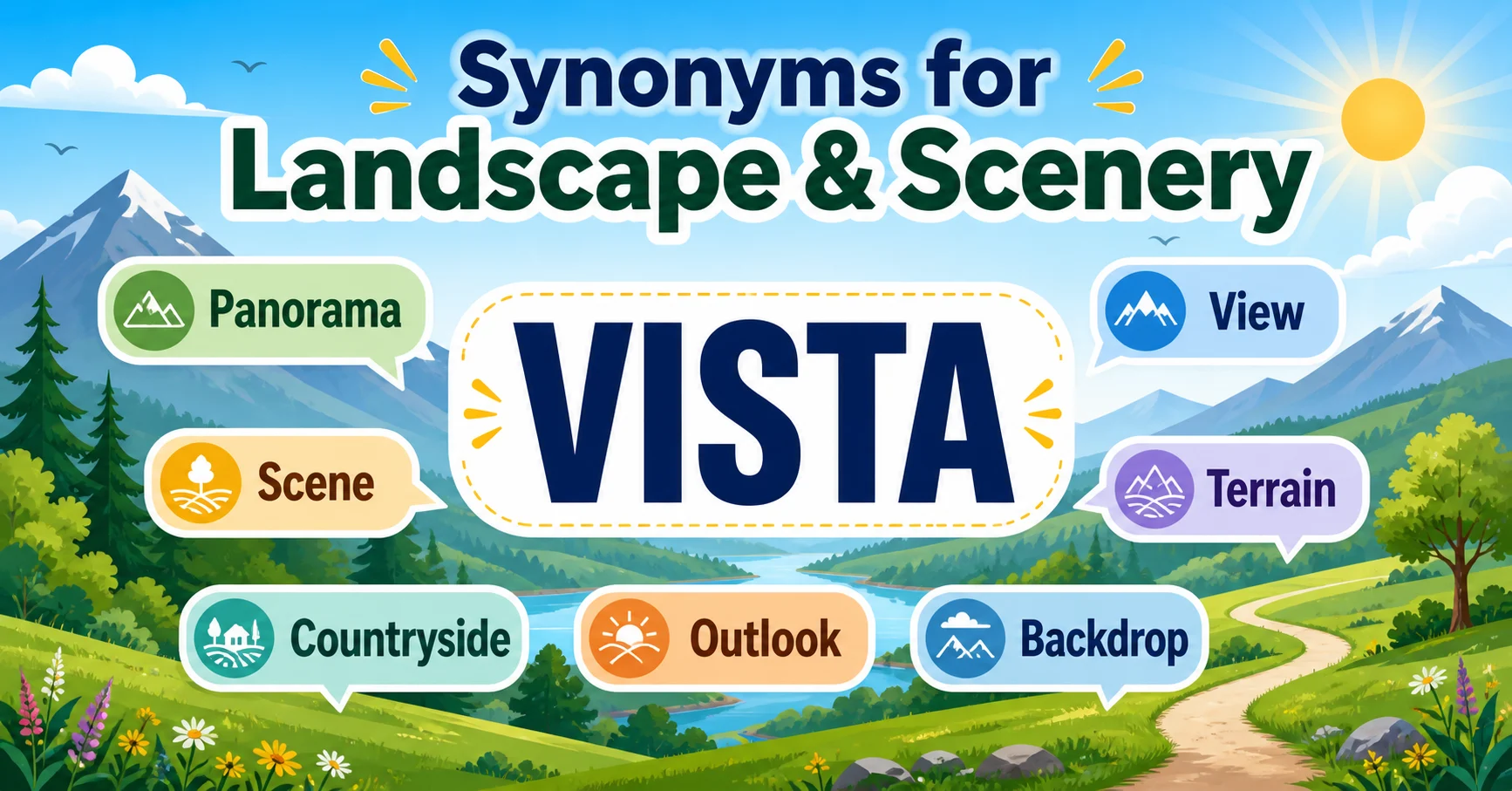
- View — what you can see from a place.
- Vista — a long, wide, beautiful view.
- Panorama — a full, sweeping view of a large area.
- Terrain — the physical surface of the land.
- Countryside — rural land outside towns and cities.
- Surroundings — the area around a person or place.
- Setting — the place or background where something happens.
- Backdrop — the visual background behind a scene.
- Outlook — a view from a particular position.
- Topography — the physical shape and features of land.
- Natural beauty — attractive features of nature.
- Environment — the natural or physical conditions of a place.
- Region — a larger area with shared features.
- Wilderness — wild, uncultivated land.
- Seascape — a view of the sea or coast.
- Cityscape — the visible features of a city.
Travel Writer’s Tip:
In our experience helping writers improve travel descriptions, the strongest word is often the most specific one. Instead of writing “nice scenery,” write “a misty valley,” “a rugged coastline,” or “a wide alpine vista.” Specific nouns make your reader see the place.
Comparison Table
| Word | Simple Meaning | Best Used When | Avoid When |
| Landscape | Visible land features | Describing land, geography, or nature | You only mean a pretty view |
| Scenery | Beautiful things you see | Praising natural beauty | Discussing land structure |
| View | What you can see | Writing simply and clearly | You need a more vivid word |
| Vista | Wide, impressive view | Describing mountains, valleys, or open land | The view is small or ordinary |
| Panorama | Sweeping full view | Showing scale and drama | The scene is narrow |
| Terrain | Land surface | Describing rough, steep, flat, or rocky land | You mean beauty, not land type |
| Countryside | Rural area | Writing about farms, fields, villages | Describing cities or deserts |
| Surroundings | Area around a place | Giving context or atmosphere | You need exact land detail |
| Setting | Place where events happen | Essays, stories, travel articles | You only mean physical land |
| Backdrop | Background scene | Describing a scene behind action | The place is the main subject |
| Topography | Shape of land | Academic or geographic writing | Casual travel description |
| Wilderness | Wild natural area | Describing remote nature | The area is managed or urban |
Formal vs Informal Synonyms
Some words sound academic. Others sound natural in blogs, travel stories, or everyday speech. You should match the word to your purpose.
| Formal Synonym | Informal Synonym | Best Context | Example Use |
| Topography | Land shape | Academic geography | “The region’s topography affects settlement patterns.” |
| Environment | Surroundings | Essays and reports | “Tourism can damage the local environment.” |
| Terrain | Ground | Hiking and travel notes | “The terrain became steeper near the ridge.” |
| Landscape | View | Academic or descriptive writing | “The landscape reflects centuries of farming.” |
| Region | Area | Formal description | “The region is known for volcanic soil.” |
| Natural environment | Nature | Academic essays | “The natural environment attracts eco-tourists.” |
| Panorama | Wide view | Polished travel writing | “A panorama of peaks opened before us.” |
| Setting | Place | Literature and essays | “The coastal setting shapes the mood.” |
Nature Writing Example:
“The path climbed through pine forest before opening onto a silver-blue panorama of lakes, cliffs, and distant snow. The word panorama works because the view is wide, layered, and visually impressive.”
Real Example Sentences
Use these examples to understand how different words behave in real writing.
- The landscape changed from green farmland to dry hills within an hour.
- The island’s scenery attracts photographers from around the world.
- From the hotel balcony, you get a clear view of the harbor.
- A wide vista of vineyards stretched toward the mountains.
- The rocky terrain made the final part of the hike difficult.
- The quiet countryside offered a welcome break from city noise.
- Snow-covered peaks formed a dramatic backdrop to the village.
- The region’s topography includes deep valleys and high plateaus.
- We admired the natural beauty of the coastline at sunset.
- The forest setting made the old monastery feel hidden and peaceful.
IELTS Tip:
For IELTS Writing Task 2 or descriptive essays, avoid repeating “beautiful scenery.” Use phrases such as coastal landscape, mountain vista, rural surroundings, or natural environment. This shows range without sounding forced.
When to Use vs When NOT to Use
Choosing synonyms for landscape and scenery is not only about variety. It is about accuracy.
When to use landscape
Use landscape when you describe:
- Landforms and geography
- Rural, urban, desert, mountain, or coastal areas
- The relationship between people and land
- Changes caused by farming, tourism, or climate
Example: “Tourism has altered the coastal landscape.”
Use of scenery
Use scenery when you describe:
- Beauty
- Pleasant views
- Travel experiences
- What visitors enjoy seeing
Example: “The scenery along the train route was spectacular.”
Use of landscape
Do not use landscape when you only mean a single view from a window. “View” is better.
Weak: “The restaurant had a good landscape.”
Better: “The restaurant had a good view.”
Use of scenery
Do not use scenery for technical land description. If you discuss slopes, soil, elevation, or land shape, use terrain or topography.
Weak: “The scenery was difficult to climb.”
Better: “The terrain was difficult to climb.”
Common Mistakes Writers Make
Writers we work with often know many words but use them in the wrong context. Here are the most common problems.
1. Using “scenery” as a countable noun
Do not write “many sceneries.” In standard English, scenery is usually uncountable.
Incorrect: “We saw many beautiful sceneries.”
Correct: “We saw beautiful scenery.”
Correct: “We saw many beautiful views.”
2. Saying “landscape” when you mean “view”
A landscape is an area of land. A view is what you see from one point.
Incorrect: “My room has a sea landscape.”
Correct: “My room has a sea view.”
3. Overusing “beautiful”
“Beautiful scenery” is correct, but repeated use makes writing dull. Try dramatic scenery, peaceful countryside, rugged terrain, or sweeping vista.
4. Using formal words in casual writing
“Topography” is accurate, but it can sound too technical in a light travel blog. Use it when land shape matters.
Too formal: “We enjoyed the topography from the café.”
Better: “We enjoyed the view from the café.”
5. Treating every synonym as equal
Vista, panorama, and view are close, but they are not identical. A view can be small. A vista is wide and often beautiful. A panorama suggests a full sweep from side to side.
Tips and Best Practices
Good descriptive writing depends on exact word choice. In Nature & Travel writing, your reader wants to feel present in the place. The right noun helps create that feeling.
1. Match the word to the scale
Use view for something seen from one place. Use panorama for a wide scene. Landscape for a whole area.
Example: “From the ridge, the panorama included forests, farms, and a blue line of sea.”
2. Add sensory detail
Do not stop at naming the scene. Add sound, light, texture, or movement.
Flat: “The scenery was nice.”
Better: “The valley glowed in late sun, with sheep bells ringing below the cliffs.”
3. Use adjectives with care
Choose adjectives that add information, not empty praise.
Strong combinations include:
- rugged terrain
- rolling countryside
- sweeping vista
- coastal landscape
- remote wilderness
- misty valley
- urban skyline
- lush surroundings
4. Think about tone
For essays, choose clear and formal words: landscape, environment, terrain, region, topography. For travel writing, you can use warmer words: view, vista, backdrop, natural beauty, countryside.
5. Avoid forced variety
You do not need a different synonym in every sentence. Repetition is sometimes clearer. Use variety when it improves meaning, not just to sound clever.
6. Connect place to purpose
Ask yourself: What am I trying to show?
- Beauty? Use scenery, vista, or natural beauty.
- Shape of land? Use terrain or topography.
- Rural life? Use countryside.
- Background mood? Use setting or backdrop.
- Wide visual scale? Use panorama.
Frequently Asked Questions
Q: What is the best synonym for landscape?
A: The best synonym for landscape depends on meaning. Use terrain for land surface, countryside for rural areas, setting for place and mood, and topography for formal geographic description. For general writing, view is often simpler.
Q: What is another word for beautiful scenery?
A: Good alternatives for beautiful scenery include stunning view, breathtaking vista, natural beauty, picturesque surroundings, and spectacular panorama. In travel writing, choose the phrase that matches the scale, mood, and exact visual details.
Q: Are landscape and scenery the same?
A: Landscape and scenery are related but not the same. Landscape describes the land and its features. Scenery focuses on what looks attractive or impressive. A rocky landscape can exist even when the scenery is not beautiful.
Q: What is a formal synonym for scenery?
A: Formal synonyms for scenery include natural environment, surroundings, setting, and landscape. In academic essays, use environment when discussing conditions, landscape when describing land, and setting when discussing context or location.
Q: Can I use vista instead of scenery?
A: You can use vista instead of scenery when describing a wide, pleasing view, especially from a high or open place. Do not use vista for a small room view, a narrow street scene, or technical land description.
Q: What are synonyms for landscape and scenery in travel writing?
A: The most useful synonyms for landscape and scenery in travel writing are view, vista, panorama, countryside, terrain, backdrop, surroundings, wilderness, seascape, and natural beauty. Each word gives your description a different focus and tone.
Conclusion
The best synonyms for landscape and scenery help you describe places with accuracy, mood, and vivid detail. Use landscape for land features, scenery for visual beauty, terrain for surface, vista for wide views, and backdrop for background effect.
Strong word choice matters in Nature & Travel writing because readers want to see, feel, and remember the place. You might also want to read our guide on vista. Keep practicing, and your descriptions will become clearer, richer, and more memorable.

Andrew Powell is a travel writer and nature journalist who has spent over a decade writing about places, landscapes, and the natural world — and thinking carefully about the words that do those subjects justice ( Biography ).