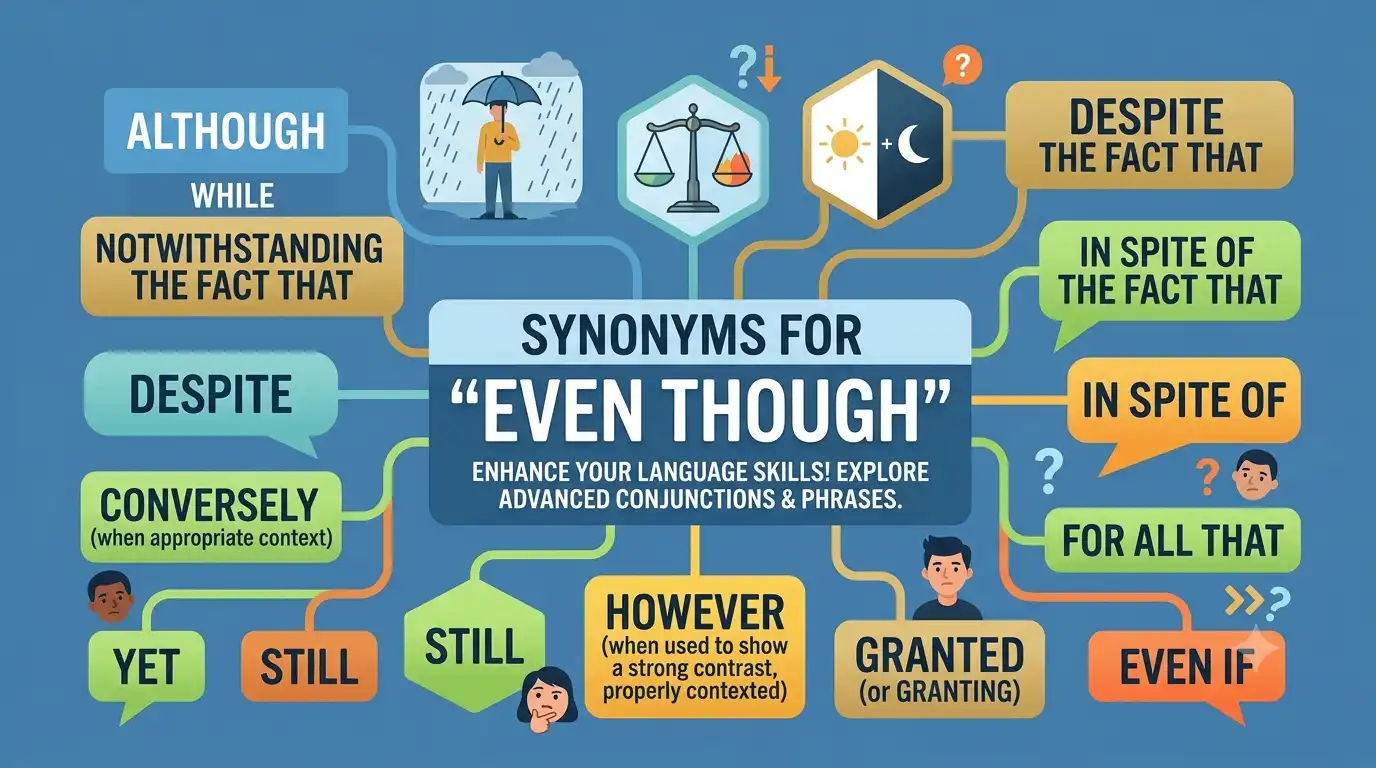
Learning synonyms for even though helps you connect contrasting ideas with smooth, precise, and sophisticated transitional language. Understanding various synonyms for even though allows you to show surprise, unexpected outcomes, and clear contrasts in your essays, stories, and daily conversations. Exploring these synonyms for even though keeps your writing fresh and prevents repetitive sentence structures.
Connecting Unexpected Ideas in Writing and Speech
Imagine writing a story about a team winning a big game. Saying “They won the match even though it was raining” gets the idea across clearly. However, using alternatives like although, despite the fact that, or nevertheless adds variety and elegance to your sentences. Using synonyms for even though allows you to link two opposing facts smoothly without repeating the same conjunction continuously.
In very simple English, even though is a connecting phrase used to show that something happened despite an obstacle or unexpected fact.
Why Word Choice Matters for Communicators
Expanding your vocabulary with these transition words provides distinct advantages across many settings:
- For Students: It enhances essay structure, improves transition flow, and elevates academic writing scores.
- For Bloggers: It creates engaging, natural sentence rhythms that keep readers immersed in your posts.
- For Content Writers: It allows you to build persuasive arguments, comparison guides, and smooth brand stories.
- For Daily English Users: It gives you confident ways to explain unexpected situations and contrast ideas effortlessly.
“Transitions are the bridges of thought, guiding readers smoothly across contrasting ideas.”
“Mastering conjunctions and linkers turns simple statements into graceful, persuasive prose.”
Linguistic Breakdown: Etymology, Connotation, and Structure
Connotative Meaning of “Even Though”
The phrase even though carries a neutral to mildly emphatic connotation. It highlights a strong contrast between two facts, emphasizing that the result occurred despite a genuine obstacle or opposing truth.
Short Etymology
- Origin: Old English and Middle English combination.
- Root: Formed by combining even (used as an intensifying adverb meaning “exactly” or “fully”) with though (derived from Old Norse þó or Old English þēah, meaning “granting that” or “in spite of”).
Pronunciation
- US IPA: /ˈiː.vən ðoʊ/
- UK IPA: /ˈiː.vən ðəʊ/
Syllables & Structure
- Syllables: 3 (e – ven | though)
- Primary Stress: Second word (though)
- Affixation Pattern: Compound transitional phrase formed by an adverb and a subordinate conjunction.
Comparison Table: Choosing the Right Synonym for Even Though
| Keyword | Meaning | Usage Type | Context |
| Even though | In spite of the fact that something is true | General / Universal | Essays, speeches, daily talk |
| Although | In spite of the fact that | Formal / Academic | School papers, articles, reports |
| Though | Despite the fact that | Casual / Conversational | Daily talk, quick messages |
| Despite the fact that | Even with a specific fact existing | Formal / Professional | Business reports, formal letters |
| In spite of the fact that | Regardless of an opposing truth | Professional / Academic | Argumentative essays, debate |
| While | At the same time that something contrasts | General / Literary | Storytelling, editorial writing |
| Whereas | In contrast with the fact that | Formal / Legal | Legal documents, comparisons |
| Albeit | Even though or although (brief form) | Formal / Literary | High-level essays, reviews |
| Even if | Regardless of whether a condition happens | Conditional / General | Predictions, future plans |
| Regardless of the fact that | Without being stopped by a fact | Authoritative | Formal statements, policy |
50 Synonyms for Even Though
1. Although
- Pronunciation: US /ɑːlˈðoʊ/ | UK /ɔːlˈðəʊ/
- Meaning: In spite of the fact that something is true.
- Examples:
- Although it was raining outside, the children played happily in the park.
- She finished her homework on time although she felt tired.
2. Though
- Pronunciation: US /ðoʊ/ | UK /ðəʊ/
- Meaning: Despite the fact that an opposing thing happened.
- Examples:
- He walked to school though the wind was blowing hard.
- The cake turned out great though we missed one ingredient.
3. Despite the fact that
- Pronunciation: US /dɪˈspaɪt ðə fækt ðæt/ | UK /dɪˈspaɪt ðə fækt ðæt/
- Meaning: Even with a specific reality taking place.
- Examples:
- She smiled despite the fact that she lost her favorite pen.
- They enjoyed the hike despite the fact that the path was steep.
4. In spite of the fact that
- Pronunciation: US /ɪn spaɪt ʌv ðə fækt ðæt/ | UK /ɪn spaɪt ɒv ðə fækt ðæt/
- Meaning: Without being affected or stopped by a real fact.
- Examples:
- He ran fast in spite of the fact that his shoes were heavy.
- We finished the project in spite of the fact that time was short.
5. While
- Pronunciation: US /waɪl/ | UK /waɪl/
- Meaning: At the same time that a contrasting truth exists.
- Examples:
- While I respect your opinion, I still see things differently.
- She loves art while her brother prefers playing sports.
6. Whereas
- Pronunciation: US /werˈæz/ | UK /weərˈæz/
- Meaning: Considering that or in direct contrast with a fact.
- Examples:
- He prefers warm weather whereas she loves snowy winters.
- The morning was bright whereas the afternoon brought clouds.
7. Albeit
- Pronunciation: US /ɑːlˈbiː.ɪt/ | UK /ɔːlˈbiː.ɪt/
- Meaning: Even though or although, used for short contrasts.
- Examples:
- He accepted the award, albeit with a modest smile.
- The trip was fun, albeit a bit tiring for everyone.
8. Even if
- Pronunciation: US /ˈiː.vən ɪf/ | UK /ˈiː.vən ɪf/
- Meaning: Regardless of whether a specific condition comes true.
- Examples:
- I will go for a walk even if it starts to drizzle.
- She plans to try her best even if the test is difficult.
9. Regardless of the fact that
- Pronunciation: US /rɪˈɡɑːrd.ləs ʌv ðə fækt ðæt/ | UK /rɪˈɡɑːd.ləs ɒv ðə fækt ðæt/
- Meaning: Without letting a clear situation change the main action.
- Examples:
- He continued studying regardless of the fact that it was late.
- They stayed confident regardless of the fact that the game was close.
10. Notwithstanding the fact that
- Pronunciation: US /ˌnɑːt.wɪθˈstæn.dɪŋ ðə fækt ðæt/ | UK /ˌnɒt.wɪðˈstæn.dɪŋ ðə fækt ðæt/
- Meaning: Despite the occurrence or existence of something mentioned.
- Examples:
- The event succeeded notwithstanding the fact that planning started late.
- She completed her speech notwithstanding the fact that she felt nervous.
11. Granted that
- Pronunciation: US /ˈɡræn.t̬ɪd ðæt/ | UK /ˈɡrɑːn.tɪd ðæt/
- Meaning: Admitting that a statement is true while showing contrast.
- Examples:
- Granted that the puzzle is hard, we can still solve it together.
- Granted that he made a mistake, he offered a sincere apology.
12. Admitting that
- Pronunciation: US /ədˈmɪt.ɪŋ ðæt/ | UK /ədˈmɪt.ɪŋ ðæt/
- Meaning: Accepting a fact while explaining another side to it.
- Examples:
- Admitting that the task takes time, it is still worth doing.
- Admitting that she was busy, she made time to help her friend.
13. Considering that
- Pronunciation: US /kənˈsɪd.ɚ.ɪŋ ðæt/ | UK /kənˈsɪd.ər.ɪŋ ðæt/
- Meaning: Taking a specific truth into account while showing surprise.
- Examples:
- He did great on the test considering that he studied for only one hour.
- The house looked neat considering that a party just ended.
14. Much as
- Pronunciation: US /mʌtʃ æz/ | UK /mʌtʃ æz/
- Meaning: Even though someone feels strongly in one direction.
- Examples:
- Much as I love ice cream, I should save room for dinner.
- Much as she wanted to stay, she had to catch her bus.
15. Even with
- Pronunciation: US /ˈiː.vən wɪð/ | UK /ˈiː.vən wɪð/
- Meaning: Despite having a specific difficulty or circumstance present.
- Examples:
- Even with heavy traffic, we arrived at the museum early.
- She baked a delicious loaf even with a basic oven.
16. Despite
- Pronunciation: US /dɪˈspaɪt/ | UK /dɪˈspaɪt/
- Meaning: Without being prevented or stopped by an obstacle.
- Examples:
- Despite the cold wind, they enjoyed building a snowman.
- She passed her driving trial despite her initial worries.
17. In spite of
- Pronunciation: US /ɪn spaɪt ʌv/ | UK /ɪn spaɪt ɒv/
- Meaning: Without taking harm or stopping because of something.
- Examples:
- We went camping in spite of the cloudy sky.
- He kept a cheerful mood in spite of his sore foot.
18. Regardless of
- Pronunciation: US /rɪˈɡɑːrd.ləs ʌv/ | UK /rɪˈɡɑːd.ləs ɒv/
- Meaning: Paying no attention to obstacles or conditions.
- Examples:
- She practices her guitar daily regardless of her busy school schedule.
- The team played hard regardless of the final score.
19. Irrespective of
- Pronunciation: US /ˌɪr.əˈspek.tɪv ʌv/ | UK /ˌɪr.ɪˈspek.tɪv ɒv/
- Meaning: Without considering or being influenced by a condition.
- Examples:
- Everyone received a gift irrespective of who won the game.
- All students are welcome irrespective of their background experience.
20. Notwithstanding
- Pronunciation: US /ˌnɑːt.wɪθˈstæn.dɪŋ/ | UK /ˌnɒt.wɪðˈstæn.dɪŋ/
- Meaning: In spite of or despite a clear factor.
- Examples:
- Notwithstanding the rain, the outdoor concert continued as planned.
- Her hard work led to success, notwithstanding early challenges.
“Clear transitional connectors help thoughts flow effortlessly like water over smooth river stones.”
21. For all that
- Pronunciation: US /fɔːr ɑːl ðæt/ | UK /fɔːr ɔːl ðæt/
- Meaning: In spite of everything that was just said or done.
- Examples:
- For all that he practiced, he still felt nervous on stage.
- For all that it rained, the picnic turned out to be fun.
22. Supposing that
- Pronunciation: US /səˈpoʊ.zɪŋ ðæt/ | UK /səˈpəʊ.zɪŋ ðæt/
- Meaning: Allowing or assuming a statement while showing an outcome.
- Examples:
- Supposing that the plan changes, we can still enjoy our weekend.
- Supposing that she arrives late, we will keep a seat saved.
23. Even granted that
- Pronunciation: US /ˈiː.vən ˈɡræn.t̬ɪd ðæt/ | UK /ˈiː.vən ˈɡrɑːn.tɪd ðæt/
- Meaning: Even when accepting that a point is entirely true.
- Examples:
- Even granted that the road is long, we will enjoy the journey.
- Even granted that the book is thick, it reads very fast.
24. Be that as it may
- Pronunciation: US /biː ðæt æz ɪt meɪ/ | UK /biː ðæt æz ɪt meɪ/
- Meaning: Accepting that something is true, but moving to another fact.
- Examples:
- Be that as it may, we still need to complete our chores today.
- The day was long; be that as it may, she smiled cheerfully.
25. Nevertheless
- Pronunciation: US /ˌnev.ɚ.ðəˈles/ | UK /ˌnev.ə.ðəˈles/
- Meaning: In spite of what has just been mentioned; however.
- Examples:
- The puzzle was difficult; nevertheless, he solved it independently.
- She felt tired; nevertheless, she stayed up to finish her reading.
26. Nonetheless
- Pronunciation: US /ˌnʌn.ðəˈles/ | UK /ˌnʌn.ðəˈles/
- Meaning: In spite of that; despite what was just stated.
- Examples:
- The movie was long; nonetheless, the audience stayed completely engaged.
- The room was small; nonetheless, it felt very cozy and warm.
27. However
- Pronunciation: US /haʊˈev.ɚ/ | UK /haʊˈev.ər/
- Meaning: Used to introduce a statement that contrasts with a previous one.
- Examples:
- I wanted to go swimming; however, the pool was closed for maintenance.
- She loves green apples; however, her sister prefers red ones.
28. Still
- Pronunciation: US /stɪl/ | UK /stɪl/
- Meaning: In spite of that fact; nevertheless.
- Examples:
- The sky looked dark and cloudy; still, they decided to walk.
- He lost the first round; still, he won the tournament.
29. Yet
- Pronunciation: US /jet/ | UK /jet/
- Meaning: But at the same time; in spite of that.
- Examples:
- The kitten was tiny, yet it had a very loud purr.
- The problem was simple, yet nobody found the correct answer.
30. But
- Pronunciation: US /bʌt/ | UK /bʌt/
- Meaning: Used to introduce a phrase or clause contrasting with what was said.
- Examples:
- She wanted to go outdoors, but her homework took longer than expected.
- The soup was hot, but it tasted absolutely wonderful.
31. Even so
- Pronunciation: US /ˈiː.vən soʊ/ | UK /ˈiː.vən səʊ/
- Meaning: In spite of that truth; nevertheless.
- Examples:
- The weather was cold; even so, they went for a morning run.
- He made a few errors; even so, his overall paper was excellent.
32. On the other hand
- Pronunciation: US /ɑːn ði ˈʌð.ɚ hænd/ | UK /ɒn ði ˈʌð.ər hænd/
- Meaning: Used to introduce a contrasting point of view or fact.
- Examples:
- I love summer sports; on the other hand, winter skiing is exciting too.
- The red shirt is bright; on the other hand, the blue one looks calm.
33. All the same
- Pronunciation: US /ɑːl ðə seɪm/ | UK /ɔːl ðə seɪm/
- Meaning: In spite of everything; nevertheless.
- Examples:
- The test was tough, but he smiled all the same.
- She knew the story already, but listened attentively all the same.
34. Just the same
- Pronunciation: US /dʒʌst ðə seɪm/ | UK /dʒʌst ðə seɪm/
- Meaning: In spite of what happened; anyway.
- Examples:
- It rained on their outdoor picnic, but they had fun just the same.
- The journey was tiring, but she was glad she came just the same.
35. Be it that
- Pronunciation: US /biː ɪt ðæt/ | UK /biː ɪt ðæt/
- Meaning: Even if it is true that a condition exists.
- Examples:
- Be it that the challenge is tough, we are ready to work hard.
- Be it that night fell quickly, our flashlight guided us home.
36. Regardless
- Pronunciation: US /rɪˈɡɑːrd.ləs/ | UK /rɪˈɡɑːd.ləs/
- Meaning: Without paying attention to present difficulties.
- Examples:
- It started to rain, but we kept walking regardless.
- The task was tricky, but she completed it regardless.
37. Mind you
- Pronunciation: US /maɪnd juː/ | UK /maɪnd juː/
- Meaning: Used to add a comment to limit or contrast a former statement.
- Examples:
- He finished the meal quickly—mind you, he was very hungry!
- She won the art trophy—mind you, she practiced every single afternoon.
38. Admit it or not
- Pronunciation: US /ədˈmɪt ɪt ɔːr nɑːt/ | UK /ədˈmɪt ɪt ɔːr nɒt/
- Meaning: Regardless of whether someone agrees with a clear truth.
- Examples:
- Admit it or not, daily practice helps you play better sports.
- Admit it or not, early bedtime gives you far more energy.
39. Despite everything
- Pronunciation: US /dɪˈspaɪt ˈev.ri.θɪŋ/ | UK /dɪˈspaɪt ˈev.ri.θɪŋ/
- Meaning: In spite of all obstacles or problems that occurred.
- Examples:
- Despite everything, the community came together to build the garden.
- She kept her cheerful smile despite everything that went wrong.
40. Though it be
- Pronunciation: US /ðoʊ ɪt biː/ | UK /ðəʊ ɪt biː/
- Meaning: Even if a situation is characterized by a specific trait.
- Examples:
- Though it be small, our local library has wonderful books.
- Though it be late, we can still read one last chapter.
41. At any rate
- Pronunciation: US /æt ˈen.i reɪt/ | UK /æt ˈen.i reɪt/
- Meaning: Whatever the situation is; anyway.
- Examples:
- We might miss the start, but at any rate, we will see the main show.
- The cake turned out lopsided, but at any rate, it tasted great.
42. In any case
- Pronunciation: US /ɪn ˈen.i keɪs/ | UK /ɪn ˈen.i keɪs/
- Meaning: Whatever happens or has happened.
- Examples:
- It might rain tomorrow; in any case, we brought our umbrellas.
- I am not sure of the time, but in any case, let us get ready.
43. Anyhow
- Pronunciation: US /ˈen.i.haʊ/ | UK /ˈen.i.haʊ/
- Meaning: In spite of that; anyway.
- Examples:
- The trail was muddy, but we finished our nature walk anyhow.
- She felt sleepy, but she finished her assigned reading anyhow.
44. Anyway
- Pronunciation: US /ˈen.i.weɪ/ | UK /ˈen.i.weɪ/
- Meaning: In spite of something; regardless.
- Examples:
- He knew the answer was tricky, but he tried to solve it anyway.
- It was cold outside, but the kids played tag anyway.
45. Even with the fact
- Pronunciation: US /ˈiː.vən wɪð ðə fækt/ | UK /ˈiː.vən wɪð ðə fækt/
- Meaning: Despite having a specific piece of information present.
- Examples:
- Even with the fact that he was new, he made friends quickly.
- She completed the runner course even with the fact that it was windy.
46. Withal
- Pronunciation: US /wɪðˈɑːl/ | UK /wɪðˈɔːl/
- Meaning: In spite of that; nevertheless (literary term).
- Examples:
- The challenge was fierce, but he stayed brave withal.
- She was quiet, yet very kind withal to everyone she met.
47. Even granting
- Pronunciation: US /ˈiː.vən ˈɡræn.tɪŋ/ | UK /ˈiː.vən ˈɡrɑːn.tɪŋ/
- Meaning: Accepting a fact as true while introducing an opposing point.
- Examples:
- Even granting his late start, he caught up with the front group.
- Even granting the high price, the quality made it a good choice.
48. Despite this
- Pronunciation: US /dɪˈspaɪt ðɪs/ | UK /dɪˈspaɪt ðɪs/
- Meaning: In spite of the statement that was just made.
- Examples:
- The team fell behind early; despite this, they never gave up.
- The morning was foggy; despite this, the plane took off on time.
49. In the face of
- Pronunciation: US /ɪn ðə feɪs ʌv/ | UK /ɪn ðə feɪs ɒv/
- Meaning: In spite of facing major difficulties or challenges.
- Examples:
- She stayed calm in the face of unexpected changes.
- The team showed courage in the face of strong opposition.
50. Even while
- Pronunciation: US /ˈiː.vən waɪl/ | UK /ˈiː.vən waɪl/
- Meaning: At the exact same time that another contrasting fact is true.
- Examples:
- Even while she rested, she thought about new creative ideas.
- He smiled even while working through the difficult math problem.
Antonyms of Even Though
To understand transition words completely, it helps to examine connecting terms that express cause, agreement, and logical continuation rather than contrast:
- Because: Used to introduce a direct reason or cause for an event.
- Since: Introducing a known fact that leads logically to a result.
- Therefore: Showing a direct logical consequence or outcome.
- Consequently: Explaining what happens as a direct result of an action.
- So: Connecting an action directly to its natural outcome.
- Furthermore: Adding supporting points that agree with the main statement.
Prototype Meaning and Categorization of Even Though
In cognitive linguistics, a prototype represents the central, most typical example of a category. The central prototype of the phrase even though is a subordinate conjunction that links two contrasting clauses, showing that a main action occurred despite an opposing circumstance. Depending on the writer’s intent and formal context, synonyms for even though naturally fall into three primary written categories:
1. Formal and Academic Conjunctions This category includes subordinate clauses and formal connectors that link two complete thoughts within a single sentence. Words and phrases such as although, despite the fact that, in spite of the fact that, whereas, notwithstanding the fact that, and albeit represent prototype choices in school essays, formal reports, and literary analysis where structured academic grammar is expected.
2. Conversational and Casual Linkers This group consists of flexible, friendly connectors suitable for daily conversations, quick email updates, and casual blogging. Connectors like though, while, even if, even with, much as, and considering that allow speakers and writers to express contrast naturally without sounding overly formal or stiff.
3. Sentence-Starting Transitions and Adverbs This category features conjunctive adverbs and transitional phrases used to start a new sentence that contrasts with the previous one. Expressions such as nevertheless, nonetheless, however, even so, still, on the other hand, and despite this allow writers to build smooth transitions across separate sentences and paragraphs.
Frequently Asked Questions (FAQ)
1. What is the main difference between “even though” and “although”?
There is very little difference in meaning between the two! Even though is slightly more emphatic, placing extra stress on the obstacle, while although is a bit more formal and widely used in academic writing.
2. Can I start a sentence with “synonyms for even though” like “although” or “even though”?
Yes, absolutely! When you start a sentence with although or even though, place a comma after the first dependent clause (for example: “Although it was cold, we went outside.”).
3. What is the difference between “even though” and “even if”?
Even though deals with real, factual situations that have already happened or exist right now. Even if deals with hypothetical or conditional situations that might happen in the future.
4. Is “in spite of” used the exact same way as “even though”?
Not quite! Even though is followed by a full subject and verb clause (“even though it rained”), whereas in spite of is followed by a noun or gerund (“in spite of the rain” or “in spite of raining”).
5. What are good formal synonyms for even though to use in school essays?
Top formal choices for academic papers include although, despite the fact that, notwithstanding, whereas, and albeit.
Conclusion
Expanding your vocabulary with this comprehensive collection of synonyms for even though is an excellent way to strengthen your writing, reading comprehension, and conversational skills. Whether you select formal academic transitions like although and despite the fact that, casual connectors like though and while, or strong sentence linkers like nevertheless and even so, choosing the exact right transition word makes your communication far more graceful and clear.
For students drafting essays, using diverse synonyms for even though eliminates repetitive sentence patterns and demonstrates a mature command of grammar and logic, bloggers and content writers, selecting precise transition words creates a captivating rhythm that keeps readers turning pages, everyday speakers, mastering these linkers allows you to explain complex ideas and surprising situations with effortless confidence.
Try practicing two or three of these new transition words this week in your school essays, emails, or daily conversations!
“A rich command of transitions turns choppy sentences into a seamless stream of thought.”
“The right connecting word gives structure, balance, and clarity to every argument.”
“Exploring vocabulary empowers you to express every subtle connection in human thought.”
Extras: SEO Metadata
- SEO Title:
- Meta Description:

Andrew Powell is a travel writer and nature journalist who has spent over a decade writing about places, landscapes, and the natural world — and thinking carefully about the words that do those subjects justice ( Biography ).