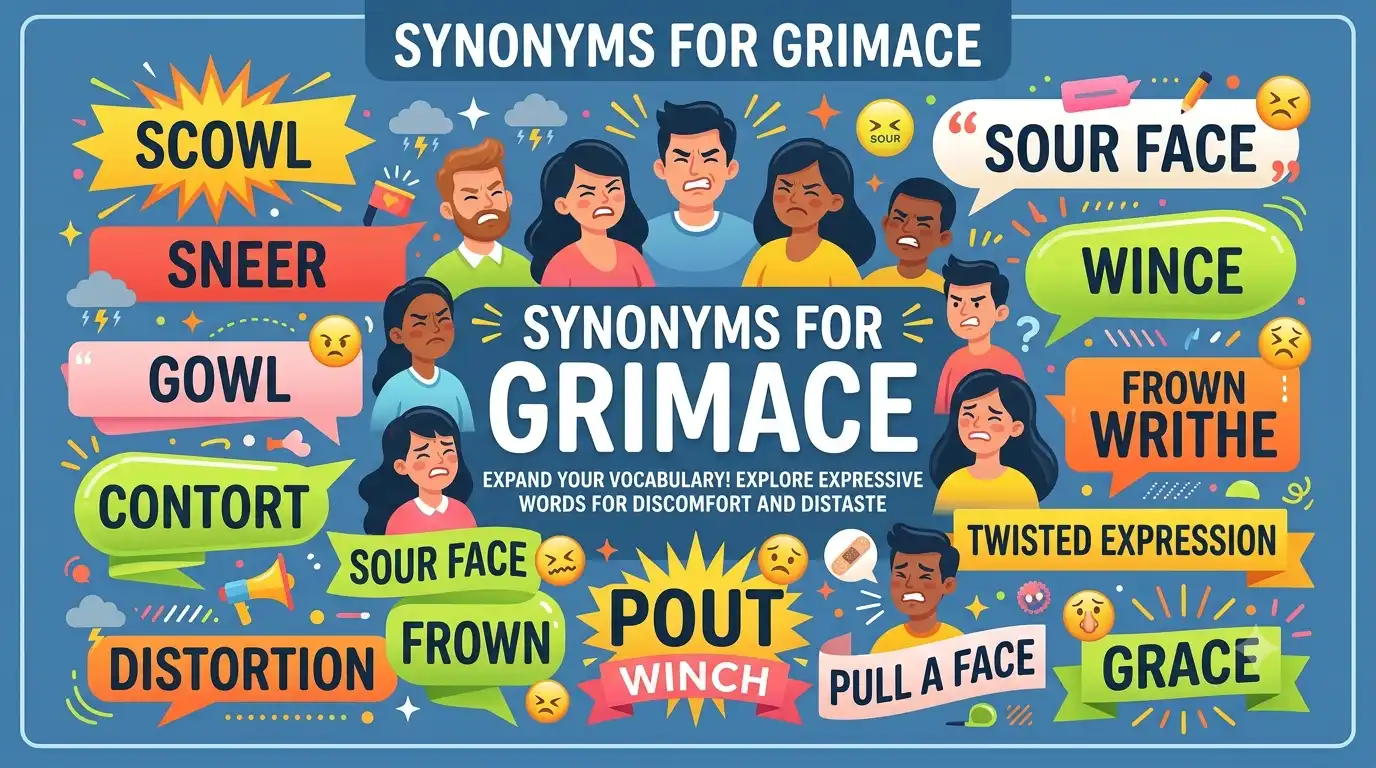
When you want to describe a painful, awkward, or disgusted facial expression, finding the right synonyms for grimace makes your writing much more vivid and clear. A grimace is a twisted facial expression that shows pain, disgust, or disapproval. Learning different synonyms for grimace helps you express exact emotions, whether you are writing a novel, composing an email, or practicing daily speech. By expanding your vocabulary with various synonyms for grimace, you can avoid repeating the same basic words and make your descriptions far more engaging.
Imagine stepping on a sharp piece of Lego in the middle of the night. Your eyes squeeze shut, your mouth contorts, and your teeth press together. That sudden, involuntary facial expression is the precise moment you use a grimace.
“A facial expression reveals what the heart tries to conceal.”
- Meaning of Grimace: A grimace simply means twisting your face because something hurts, tastes bad, or feels uncomfortable.
- Why this word is useful:
- Students: Helps you write descriptive essays and score higher in creative writing tests.
- Bloggers: Keeps readers engaged by creating vivid visual images in their minds.
- Content Writers: Gives you precise words to describe human reactions in stories and articles.
- Daily English Users: Improves your everyday storytelling skills when sharing life experiences with friends.
“The human face is the finest canvas for emotional expression.”
Linguistic Profile of “Grimace”
Connotative Meaning
The word grimace carries a slightly negative or uncomfortable connotation. It implies an uncontrollable reaction to physical pain, intense emotional discomfort, awkwardness, or strong dislike.
Etymology
- Origin: Mid-16th century.
- Source: From Middle French grimace, derived from Old French grime (meaning mask).
- Root Connection: Related to the Frankish word for “mask” or “phantom.”
Pronunciation (IPA)
- US: /ˈɡrɪm.əs/ or /ɡrɪˈmeɪs/
- UK: /ˈɡrɪm.əs/ or /ɡrɪˈmeɪs/
Word Breakdown
- Syllables: 2 (gri-mace)
- Affixation Pattern: Root word (grimace); Derivatives include grimaced (past tense), grimacing (present participle), and grimacer (noun).
Comparison Table: Popular Expressions of Discomfort
| Keyword | Meaning | Usage Type | Context |
| Grimace | A twisted face made from pain or disgust | Casual / Literary | Daily life, accidents, sour foods |
| Wince | A quick shrink or facial twitch from sudden pain | Formal / Casual | Injections, emotional shocks, insults |
| Frown | Furrowing the brow to show anger or thought | Casual / Professional | Workplaces, classrooms, arguments |
| Scowl | An angry, threatening facial look | Casual / Literary | Arguments, villainous characters |
| Sneer | A facial expression showing mockery or contempt | Formal / Casual | Debates, rivalries, social drama |
| Smirk | An irritating, self-satisfied smile | Casual | Teasing, winning an argument |
| Gasp | A sudden mouth expression while breathing in | Casual | Surprises, sudden fear |
| Pout | Pushing out lips in sadness or annoyance | Casual / Emotional | Children, romantic relationships |
50 Synonyms for Grimace
1. Wince
- Pronunciation: US: /wɪns/ | UK: /wɪns/
- Meaning: A quick movement or facial shrink caused by sudden pain.
- Examples:
- I saw him wince when the doctor touched his bruised arm.
- She tried not to wince as she took a sip of hot tea.
2. Scowl
- Pronunciation: US: /skaʊl/ | UK: /skaʊl/
- Meaning: An angry or bad-tempered facial expression.
- Examples:
- The teacher gave a scowl when the class became noisy.
- Mark had a deep scowl on his face after losing the game.
3. Frown
- Pronunciation: US: /fraʊn/ | UK: /fraʊn/
- Meaning: Moving your eyebrows together to show sadness, confusion, or anger.
- Examples:
- Sarah looked at her test results with a sad frown.
- He read the difficult email with a serious frown.
4. Sneer
- Pronunciation: US: /snɪr/ | UK: /snɪə/
- Meaning: A smile or expression that shows you do not respect someone.
- Examples:
- The bully looked at my old shoes with a rude sneer.
- She answered his question with a cruel sneer.
5. Smirk
- Pronunciation: US: /smɝːk/ | UK: /smɜːk/
- Meaning: A silly or proud smile that annoys other people.
- Examples:
- He had an annoying smirk after winning the simple card game.
- Wipe that silly smirk off your face right now.
6. Contortion
- Pronunciation: US: /kənˈtɔːr.ʃən/ | UK: /kənˈtɔː.ʃən/
- Meaning: A twisted or unnatural shape of the face or body.
- Examples:
- Pain caused a strange contortion on his face.
- Her facial contortion showed how bitter the lemon tasted.
7. Pout
- Pronunciation: US: /paʊt/ | UK: /paʊt/
- Meaning: Pushing your lips forward to show you are unhappy or annoyed.
- Examples:
- The little boy put on a pout when he could not buy candy.
- Stop your pout and help us clean the living room.
8. Mug
- Pronunciation: US: /mʌɡ/ | UK: /mʌɡ/
- Meaning: Making silly or dramatic faces to entertain or react to something.
- Examples:
- The actor began to mug for the camera during the interview.
- He pulled a funny mug to make his baby sister laugh.
9. Face
- Pronunciation: US: /feɪs/ | UK: /feɪs/
- Meaning: Changing your facial expression to show dislike or pain.
- Examples:
- She made a terrible face after tasting the medicine.
- Please stop making that strange face at your lunch.
10. Twitch
- Pronunciation: US: /twɪtʃ/ | UK: /twɪtʃ/
- Meaning: A sudden small jump or movement of a muscle in your face.
- Examples:
- I noticed a small twitch near his eye when he lied.
- Her cheek gave a quick twitch from stress.
11. Gape
- Pronunciation: US: /ɡæp/ or /ɡeɪp/ | UK: /ɡeɪp/
- Meaning: Opening your mouth wide because of shock or pain.
- Examples:
- The audience gave a sudden gape at the dangerous stunt.
- He could only gape in silence after hearing the bad news.
12. Gawk
- Pronunciation: US: /ɡɑːk/ | UK: /ɡɔːk/
- Meaning: Looking at something with an open mouth in a rude way.
- Examples:
- Don’t gawk at people who drop their food in public.
- They stood there with a open gawk at the accident site.
13. Glare
- Pronunciation: US: /ɡler/ | UK: /ɡleə/
- Meaning: A long, angry look at someone.
- Examples:
- Mom gave me a sharp glare when I spoke too loudly.
- His fierce glare stopped the dog from barking.
14. Glower
- Pronunciation: US: /ˈɡlaʊ.ɚ/ | UK: /ˈɡlaʊ.ər/
- Meaning: Looking at someone with a dark, angry face.
- Examples:
- The boss began to glower as the meeting dragged on.
- He continued to glower at the broken computer screen.
15. Pucker
- Pronunciation: US: /ˈpʌk.ɚ/ | UK: /ˈpʌk.ər/
- Meaning: Squeezing your lips together into small folds.
- Examples:
- The sour candy made her mouth pucker instantly.
- A quick pucker of his lips showed he did not like the smell.
16. Squint
- Pronunciation: US: /skwɪnt/ | UK: /skwɪnt/
- Meaning: Squeezing your eyes partly shut to see better or react to light.
- Examples:
- He had to squint his eyes against the bright sunlight.
- She gave a little squint when reading the tiny print.
17. Blear
- Pronunciation: US: /blɪr/ | UK: /blɪə/
- Meaning: A tired, dim, or unfocused facial expression around the eyes.
- Examples:
- He looked up with a blear face after studying all night.
- Her eyes had a tired blear from working late on the laptop.
18. Distortion
- Pronunciation: US: /dɪˈstɔːr.ʃən/ | UK: /dɪˈstɔː.ʃən/
- Meaning: A change that makes the face look unusual or out of shape.
- Examples:
- Fear caused a sudden distortion on her face.
- The strong wind created a funny distortion on his cheeks.
19. Grimness
- Pronunciation: US: /ˈɡrɪm.nəs/ | UK: /ˈɡrɪm.nəs/
- Meaning: A stern, severe, or very serious facial look.
- Examples:
- The grimness on the doctor’s face made us worried.
- He spoke with a dark grimness about the situation.
20. Fleer
- Pronunciation: US: /flɪr/ | UK: /flɪə/
- Meaning: Laughing or grinning in a rude and disrespectful way.
- Examples:
- The rude boy gave a quiet fleer as I walked past him.
- Avoid making a fleer when someone makes an honest mistake.
21. Leer
- Pronunciation: US: /lɪr/ | UK: /lɪə/
- Meaning: An unpleasant, creepy, or dangerous look at someone.
- Examples:
- The strange man gave an uncomfortable leer across the room.
- She turned her back to avoid his creepy leer.
22. Moue
- Pronunciation: US: /muː/ | UK: /muː/
- Meaning: A small, pouty facial expression showing slight annoyance or playfulness.
- Examples:
- She made a little moue when her favorite tea was sold out.
- He replied with a subtle moue to show his disapproval.
23. Mump
- Pronunciation: US: /mʌmp/ | UK: /mʌmp/
- Meaning: A sulky or silent facial expression of bad mood.
- Examples:
- She sat in the corner with a sudden mump on her face.
- His constant mump made the family dinner uncomfortable.
24. Poutiness
- Pronunciation: US: /ˈpaʊ.ti.nəs/ | UK: /ˈpaʊ.ti.nəs/
- Meaning: The habit or state of pushing out lips in displeasure.
- Examples:
- Her poutiness was obvious when she did not get her way.
- He showed his child-like poutiness after losing the game.
25. Snarl
- Pronunciation: US: /snɑːrl/ | UK: /snɑːl/
- Meaning: Showing teeth and twisting the mouth in an angry, threat-like way.
- Examples:
- The angry dog gave a scary snarl at the intruder.
- He showed a mean snarl before shouting at his opponent.
26. Grin
- Pronunciation: US: /ɡrɪn/ | UK: /ɡrɪn/
- Meaning: A wide smile, sometimes used nervously or sarcastically.
- Examples:
- She gave a nervous grin as she took the stage.
- His broad grin showed he was up to no good.
27. Sulk
- Pronunciation: US: /sʌlk/ | UK: /sʌlk/
- Meaning: Looking silent, bad-tempered, and annoyed.
- Examples:
- He had a silent sulk for the rest of the day.
- Her quiet sulk made everyone feel awkward.
28. Brow-furrow
- Pronunciation: US: /braʊ ˈfɝː.oʊ/ | UK: /braʊ ˈfʌr.əʊ/
- Meaning: Wrinkling your forehead due to pain, confusion, or deep concern.
- Examples:
- His brow-furrow showed he was deep in thought.
- I noticed a quick brow-furrow when she felt the sharp pain.
29. Lip-curl
- Pronunciation: US: /lɪp kɝːl/ | UK: /lɪp kɜːl/
- Meaning: Raising one corner of the mouth to show disgust or disrespect.
- Examples:
- A quick lip-curl showed her dislike for the cheap perfume.
- He looked at the dirty car with a noticeable lip-curl.
30. Jaw-clench
- Pronunciation: US: /dʒɑː klentʃ/ | UK: /dʒɔː klentʃ/
- Meaning: Pressing teeth tightly together from anger or physical pain.
- Examples:
- His sudden jaw-clench showed he was holding back tears.
- I saw her jaw-clench as she lifted the heavy box.
31. Wry face
- Pronunciation: US: /raɪ feɪs/ | UK: /raɪ feɪs/
- Meaning: A facial look that combines disappointment with dry humor.
- Examples:
- He made a wry face when the rain ruined our outdoor plans.
- She pulled a wry face after taking a sip of unsweetened coffee.
32. Pain-mask
- Pronunciation: US: /peɪn mæsk/ | UK: /peɪn mɑːsk/
- Meaning: A frozen facial expression caused by severe suffering.
- Examples:
- His face turned into a rigid pain-mask during the accident.
- She tried to hide her illness, but her face was a pain-mask.
33. Disgust-look
- Pronunciation: US: /dɪsˈɡʌst lʊk/ | UK: /dɪsˈɡʌst lʊk/
- Meaning: A facial expression caused by something gross or bad-smelling.
- Examples:
- He gave a clear disgust-look when he smelled the spoiled milk.
- Her disgust-look made it clear she hated seafood.
34. Sour-face
- Pronunciation: US: /ˈsaʊ.ɚ feɪs/ | UK: /ˈsaʊ.ər feɪs/
- Meaning: An unhappy, bitter facial expression.
- Examples:
- Don’t keep that sour-face on such a beautiful sunny day.
- He walked into the office with his usual sour-face.
35. Twist
- Pronunciation: US: /twɪst/ | UK: /twɪst/
- Meaning: A change in the position of your mouth or face caused by pain.
- Examples:
- There was a sudden twist in his mouth as he felt the cramp.
- A sharp twist of her features revealed her inner distress.
36. Wrinkle
- Pronunciation: US: /ˈrɪŋ.kəl/ | UK: /ˈrɪŋ.kəl/
- Meaning: Creasing the skin on your nose or forehead in reaction to something.
- Examples:
- A small wrinkle appeared on her nose at the bad odor.
- He gave a quick nose wrinkle when he tasted the sour pickle.
37. Quiver
- Pronunciation: US: /ˈkwɪv.ɚ/ | UK: /ˈkwɪv.ər/
- Meaning: A slight shaking movement in the lips or chin due to sadness or fear.
- Examples:
- Her lower lip gave a sad quiver before she started crying.
- I saw a small quiver in his chin when he heard the news.
38. Gasp-face
- Pronunciation: US: /ɡæsp feɪs/ | UK: /ɡɑːsp feɪs/
- Meaning: An open-mouthed expression showing sharp shock or sudden hurt.
- Examples:
- She made a gasp-face as she touched the boiling water.
- His gasp-face showed total shock at the news.
39. Mock-smile
- Pronunciation: US: /mɑːk smaɪl/ | UK: /mɒk smaɪl/
- Meaning: A fake, uncomfortable smile used to cover pain or disgust.
- Examples:
- She forced a quick mock-smile to hide her deep disappointment.
- His mock-smile could not hide the fact that he was hurt.
40. Pain-grimace
- Pronunciation: US: /peɪn ˈɡrɪm.əs/ | UK: /peɪn ˈɡrɪm.əs/
- Meaning: A strong facial reaction made specifically due to physical suffering.
- Examples:
- The athlete made a pain-grimace after twisting his ankle.
- A sharp pain-grimace passed over his face during the test.
“A word fitly spoken is like apples of gold in settings of silver.”
41. Horror-look
- Pronunciation: US: /ˈhɔːr.ɚ lʊk/ | UK: /ˈhɒr.ər lʊk/
- Meaning: A facial expression of great shock, terror, or deep disgust.
- Examples:
- She had a horror-look as the car slipped on the ice.
- His horror-look showed he had seen something terrible.
42. Shock-face
- Pronunciation: US: /ʃɑːk feɪs/ | UK: /ʃɒk feɪs/
- Meaning: A sudden, wild facial look caused by unexpected news.
- Examples:
- The whole room showed a collective shock-face.
- He put on a shock-face when his name was called out.
43. Bitter-look
- Pronunciation: US: /ˈbɪt̬.ɚ lʊk/ | UK: /ˈbɪt.ər lʊk/
- Meaning: A facial reaction showing deep disappointment or resentment.
- Examples:
- She carried a bitter-look after losing the final round.
- His bitter-look made it clear he still held a grudge.
44. Distress-mask
- Pronunciation: US: /dɪˈstres mæsk/ | UK: /dɪˈstres mɑːsk/
- Meaning: An expression showing intense emotional or physical worry.
- Examples:
- Her face was a complete distress-mask during the emergency.
- He tried to stay calm, but his face remained a distress-mask.
45. Strain-face
- Pronunciation: US: /streɪn feɪs/ | UK: /streɪn feɪs/
- Meaning: A tight facial look caused by heavy physical effort.
- Examples:
- The weightlifter made a strain-face as he lifted the bar.
- You could see the strain-face on him as he pushed the car.
46. Sneer-smile
- Pronunciation: US: /snɪr smaɪl/ | UK: /snɪə smaɪl/
- Meaning: A mixture of a smile and a disrespectful facial curl.
- Examples:
- He greeted his competitor with a cool sneer-smile.
- Her subtle sneer-smile angered everyone in the room.
47. Cringe-face
- Pronunciation: US: /krɪndʒ feɪs/ | UK: /krɪndʒ feɪs/
- Meaning: A facial reaction made when seeing something very embarrassing.
- Examples:
- I made a total cringe-face when he forgot his speech lines.
- She pulled a cringe-face during the awkward scene in the movie.
48. Displeasure-look
- Pronunciation: US: /dɪsˈpleʒ.ɚ lʊk/ | UK: /dɪsˈpleʒ.ər lʊk/
- Meaning: A formal facial look showing that you do not approve of something.
- Examples:
- The manager gave a displeasure-look at the late report.
- Her displeasure-look made the team quiet down quickly.
49. Upset-face
- Pronunciation: US: /ʌpˈset feɪs/ | UK: /ʌpˈset feɪs/
- Meaning: A common facial expression showing sadness, worry, or distress.
- Examples:
- The child had an upset-face after dropping his ice cream.
- Try to cheer her up because she has an upset-face today.
50. Scowl-face
- Pronunciation: US: /skaʊl feɪs/ | UK: /skaʊl feɪs/
- Meaning: A dark, tight facial expression showing heavy anger.
- Examples:
- He kept a strong scowl-face throughout the whole meeting.
- Her sudden scowl-face warned us not to disturb her.
Antonyms for Grimace
Understanding opposite words helps you master tone and context. Here are the top antonyms for grimace:
- Smile: A relaxed, happy facial expression showing pleasure.
- Grin: A broad, joyful smile indicating delight or amusement.
- Beam: A radiant, glowing facial expression showing great happiness.
- Laugh: A cheerful vocal and facial reaction to something funny.
- Smiley: A cheerful, friendly look without any pain or anger.
Prototype Meaning and Categorization of Grimace
In cognitive linguistics, the prototype meaning of a word represents its most central, ideal instance in human experience.
- Core Prototype: The primary image associated with a grimace is a person squeezing their eyes shut, tightening their jaw, and exposing their teeth in response to a sudden, sharp pain (like stubbing a toe).
- Category: Non-verbal communication / Involuntary facial reactions.
- Sub-categories:
- Physical Expressions: Reactions to pain, injury, physical effort, or sour tastes.
- Emotional Expressions: Reactions to awkwardness, disgust, social embarrassment, or emotional hurt.
Frequently Asked Questions (FAQs)
1. What is the main difference between a grimace and a wince?
A grimace is a twisted facial expression caused by pain, disgust, or discomfort. A wince is a sudden, physical shrinking movement or facial twitch that happens instantly as a reflex to sudden pain or shock.
2. Can a grimace ever mean something positive?
No, a grimace almost always indicates negative sensations or uncomfortable emotions such as physical suffering, embarrassment, bitterness, or disgust.
3. How do I use synonyms for grimace in creative writing?
Match the word to the emotion! Use wince for quick pain, scowl for anger, cringe-face for social embarrassment, and strain-face for physical effort.
4. Is grimace a verb or a noun?
Grimace works as both! You can say “He made a painful grimace” (noun) or “She grimaced after drinking the sour medicine” (verb).
5. What is the origin of the word grimace?
The word comes from Middle French (grimace), which is rooted in Old French (grime), meaning a mask or phantom.
Conclusion
Mastering various synonyms for grimace instantly enhances your writing, blogging, speaking, and daily communication skills. Instead of relying on repetitive language, choosing precise vocabulary allows you to describe human emotions with high accuracy and visual detail. Whether you are crafting an engaging essay, writing a compelling blog post, or expressing your daily experiences, using the right synonyms for grimace makes your English sound polished and natural. Practice using these alternative terms in your emails, stories, and conversations to communicate more dynamically every day!
“Language is the dress of thought.”
“Expand your vocabulary, and you expand the horizon of your mind.”

Andrew Powell is a travel writer and nature journalist who has spent over a decade writing about places, landscapes, and the natural world — and thinking carefully about the words that do those subjects justice ( Biography ).