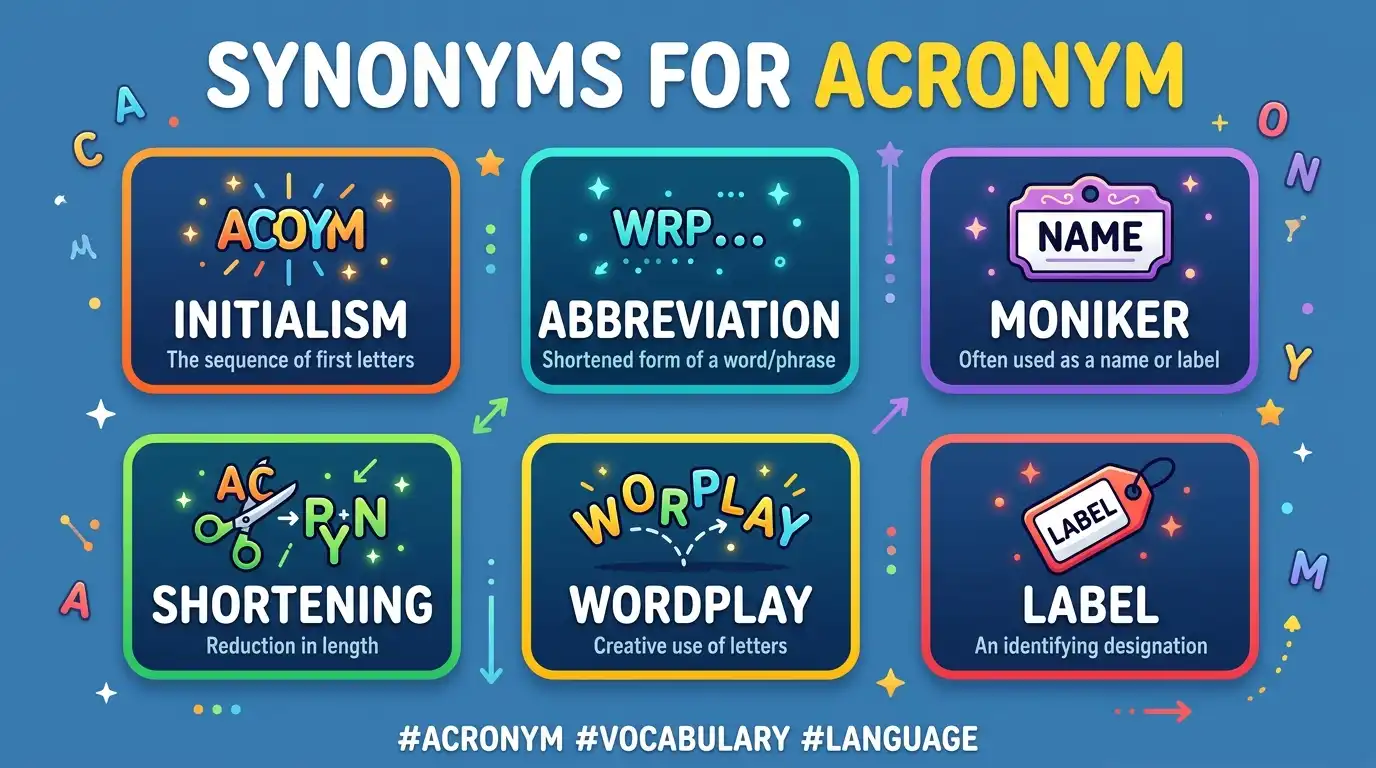
Searching for clear synonyms for acronym helps you vary your word choice and avoid repetitive language. Knowing proper synonyms for acronym allows you to explain shortened terms easily in academic, technical, or creative writing. When you understand different synonyms for acronym, you can choose the exact term needed for any context.
Imagine sitting in a fast-paced team meeting where someone suddenly shouts out, “Send that report ASAP to the CEO before our KPI meeting!” Your brain quickly translates those quick letter groupings into full ideas. An acronym is simply a single word made from the first letters of a longer group of words, like NASA or RADAR. Finding synonyms for acronym gives you fresh ways to describe these handy shortcuts. In simple terms, an acronym is a shortened word built from first letters that you pronounce as a single word. Learning synonyms for acronym helps students write clearer essays, bloggers keep their content lively, content writers avoid repetitive jargon, and daily English speakers communicate with precision. Using varied synonyms for acronym makes every piece of text feel polished and engaging.
“Words are lens to focus one’s mind.” — Ayn Rand
“The limits of my language mean the limits of my world.” — Ludwig Wittgenstein
Linguistic Details of “Acronym”
- Connotative Meaning: “Acronym” carries a practical, modern, and efficient connotation. It suggests speed, conciseness, and structured technical communication.
- Etymology:
- Origin: Derived from modern Greek elements in the 1940s.
- Prefix: Acro- (from Greek akros meaning “top,” “tip,” or “beginning”).
- Suffix: -nym (from Greek onyma meaning “name”).
- Pronunciation of “Acronym”:
- US IPA: /ˈæk.rə.nɪm/
- UK IPA: /ˈæk.rə.nɪm/
- Syllables: 3 syllables (Ac-ro-nym)
- Affixation Pattern: Root-based compound combining the prefix acro- with the noun root -nym.
Comparison Table of Key Related Terms
| Keyword / Synonym | Meaning | Usage Type | Context |
| Acronym | A word formed from initial letters and spoken as a word (e.g., NASA). | Professional / General | Workplace, Science, Tech |
| Initialism | A group of initial letters spoken letter by letter (e.g., FBI). | Formal / Technical | Government, Media, Law |
| Abbreviation | Any shortened form of a word or phrase. | General / Daily | Everyday writing, Texting |
| Shorthand | A rapid method of writing using symbols or abbreviations. | Casual / Practical | Note-taking, Office work |
| Monogram | A motif made by combining two or more letters. | Artistic / Personal | Branding, Design, Stationery |
| Cryptonym | A code name used to hide an identity. | Specialized / Formal | Intelligence, Security, Fiction |
50 Synonyms for Acronym
1. Abbreviation
- Pronunciation: US: /əˌbriː.viˈeɪ.ʃən/ | UK: /əˌbriː.viˈeɪ.ʃən/
- Meaning: A short form of a word or phrase.
- Examples:
- Dr. is a common abbreviation for doctor.
- She used an abbreviation to save space on the form.
2. Initialism
- Pronunciation: US: /ɪˈnɪʃ.əl.ɪ.zəm/ | UK: /ɪˈnɪʃ.əl.ɪ.zəm/
- Meaning: Short terms formed from first letters where each letter is named out loud.
- Examples:
- FBI is an initialism because you say each letter.
- The teacher explained the difference between an acronym and an initialism.
3. Short Form
- Pronunciation: US: /ʃɔːrt fɔːrm/ | UK: /ʃɔːt fɔːm/
- Meaning: A brief way to write a longer phrase.
- Examples:
- App is the short form for application.
- Please write the short form of your state name.
4. Shortening
- Pronunciation: US: /ˈʃɔːrt.nɪŋ/ | UK: /ˈʃɔːt.nɪŋ/
- Meaning: A word that has been made shorter.
- Examples:
- Math is a simple shortening of mathematics.
- The article used a quick shortening for the long product name.
5. Monogram
- Pronunciation: US: /ˈmɑː.nə.ɡræm/ | UK: /ˈmɒn.ə.ɡræm/
- Meaning: A decorative design made from initial letters.
- Examples:
- Her bag features a stylish gold monogram.
- They printed our monogram on the wedding invitations.
6. Cipher
- Pronunciation: US: /ˈsaɪ.fɚ/ | UK: /ˈsaɪ.fə/
- Meaning: A secret or coded way of writing letters.
- Examples:
- The secret agent decoded the mysterious cipher.
- Each symbol in the cipher stood for a real letter.
7. Contraction
- Pronunciation: US: /kənˈtræk.ʃən/ | UK: /kənˈtræk.ʃən/
- Meaning: Two words combined into one short word using an apostrophe.
- Examples:
- Don’t is a common contraction for do not.
- You can use a contraction to make speech sound natural.
8. Symbol
- Pronunciation: US: /ˈsɪm.bəl/ | UK: /ˈsɪm.bəl/
- Meaning: A mark or letter used to represent something else.
- Examples:
- The chemical symbol for gold is Au.
- A dollar sign is a useful symbol for money.
9. Code
- Pronunciation: US: /koʊd/ | UK: /kəʊd/
- Meaning: A set of letters or words used to represent information.
- Examples:
- The team used a letter code to label the files.
- Please enter the security code on the keypad.
10. Key
- Pronunciation: US: /kiː/ | UK: /kiː/
- Meaning: A word or set of signs that explains shortened terms.
- Examples:
- Look at the map key to read the symbols correctly.
- The chart includes a key for all shortened titles.
11. Designator
- Pronunciation: US: /ˈdez.ɪɡ.neɪ.t̬ɚ/ | UK: /ˈdez.ɪɡ.neɪ.tə/
- Meaning: A code or letter group that identifies a specific item.
- Examples:
- Flight 402 is the official designator for our plane.
- The army uses a designator for each base unit.
12. Label
- Pronunciation: US: /ˈleɪ.bəl/ | UK: /ˈleɪ.bəl/
- Meaning: A brief name or sign attached to something.
- Examples:
- Each box has a clear letter label on the side.
- The report put a short label on the graphic.
13. Tag
- Pronunciation: US: /tæɡ/ | UK: /tæɡ/
- Meaning: A short label used for quick tracking or identification.
- Examples:
- Put a price tag on every new store item.
- Digital photos often carry a descriptive tag.
14. Term
- Pronunciation: US: /tɝːm/ | UK: /tɜːm/
- Meaning: A specific word or expression used in a subject.
- Examples:
- RAM is a technical term used in computing.
- The doctor explained the medical term clearly.
15. Word-symbol
- Pronunciation: US: /wɝːd ˈsɪm.bəl/ | UK: /wɜːd ˈsɪm.bəl/
- Meaning: A symbol that functions directly as a full word.
- Examples:
- The ampersand sign acts as a simple word-symbol for and.
- A new word-symbol was created for the brand logo.
16. Title
- Pronunciation: US: /ˈtaɪ.t̬əl/ | UK: /ˈtaɪ.təl/
- Meaning: A name given to a person, job, or document.
- Examples:
- CEO is a corporate title for a top executive.
- Write your job title at the top of the resume.
17. Name
- Pronunciation: US: /neɪm/ | UK: /neɪm/
- Meaning: The word used to identify a person, place, or thing.
- Examples:
- NASA is the popular name for the space agency.
- We chose a short name for our new company project.
18. Identifier
- Pronunciation: US: /aɪˈden.t̬ə.faɪ.ɚ/ | UK: /aɪˈden.tɪ.faɪ.ə/
- Meaning: A letter set or sign that shows who or what something is.
- Examples:
- Your tax number serves as a personal identifier.
- The system creates a unique identifier for every user.
19. Sign
- Pronunciation: US: /saɪn/ | UK: /saɪn/
- Meaning: A mark or letter representing a meaning.
- Examples:
- The plus sign shows you need to add numbers.
- Traffic police used a hand sign to direct cars.
20. Representation
- Pronunciation: US: /ˌrep.rɪ.zenˈteɪ.ʃən/ | UK: /ˌrep.rɪ.zenˈteɪ.ʃən/
- Meaning: Something that stands for something else.
- Examples:
- The flag is a representation of the country.
- These letters are a simple representation of a longer rule.
“Precision of language is at the core of effective communication.” — Edwin Newman
21. Brevity
- Pronunciation: US: /ˈbrev.ə.t̬i/ | UK: /ˈbrev.ə.ti/
- Meaning: The use of few words to say something.
- Examples:
- The editor praised the brevity of the news headline.
- We appreciated the brevity of his clear presentation.
22. Cut-down Word
- Pronunciation: US: /kʌt daʊn wɝːd/ | UK: /kʌt daʊn wɜːd/
- Meaning: An informal phrase for a shortened word.
- Examples:
- Phone is a cut-down word for telephone.
- Kids often use a cut-down word when texting friends.
23. Condensed Word
- Pronunciation: US: /kənˈdenst wɝːd/ | UK: /kənˈdenst wɜːd/
- Meaning: A word made compact by removing parts.
- Examples:
- Email is a condensed word formed from electronic mail.
- The book used a condensed word to save page space.
24. Compressed Word
- Pronunciation: US: /kəmˈprest wɝːd/ | UK: /kəmˈprest wɜːd/
- Meaning: A phrase squeezed into a single brief term.
- Examples:
- Modem is a compressed word built from modular components.
- Engineers created a compressed word for the complex part.
25. Truncation
- Pronunciation: US: /trʌŋˈkeɪ.ʃən/ | UK: /trʌŋˈkeɪ.ʃən/
- Meaning: The act of cutting off the end of a word.
- Examples:
- Info is a truncation of the word information.
- Word processors use truncation to create search tags.
26. Summary Word
- Pronunciation: US: /ˈsʌm.ɚ.i wɝːd/ | UK: /ˈsʌm.ər.i wɜːd/
- Meaning: A single word that sums up a long title.
- Examples:
- STEM acts as a summary word for science and math fields.
- The writer created a summary word for the article headline.
27. Quick-word
- Pronunciation: US: /kwɪk wɝːd/ | UK: /kwɪk wɜːd/
- Meaning: A fast, casual term used instead of a long phrase.
- Examples:
- RSVP is a handy quick-word for event responses.
- Let’s use a quick-word during our speech rehearsal.
28. Speed-term
- Pronunciation: US: /spiːd tɝːm/ | UK: /spiːd tɜːm/
- Meaning: A rapid shortened term used for fast communication.
- Examples:
- Gamers use a speed-term like GG to say good game.
- The chat room was full of helpful speed-term choices.
29. Letter-code
- Pronunciation: US: /ˈlet.ɚ koʊd/ | UK: /ˈlet.ə kəʊd/
- Meaning: A combination of letters used as a signal or name.
- Examples:
- Airport designations use a three-letter letter-code.
- Check the product letter-code on the back label.
30. Lettering
- Pronunciation: US: /ˈlet.ɚ.ɪŋ/ | UK: /ˈlet.ər.ɪŋ/
- Meaning: A set of printed or written letters.
- Examples:
- The jersey featured bold gold lettering on the back.
- Clear lettering makes signs easy to read from far away.
31. Cryptonym
- Pronunciation: US: /ˈkrɪp.tə.nɪm/ | UK: /ˈkrɪp.tə.nɪm/
- Meaning: A secret code word used to hide a real identity.
- Examples:
- The spy operated under a classified cryptonym.
- Historians revealed the real name behind the cold war cryptonym.
32. Pseudonym
- Pronunciation: US: /ˈsuː.də.nɪm/ | UK: /ˈsjuː.də.nɪm/
- Meaning: A fictitious name used by an author or public figure.
- Examples:
- Mark Twain was the famous pseudonym of Samuel Clemens.
- She published her fantasy novels under a fun pseudonym.
33. Handles
- Pronunciation: US: /ˈhæn.dəlz/ | UK: /ˈhæn.dəlz/
- Meaning: Informal short names used online or on radios.
- Examples:
- Social media users choose memorable online handles.
- CB radio operators communicated using custom handles.
34. Alias
- Pronunciation: US: /ˈeɪ.li.əs/ | UK: /ˈeɪ.li.əs/
- Meaning: An assumed name used in place of an original name.
- Examples:
- The detective tracked the suspect’s internet alias.
- He traveled across the border using an official alias.
35. Nickname
- Pronunciation: US: /ˈnɪk.neɪm/ | UK: /ˈnɪk.neɪm/
- Meaning: A familiar or humorous short name given to someone.
- Examples:
- Alex is a friendly nickname for Alexander.
- Her fast running earned her the nickname Flash.
36. Shorthand
- Pronunciation: US: /ˈʃɔːrt.hænd/ | UK: /ˈʃɔːt.hænd/
- Meaning: A fast method of writing using short symbols or letters.
- Examples:
- Journalists take notes in shorthand during live trials.
- Texting slang has become a modern shorthand for youth.
37. Call Sign
- Pronunciation: US: /kɑːl saɪn/ | UK: /kɔːl saɪn/
- Meaning: A set of letters and numbers identifying a radio station or pilot.
- Examples:
- The pilot confirmed his call sign over the radio system.
- The radio station announced its official call sign on air.
38. Designation
- Pronunciation: US: /ˌdez.ɪɡˈneɪ.ʃən/ | UK: /ˌdez.ɪɡˈneɪ.ʃən/
- Meaning: An official name or letter code assigned to something.
- Examples:
- The highway has a new federal designation.
- They gave the new hospital wing a special designation.
39. Marker
- Pronunciation: US: /ˈmɑːr.kɚ/ | UK: /ˈmɑː.kə/
- Meaning: A sign or word that shows a specific position or identity.
- Examples:
- DNA testing uses a genetic marker to trace history.
- The map places a red marker over city capitals.
40. Brand-name Abbreviation
- Pronunciation: US: /brænd neɪm əˌbriː.viˈeɪ.ʃən/ | UK: /brænd neɪm əˌbriː.viˈeɪ.ʃən/
- Meaning: A short corporate name derived from initial letters.
- Examples:
- IBM is a famous brand-name abbreviation.
- The company registered its brand-name abbreviation worldwide.
41. Compact Term
- Pronunciation: US: /ˈkɑːm.pækt tɝːm/ | UK: /ˈkɒm.pækt tɜːm/
- Meaning: A brief, efficient word that replaces a long expression.
- Examples:
- Scuba is a compact term for underwater diving gear.
- The manual used a compact term for easy reading.
42. Letter-combination
- Pronunciation: US: /ˈlet.ɚ kɑːm.bəˈneɪ.ʃən/ | UK: /ˈlet.ə kɒm.bɪˈneɪ.ʃən/
- Meaning: A group of letters combined to form a unit.
- Examples:
- Enter the correct letter-combination to unlock the software.
- The password requires a six-character letter-combination.
43. Shortened Word
- Pronunciation: US: /ˈʃɔːrt.ənd wɝːd/ | UK: /ˈʃɔːt.ənd wɜːd/
- Meaning: A full word that has been reduced in length.
- Examples:
- Auto is a shortened word for automobile.
- Students prefer using a shortened word during fast lectures.
44. Phonetic Shortened Term
- Pronunciation: US: /fəˈnet.ɪk ˈʃɔːrt.ənd tɝːm/ | UK: /fəˈnet.ɪk ˈʃɔːt.ənd tɜːm/
- Meaning: A reduced phrase pronounced exactly as it is spelled.
- Examples:
- Radar serves as a phonetic shortened term in science.
- Laser is another classic phonetic shortened term.
45. Letter-group
- Pronunciation: US: /ˈlet.ɚ ɡruːp/ | UK: /ˈlet.ə ɡruːp/
- Meaning: A cluster of letters standing together.
- Examples:
- Match each letter-group with its correct description.
- The code consists of a four-letter letter-group.
46. Acrostic
- Pronunciation: US: /əˈkrɑː.stɪk/ | UK: /əˈkrɒs.tɪk/
- Meaning: A composition where first letters in lines form a word.
- Examples:
- The children wrote an acrostic poem using their names.
- Memory tricks often rely on a simple acrostic pattern.
47. Word-head
- Pronunciation: US: /wɝːd hed/ | UK: /wɜːd hed/
- Meaning: The leading letter or main word element used in shortcuts.
- Examples:
- Focus on the word-head of each phrase to memorize them.
- The index listed each term under its primary word-head.
48. Initialed Word
- Pronunciation: US: /ɪˈnɪʃ.əld wɝːd/ | UK: /ɪˈnɪʃ.əld wɜːd/
- Meaning: A word constructed directly out of individual initials.
- Examples:
- SWAT is an initialed word used by law enforcement.
- The group formed an initialed word for their charity name.
49. Micro-term
- Pronunciation: US: /ˈmaɪ.kroʊ tɝːm/ | UK: /ˈmaɪ.krəʊ tɜːm/
- Meaning: A very small, condensed word choice.
- Examples:
- Micro-term usage is rising fast on mobile apps.
- Tech blogs use a micro-term to fit social media limits.
50. Slang-shortener
- Pronunciation: US: /slæŋ ˈʃɔːrt.nɚ/ | UK: /slæŋ ˈʃɔːt.nə/
- Meaning: A casual shortened word used in informal chat.
- Examples:
- LOL is a popular slang-shortener used in text messaging.
- Online games feature many slang-shortener terms.
Antonyms of “Acronym”
Understanding opposite terms helps highlight what an acronym is not:
- Full Phrase: The complete, unabbreviated multi-word expression (e.g., “National Aeronautics and Space Administration” instead of NASA).
- Unabbreviated Term: A word or title written out completely without dropping any letters.
- Expanded Form: The full text explanation written out completely for clarity.
- Long-form Title: The formal, unabridged title of an institution or concept.
Prototype Meaning and Categorization of “Acronym”
- Prototype Meaning: In cognitive linguistics, the prototypical “acronym” is a word formed from the initial letters of a phrase that is pronounced as a single continuous word (such as NASA, RADAR, or SCUBA), rather than as individual letters.
- Categorization Hierarchy:
- Superordinate (Broader Category): Lexical Units / Abbreviations / Linguistic Formations.
- Basic Level (Target Concept): Acronym.
- Subordinate (Specific Categories):
- Pronounceable Acronyms: Words spoken like normal lexical items (e.g., NATO, OPEC).
- Recursive Acronyms: Acronyms that refer to themselves (e.g., VISA standing for VISA International Service Association).
- Acrophonic Terms: Terms created specifically so the resulting word spells a familiar, meaningful term (e.g., BASIC).
Frequently Asked Questions (FAQs)
What is the main difference between an acronym and an initialism?
An acronym is pronounced as a single word (like NASA or LASER). An initialism is spoken letter by letter (like FBI, CEO, or USA).
What are the most common synonyms for acronym?
The most common synonyms include abbreviation, initialism, short form, shortening, and shorthand.
Can an acronym be considered an abbreviation?
Yes, abbreviation is an umbrella term. All acronyms are abbreviations, but not all abbreviations are acronyms.
How do I know which synonym for acronym to use?
Choose based on your context. Use initialism for letter-by-letter terms, monogram for artistic initials, shorthand for quick notes, and abbreviation for general writing.
Why do writers use acronyms and their synonyms in content?
Writers use these terms to avoid repeating long phrases, save screen space, improve reading speed, and keep language concise.
Conclusion
Mastering a variety of synonyms for acronym significantly improves your daily writing, blogging, speaking, and digital communication skills. Expanding your vocabulary allows you to describe technical terms with exact precision rather than relying on repetitive language. When you choose the right word—whether it is an initialism, abbreviation, shorthand, or monogram—you communicate your ideas faster and far more clearly.
We encourage you to practice these terms in your everyday emails, academic essays, and daily work conversations. Next time you edit a document or craft a blog post, try swapping out generic terms for precise vocabulary. Your readers will appreciate the clarity and smooth flow of your language.
“Good words are worth much, and cost little.” — George Herbert
“The secret of effective writing is simplification.” — Zinsser