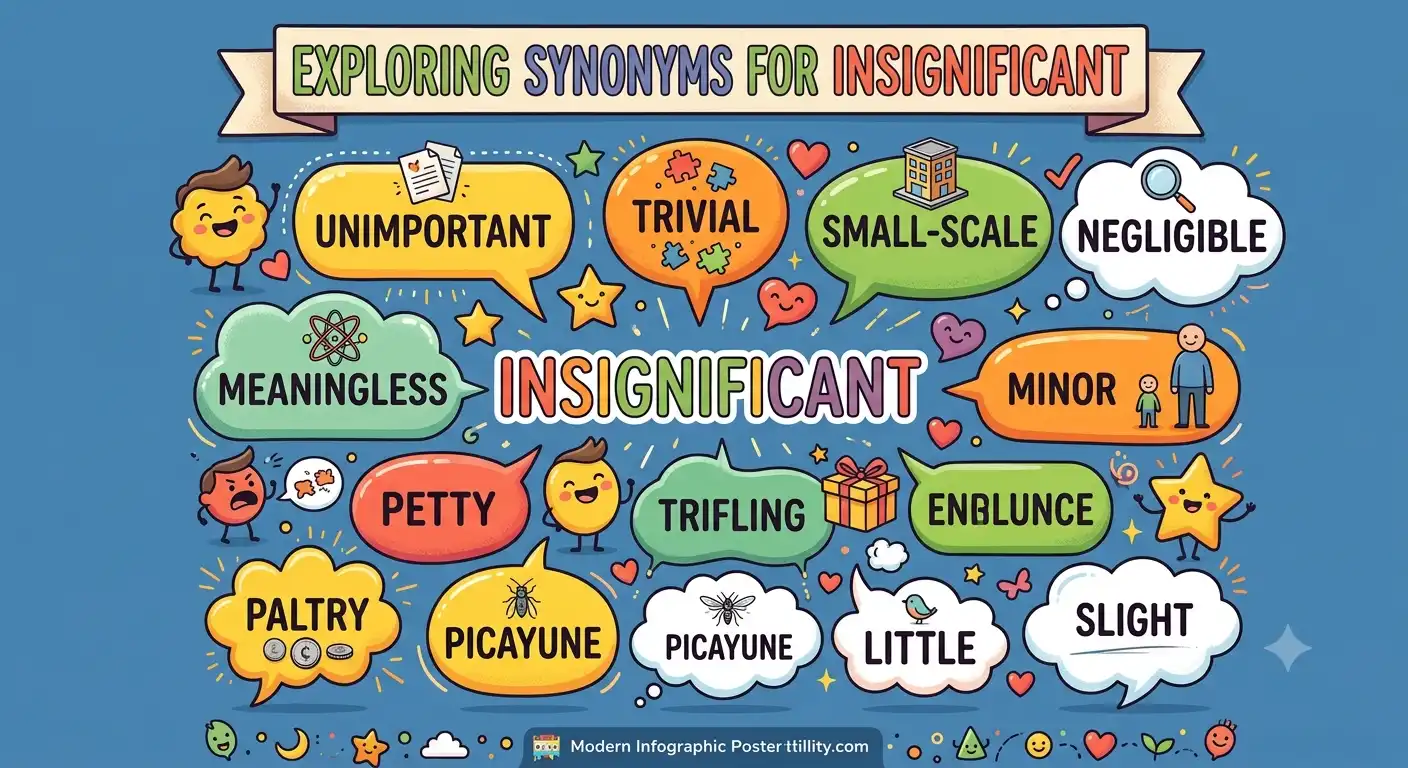
Finding the right synonyms for insignificant can completely transform your writing and vocabulary. When something lacks importance, size, or impact, using exact synonyms for insignificant allows you to describe it with clarity. Exploring different synonyms for insignificant helps you express small details, tiny errors, or minor events with perfect tone and context.
Imagine sitting down to grade a paper or edit an important work email. You want to describe a tiny, unimportant mistake without sounding harsh or repeating the same basic words. Words have power, and selecting the right word can change a plain sentence into a precise statement. For example, calling a minor delay “insignificant” works fine, but calling it “negligible” or “trivial” instantly paints a clearer picture for your reader.
What Does “Insignificant” Mean?
In plain English, insignificant means something is too small, weak, or unimportant to matter. It describes things that do not make a big difference in a situation.
Why Learn Synonyms for Insignificant?
- Students: Boost your essay scores by replacing generic words with advanced academic vocabulary.
- Bloggers: Keep your readers engaged by avoiding repetitive phrasing in long articles.
- Content Writers: Enhance SEO performance and match exact search intent with varied wording.
- Daily English Users: Express subtle differences in emotion, size, and priority in everyday conversations.
“The difference between the almost right word and the right word is really a large matter—’tis the difference between the lightning bug and the lightning.”
“Words are, in my not-so-humble opinion, our most inexhaustible source of magic.”
Word Profile: Insignificant
Connotative Meaning
The word insignificant carries a neutral to slightly negative connotation. It implies that something lacks value, power, weight, or influence. In social contexts, calling a person’s efforts “insignificant” can feel dismissive or disrespectful, whereas calling a numeric difference “insignificant” is objective and analytical.
Etymology (Short Breakdown)
- Prefix: in- (Latin: “not” or “opposite of”)
- Root: significans (Latin: “meaningful” or “showing”)
- Origin: Came into Middle English from Late Latin insignificans via French in the 17th century.
Pronunciation
- US IPA: /ˌɪn.sɪɡˈnɪf.ɪ.kənt/
- UK IPA: /ˌɪn.sɪɡˈnɪf.ɪ.kənt/
Linguistic Properties
- Syllables: 5 (in-sig-nif-i-cant)
- Affixation Pattern: Prefix (in-) + Root (signific) + Suffix (-ant)
Comparison Table: Top Synonyms at a Glance
| Keyword | Simple Meaning | Usage Type | Context |
| Insignificant | Not important or noticeable | Neutral / Formal | General, Data, Daily Life |
| Trivial | Very small and not worth worrying about | Casual / Informal | Opinions, Arguments, Details |
| Negligible | So small that it can be safely ignored | Professional / Technical | Statistics, Science, Finance |
| Minor | Small in size, extent, or importance | Neutral / Standard | Rules, Injuries, Changes |
| Paltry | Very small in amount and disappointing | Emotional / Expressive | Money, Wages, Gifts |
| Petty | Unimportant and narrow-minded | Emotional / Casual | Arguments, Rules, Jealousy |
| Slight | Small in degree or amount | Neutral / Formal | Differences, Changes, Delay |
| Inconsequential | Having no real effect or outcome | Professional / Academic | Results, Decisions, Errors |
50 Synonyms for Insignificant
1. Trivial
- Pronunciation: US /ˈtrɪv.i.əl/ | UK /ˈtrɪv.i.əl/
- Meaning: Something that is small and not important at all.
- Examples:
- They spent hours arguing over a trivial matter.
- Don’t waste your energy on trivial details today.
2. Negligible
- Pronunciation: US /ˈneɡ.lɪ.dʒə.bəl/ | UK /ˈneɡ.lɪ.dʒə.bəl/
- Meaning: So tiny that you can safely ignore it.
- Examples:
- The damage to the car was negligible after the bump.
- The price difference between the two items is negligible.
3. Minor
- Pronunciation: US /ˈmaɪ.nɚ/ | UK /ˈmaɪ.nər/
- Meaning: Small in size, importance, or seriousness.
- Examples:
- She suffered a minor scratch on her elbow.
- We made a few minor changes to the plan.
4. Inconsequential
- Pronunciation: US /ɪnˌkɑːn.səˈkwen.ʃəl/ | UK /ɪnˌkɒn.sɪˈkwen.ʃəl/
- Meaning: Having no important result or effect.
- Examples:
- His mistake was inconsequential to the final outcome.
- They discussed inconsequential topics during dinner.
5. Paltry
- Pronunciation: US /ˈpɑːl.tri/ | UK /ˈpɔːl.tri/
- Meaning: An amount that is very small and disappointing.
- Examples:
- He received a paltry tip for his hard work.
- The store offered a paltry discount on the shirt.
6. Petty
- Pronunciation: US /ˈpet.i/ | UK /ˈpet.i/
- Meaning: Unimportant and often related to small complaints.
- Examples:
- Try to ignore petty gossip at the office.
- They had a petty fight over who used the mug.
7. Slight
- Pronunciation: US /slaɪt/ | UK /slaɪt/
- Meaning: Small in amount or degree.
- Examples:
- There is a slight chance of rain this afternoon.
- I felt a slight pain in my knee.
8. Unimportant
- Pronunciation: US /ˌʌn.ɪmˈpɔːr.tənt/ | UK /ˌʌn.ɪmˈpɔː.tənt/
- Meaning: Not having value, meaning, or impact.
- Examples:
- The news focused on unimportant celebrity updates.
- Keep your speech focused and cut unimportant facts.
9. Trifle
- Pronunciation: US /ˈtraɪ.fəl/ | UK /ˈtraɪ.fəl/
- Meaning: A thing that has very little value or meaning.
- Examples:
- Why worry about such a small trifle?
- He spent his remaining money on a cheap trifle.
10. Meager
- Pronunciation: US /ˈmiː.ɡɚ/ | UK /ˈmiː.ɡər/
- Meaning: Lacking in quantity, quality, or richness.
- Examples:
- The traveler ate a meager meal of bread and cheese.
- They survived on a meager income for years.
11. Minimal
- Pronunciation: US /ˈmɪn.ə.məl/ | UK /ˈmɪn.ɪ.məl/
- Meaning: The smallest amount possible or required.
- Examples:
- The job requires minimal effort each morning.
- We made minimal adjustments to the final budget.
12. Immaterial
- Pronunciation: US /ˌɪm.əˈtɪr.i.əl/ | UK /ˌɪm.əˈtɪə.ri.əl/
- Meaning: Not important or relevant to the main subject.
- Examples:
- The color of the box is immaterial to what is inside.
- Her age is immaterial to her skill as an artist.
13. Unappreciable
- Pronunciation: US /ˌʌn.əˈpriː.ʃə.bəl/ | UK /ˌʌn.əˈpriː.ʃə.bəl/
- Meaning: Too small to be noticed or measured.
- Examples:
- There was an unappreciable change in the room temperature.
- The noise level showed an unappreciable drop.
14. Imperceptible
- Pronunciation: US /ˌɪm.pɚˈsep.tə.bəl/ | UK /ˌɪm.pəˈsep.tə.bəl/
- Meaning: Almost impossible to see, hear, or feel.
- Examples:
- She gave an imperceptible nod of agreement.
- The shadow moved with an imperceptible speed.
15. Inappreciable
- Pronunciation: US /ˌɪn.əˈpriː.ʃə.bəl/ | UK /ˌɪn.əˈpriː.ʃə.bəl/
- Meaning: So tiny that it cannot be calculated or valued.
- Examples:
- The growth rate was inappreciable this quarter.
- The distinction between the two options is inappreciable.
16. Marginal
- Pronunciation: US /ˈmɑːr.dʒɪ.nəl/ | UK /ˈmɑː.dʒɪ.nəl/
- Meaning: Small and close to the lower limit of usefulness.
- Examples:
- We noticed a marginal gain in our study test scores.
- The team made a marginal improvement this week.
17. Secondary
- Pronunciation: US /ˈsek.ən.der.i/ | UK /ˈsek.ən.dri/
- Meaning: Less important than the primary thing.
- Examples:
- Price is a secondary concern when safety is at risk.
- Her main goal was learning; winning was secondary.
18. Nonessential
- Pronunciation: US /ˌnɑːn.ɪˈsen.ʃəl/ | UK /ˌnɒn.ɪˈsen.ʃəl/
- Meaning: Not completely necessary for success or survival.
- Examples:
- Pack light and leave nonessential items at home.
- The store closed all nonessential departments today.
19. Irrelevant
- Pronunciation: US /ɪˈrel.ə.vənt/ | UK /ɪˈrel.ə.vənt/
- Meaning: Not related to the topic being discussed.
- Examples:
- That point is irrelevant to our main conversation.
- Please remove all irrelevant details from your paper.
20. Worthless
- Pronunciation: US /ˈwɝːθ.ləs/ | UK /ˈwɜːθ.ləs/
- Meaning: Having no real value, use, or merit.
- Examples:
- An old ticket stub is usually worthless after the game.
- Without accurate facts, the advice is worthless.
21. Meaningless
- Pronunciation: US /ˈmiː.nɪŋ.ləs/ | UK /ˈmiː.nɪŋ.ləs/
- Meaning: Having no purpose, sense, or importance.
- Examples:
- Empty promises are completely meaningless.
- The symbol was meaningless to the foreign tourist.
22. Ineffective
- Pronunciation: US /ˌɪn.əˈfek.tɪv/ | UK /ˌɪn.ɪˈfek.tɪv/
- Meaning: Not producing any significant or desired result.
- Examples:
- The old law was ineffective in stopping crime.
- This medicine proved ineffective against the cough.
23. Pointless
- Pronunciation: US /ˈpɔɪnt.ləs/ | UK /ˈpɔɪnt.ləs/
- Meaning: Having no clear purpose or sensible goal.
- Examples:
- It is pointless to argue over spilt milk.
- We left the movie because the plot was pointless.
“Proper words in proper places, make the true definition of a style.”
24. Trifling
- Pronunciation: US /ˈtraɪ.flɪŋ/ | UK /ˈtraɪ.flɪŋ/
- Meaning: Small and lacking worth or importance.
- Examples:
- She refused to worry over such trifling sums of money.
- A trifling error did not ruin the overall project.
25. Picayune
- Pronunciation: US /ˌpɪk.əˈjuːn/ | UK /ˌpɪk.əˈjuːn/
- Meaning: Very petty or trivial in nature.
- Examples:
- The reviewer made several picayune criticisms of the book.
- Stop focusing on picayune details and look at the big picture.
26. Diddly
- Pronunciation: US /ˈdɪd.li/ | UK /ˈdɪd.li/
- Meaning: Extremely small or practically nothing (informal).
- Examples:
- He knows diddly about how to repair cars.
- The coupon saved us next to diddly on the meal.
27. Measly
- Pronunciation: US /ˈmiː.zəl.i/ | UK /ˈmiː.zəl.i/
- Meaning: Small and shockingly inadequate.
- Examples:
- They offered a measly two-dollar pay raise.
- I only got a measly slice of cake at the party.
28. Tiny
- Pronunciation: US /ˈtaɪ.ni/ | UK /ˈtaɪ.ni/
- Meaning: Very small in physical size or amount.
- Examples:
- A tiny bug crawled across the kitchen desk.
- There is a tiny hole in the left sleeve.
29. Puny
- Pronunciation: US /ˈpjuː.ni/ | UK /ˈpjuː.ni/
- Meaning: Small, weak, and unimpressive.
- Examples:
- The young plant looked puny beside the massive oak tree.
- His efforts produced a puny result.
30. Minute
- Pronunciation: US /maɪˈnuːt/ | UK /maɪˈnjuːt/
- Meaning: Extremely small in size or degree.
- Examples:
- The scientist carefully examined the minute organisms.
- There were only minute differences between the prints.
31. Microscopic
- Pronunciation: US /ˌmaɪ.krəˈskɑː.pɪk/ | UK /ˌmaɪ.krəˈskɒp.ɪk/
- Meaning: So tiny it can only be seen with a microscope.
- Examples:
- The tear in the fabric was almost microscopic.
- Bacteria are microscopic living creatures.
32. Insubstantial
- Pronunciation: US /ˌɪn.səbˈstæn.ʃəl/ | UK /ˌɪn.səbˈstæn.ʃəl/
- Meaning: Lacking strength, substance, or solid truth.
- Examples:
- The evidence against the suspect was insubstantial.
- They built an insubstantial fence that fell over.
33. Flimsy
- Pronunciation: US /ˈflɪm.zi/ | UK /ˈflɪm.zi/
- Meaning: Weak, thin, and easily broken or doubted.
- Examples:
- He offered a flimsy excuse for missing class.
- The box was too flimsy to hold heavy books.
34. Small-time
- Pronunciation: US /ˈsmɑːl.taɪm/ | UK /ˈsmɔːl.taɪm/
- Meaning: Operating on a minor scale without big success.
- Examples:
- He started as a small-time actor in local plays.
- The shop was run by a small-time business owner.
35. Lightweight
- Pronunciation: US /ˈlaɪt.weɪt/ | UK /ˈlaɪt.weɪt/
- Meaning: Lacking depth, serious meaning, or authority.
- Examples:
- The movie was a lightweight comedy for summer.
- Critics dismissed his book as lightweight journalism.
36. Unnoticeable
- Pronunciation: US /ʌnˈnoʊ.t̬ɪ.sə.bəl/ | UK /ʌnˈnəʊ.tɪ.sə.bəl/
- Meaning: Hard to spot or pay attention to.
- Examples:
- The stain was small and almost unnoticeable.
- She made an unnoticeable movement toward the door.
37. Zero-value
- Pronunciation: US /ˈzɪr.oʊ ˈvæl.juː/ | UK /ˈzɪə.rəʊ ˈvæl.juː/
- Meaning: Worth nothing at all in market or use.
- Examples:
- Expired paper coupons hold zero-value today.
- The old code was of zero-value to developers.
38. Fiddling
- Pronunciation: US /ˈfɪd.lɪŋ/ | UK /ˈfɪd.lɪŋ/
- Meaning: Small, annoyance-causing, and unimportant.
- Examples:
- Don’t spend all afternoon on fiddling tasks.
- It was a fiddling sum of money to worry about.
39. Peanuts
- Pronunciation: US /ˈpiː.nʌts/ | UK /ˈpiː.nʌts/
- Meaning: A tiny, laughable amount of money (slang).
- Examples:
- He works ten hours a day for peanuts.
- The company sold the old furniture for peanuts.
40. Banal
- Pronunciation: US /bəˈnɑːl/ | UK /bəˈnɑːl/
- Meaning: So lacking in originality as to be boring and clear.
- Examples:
- The film had a banal plot that everyone predicted.
- He made banal comments about the rainy weather.
41. Hollow
- Pronunciation: US /ˈhɑː.loʊ/ | UK /ˈhɒl.əʊ/
- Meaning: Without real worth, truth, or deep meaning.
- Examples:
- They celebrated a hollow victory over weak rivals.
- His words felt hollow and insincere to her.
42. Shallow
- Pronunciation: US /ˈʃæl.oʊ/ | UK /ˈʃæl.əʊ/
- Meaning: Lacking deep thought, feeling, or real impact.
- Examples:
- The essay offered a shallow analysis of history.
- He avoided deep talks and kept discussions shallow.
43. Minimalist
- Pronunciation: US /ˈmɪn.ə.mə.lɪst/ | UK /ˈmɪn.ɪ.mə.lɪst/
- Meaning: Keeping elements to a tiny, basic minimum.
- Examples:
- The home featured a minimalist design with simple chairs.
- She preferred a minimalist routine every morning.
44. Footling
- Pronunciation: US /ˈfʊt.lɪŋ/ | UK /ˈfʊt.lɪŋ/
- Meaning: Trivial, foolish, and wasting valuable time.
- Examples:
- Stop wasting time on footling details during meetings.
- They spent the morning on footling household chores.
45. Inessential
- Pronunciation: US /ˌɪn.əˈsen.ʃəl/ | UK /ˌɪn.ɪˈsen.ʃəl/
- Meaning: Not vital for completing a project or goal.
- Examples:
- Trim all inessential expenses from your budget.
- The editor removed inessential scenes from the movie.
46. Peripheral
- Pronunciation: US /pəˈrɪf.ɚ.əl/ | UK /pəˈrɪf.ər.əl/
- Meaning: On the edge and not central or major.
- Examples:
- Keep your focus on the main goal, not peripheral issues.
- The character played a peripheral role in the story.
47. Negligible-impact
- Pronunciation: US /ˈneɡ.lɪ.dʒə.bəl ˈɪm.pækt/ | UK /ˈneɡ.lɪ.dʒə.bəl ˈɪm.pækt/
- Meaning: Causing almost no noticeable change or outcome.
- Examples:
- The new policy had a negligible-impact on sales.
- Her late vote had a negligible-impact on results.
48. Second-rate
- Pronunciation: US /ˌsek.əndˈreɪt/ | UK /ˌsek.əndˈreɪt/
- Meaning: Low in quality, standing, or value.
- Examples:
- We stayed at a second-rate hotel near the station.
- Nobody wants to buy second-rate tools for work.
49. Exiguous
- Pronunciation: US /eɡˈzɪɡ.ju.əs/ | UK /eɡˈzɪɡ.ju.əs/
- Meaning: Very small in size or amount (formal).
- Examples:
- The team tried to work with exiguous financial resources.
- Her exiguous diet left her feeling hungry.
50. Niggling
- Pronunciation: US /ˈnɪɡ.əl.ɪŋ/ | UK /ˈnɪɡ.əl.ɪŋ/
- Meaning: Persistent in a annoying, small, or petty way.
- Examples:
- He suffered from a niggling pain in his back.
- She could not silence her niggling doubts about the plan.
Antonyms of Insignificant
To understand a word fully, it helps to look at its opposites. Here are key antonyms for insignificant:
- Significant: Full of importance, meaning, or consequence.
- Crucial: Extremely important or decisive for a final success.
- Vital: Absolutely necessary or essential for life and work.
- Major: Great in size, importance, or serious effect.
- Substantial: Large in size, value, importance, or reality.
Prototype Meaning and Categorization
To master synonyms for insignificant, we can categorize them using a prototype framework based on core characteristics:
[INSIGNIFICANT]
│
┌───────────────────────┼───────────────────────┐
▼ ▼ ▼
[By Size/Amount] [By Importance] [By Value/Cost]
Tiny Trivial Paltry
Minute Minor Worthless
Microscopic Inconsequential Peanuts
Meager Irrelevant Measly
- Size and Amount Prototype: Focuses on physical scale or quantity (e.g., tiny, minute, microscopic).
- Importance and Meaning Prototype: Focuses on lack of influence, power, or relevance (e.g., trivial, inconsequential, irrelevant).
- Value and Cost Prototype: Focuses on lack of financial or emotional worth (e.g., paltry, worthless, peanuts).
Frequently Asked Questions (FAQ)
1. What is the best synonym for insignificant in business writing?
Negligible or inconsequential are usually the best choices. They sound professional and objective when describing minor errors, small budget changes, or minor delays.
2. Can “trivial” and “insignificant” be used interchangeably?
Yes, in most casual settings. However, trivial often implies that something is so minor it is foolish to pay attention to it, whereas insignificant simply describes a lack of size or importance.
3. What is a strong formal synonym for insignificant?
Exiguous or immaterial are strong formal synonyms. “Immaterial” is widely used in legal contexts, while “exiguous” is common in advanced academic writing.
4. What is a casual or slang synonym for insignificant?
Informal terms like peanuts, small-time, or diddly serve as casual synonyms in spoken English.
5. How do I choose between “minor” and “insignificant”?
Use minor when referring to a small part of a larger whole (like a minor delay). Use insignificant when something carries no weight or effect at all.
Conclusion
Building your command of synonyms for insignificant is an easy way to level up your English skills across all forms of communication. Choosing exact words helps you express ideas clearly without repeating simple terms like “small” or “unimportant.”
For bloggers and content writers, using varied synonyms for insignificant improves SEO readability, prevents word repetition, and satisfies user intent, students and daily speakers, selecting precise words makes essays more convincing and conversations more lively. Take time to practice using words like trivial, negligible, or paltry in your emails and daily writing. Small steps in vocabulary building lead to remarkable gains in clear communication!
“Word by word, page by page, picture by picture, the story takes shape.”
“Language is the dress of thought.”
“To have another language is to possess a second soul.”

Andrew Powell is a travel writer and nature journalist who has spent over a decade writing about places, landscapes, and the natural world — and thinking carefully about the words that do those subjects justice ( Biography ).