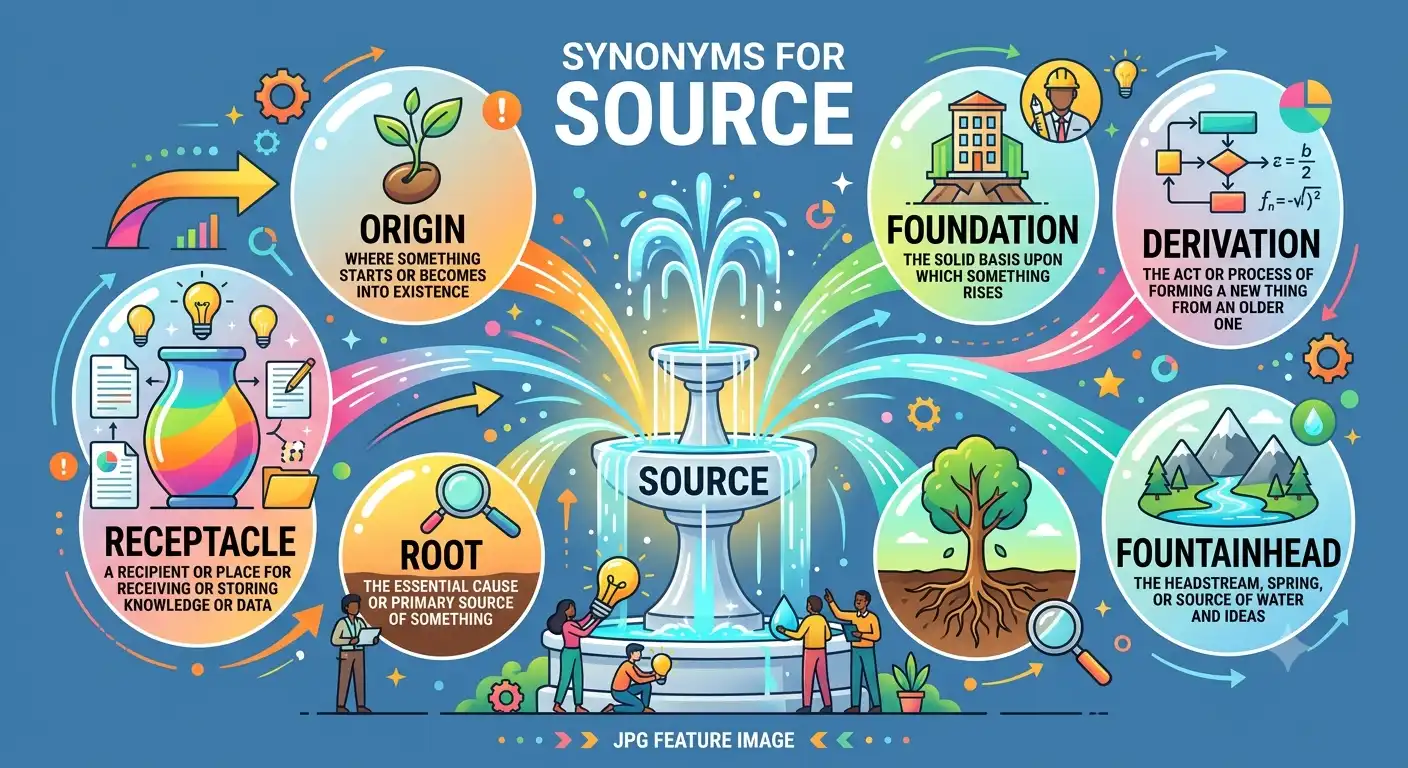
Discovering versatile synonyms for source helps you describe origins, beginnings, references, and foundations with exact clarity. Understanding various synonyms for source allows you to pinpoint where an idea starts, where information comes from, or what causes a specific event. Learning these synonyms for source gives you the precise vocabulary needed to improve research papers, creative stories, professional blogs, and daily conversations.
Finding the Origin in Research and Daily Life
Imagine writing a science report about a famous river and needing to explain where the water begins. Calling every starting point a source gets repetitive quickly, but describing it as the origin, fountainhead, or headwaters paints a clearer picture for your reader. Exploring synonyms for source gives you precise words to describe starting points, citation references, and core causes.
In very simple English, a source is the place, person, or thing where something comes from or starts.
Why Word Choice Matters for Communicators
Expanding your vocabulary with these terms offers valuable benefits across many areas:
- For Students: It helps you cite research references, explain scientific origins, and write stronger essays.
- For Bloggers: It keeps your writing fresh and helps you share information clearly with your readers.
- For Content Writers: It allows you to describe research materials, origins, and root causes with authority.
- For Daily English Users: It gives you easy, accurate words to explain where you heard news or learned something new.
“Knowledge grows when we trace ideas back to their true origins.”
“Choosing the right word allows us to explain the root of every idea with clarity.”
Linguistic Breakdown: Etymology, Connotation, and Structure
Connotative Meaning of “Source”
The word source carries a neutral, authoritative, and positive connotation. It implies authenticity, beginnings, essential supply, or foundational reference. Depending on context, its tone ranges from academic research (e.g., primary sources) to natural beginnings (e.g., spring water).
Short Etymology
- Origin: Middle English (in the sense “support” or “spring of water”).
- Root: Derived from Old French sourse (a spring, a rising), from Latin surgere (to rise).
Pronunciation
- US IPA: /sɔːrs/
- UK IPA: /sɔːs/
Syllables & Structure
- Syllables: 1 (source)
- Primary Stress: Monosyllable
- Affixation Pattern: Root word with no prefixes or suffixes.
Comparison Table: Choosing the Right Synonym for Source
| Keyword | Meaning | Usage Type | Context |
| Source | The place, person, or thing from which something comes | General / Common | Daily life, research, nature |
| Origin | The point or place where something begins | Formal / Descriptive | History, science, stories |
| Root | The deep cause or main origin of something | Practical / Deep | Problem-solving, family tree |
| Reference | A book, person, or document used for information | Academic / Formal | School papers, research |
| Spring | A natural flow of water coming from the ground | Natural / Casual | Outdoors, nature, geography |
| Fountainhead | The ultimate original source of something large | Literary / Formal | Philosophy, art, wisdom |
| Authority | A trusted expert or official book providing facts | Formal / Professional | News, law, academic research |
| Cause | A person or thing that gives rise to an action | Practical / General | Science, explanations, events |
| Genesis | The original beginning or creation of something | Formal / Literary | History, major projects |
| Supplier | A person or organization that provides goods | Business / Professional | Commerce, trade, workplace |
50 Synonyms for Source
1. Origin
- Pronunciation: US /ˈɔːr.ə.dʒɪn/ | UK /ˈɒr.ɪ.dʒɪn/
- Meaning: The starting point where something comes into existence.
- Examples:
- Scientists studied the origin of the distant mountain lake.
- She explained the origin of her favorite family tradition.
2. Root
- Pronunciation: US /ruːt/ | UK /ruːt/
- Meaning: The core cause or fundamental base of something.
- Examples:
- Hard work is the root of his success.
- We need to fix the root cause of the computer glitch.
3. Fountainhead
- Pronunciation: US /ˈfaʊn.tən.hed/ | UK /ˈfaʊn.tɪn.hed/
- Meaning: The primary or ultimate starting point of a huge idea.
- Examples:
- The library was a fountainhead of wisdom for students.
- Nature serves as a fountainhead of artistic inspiration.
4. Reference
- Pronunciation: US /ˈref.ɚ.əns/ | UK /ˈref.ər.əns/
- Meaning: A book, website, or document used for getting facts.
- Examples:
- Check your dictionary as a reliable reference for spelling.
- She included a reference link at the end of her project.
5. Spring
- Pronunciation: US /sprɪŋ/ | UK /sprɪŋ/
- Meaning: A place where water rises naturally from underground.
- Examples:
- Fresh water flowed continuously from the mountain spring.
- The quiet park was a spring of peace for nearby neighbors.
6. Beginning
- Pronunciation: US /bɪˈɡɪn.ɪŋ/ | UK /bɪˈɡɪn.ɪŋ/
- Meaning: The first part or starting time of something.
- Examples:
- The beginning of the book captured everyone’s attention.
- Spring marks the beginning of the flower season.
7. Foundation
- Pronunciation: US /faʊnˈdeɪ.ʃən/ | UK /faʊnˈdeɪ.ʃən/
- Meaning: The solid base on which something is built or supported.
- Examples:
- Trust forms the foundation of a lasting friendship.
- Reading early builds a strong foundation for learning.
8. Genesis
- Pronunciation: US /ˈdʒen.ə.sɪs/ | UK /ˈdʒen.ə.sɪs/
- Meaning: The start or original creation of a project or idea.
- Examples:
- The genesis of their club started in a small classroom.
- Her quick sketch was the genesis of a giant mural.
9. Supplier
- Pronunciation: US /səˈplaɪ.ɚ/ | UK /səˈplaɪ.ər/
- Meaning: A person or company that provides needed goods or items.
- Examples:
- The bakery buys flour from a local farm supplier.
- They called the paper supplier to reorder sketchbooks.
10. Cause
- Pronunciation: US /kɑːz/ | UK /kɔːz/
- Meaning: The reason why an event or situation happens.
- Examples:
- Heavy rain was the main cause of the sudden flood.
- Curiosity was the cause of his new discovery.
11. Wellspring
- Pronunciation: US /ˈwel.sprɪŋ/ | UK /ˈwel.sprɪŋ/
- Meaning: A continuous and abundant supply of something good.
- Examples:
- The coach was a wellspring of encouragement for the team.
- She tapped into her internal wellspring of creativity.
12. Headwaters
- Pronunciation: US /ˈhedˌwɑː.t̬ɚz/ | UK /ˈhedˌwɔː.təz/
- Meaning: The streams that form the starting point of a river.
- Examples:
- Hikers visited the icy headwaters of the Amazon River.
- Small streams join at the headwaters to make a river.
13. Derivation
- Pronunciation: US /ˌder.əˈveɪ.ʃən/ | UK /ˌder.ɪˈveɪ.ʃən/
- Meaning: The process of tracing a word or idea to its origin.
- Examples:
- The derivation of the English word comes from Old French.
- Linguistic maps show the derivation of local names.
14. Authority
- Pronunciation: US /əˈθɔːr.ə.t̬i/ | UK /ɔːˈθɒr.ə.ti/
- Meaning: A reliable expert or document trusted for facts.
- Examples:
- The scientist is an authority on weather patterns.
- You can cite this medical guide as an official authority.
15. Cradle
- Pronunciation: US /ˈkreɪ.dəl/ | UK /ˈkreɪ.dəl/
- Meaning: The place where something original first grew or developed.
- Examples:
- Greece is often called the cradle of democracy.
- The forest valley was a quiet cradle for wildlife.
16. Birthplace
- Pronunciation: US /ˈbɝːθ.pleɪs/ | UK /ˈbɜːθ.pleɪs/
- Meaning: The town or region where a person or movement began.
- Examples:
- The museum marks the birthplace of the famous inventor.
- This city is the birthplace of modern jazz music.
17. Seed
- Pronunciation: US /siːd/ | UK /siːd/
- Meaning: A tiny starting unit that grows into a big result.
- Examples:
- Her thoughtful question planted the seed of a new plan.
- A single good idea can be the seed for progress.
18. Basis
- Pronunciation: US /ˈbeɪ.sɪs/ | UK /ˈbeɪ.sɪs/
- Meaning: The main principle or ground on which something rests.
- Examples:
- Facts should form the basis of every news report.
- Respect is the basis of a good class policy.
19. Well
- Pronunciation: US /wel/ | UK /wel/
- Meaning: A deep reservoir or store of valuable resources or water.
- Examples:
- He drew from a deep well of memories for his poem.
- Villagers collected clean drinking water from the well.
20. Inception
- Pronunciation: US /ɪnˈsep.ʃən/ | UK /ɪnˈsep.ʃən/
- Meaning: The starting point or formal beginning of an organization.
- Examples:
- She has worked at the park since its inception five years ago.
- The project expanded quickly after its inception.
“Tracing information back to its source turns speculation into reliable truth.”
21. Fountain
- Pronunciation: US /ˈfaʊn.tən/ | UK /ˈfaʊn.tɪn/
- Meaning: A natural or artificial supply point releasing water or ideas.
- Examples:
- Youthful enthusiasm is a fountain of positive energy.
- Water bubbled up from the stone fountain in the yard.
22. Provider
- Pronunciation: US /prəˈvaɪ.dɚ/ | UK /prəˈvaɪ.dər/
- Meaning: A person, system, or entity that supplies something needed.
- Examples:
- The sun is our main provider of daylight and heat.
- Our internet provider restored service quickly today.
23. Provenance
- Pronunciation: US /ˈprɑː.və.nəns/ | UK /ˈprɒv.ən.əns/
- Meaning: The history of ownership or origin of a valuable object.
- Examples:
- The gallery verified the provenance of the ancient vase.
- Experts studied the paper to confirm its historical provenance.
24. Rootstock
- Pronunciation: US /ˈruːt.stɑːk/ | UK /ˈruːt.stɒk/
- Meaning: The primary underground base from which new growth springs.
- Examples:
- Gardeners grafted the apple branch onto strong rootstock.
- The traditions of the town form its cultural rootstock.
25. Mainspring
- Pronunciation: US /ˈmeɪn.sprɪŋ/ | UK /ˈmeɪn.sprɪŋ/
- Meaning: The chief cause, motive, or driving force behind something.
- Examples:
- Curiosity was the mainspring behind her scientific study.
- Hope remains the mainspring of human effort.
- Starting point
- Pronunciation: US /ˈstɑːr.t̬ɪŋ.pɔɪnt/ | UK /ˈstɑː.tɪŋ.pɔɪnt/
- Meaning: The initial step or place from which an activity begins.
- Examples:
- The trail map shows the starting point for the hike.
- Let us use this idea as a starting point for discussion.
27. Background
- Pronunciation: US /ˈbæk.ɡraʊnd/ | UK /ˈbæk.ɡraʊnd/
- Meaning: The conditions or context that explain where something comes from.
- Examples:
- Her family background inspired her love for baking.
- Reading the background notes helped us understand the story.
28. Supply
- Pronunciation: US /səˈplaɪ/ | UK /səˈplaɪ/
- Meaning: A stock or store of necessary items ready for use.
- Examples:
- The classroom kept a fresh supply of pencils and paper.
- Rainwater increased the city’s water supply.
29. Head
- Pronunciation: US /hed/ | UK /hed/
- Meaning: The top or original starting spot of a body of water.
- Examples:
- They rowed their canoe up to the head of the stream.
- A clear spring forms the head of the mountain creek.
30. Rise
- Pronunciation: US /raɪz/ | UK /raɪz/
- Meaning: The upward beginning or emergence of something new.
- Examples:
- The book covers the rise of digital technology.
- We watched the rise of the morning sun over the hills.
31. Outset
- Pronunciation: US /ˈaʊt.set/ | UK /ˈaʊt.set/
- Meaning: The very beginning or initial stage of an action.
- Examples:
- We set clear ground rules from the outset of the game.
- She was helpful from the outset of the project.
32. Mine
- Pronunciation: US /maɪn/ | UK /maɪn/
- Meaning: An abundant store or rich supply of valuable information.
- Examples:
- The old encyclopedia is a mine of interesting facts.
- My grandfather is a mine of local historical stories.
33. Core
- Pronunciation: US /kɔːr/ | UK /kɔː/
- Meaning: The central and most essential part of an idea or thing.
- Examples:
- Kindness is at the core of her personality.
- Let us focus on the core message of the article.
34. Starting place
- Pronunciation: US /ˈstɑːr.t̬ɪŋ.pleɪs/ | UK /ˈstɑː.tɪŋ.pleɪs/
- Meaning: The physical spot where a journey or event commences.
- Examples:
- The visitor center was the starting place for our tour.
- Pick a quiet room as your starting place for studying.
35. Root-cause
- Pronunciation: US /ruːt.kɑːz/ | UK /ruːt.kɔːz/
- Meaning: The foundational reason why a problem or situation exists.
- Examples:
- Mechanics found the root-cause of the engine noise.
- Proper sleep fixes the root-cause of tired school mornings.
36. Informant
- Pronunciation: US /ɪnˈfɔːr.mənt/ | UK /ɪnˈfɔː.mənt/
- Meaning: A person who gives factual news or information to others.
- Examples:
- The reporter protected the identity of her trusted informant.
- A local guide acted as an informant during the field study.
37. Fountain-head
- Pronunciation: US /ˈfaʊn.tən.hed/ | UK /ˈfaʊn.tɪn.hed/
- Meaning: A major primary origin from which many things flow.
- Examples:
- The research lab acted as a fountain-head of invention.
- Honesty is a fountain-head of personal trust.
38. Springhead
- Pronunciation: US /ˈsprɪŋ.hed/ | UK /ˈsprɪŋ.hed/
- Meaning: The exact spot where a spring rises out of the ground.
- Examples:
- Explorers traced the creek all the way to its springhead.
- Cold water bubbled up at the rocky springhead.
39. Resource
- Pronunciation: US /ˈriː.sɔːrs/ | UK /rɪˈzɔːs/
- Meaning: A useful supply of help, information, or material.
- Examples:
- The school library is a great resource for research.
- Water is an essential natural resource for life.
40. Document
- Pronunciation: US /ˈdɑː.kjə.mənt/ | UK /ˈdɒk.jə.mənt/
- Meaning: A written paper or record used as an official reference.
- Examples:
- Keep your birth certificate in a safe place as a primary document.
- She attached a digital document to her school email.
41. Mother-plant
- Pronunciation: US /ˈmʌð.ɚ.plænt/ | UK /ˈmʌð.ə.plɑːnt/
- Meaning: The main original plant from which new cuttings are taken.
- Examples:
- The gardener grew ten new bushes from one strong mother-plant.
- Cuttings taken from the mother-plant grew quickly in pots.
42. Base-line
- Pronunciation: US /ˈbeɪs.laɪn/ | UK /ˈbeɪs.laɪn/
- Meaning: A starting point or standard measurement used for comparison.
- Examples:
- Doctors checked his fitness level to establish a base-line.
- We used last year’s scores as a base-line for our progress.
43. Point of origin
- Pronunciation: US /pɔɪnt əv ˈɔːr.ə.dʒɪn/ | UK /pɔɪnt əv ˈɒr.ɪ.dʒɪn/
- Meaning: The exact location where something started or was sent.
- Examples:
- The postal service tracked the package back to its point of origin.
- Firefighters investigated the exact point of origin of the spark.
44. Citation
- Pronunciation: US /saɪˈteɪ.ʃən/ | UK /saɪˈteɪ.ʃən/
- Meaning: A formal credit or reference note pointing to a source.
- Examples:
- Every quote in your essay needs a clear citation.
- He added a citation to credit the scientist’s discovery.
45. Ground
- Pronunciation: US /ɡraʊnd/ | UK /ɡraʊnd/
- Meaning: The solid foundation or basic reason behind an action.
- Examples:
- Kindness gives us solid ground for building strong teamwork.
- She had good ground for asking her question in class.
46. Seedbed
- Pronunciation: US /ˈsiːd.bed/ | UK /ˈsiːd.bed/
- Meaning: A place or environment where ideas grow and flourish easily.
- Examples:
- The science fair was a fertile seedbed for brilliant ideas.
- Encouraging words create a seedbed for student confidence.
47. Generator
- Pronunciation: US /ˈdʒen.ɚ.eɪ.t̬ɚ/ | UK /ˈdʒen.ər.eɪ.tər/
- Meaning: Something that creates, produces, or generates energy or ideas.
- Examples:
- Solar panels act as a clean power generator for the home.
- Brainstorming sessions work as an idea generator for projects.
48. Agent
- Pronunciation: US /ˈeɪ.dʒənt/ | UK /ˈeɪ.dʒənt/
- Meaning: A person or force that causes a specific result or change.
- Examples:
- Education is a powerful agent for positive growth in society.
- Wind acts as a primary agent of soil movement on beach dunes.
49. Spring-board
- Pronunciation: US /ˈsprɪŋ.bɔːrd/ | UK /ˈsprɪŋ.bɔːd/
- Meaning: A starting point that helps propel someone into future action.
- Examples:
- Her summer internship acted as a spring-board for her career.
- This simple science project served as a spring-board for big ideas.
50. Stock
- Pronunciation: US /stɑːk/ | UK /stɒk/
- Meaning: A store, line of descent, or accumulated supply of items.
- Examples:
- The craft room holds a large stock of colorful paper.
- She comes from a long stock of dedicated teachers.
Antonyms of Source
To understand a concept completely, it is equally helpful to look at its direct opposites. Where source describes where something starts or comes from, its antonyms describe where something finishes, empties, or settles:
- Result: The outcome or effect produced by a cause.
- Effect: A change or outcome that is brought about by a cause.
- Destination: The end point or place to which something is traveling.
- End: The final part, spot, or conclusion of something.
- Mouth: The place where a river empties into a larger ocean or sea.
- Outcome: The final result or consequence of an event.
Prototype Meaning and Categorization of Source
In cognitive linguistics, a prototype represents the central, most typical example of a category. The central prototype of the word source is a natural spring where fresh water rises, or an original reference from which truth and information flow. Depending on the speaker’s tone, context, and intent, synonyms for source naturally fall into three primary written categories:
1. Academic and Informational References This category includes formal words used when citing books, research, experts, and data. Words such as reference, authority, citation, document, informant, and resource represent prototype choices in school essays, journalistic articles, and scientific reports where verifiable facts are essential.
2. Origins and Natural Beginnings This group focuses on words that describe physical starting points in nature, history, or geography. Synonyms like origin, headwaters, spring, fountainhead, genesis, and point of origin are typically used in geography lessons, historical reviews, and nature storytelling to explain where something physically or historically began.
3. Causes and Foundational Bases This category consists of practical words used to explain reasons, root causes, or underlying supports. Descriptors such as root, cause, foundation, basis, seed, and spring-board allow writers to explain why events happen or how small actions grow into bigger results in daily life.
Frequently Asked Questions (FAQ)
1. What is the difference between “source” and “origin”?
While source often refers to an active supplier or point of supply (like a river source or information source), origin specifically highlights the initial moment or place where something first came into existence.
2. What is a primary source versus a secondary source?
A primary source is an original document or firsthand record (like a diary, photo, or official document). A secondary source discusses, analyzes, or summarizes that primary information (like a textbook or review article).
3. What is a good academic synonym for source in school essays?
In academic writing, effective synonyms for source include reference, authority, citation, document, and resource.
4. Can “root” be used as a synonym for source?
Yes! “Root” works well as a synonym when describing the underlying cause or fundamental origin of a problem, idea, or tradition.
5. What are natural, water-related synonyms for source?
Natural, geography-based synonyms include spring, headwaters, wellspring, springhead, and fountain.
Conclusion
Expanding your vocabulary with this comprehensive collection of synonyms for source is a fantastic way to elevate your academic writing, research skills, and daily communication. Whether you select academic terms like reference and citation, natural descriptors like headwaters and spring, or foundational words like root and basis, choosing the exact right term brings precision to your ideas.
For students writing research papers and science projects, using diverse synonyms for source prevents repetitive phrasing and shows a strong command of analytical language, bloggers and content writers, replacing generic words with vivid alternatives makes your posts engaging, clear, and informative, everyday English users, having a broad choice of terms helps you express where you found information and why events happen with confidence.
Try practicing two or three of these descriptive terms this week in your class notes, research projects, or daily conversations!
“A rich vocabulary provides the exact tools needed to share knowledge with clarity and confidence.”
“Tracing our thoughts back to clear foundations helps us build better ideas.”
“Learning new synonyms transforms simple descriptions into engaging, powerful communication.”

Andrew Powell is a travel writer and nature journalist who has spent over a decade writing about places, landscapes, and the natural world — and thinking carefully about the words that do those subjects justice ( Biography ).