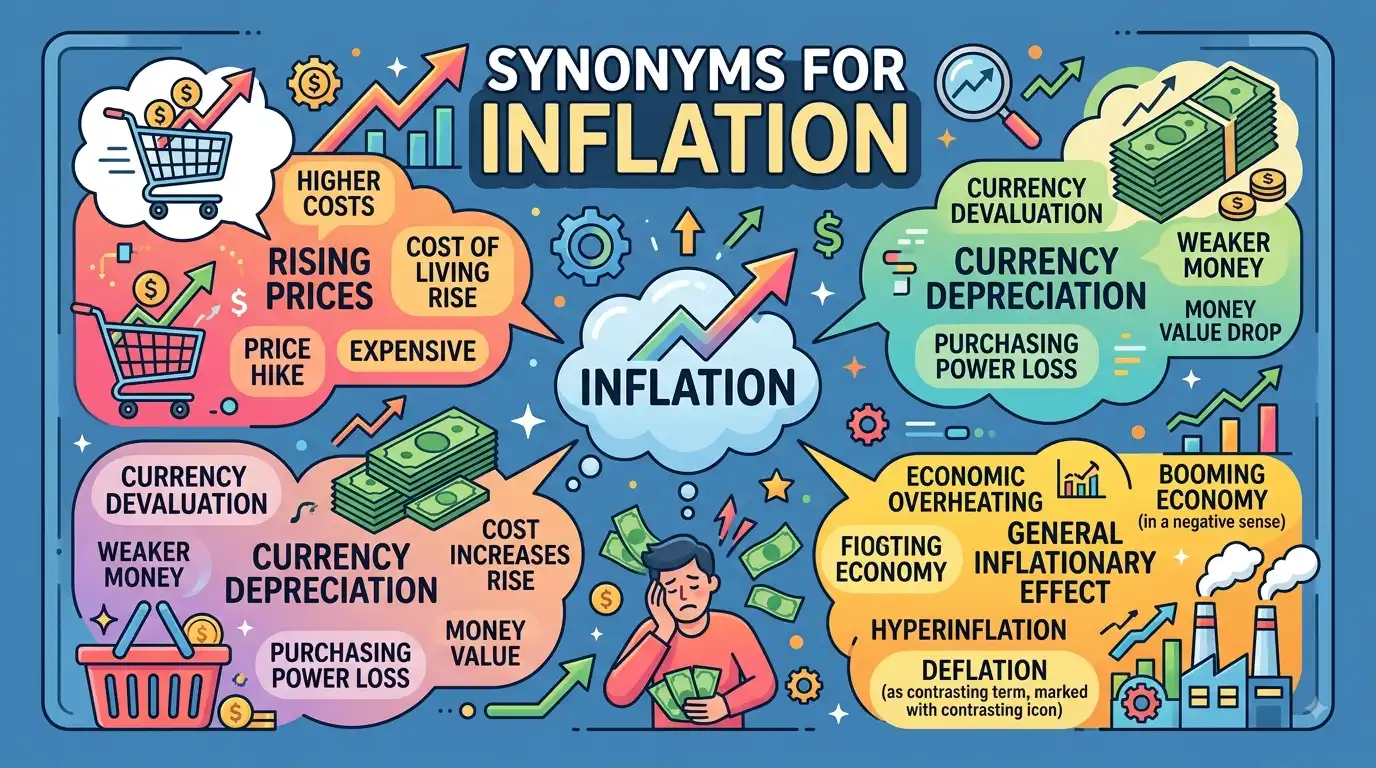
Learning various synonyms for inflation gives you precise words to describe rising prices, economic expansion, swelling sizes, and financial shifts. Understanding diverse synonyms for inflation helps you discuss price hikes, money values, and growing costs with exact clarity. When you explore synonyms for inflation, you discover how to make economics essays, news summaries, business blogs, and everyday budget chats sound natural, clear, and professional.
Understanding Price Hikes and Growth in Daily Life
Imagine going to your local bakery to buy a loaf of bread that used to cost two dollars, only to find that the price went up to three dollars this week. You notice that your allowance buys fewer snacks than it did last year, even though you have the same amount of money in your pocket. Calling this sudden change a simple price jump is accurate, but using descriptive synonyms for inflation like price increase, cost surge, or rate hike gives a much clearer picture of financial changes.
In very simple English, inflation means a general rise in prices that makes money buy fewer things over time.
Why Word Choice Matters for Communicators
Expanding your vocabulary with these economic terms offers great advantages across many areas:
- For Students: It helps you write clear social studies essays, economics reports, and well-researched school presentations.
- For Bloggers: It makes your personal finance tips, shopping guides, and household budgeting articles engaging for readers.
- For Content Writers: It allows you to write informative market news, business updates, and financial advice articles with precision.
- For Daily English Users: It gives you practical words to discuss living expenses, shopping choices, and family savings confidently.
“Understanding financial language helps us make smarter choices and express economic changes with confidence.”
“Choosing the exact word to describe rising costs turns complex money topics into clear conversations.”
Linguistic Breakdown: Etymology, Connotation, and Structure
Connotative Meaning of “Inflation”
The word inflation carries a serious, technical, and often cautious connotation in economics, representing decreasing purchasing power. In general contexts, however, it carries a neutral tone describing swelling, blowing up, or physical expansion.
Short Etymology
- Origin: Mid-14th century (originally referring to blowing air into something or swelling).
- Root: Derived from Latin inflatio(n-), from inflare (to blow into), combining in- (into) + flare (to blow). Financial usage began in the mid-19th century.
Pronunciation
- US IPA: /ɪnˈfleɪ.ʃən/
- UK IPA: /ɪnˈfleɪ.ʃən/
Syllables & Structure
- Syllables: 3 (in – fla – tion)
- Primary Stress: Second syllable (fla)
- Affixation Pattern: Prefix in- (into) + Root fla (blow) + Suffix -tion (noun suffix forming state or condition).
Comparison Table: Choosing the Right Synonym for Inflation
| Keyword | Meaning | Usage Type | Context |
| Inflation | A general rise in prices reducing money value | Professional / Technical | Economics, news, household budgets |
| Price hike | A sudden or noticeable increase in prices | Casual / Popular | Grocery shopping, news, daily life |
| Cost surge | A rapid and large jump in expenses | Formal / Descriptive | Business, energy bills, market news |
| Escalation | A gradual rise or growth in intensity or cost | Formal / Professional | Contracts, conflict, housing markets |
| Swelling | An increase in size, volume, or amount | General / Physical | Objects, balloons, physical size |
| Expansion | Growing larger in size, scope, or volume | Professional / Neutral | Business growth, money supply, space |
| Spike | A sharp, temporary rise in a price or value | Casual / Technical | Gas prices, electricity, stock markets |
| Mark-up | An amount added to a cost to set a price | Business / Practical | Retail stores, shopping, trade |
| Overheating | Excessive economic growth causing price rises | Technical / Economic | Financial markets, national economy |
| Devaluation | A reduction in the official value of money | Formal / Technical | International trade, currency, banking |
50 Synonyms for Inflation
1. Price hike
- Pronunciation: US /praɪs haɪk/ | UK /praɪs haɪk/
- Meaning: An increase in the cost of goods or services.
- Examples:
- Local stores announced a price hike on fresh milk this morning.
- Consumers complained about the sudden price hike at the gas station.
2. Cost surge
- Pronunciation: US /kɑːst sɝːdʒ/ | UK /kɒst sɜːdʒ/
- Meaning: A rapid and large increase in spending or prices.
- Examples:
- Families noticed a cost surge in their monthly heating bills last winter.
- The sudden cost surge made building new homes more expensive.
3. Price rise
- Pronunciation: US /praɪs raɪz/ | UK /praɪs raɪz/
- Meaning: An upward movement in what people pay for items.
- Examples:
- The steady price rise made shopping for groceries quite tricky.
- Buyers expected a small price rise before the holiday season.
4. Expansion
- Pronunciation: US /ɪkˈspæn.ʃən/ | UK /ɪkˈspæn.ʃən/
- Meaning: The act of growing larger in size or total amount.
- Examples:
- Central banks monitor money expansion to keep markets stable.
- The air inside the balloon caused rapid expansion until it popped.
5. Escalation
- Pronunciation: US /ˌes.kəˈleɪ.ʃən/ | UK /ˌes.kəˈleɪ.ʃən/
- Meaning: A continuous increase or growth in cost or intensity.
- Examples:
- Tenants worried about the yearly escalation of house rent prices.
- Careful planning prevented the escalation of total project costs.
6. Swelling
- Pronunciation: US /ˈswel.ɪŋ/ | UK /ˈswel.ɪŋ/
- Meaning: An increase in physical size or volume.
- Examples:
- The swelling of the sails carried the boat across the lake.
- Pumping air into the tire caused noticeable swelling right away.
7. Price jump
- Pronunciation: US /praɪs dʒʌmp/ | UK /praɪs dʒʌmp/
- Meaning: A quick and noticeable rise in product prices.
- Examples:
- A sudden price jump made travelers delay their holiday trip plans.
- The shopkeeper explained why the food items suffered a price jump.
8. Cost increase
- Pronunciation: US /kɑːst ɪnˈkriːs/ | UK /kɒst ɪnˈkriːs/
- Meaning: An addition to the total money needed to buy something.
- Examples:
- School supplies experienced a small cost increase before September.
- Our family adjusted our budget to handle the cost increase.
9. Price spike
- Pronunciation: US /praɪs spaɪk/ | UK /praɪs spaɪk/
- Meaning: A sudden, sharp, and usually brief rise in prices.
- Examples:
- Bad weather caused a temporary price spike in fresh vegetables.
- Drivers avoided buying fuel during the weekend price spike.
10. Devaluation
- Pronunciation: US /ˌdiː.væl.juˈeɪ.ʃən/ | UK /ˌdiː.væl.juˈeɪ.ʃən/
- Meaning: A reduction in the value or buying power of money.
- Examples:
- Currency devaluation makes imported toys more expensive to buy.
- Economists discussed how devaluation affected international trade deals.
11. Puffing
- Pronunciation: US /ˈpʌf.ɪŋ/ | UK /ˈpʌf.ɪŋ/
- Meaning: Blowing up or expanding something with air or steam.
- Examples:
- The child laughed while puffing air into colorful party balloons.
- Steam caused the puffing of the pastry dough inside the oven.
12. Distension
- Pronunciation: US /dɪˈsten.ʃən/ | UK /dɪˈsten.ʃən/
- Meaning: The state of stretching or swelling outward from within.
- Examples:
- Pumping gas into the vessel caused visible distension of the walls.
- The rubber tube showed slight distension under high air pressure.
13. Enlargement
- Pronunciation: US /ɪnˈlɑːrdʒ.mənt/ | UK /ɪnˈlɑːdʒ.mənt/
- Meaning: Making something bigger in physical size or quantity.
- Examples:
- The photographer framed an enlargement of the sunset picture.
- The school announced the enlargement of its main library floor.
14. Inflationary pressure
- Pronunciation: US /ɪnˈfleɪ.ʃən.er.i ˈpreʃ.ɚ/ | UK /ɪnˈfleɪ.ʃən.ər.i ˈpreʃ.ə/
- Meaning: Economic forces that push overall price levels higher.
- Examples:
- High shipping costs created inflationary pressure on retail goods.
- The central bank acted quickly to lower inflationary pressure.
15. Price escalation
- Pronunciation: US /praɪs ˌes.kəˈleɪ.ʃən/ | UK /praɪs ˌes.kəˈleɪ.ʃən/
- Meaning: A steady, ongoing increase in costs over time.
- Examples:
- Building contracts often include protection against price escalation.
- The ongoing price escalation affected city construction projects.
16. Bloating
- Pronunciation: US /ˈbloʊ.t̬ɪŋ/ | UK /ˈbləʊ.tɪŋ/
- Meaning: Swelling up excessively beyond normal size.
- Examples:
- The budget suffered from bloating due to unnecessary spending.
- Water trapped in the wood caused visible bloating along the floor.
17. Expansion of money supply
- Pronunciation: US /ɪkˈspæn.ʃən ʌv ˈmʌn.i səˈplaɪ/ | UK /ɪkˈspæn.ʃən ɒv ˈmʌn.i səˈplaɪ/
- Meaning: An increase in the total cash and credit in an economy.
- Examples:
- Rapid expansion of money supply often leads to higher store prices.
- Banks managed the expansion of money supply to keep living costs stable.
18. Cost growth
- Pronunciation: US /kɑːst ɡroʊθ/ | UK /kɒst ɡrəʊθ/
- Meaning: The steady rise in total production or living expenses.
- Examples:
- Companies monitor cost growth to keep product prices fair.
- Natural resource shortages contributed to cost growth this year.
19. Mark-up
- Pronunciation: US /ˈmɑːrk.ʌp/ | UK /ˈmɑːk.ʌp/
- Meaning: An added amount put on the cost price to make profit.
- Examples:
- Retail stores add a small mark-up to cover overhead costs.
- The farmer market sold fresh apples without a heavy store mark-up.
20. Price surge
- Pronunciation: US /praɪs sɝːdʒ/ | UK /praɪs sɜːdʒ/
- Meaning: A sudden, powerful movement upward in retail prices.
- Examples:
- Holiday demand created a price surge for popular electronic toys.
- Families adjusted shopping habits after the unexpected price surge.
“Monitoring economic trends allows businesses and consumers to navigate price changes smoothly.”
21. Rate hike
- Pronunciation: US /reɪt haɪk/ | UK /reɪt haɪk/
- Meaning: An official increase in interest rates or fees.
- Examples:
- The central bank announced a small rate hike to slow inflation.
- Borrowers discussed how the recent rate hike affected loan payments.
22. Swelling of prices
- Pronunciation: US /ˈswel.ɪŋ ʌv praɪsɪz/ | UK /ˈswel.ɪŋ ɒv praɪsɪz/
- Meaning: A gradual, noticeable increase in overall item costs.
- Examples:
- The swelling of prices led shoppers to compare deals carefully.
- Simple savings habits help families deal with the swelling of prices.
23. Overheating
- Pronunciation: US /ˌoʊ.vɚˈhiː.t̬ɪŋ/ | UK /ˌəʊ.vəˈhiː.tɪŋ/
- Meaning: An economy growing too fast and pushing prices up.
- Examples:
- Financial experts warned that rapid borrowing caused market overheating.
- Government policies aimed to cool down economic overheating.
24. Hyperinflation
- Pronunciation: US /ˌhaɪ.pɚ.ɪnˈfleɪ.ʃən/ | UK /ˌhaɪ.pər.ɪnˈfleɪ.ʃən/
- Meaning: Extremely fast and out-of-control price increases.
- Examples:
- History books describe how hyperinflation ruined currency value.
- Stores changed price labels twice daily during periods of hyperinflation.
25. Cost explosion
- Pronunciation: US /kɑːst ɪkˈsploʊ.ʒən/ | UK /kɒst ɪkˈspləʊ.ʒən/
- Meaning: A huge, sudden, and unchecked rise in expenses.
- Examples:
- The construction project faced a cost explosion due to raw material delays.
- Wise planning helps small businesses avoid a sudden cost explosion.
26. Price acceleration
- Pronunciation: US /praɪs əkˌsel.əˈreɪ.ʃən/ | UK /praɪs əkˌsel.əˈreɪ.ʃən/
- Meaning: A faster rate of growth in product price levels.
- Examples:
- Analysts measured recent price acceleration across grocery stores.
- Steady supply chains help prevent unnecessary price acceleration.
27. Value erosion
- Pronunciation: US /ˈvæl.juː ɪˈroʊ.ʒən/ | UK /ˈvæl.juː ɪˈrəʊ.ʒən/
- Meaning: The slow loss of money’s true purchasing strength.
- Examples:
- High inflation causes steady value erosion for cash savings accounts.
- Investing wisely helps protect family funds against value erosion.
28. Cost-of-living increase
- Pronunciation: US /kɑːst ʌv ˈlɪv.ɪŋ ɪnˈkriːs/ | UK /kɒst ɒv ˈlɪv.ɪŋ ɪnˈkriːs/
- Meaning: A rise in the money needed for everyday necessities.
- Examples:
- Workers received a bonus to match the cost-of-living increase.
- Monthly budgets must account for the annual cost-of-living increase.
29. Price premium
- Pronunciation: US /praɪs ˈpriː.mi.əm/ | UK /praɪs ˈpriː.mi.əm/
- Meaning: An extra cost added to high-demand or quality goods.
- Examples:
- Organic fruit often carries a slight price premium at market stalls.
- Customers paid a price premium for fast delivery before holidays.
30. Inflationary spiral
- Pronunciation: US /ɪnˈfleɪ.ʃən.er.i ˈspaɪ.rəl/ | UK /ɪnˈfleɪ.ʃən.ər.i ˈspaɪ.rəl/
- Meaning: A continuous loop where rising prices cause wage increases.
- Examples:
- Policy changes prevented the economy from entering an inflationary spiral.
- Both workers and business owners wanted to break the inflationary spiral.
31. Upward price movement
- Pronunciation: US /ˈʌp.wɚd praɪs ˈmuːv.mənt/ | UK /ˈʌp.wəd praɪs ˈmuːv.mənt/
- Meaning: The trend of item values going higher over time.
- Examples:
- Market graphs showed an upward price movement for tech goods.
- Shoppers noticed an upward price movement in seasonal fruits.
32. Dilution of buying power
- Pronunciation: US /daɪˈluː.ʃən ʌv ˈbaɪ.ɪŋ ˈpaʊ.ɚ/ | UK /daɪˈluː.ʃən ɒv ˈbaɪ.ɪŋ ˈpaʊ.ə/
- Meaning: Weakening of how much goods money can purchase.
- Examples:
- Unchecked money printing leads to the dilution of buying power.
- Families worked hard to protect their savings from dilution of buying power.
33. Price inflation
- Pronunciation: US /praɪs ɪnˈfleɪ.ʃən/ | UK /praɪs ɪnˈfleɪ.ʃən/
- Meaning: The specific rise in price tags for goods and services.
- Examples:
- Annual statistics revealed moderate price inflation across clothing brands.
- Consumers adjusted spending habits to cope with price inflation.
34. Money inflation
- Pronunciation: US /ˈmʌn.i ɪnˈfleɪ.ʃən/ | UK /ˈmʌn.i ɪnˈfleɪ.ʃən/
- Meaning: Creating too much money, making each unit worth less.
- Examples:
- Excessive credit creation leads directly to money inflation.
- Economists studied historical examples of severe money inflation.
35. Price expansion
- Pronunciation: US /praɪs ɪkˈspæn.ʃən/ | UK /praɪs ɪkˈspæn.ʃən/
- Meaning: The widening or growth of retail prices across markets.
- Examples:
- The housing market experienced rapid price expansion last spring.
- Financial planners monitored price expansion in local real estate.
36. Cost escalation
- Pronunciation: US /kɑːst ˌes.kəˈleɪ.ʃən/ | UK /kɒst ˌes.kəˈleɪ.ʃən/
- Meaning: A steady build-up in project expenses or living fees.
- Examples:
- The company avoided cost escalation by ordering materials in advance.
- Unexpected delays led to cost escalation during home repairs.
37. Price appreciation
- Pronunciation: US /praɪs əˌpriː.ʃiˈeɪ.ʃən/ | UK /praɪs əˌpriː.siˈeɪ.ʃən/
- Meaning: An increase in the value or market cost of property.
- Examples:
- Homeowners enjoyed steady price appreciation in their neighborhood.
- Rare art pieces often show strong price appreciation over time.
38. Bumping up
- Pronunciation: US /bʌmp.ɪŋ ʌp/ | UK /bʌmp.ɪŋ ʌp/
- Meaning: Raising prices or amounts by a small increment.
- Examples:
- The café was bumping up coffee prices by ten cents today.
- Sellers tried bumping up ticket costs right before game time.
39. Blowing up
- Pronunciation: US /bloʊ.ɪŋ ʌp/ | UK /bləʊ.ɪŋ ʌp/
- Meaning: Filling an object with air to expand its boundaries.
- Examples:
- The kids enjoyed blowing up beach balls before swimming in the pool.
- He spent thirty minutes blowing up air mattresses for camp guests.
40. Pumping up
- Pronunciation: US /pʌmp.ɪŋ ʌp/ | UK /pʌmp.ɪŋ ʌp/
- Meaning: Increasing size, volume, or price by force or effort.
- Examples:
- The mechanic was pumping up the bicycle tires to correct pressure.
- Marketing campaigns were pumping up enthusiasm for the new phone.
41. Ballooning
- Pronunciation: US /bəˈluːn.ɪŋ/ | UK /bəˈluːn.ɪŋ/
- Meaning: Growing larger at a rapid and unexpected speed.
- Examples:
- Uncontrolled borrowing led to ballooning debt for the small firm.
- The chef watched the ballooning bread dough rise in the bowl.
42. Surge
- Pronunciation: US /sɝːdʒ/ | UK /sɜːdʒ/
- Meaning: A sudden, strong rise or push forward in numbers.
- Examples:
- The heatwave caused a surge in electricity use across the town.
- A surge in online orders kept the warehouse team busy all week.
43. Swelling cost
- Pronunciation: US /ˈswel.ɪŋ kɑːst/ | UK /ˈswel.ɪŋ kɒst/
- Meaning: Expenses growing bigger and taking more funds over time.
- Examples:
- Managing a swelling cost requires smart budgeting and careful habits.
- The swelling cost of ingredients made bakery owners review prices.
44. Upward trend
- Pronunciation: US /ˈʌp.wɚd trend/ | UK /ˈʌp.wəd trend/
- Meaning: A general movement toward higher levels or numbers.
- Examples:
- Graphs showed an upward trend in fuel costs over six months.
- The upward trend in store visits cheered the small shopkeeper.
45. Price boost
- Pronunciation: US /praɪs buːst/ | UK /praɪs buːst/
- Meaning: An intentional lift or increase given to an item’s value.
- Examples:
- Upgrading the hotel rooms justified a slight price boost.
- The new features provided a clear reason for the price boost.
46. Value shrinkage
- Pronunciation: US /ˈvæl.juː ˈʃrɪŋk.ɪdʒ/ | UK /ˈvæl.juː ˈʃrɪŋk.ɪdʒ/
- Meaning: The gradual decrease in what money can buy over time.
- Examples:
- High market costs lead directly to noticeable value shrinkage for cash.
- Smart investments help protect savings from value shrinkage.
47. Currency weakening
- Pronunciation: US /ˈkɝː.ən.si ˈwiː.kən.ɪŋ/ | UK /ˈkʌr.ən.si ˈwiː.kən.ɪŋ/
- Meaning: Loss of purchasing strength of money against goods or foreign currencies.
- Examples:
- Imports became pricier due to ongoing currency weakening.
- Central banks monitor national trade to manage currency weakening.
48. Cost expansion
- Pronunciation: US /kɑːst ɪkˈspæn.ʃən/ | UK /kɒst ɪkˈspæn.ʃən/
- Meaning: Broad increase in total operating or living expenses.
- Examples:
- Careful accounting kept business cost expansion under control.
- Rising energy bills contributed to household cost expansion.
49. Price growth
- Pronunciation: US /praɪs ɡroʊθ/ | UK /praɪs ɡrəʊθ/
- Meaning: The rate at which consumer prices increase over time.
- Examples:
- Government reports recorded steady price growth in organic food.
- Moderate price growth is normal for a healthy growing economy.
50. Value drop
- Pronunciation: US /ˈvæl.juː drɑːp/ | UK /ˈvæl.juː drɒp/
- Meaning: A decrease in the worth or buying strength of money or goods.
- Examples:
- Rapid printing of paper notes causes a sudden value drop.
- The old car experienced a natural value drop after many years.
Antonyms of Inflation
To understand economic terms completely, looking at contrasting words that describe falling prices, shrinking sizes, or increasing money power is equally helpful:
- Deflation: A general decrease in overall prices that increases money’s purchasing power.
- Price cut: A reduction or discount in the cost of goods and services.
- Contraction: The process of becoming smaller in size, volume, or economic activity.
- Shrinkage: The process of shrinking or getting smaller in size or amount.
- Depressurization: Releasing air or pressure from an object or space.
- Price drop: A clear decrease in what customers pay for products.
Prototype Meaning and Categorization of Inflation
In cognitive linguistics, a prototype represents the central, most typical example of a category. The central prototype of the word inflation is a continuous economic rise in prices that reduces money’s purchasing power over time. Depending on the writer’s intent and context, synonyms for inflation naturally fall into three primary written categories:
1. Everyday Price and Cost Increases This category includes terms used in daily speech, retail shopping, and personal budgeting when prices go up. Words such as price hike, cost surge, price rise, cost increase, price jump, and price spike represent prototype choices in consumer news, grocery shopping chats, and family budget discussions where everyday costs are going up.
2. Financial and Economic Terms This group focuses on technical terms used by economists, banks, news reporters, and financial planners. Synonyms like devaluation, inflationary pressure, expansion of money supply, rate hike, hyperinflation, value erosion, and cost-of-living increase are typically used in formal reports, business news, economics essays, and banking policies to explain market trends precisely.
3. Physical Swelling and Size Expansion This category consists of general, non-financial terms describing physical objects growing, expanding, or filling with air. Descriptors such as swelling, expansion, distension, enlargement, bloating, blowing up, pumping up, and ballooning allow writers to describe physical science experiments, medical contexts, or spatial growth clearly.
Frequently Asked Questions (FAQ)
1. What is the difference between “inflation” and “price hike”?
While inflation describes a broad, economy-wide rise in prices over time, a price hike refers to a specific, single increase in the cost of one product or service.
2. What is a formal economic synonym for inflation in academic writing?
In school reports and economics essays, effective synonyms for inflation include price escalation, devaluation, inflationary pressure, value erosion, and cost-of-living increase.
3. Can “expansion” be used as a synonym for inflation?
Yes! Expansion works as a synonym when talking about money supply growth in finance or physical volume increases in science and everyday language.
4. What is the opposite of inflation in economics?
The direct opposite of inflation is deflation, which means a general decrease in product prices that increases the buying power of money.
5. What are everyday casual synonyms for inflation when talking about shopping?
Casual terms for daily chats include price hike, cost surge, price jump, price spike, and bumping up.
Conclusion
Expanding your vocabulary with this comprehensive collection of synonyms for inflation is a wonderful way to enrich your writing, economic understanding, and everyday conversations. Whether you select everyday retail terms like price hike and cost surge, formal financial terms like devaluation and value erosion, or physical descriptors like expansion and swelling, choosing the exact right word makes your message clear and precise.
For students writing social studies papers or economics reports, using diverse synonyms for inflation prevents repetitive phrasing and shows a mature understanding of market concepts, bloggers and content writers, replacing basic price words with expressive alternatives makes financial advice, news summaries, and shopping guides far more engaging, everyday speakers, having a broad vocabulary helps you discuss living expenses, budget planning, and savings goals with confidence.
Try practicing two or three of these practical, informative new words this week in your school reports, blog posts, or daily conversations!
“Building a strong vocabulary gives you the exact tools needed to navigate financial discussions with confidence.”
“Clear words turn complex economic trends into simple, relatable conversations for everyone.”
“Exploring expressive synonyms allows us to share financial ideas clearly and accurately.”