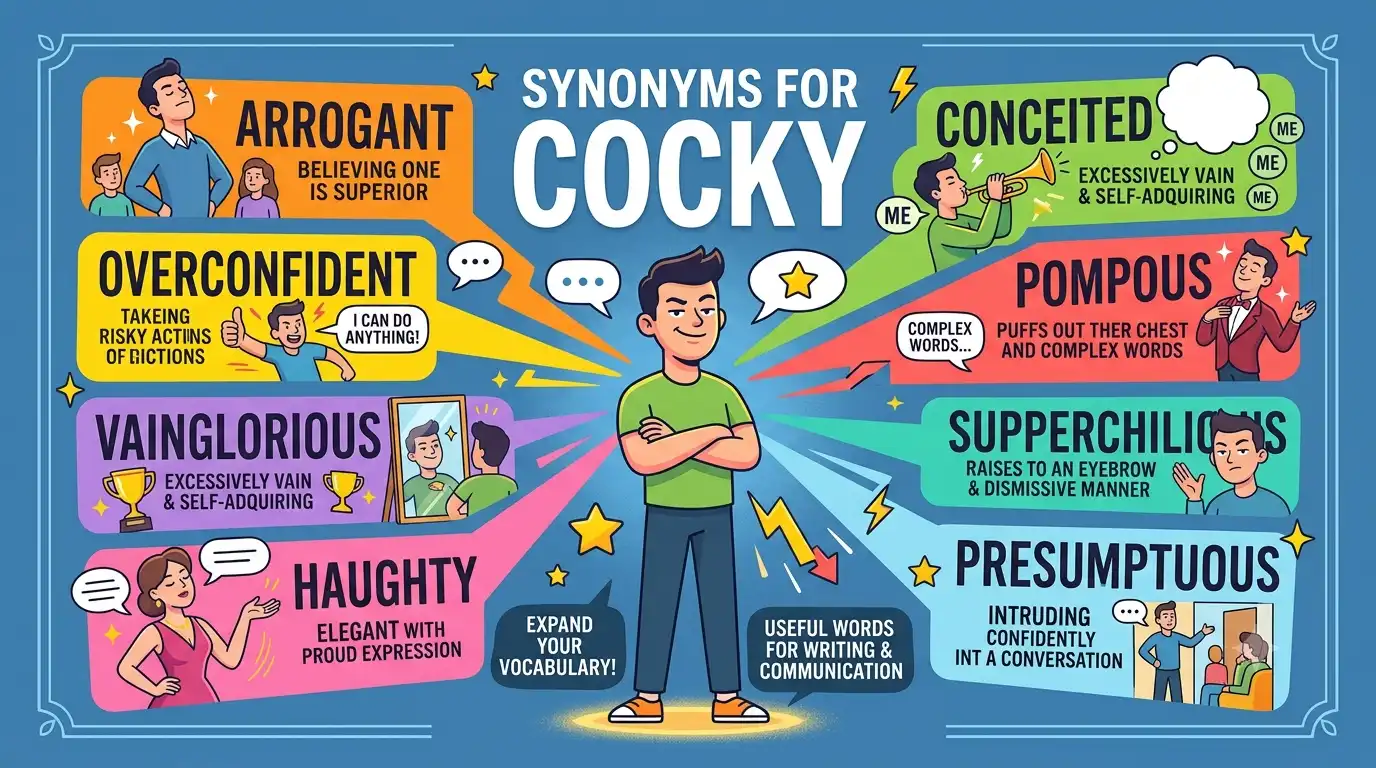
Learning descriptive synonyms for cocky gives you dynamic words to describe overly proud attitudes, boastful behavior, and bold self-confidence. Understanding various synonyms for cocky helps you describe self-centered behavior, playful arrogance, or excessive pride with exact precision. Exploring these synonyms for cocky allows you to express character traits, behavioral shades, and social observations clearly in your daily writing and speech.
Describing Overconfident Characters in Daily Life
Picture a story where a player wins a local chess match and immediately starts boasting that nobody can ever defeat them. Calling them proud gets the idea across, but describing them as arrogant, boastful, or overconfident gives your reader a much clearer view of their attitude. Exploring synonyms for cocky gives you colorful, expressive words to describe personality traits in creative stories and everyday conversations.
In very simple English, cocky means being overly confident in a bold, proud, or boastful way that can annoy other people.
Why Word Choice Matters for Communicators
Expanding your vocabulary with these personality terms offers great benefits across many areas:
- For Students: It helps you analyze character motives, flaws, and behaviors in book reports and literature essays.
- For Bloggers: It makes your personal stories, character reviews, and opinion pieces lively and descriptive.
- For Content Writers: It allows you to write precise character profiles, script dialogues, and engaging storytelling content.
- For Daily English Users: It gives you accurate, respectful words to describe attitudes you notice in sports, media, and everyday life.
“True confidence speaks softly, while overconfidence shouts to be heard.”
“Choosing the precise word allowed us to describe personality with perfect clarity and insight.”
Linguistic Breakdown: Etymology, Connotation, and Structure
Connotative Meaning of “Cocky”
The word cocky carries a negative to slightly playful connotation. It implies overly bold confidence, self-importance, and a boastful attitude. Depending on the setting, its tone ranges from playful swagger (e.g., a confident athlete) to rude self-centeredness (e.g., someone who looks down on others).
Short Etymology
- Origin: Early 18th century (around the 1710s).
- Root: Derived from the noun cock (referring to a rooster, known for its proud strut and loud crowing) + the adjectival suffix -y.
Pronunciation
- US IPA: /ˈkɑː.ki/
- UK IPA: /ˈkɒk.i/
Syllables & Structure
- Syllables: 2 (cock – y)
- Primary Stress: First syllable (cock)
- Affixation Pattern: Root cock + Suffix -y (meaning “having the qualities of”).
Comparison Table: Choosing the Right Synonym for Cocky
| Keyword | Meaning | Usage Type | Context |
| Cocky | Boldly confident in a proud or boastful way | Casual / Descriptive | Sports, school, daily life |
| Arrogant | Having an unpleasantly proud feeling of superiority | Formal / Strong | Literature, workplace, disputes |
| Overconfident | Too sure of oneself or one’s abilities | Practical / General | Exams, games, decision making |
| Boastful | Frequently talking with too much pride about oneself | Friendly / General | Conversations, stories, games |
| Conceited | Having an excessively high opinion of oneself | Personal / Descriptive | Relationships, character analysis |
| Haughty | Showing arrogant superiority and disdain for others | Formal / Literary | Classic books, drama, history |
| Smug | Showing excessive satisfaction with oneself | Expressive / Casual | Competitions, debates, reactions |
| Brash | Bold, loud, and acting without careful thought | Casual / Dynamic | Action stories, quick decisions |
| Vain | Overly concerned with one’s appearance or achievement | Personal / Moral | Fashion, personal habits, fables |
| Presumptuous | Going beyond what is proper or polite out of pride | Formal / Polite | Manners, requests, social rules |
50 Synonyms for Cocky
1. Arrogant
- Pronunciation: US /ˈær.ə.ɡənt/ | UK /ˈær.ə.ɡənt/
- Meaning: Believing you are better or more important than other people.
- Examples:
- The arrogant player refused to shake hands after the game.
- She remained polite and humble instead of acting arrogant.
2. Overconfident
- Pronunciation: US /ˌoʊ.vɚˈkɑːn.fə.dənt/ | UK /ˌəʊ.vəˈkɒn.fɪ.dənt/
- Meaning: Being far too sure of your success or skills.
- Examples:
- Being overconfident made him skip reviewing his study notes.
- The team lost the match because they were overconfident.
3. Boastful
- Pronunciation: US /ˈboʊst.fəl/ | UK /ˈbəʊst.fəl/
- Meaning: Liking to brag about your achievements or belongings.
- Examples:
- Nobody enjoyed listening to the boastful student brag about his score.
- She wrote a modest essay without using a boastful tone.
4. Conceited
- Pronunciation: US /kənˈsiː.t̬ɪd/ | UK /kənˈsiː.tɪd/
- Meaning: Having an overly high opinion of your own worth.
- Examples:
- He became conceited after winning three art trophies in a row.
- A true leader stays kind rather than becoming conceited.
5. Smug
- Pronunciation: US /smʌɡ/ | UK /smʌɡ/
- Meaning: Showing too much satisfaction with your own smartness or success.
- Examples:
- She wore a smug smile after winning the board game.
- He gave a smug look when his prediction came true.
6. Haughty
- Pronunciation: US /ˈhɑː.t̬i/ | UK /ˈhɔː.ti/
- Meaning: Unpleasantly proud and looking down on other people.
- Examples:
- The haughty king ignored the simple requests of his people.
- She answered the question with a haughty wave of her hand.
7. Brash
- Pronunciation: US /bræʃ/ | UK /bræʃ/
- Meaning: Bold, loud, and acting without thinking carefully.
- Examples:
- His brash statement interrupted the quiet classroom discussion.
- She made a brash choice to jump across the wide stream.
8. Vain
- Pronunciation: US /veɪn/ | UK /veɪn/
- Meaning: Thinking too much about your own looks or achievements.
- Examples:
- The vain character spent hours staring into the mirror.
- He was careful not to seem vain when receiving his prize.
9. Cocksure
- Pronunciation: US /ˈkɑːk.ʃʊr/ | UK /ˈkɒk.ʃɔː/
- Meaning: Extremely confident in a way that annoys others.
- Examples:
- He entered the science room with a cocksure attitude.
- Her cocksure claim was proven wrong by the experiment.
10. Swaggering
- Pronunciation: US /ˈswæɡ.ɚ.ɪŋ/ | UK /ˈswæɡ.ər.ɪŋ/
- Meaning: Walking or behaving in an overly proud and confident way.
- Examples:
- The swaggering runner walked onto the track with high energy.
- We laughed at the mascot’s swaggering dance during halftime.
11. Full of oneself
- Pronunciation: US /fʊl əv wʌnˈself/ | UK /fʊl əv wʌnˈself/
- Meaning: Thinking only about your own importance and qualities.
- Examples:
- He was so full of himself that he forgot to thank his team.
- She avoids being full of herself by helping her classmates.
12. Pompous
- Pronunciation: US /ˈpɑːm.pəs/ | UK /ˈpɒm.pəs/
- Meaning: Acting overly grand, serious, and self-important.
- Examples:
- The speaker used a pompous voice during his short speech.
- We prefer friendly advice over a pompous lecture.
13. Pretentious
- Pronunciation: US /prɪˈten.ʃəs/ | UK /prɪˈten.ʃəs/
- Meaning: Trying to appear more important or talented than you really are.
- Examples:
- Using overly fancy words can sound pretentious in simple notes.
- She wrote a clear paper without any pretentious claims.
14. Presumptuous
- Pronunciation: US /prɪˈzʌmp.tʃu.əs/ | UK /prɪˈzʌmp.tʃu.əs/
- Meaning: Doing something bold without having the right or permission.
- Examples:
- It was presumptuous to answer the phone on the teacher’s desk.
- She apologized for her presumptuous decision to speak first.
15. Egotistical
- Pronunciation: US /ˌiː.ɡəˈtɪs.tɪ.kəl/ | UK /ˌiː.ɡəˈtɪs.tɪ.kəl/
- Meaning: Thinking mainly about yourself and your own desires.
- Examples:
- An egotistical person rarely stops to listen to others.
- His egotistical behavior made group projects difficult.
16. Self-important
- Pronunciation: US /ˌself.ɪmˈpɔːr.tənt/ | UK /ˌself.ɪmˈpɔː.tənt/
- Meaning: Believing that you are more significant than everyone else.
- Examples:
- The self-important rooster crowed loudly from the fence top.
- He walked into the hall with a self-important step.
17. Bigheaded
- Pronunciation: US /ˌbɪɡˈhed.ɪd/ | UK /ˌbɪɡˈhed.ɪd/
- Meaning: Having an inflated view of your own talent or value.
- Examples:
- Don’t let winning one game make you bigheaded.
- She stayed humble and never got bigheaded about her grades.
18. Cheeky
- Pronunciation: US /ˈtʃiː.ki/ | UK /ˈtʃiː.ki/
- Meaning: Bold, playful, and slightly disrespectful in a cheerful way.
- Examples:
- The monkey gave a cheeky grin before grabbing the banana.
- He made a cheeky joke that made the whole class laugh.
19. Forward
- Pronunciation: US /ˈfɔːr.wɚd/ | UK /ˈfɔː.wəd/
- Meaning: Boldly confident and lacking proper shyness or restraint.
- Examples:
- It was a bit forward to ask for a second piece of cake right away.
- She gave a forward suggestion during the student meeting.
20. Overbearing
- Pronunciation: US /ˌoʊ.vɚˈber.ɪŋ/ | UK /ˌəʊ.vəˈbeə.rɪŋ/
- Meaning: Trying to control others in a proud and pushy manner.
- Examples:
- An overbearing captain can make sports less fun for the team.
- She used a gentle tone instead of being overbearing.
“Understanding word choices helps us spot the difference between simple self-respect and boastful pride.”
21. Sassy
- Pronunciation: US /ˈsæs.i/ | UK /ˈsæs.i/
- Meaning: Lively, bold, and full of spirited confidence.
- Examples:
- The main character in the story gave a sassy reply to the villain.
- She walked on stage with a sassy and cheerful smile.
22. Pert
- Pronunciation: US /pɝːt/ | UK /pɜːt/
- Meaning: Boldly lively and slightly impudent in behavior.
- Examples:
- The small bird made a pert chirp from the tree branch.
- She gave a pert answer that surprised her friends.
23. Impudent
- Pronunciation: US /ˈɪm.pjə.dənt/ | UK /ˈɪm.pjə.dənt/
- Meaning: Not showing proper respect to other people.
- Examples:
- The impudent child made faces behind the guard’s back.
- Interrupting the speaker was considered impudent behavior.
24. Insolent
- Pronunciation: US /ˈɪn.sə.lənt/ | UK /ˈɪn.sə.lənt/
- Meaning: Showing rude and bold disrespect toward authority.
- Examples:
- The insolent answer earned the student a quiet warning.
- He regretted his insolent tone after thinking it over.
25. High-and-mighty
- Pronunciation: US /ˌhaɪ.ənˈmaɪ.ti/ | UK /ˌhaɪ.ənˈmaɪ.ti/
- Meaning: Acting as if you are far superior to everyone around you.
- Examples:
- She didn’t like his high-and-mighty attitude toward new players.
- He stopped acting high-and-mighty after making a silly mistake.
26. Proud
- Pronunciation: US /praʊd/ | UK /praʊd/
- Meaning: Feeling deep pleasure or satisfaction in your own achievements.
- Examples:
- Her parents felt proud when she won the spelling bee.
- He was proud of his hard work on the science model.
27. Superior
- Pronunciation: US /səˈpɪr.i.ɚ/ | UK /suːˈpɪə.ri.ər/
- Meaning: Showing a belief that you are better than others.
- Examples:
- He spoke with a superior tone that annoyed his teammates.
- A good teacher treats every student equally without acting superior.
28. Flippant
- Pronunciation: US /ˈflɪp.ənt/ | UK /ˈflɪp.ənt/
- Meaning: Not showing serious or respectful thought about important things.
- Examples:
- Making a flippant joke during a safety drill is not wise.
- She gave a flippant answer when asked about her missing homework.
29. Bold
- Pronunciation: US /boʊld/ | UK /bəʊld/
- Meaning: Brave, daring, and confident in taking action.
- Examples:
- The knight made a bold move to protect the castle gate.
- She had a bold idea for the new class painting project.
30. Barefaced
- Pronunciation: US /ˈber.feɪst/ | UK /ˈbeə.feɪst/
- Meaning: Openly bold and shameless in behavior or speech.
- Examples:
- Telling a barefaced lie is easy to catch and fix.
- He showed barefaced confidence when stepping onto the court.
31. Overweening
- Pronunciation: US /ˌoʊ.vɚˈwiː.nɪŋ/ | UK /ˌəʊ.vəˈwiː.nɪŋ/
- Meaning: Showing exaggerated, excessive, or arrogant pride.
- Examples:
- His overweening pride led him to ignore helpful advice.
- The fable taught a lesson about overweening ambition.
32. Vainglorious
- Pronunciation: US /ˌveɪnˈɡlɔːr.i.əs/ | UK /ˌveɪnˈɡlɔː.ri.əs/
- Meaning: Excessively proud of your own achievements or appearance.
- Examples:
- The vainglorious prince demanded a giant statue of himself.
- She avoided making vainglorious posts on social media.
33. Self-satisfied
- Pronunciation: US /ˌselfˈsæt̬.əs.faɪd/ | UK /ˌselfˈsæt.ɪs.faɪd/
- Meaning: Very pleased with yourself and your accomplishments.
- Examples:
- He sat back with a self-satisfied grin after finishing the puzzle.
- Being self-satisfied can stop you from learning new skills.
34. Supercilious
- Pronunciation: US /ˌsuː.pɚˈsɪl.i.əs/ | UK /ˌsuː.pəˈsɪl.i.əs/
- Meaning: Behaving as if you think other people are less important.
- Examples:
- The villain gave a supercilious glance at the hero.
- She raised a supercilious eyebrow when hearing the excuse.
35. Imperious
- Pronunciation: US /ɪmˈpɪr.i.əs/ | UK /ɪmˈpɪə.ri.əs/
- Meaning: Expecting obedience and acting like a ruler.
- Examples:
- She gave an imperious command for everyone to be quiet.
- His imperious manner made it hard for friends to relax.
36. High-hat
- Pronunciation: US /ˈhaɪ.hæt/ | UK /ˈhaɪ.hæt/
- Meaning: Snobbish, aloof, or acting better than others.
- Examples:
- Don’t act high-hat just because you learned the game first.
- She remained friendly and never turned high-hat.
37. Swollen-headed
- Pronunciation: US /ˌswoʊ.lənˈhed.ɪd/ | UK /ˌswəʊ.lənˈhed.ɪd/
- Meaning: Filled with excessive pride about your own success.
- Examples:
- He became swollen-headed after winning the race.
- A good mentor keeps young athletes from becoming swollen-headed.
38. Self-assured
- Pronunciation: US /ˌself.əˈʃʊrd/ | UK /ˌself.əˈʃɔːd/
- Meaning: Confident in your own abilities and character.
- Examples:
- She walked onto the debate stage in a self-assured manner.
- Being self-assured helps you handle difficult questions easily.
39. Pushy
- Pronunciation: US /ˈpʊʃ.i/ | UK /ˈpʊʃ.i/
- Meaning: Excessively forceful or assertive in getting what you want.
- Examples:
- The pushy salesperson tried to make us buy three items.
- She asked politely instead of sounding pushy.
40. Strutting
- Pronunciation: US /ˈstrʌt.ɪŋ/ | UK /ˈstrʌt.ɪŋ/
- Meaning: Walking with a proud, puffed-up posture to show off.
- Examples:
- The strutting peacock showed off its colorful feathers.
- He walked with a strutting step across the playground.
41. Brazen
- Pronunciation: US /ˈbreɪ.zən/ | UK /ˈbreɪ.zən/
- Meaning: Openly bold and shocking without any shame.
- Examples:
- It took brazen nerve to cut in front of the line.
- The cat made a brazen move for the dinner plate.
42. Overweening-proud
- Pronunciation: US /ˌoʊ.vɚˈwiː.nɪŋ.praʊd/ | UK /ˌəʊ.vəˈwiː.nɪŋ.praʊd/
- Meaning: Possessing an extreme, unchecked level of personal pride.
- Examples:
- The ruler’s overweening-proud nature led to his downfall.
- Her overweening-proud response hurt her friend’s feelings.
43. Lordly
- Pronunciation: US /ˈlɔːrd.li/ | UK /ˈlɔːd.li/
- Meaning: Acting in a grand, noble, or domineering way.
- Examples:
- He gave a lordly wave as he entered the classroom.
- She avoided making lordly demands during group work.
44. Big-talking
- Pronunciation: US /ˈbɪɡ.tɑː.kɪŋ/ | UK /ˈbɪɡ.tɔː.kɪŋ/
- Meaning: Making big, boastful claims about what you can do.
- Examples:
- The big-talking player was quiet after losing the game.
- We prefer quiet effort over big-talking promises.
45. Cheeky-faced
- Pronunciation: US /ˈtʃiː.ki.feɪst/ | UK /ˈtʃiː.ki.feɪst/
- Meaning: Showing a bold, playful, or irreverent expression.
- Examples:
- The cheeky-faced boy winked before running into the yard.
- She gave a cheeky-faced grin during the photo shoot.
46. High-nosed
- Pronunciation: US /ˈhaɪ.noʊzd/ | UK /ˈhaɪ.nəʊzd/
- Meaning: Looking down your nose at others in a snobbish way.
- Examples:
- The high-nosed character refused to sit on the grass.
- He put away his high-nosed look and joined the fun.
47. Snooty
- Pronunciation: US /ˈsnuː.ti/ | UK /ˈsnuː.ti/
- Meaning: Looking down on people you think are lower in social rank.
- Examples:
- The snooty cat walked past the puppy without looking.
- She chose a warm greeting instead of a snooty silence.
48. Stuck-up
- Pronunciation: US /ˌstʌkˈʌp/ | UK /ˌstʌkˈʌp/
- Meaning: Thinking you are too good to socialize with others.
- Examples:
- He seemed stuck-up at first, but he was actually just shy.
- Nobody likes a stuck-up attitude in a group project.
49. Airy
- Pronunciation: US /ˈer.i/ | UK /ˈeə.ri/
- Meaning: Showing a light, careless, and overly casual confidence.
- Examples:
- She dismissed the problem with an airy wave of her hand.
- His airy response showed he wasn’t worried about the deadline.
50. Audacious
- Pronunciation: US /ɑːˈdeɪ.ʃəs/ | UK /ɔːˈdeɪ.ʃəs/
- Meaning: Showing a willingness to take surprisingly bold risks.
- Examples:
- The hero made an audacious leap across the wide canyon.
- She had the audacious goal of reading fifty books this summer.
Antonyms of Cocky
To understand a personality concept completely, it is equally helpful to look at its direct opposites. Where cocky describes boastfulness and overconfidence, its antonyms describe quiet modesty, respect, and self-awareness:
- Humble: Showing a modest opinion of your own importance or rank.
- Modest: Not talking proudly about your own abilities or wins.
- Meek: Quiet, gentle, and easily staying out of arguments.
- Unassuming: Not drawing attention to yourself or acting important.
- Deferential: Showing polite respect for the feelings or wishes of others.
- Self-effacing: Tending to keep yourself in the background and minimize your success.
Prototype Meaning and Categorization of Cocky
In cognitive linguistics, a prototype represents the central, most typical example of a category. The central prototype of the word cocky is a boastful, loud person who displays excessive self-confidence in a way that rubs others the wrong way, like a crowing rooster. Depending on the writer’s intent and setting, synonyms for cocky naturally fall into three primary written categories:
1. Rude and Superior Arrogance This category includes formal and strong words used when someone looks down on others with disdain. Terms such as arrogant, haughty, pompous, supercilious, imperious, and high-and-mighty represent prototype choices in classic literature, drama, and formal character analyses where deep-seated pride causes social division.
2. Boastful and Overconfident Behavior This group focuses on words used when someone talks too much about their own skills or acts far too sure of success. Synonyms like overconfident, boastful, conceited, smug, bigheaded, and full of oneself are typically used in sports writing, school stories, and personal reviews to highlight boastful habits or inflated self-regard.
3. Playful or Bold Swagger This category consists of lighter, dynamic words that express bold energy, cheeky charm, or fearless risk-taking. Descriptors such as brash, swaggering, cheeky, sassy, bold, and audacious allow writers to describe energetic heroes, fun cartoon characters, or lively friends whose bold confidence feels spunky rather than mean-spirited.
Frequently Asked Questions (FAQ)
1. What is the difference between “confident” and “cocky”?
Being confident means trusting your skills while remaining quiet, polite, and realistic. Being cocky means bragging about your skills, acting superior, or showing off in a way that annoys others.
2. What is a polite or gentle synonym for cocky?
Gentle terms to describe overconfidence include overconfident, overbold, forward, or overly sure.
3. Can “cocky” ever be used in a positive way?
In casual sports or action storytelling, cocky can describe a fun, charming swagger or playful confidence, but it usually carries a slightly negative tone in everyday social settings.
4. What are good synonyms for cocky to use in school essays?
In academic papers and literature reports, effective synonyms include arrogant, conceited, haughty, presumptuous, and pompous.
5. What does “cocksure” mean compared to “cocky”?
Cocksure means being completely, stubborn-level certain that you are right about something, whereas cocky describes a broader attitude of swagger, pride, and boastfulness.
Conclusion
Expanding your vocabulary with this rich collection of synonyms for cocky is a fantastic way to elevate your character descriptions, literature essays, and everyday communication. Whether you select strong, formal words like arrogant and haughty, practical terms like overconfident and boastful, or lively descriptors like cheeky and audacious, choosing the exact right word brings clarity and insight to your message.
For students writing book reviews or character analyses, using diverse synonyms for cocky prevents repetitive phrasing and shows a mature understanding of personality traits, bloggers and content creators, replacing plain words with vivid alternatives makes your stories engaging, memorable, and fun to read, daily English speakers, having a broad selection of terms helps you describe attitudes with accuracy and nuance.
Try practicing two or three of these new descriptive words this week in your class discussions, creative stories, or journal entries!
“A rich vocabulary gives us the exact tools to paint personalities with accuracy and grace.”
“Words allow us to describe every subtle shade of human behavior and character.”
“Learning new synonyms turns simple storytelling into vivid and memorable communication.”

Andrew Powell is a travel writer and nature journalist who has spent over a decade writing about places, landscapes, and the natural world — and thinking carefully about the words that do those subjects justice ( Biography ).