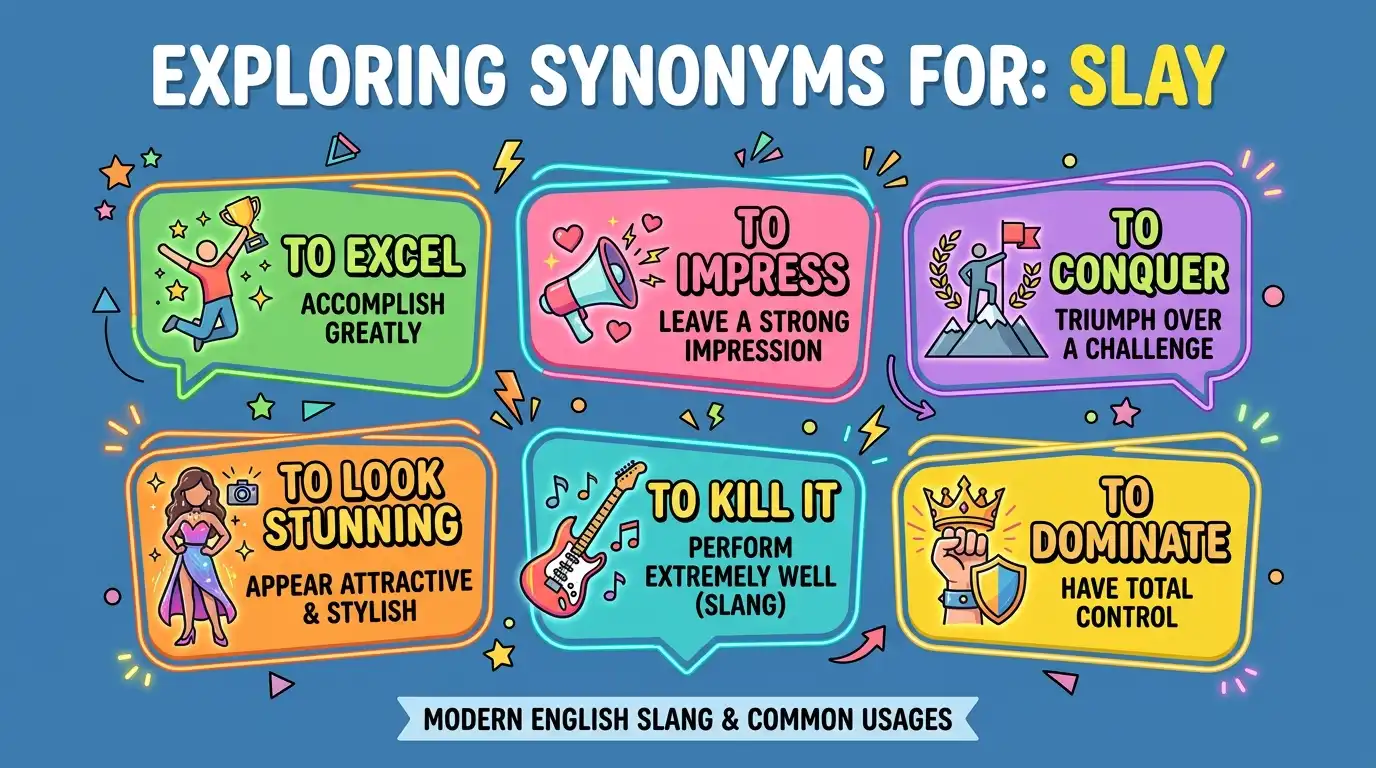
Finding the right synonyms for slay can transform your writing from plain to extraordinary. When you look up synonyms for slay, you discover words that describe either succeeding with great style or defeating a tough challenge. Exploring synonyms for slay gives you colorful options for social media posts, academic essays, and creative storytelling.
Imagine stepping onto a stage or turning in a project and doing so well that everyone cheers. In everyday modern English, people say you “slayed” that performance. The word slay simply means to do something amazingly well, to impress an audience deeply, or to defeat an opponent.
Learning different synonyms for slay helps students write lively essays without repeating slang. It allows bloggers and content writers to craft engaging headlines that grab attention. For daily English users, expanding your vocabulary makes everyday conversations more energetic and expressive.
“Words are the powerful key to unlocking human emotion and clear communication.”
“Choosing the perfect synonym turns simple ideas into memorable visual stories.”
Linguistic Profile of “Slay”
- Connotative Meaning:
- Literal: To kill, strike down, or destroy an enemy in combat.
- Figurative / Slang: To perform spectacularly, impress deeply, or dominate a task with immense skill and confidence.
- Etymology of Slay:
- Originates from Old English slēan (meaning “to strike, hit, or kill”).
- Derived from Proto-Germanic *shlahanan (“to strike”).
- Evolved in Middle English as slayen.
- Gained modern slang usage in pop culture, fashion, and performance spaces to mean “excel completely.”
- Pronunciation of Slay:
- US (IPA): /sleɪ/
- UK (IPA): /sleɪ/
- Syllables: 1 syllable (slay)
- Affixation Pattern:
- Base verb: slay
- Past tense: slew (literal) / slayed (informal/slang)
- Past participle: slain (literal) / slayed (informal/slang)
- Present participle: slaying
- Noun form: slayer
Prototype Meaning and Categorization of “Slay”
The word slay belongs to two primary prototype categories depending on context:
- Category 1: Action of Exceling / Impressing (Modern / Figurative Prototype)
- Core Meaning: Achieving outstanding success or captivating an audience through talent, style, or effort.
- Typical Contexts: Entertainment, fashion, public speaking, academic achievement, daily triumphs.
- Category 2: Action of Overcoming / Defeating (Traditional / Literal Prototype)
- Core Meaning: Overpowering, conquering, or destroying a rival or obstacle.
- Typical Contexts: Storytelling, historical accounts, fantasy literature, competitive sports.
Synonym Comparison Table
| Keyword / Synonym | Meaning | Usage Type | Context |
| Slay | To do something wonderfully well or defeat a challenge. | Casual / Slang | Daily conversation, social media, entertainment |
| Ace | To pass or complete a task with top results. | Casual / Academic | Exams, job interviews, sports games |
| Conquer | To overcome a major problem or win against a force. | Formal / Emotional | Historical battles, personal goal achievements |
| Outshine | To be much brighter or better than others around you. | Professional / Casual | Workplace achievements, artistic performances |
| Vanquish | To completely defeat an opponent in a contest or fight. | Literary / Formal | Books, speeches, dramatic stories |
| Crush | To handle a responsibility easily and successfully. | Casual / Emotional | Gym workouts, project presentations, competitions |
| Dazzle | To amaze people with beauty, talent, or bright style. | Professional / Casual | Fashion shows, music shows, design work |
50 Best Synonyms for Slay
“A rich vocabulary gives you the exact tools to paint your thoughts clearly.”
1. Conquer
- Pronunciation: US: /ˈkɑːŋ.kɚ/ | UK: /ˈkɒŋ.kə/
- Meaning: To win against a difficult problem or enemy.
- Examples:
- She worked hard to conquer her fear of public speaking.
- The team managed to conquer every team in the tournament.
2. Excel
- Pronunciation: US: /ɪkˈsel/ | UK: /ɪkˈsel/
- Meaning: To do something extremely well.
- Examples:
- Mark continues to excel in his math and science classes.
- Our company aims to excel in customer service every day.
3. Ace
- Pronunciation: US: /eɪs/ | UK: /eɪs/
- Meaning: To get a perfect result on a task or test.
- Examples:
- Maria studied all night to ace her history exam.
- He had enough practice to ace the job interview easily.
4. Vanquish
- Pronunciation: US: /ˈvæŋ.kwɪʃ/ | UK: /ˈvæŋ.kwɪʃ/
- Meaning: To defeat an opponent completely.
- Examples:
- The hero in the story worked hard to vanquish the monster.
- They hope to vanquish their rivals in the championship match.
5. Triumph
- Pronunciation: US: /ˈtraɪ.əmf/ | UK: /ˈtraɪ.ʌmf/
- Meaning: To achieve a great victory or success.
- Examples:
- The small school was able to triumph over the larger team.
- Her determination allowed her to triumph in the final round.
6. Overpower
- Pronunciation: US: /ˌoʊ.vɚˈpaʊ.ɚ/ | UK: /ˌəʊ.vəˈpaʊ.ə/
- Meaning: To gain control using greater strength or skill.
- Examples:
- The strong defense helped overpower the opposing players.
- Facts and logic will overpower false claims every time.
7. Outshine
- Pronunciation: US: /ˌaʊtˈʃaɪn/ | UK: /ˌaʊtˈʃaɪn/
- Meaning: To be much better or more noticeable than others.
- Examples:
- Her brilliant singing performance managed to outshine all other acts.
- Clean designs usually outshine cluttered ones in marketing.
8. Dazzle
- Pronunciation: US: /ˈdæz.əl/ | UK: /ˈdæz.əl/
- Meaning: To amaze someone with great talent or beauty.
- Examples:
- The bright costumes dazzle the audience at the theater.
- Her quick math skills dazzle everyone in the classroom.
9. Impress
- Pronunciation: US: /ɪmˈpres/ | UK: /ɪmˈpres/
- Meaning: To make someone feel admiration and respect.
- Examples:
- He tried his best to impress the new manager today.
- Good manners always impress people in social settings.
10. Crush
- Pronunciation: US: /krʌʃ/ | UK: /krʌʃ/
- Meaning: To perform a task with complete success.
- Examples:
- You will crush your speech if you practice enough.
- Our team plans to crush the sales goal this month.
11. Dominate
- Pronunciation: US: /ˈdɑː.mə.neɪt/ | UK: /ˈdɒm.ɪ.neɪt/
- Meaning: To be the strongest or most successful in a group.
- Examples:
- The tall player began to dominate the basketball game.
- Green energy solutions continue to dominate the market.
12. Overcome
- Pronunciation: US: /ˌoʊ.vɚˈkʌm/ | UK: /ˌəʊ.vəˈkʌm/
- Meaning: To successfully deal with a problem or hardship.
- Examples:
- She learned to overcome her anxiety through daily meditation.
- Together we can overcome any challenge that comes our way.
13. Master
- Pronunciation: US: /ˈmæs.tɚ/ | UK: /ˈmɑː.stə/
- Meaning: To gain complete knowledge or skill in a subject.
- Examples:
- It takes years of practice to master a musical instrument.
- He wants to master coding before starting his new job.
14. Defeat
- Pronunciation: US: /dɪˈfiːt/ | UK: /dɪˈfiːt/
- Meaning: To win a victory over someone in a game or contest.
- Examples:
- The chess master was able to defeat his challenger quickly.
- Good preparation helps you defeat self-doubt.
15. Nail
- Pronunciation: US: /neɪl/ | UK: /neɪl/
- Meaning: To complete something perfectly.
- Examples:
- She practiced every day to nail her dance routine.
- He managed to nail the high note during the concert.
16. Flourish
- Pronunciation: US: /ˈflɝː.ɪʃ/ | UK: /ˈflʌr.ɪʃ/
- Meaning: To grow and succeed very well.
- Examples:
- The young artist began to flourish in her new environment.
- Small businesses flourish when local neighbors support them.
17. Thrill
- Pronunciation: US: /θrɪl/ | UK: /θrɪl/
- Meaning: To cause someone to feel great excitement or pleasure.
- Examples:
- The exciting news will thrill the entire family today.
- Fast roller coasters thrill fans of extreme fun.
18. Captivate
- Pronunciation: US: /ˈkæp.tə.veɪt/ | UK: /ˈkæp.tɪ.veɪt/
- Meaning: To hold the interest and attention of someone completely.
- Examples:
- Her bedtime story was able to captivate the young children.
- The beautiful painting will captivate visitors at the museum.
19. Subdue
- Pronunciation: US: /səbˈduː/ | UK: /səbˈdʒuː/
- Meaning: To bring a person or feeling under control.
- Examples:
- The calm words helped subdue the angry feelings in the room.
- Guards worked together to subdue the chaotic crowd.
20. Outdo
- Pronunciation: US: /ˌaʊtˈduː/ | UK: /ˌaʊtˈduː/
- Meaning: To do better than someone else or your past effort.
- Examples:
- Chef David tries to outdo his best recipes every season.
- She wanted to outdo her past record in the track race.
21. Demolish
- Pronunciation: US: /dɪˈmɑː.lɪʃ/ | UK: /dɪˈmɒl.ɪʃ/
- Meaning: To destroy or ruin an opponent or structure completely.
- Examples:
- The heavy rain threatens to demolish the small sandcastle.
- The debater used facts to demolish the opposing arguments.
22. Smite
- Pronunciation: US: /smaɪt/ | UK: /smaɪt/
- Meaning: To strike firmly or defeat with a heavy blow.
- Examples:
- Ancient legends tell of heroes who smite evil forces.
- The powerful champion managed to smite his rival quickly.
23. Prevail
- Pronunciation: US: /prɪˈveɪl/ | UK: /prɪˈveɪl/
- Meaning: To prove superior and win in the end.
- Examples:
- Truth and honesty will always prevail over lies.
- The team worked together to prevail during the final seconds.
24. Beat
- Pronunciation: US: /biːt/ | UK: /biːt/
- Meaning: To defeat someone in a game, competition, or fight.
- Examples:
- Sam was proud to beat his best time in the marathon.
- Our school soccer team managed to beat the champions.
25. Overwhelm
- Pronunciation: US: /ˌoʊ.vɚˈwelm/ | UK: /ˌəʊ.vəˈwelm/
- Meaning: To defeat completely by using far greater force or talent.
- Examples:
- The star player was able to overwhelm the other defense.
- Kindness can overwhelm anger in tough situations.
26. Floor
- Pronunciation: US: /flɔːr/ | UK: /flɔː/
- Meaning: To surprise or impress someone so much they are stunned.
- Examples:
- Her incredible singing voice will floor everyone in the room.
- The surprise birthday gift served to floor my grandmother.
27. Wow
- Pronunciation: US: /waʊ/ | UK: /waʊ/
- Meaning: To excite or impress someone very much.
- Examples:
- The new magic tricks wow audiences of all ages.
- She hopes her presentation will wow the company directors.
28. Astonish
- Pronunciation: US: /əˈstɑː.nɪʃ/ | UK: /əˈstɒn.ɪʃ/
- Meaning: To surprise someone greatly with a big achievement.
- Examples:
- His quick recovery will astonish the local doctors.
- Scientific discoveries continue to astonish people worldwide.
29. Topple
- Pronunciation: US: /ˈtɑː.pəl/ | UK: /ˈtɒp.əl/
- Meaning: To remove a strong leader, power, or competitor from top position.
- Examples:
- The young team worked hard to topple the former champions.
- High prices can topple a popular brand over time.
30. Outclass
- Pronunciation: US: /ˌaʊtˈklæs/ | UK: /ˌaʊtˈklɑːs/
- Meaning: To be far better in quality or skill than a competitor.
- Examples:
- The experienced team will outclass their younger opponents.
- High-quality materials easily outclass cheap plastic alternatives.
31. Flatten
- Pronunciation: US: /ˈflæt.ən/ | UK: /ˈflæt.ən/
- Meaning: To defeat or knock down an opponent decisively.
- Examples:
- The boxer used a fast punch to flatten his opponent.
- Strong evidence helped flatten the false rumor quickly.
32. Best
- Pronunciation: US: /best/ | UK: /best/
- Meaning: To defeat or outdo someone in a match.
- Examples:
- He managed to best his brother in a game of chess.
- She worked tirelessly to best her rival in the election.
33. Outperform
- Pronunciation: US: /ˌaʊt.pɚˈfɔːrm/ | UK: /ˌaʊt.pəˈfɔːm/
- Meaning: To perform better than another person or standard.
- Examples:
- The electric car can outperform many traditional vehicles.
- Her sales record allowed her to outperform every worker.
34. Stun
- Pronunciation: US: /stʌn/ | UK: /stʌn/
- Meaning: To shock or amaze someone completely.
- Examples:
- Her stylish red dress will stun everyone at the party.
- The sudden comeback will stun sports fans everywhere.
35. Charm
- Pronunciation: US: /tʃɑːrm/ | UK: /tʃɑːm/
- Meaning: To delight and attract people easily.
- Examples:
- The speaker knows how to charm a large audience.
- Her polite personality will charm your parents right away.
36. Overthrow
- Pronunciation: US: /ˌoʊ.vɚˈθroʊ/ | UK: /ˌəʊ.vəˈθrəʊ/
- Meaning: To defeat and remove a ruling power or champion.
- Examples:
- Rebel forces worked together to overthrow the bad leader.
- The new team hopes to overthrow the current league leaders.
37. Sparkle
- Pronunciation: US: /ˈspɑːr.kəl/ | UK: /ˈspɑː.kəl/
- Meaning: To shine brightly with talent or liveliness.
- Examples:
- Her bright humor makes her sparkle in group conversations.
- Clean diamonds sparkle under the bright store lights.
38. Win
- Pronunciation: US: /wɪn/ | UK: /wɪn/
- Meaning: To achieve victory in a game, contest, or fight.
- Examples:
- Practice every day if you want to win the game.
- Her clear speech helped her win first prize today.
39. Surpass
- Pronunciation: US: /sɚˈpæs/ | UK: /səˈpɑːs/
- Meaning: To become better, greater, or stronger than expected.
- Examples:
- Your final score can surpass your original expectations.
- The new movie managed to surpass the box office sales.
40. Outmaneuver
- Pronunciation: US: /ˌaʊt.məˈnuː.vɚ/ | UK: /ˌaʊt.məˈnuː.və/
- Meaning: To gain an advantage by acting more cleverly than a rival.
- Examples:
- The smart driver was able to outmaneuver traffic easily.
- Good planning will outmaneuver competing businesses.
41. Rule
- Pronunciation: US: /ruːl/ | UK: /ruːl/
- Meaning: To dominate or be the best in a specific area.
- Examples:
- Top athletes rule their sport through constant dedication.
- Confidence helps you rule the stage during a speech.
42. Shine
- Pronunciation: US: /ʃaɪn/ | UK: /ʃaɪn/
- Meaning: To perform exceptionally well and stand out.
- Examples:
- You will shine bright during your solo performance tonight.
- Young students shine when teachers encourage their efforts.
43. Disarm
- Pronunciation: US: /dɪsˈɑːrm/ | UK: /dɪsˈɑːm/
- Meaning: To win over or soothe people using charm or kindness.
- Examples:
- Her warm smile can disarm even the angriest people.
- Humor is a great tool to disarm tense situations.
44. Mesmerize
- Pronunciation: US: /ˈmez.mə.raɪz/ | UK: /ˈmez.mə.raɪz/
- Meaning: To hold someone’s full attention as if by magic.
- Examples:
- The graceful dancer managed to mesmerize the entire crowd.
- Storytellers mesmerize children with exciting tales.
45. Electrify
- Pronunciation: US: /iˈlek.trə.faɪ/ | UK: /iˈlek.trɪ.faɪ/
- Meaning: To fill a group of people with sudden excitement.
- Examples:
- The musician’s guitar solo will electrify the stadium.
- Passionate speeches can electrify voters across the nation.
46. Rout
- Pronunciation: US: /raʊt/ | UK: /raʊt/
- Meaning: To defeat an opponent completely and force them to retreat.
- Examples:
- The home team managed to rout their main rivals today.
- Superior strategy helped rout the opposing army quickly.
47. Suppress
- Pronunciation: US: /səˈpres/ | UK: /səˈpres/
- Meaning: To put an end to something by force or control.
- Examples:
- The strong government worked to suppress the uprising.
- Deep breathing helps suppress feelings of sudden panic.
48. Exterminate
- Pronunciation: US: /ɪkˈstɝː.mə.neɪt/ | UK: /ɪkˈstɜː.mɪ.neɪt/
- Meaning: To destroy or wipe out completely.
- Examples:
- The pest control team arrived to exterminate the bugs.
- Science worked hard to exterminate dangerous old diseases.
49. Outrival
- Pronunciation: US: /ˌaʊtˈraɪ.vəl/ | UK: /ˌaʊtˈraɪ.vəl/
- Meaning: To be better or more successful than a rival.
- Examples:
- Her creative ideas easily outrival competing market products.
- Quality service will outrival lower prices over time.
50. Enchant
- Pronunciation: US: /ɪnˈtʃænt/ | UK: /ɪnˈtʃɑːnt/
- Meaning: To attract and delight someone completely.
- Examples:
- The beautiful singing voice will enchant everyone present.
- Fairy tales enchant readers with wonderful world details.
Antonyms of Slay
- Fail: To not succeed in achieving a goal.
- Lose: To be defeated in a game, contest, or fight.
- Surrender: To stop fighting and accept defeat.
- Underperform: To yield worse results than expected.
- Yield: To give up control or submit to pressure.
- Protect: To guard someone or something from harm instead of destroying them.
- Build: To create or construct rather than destroy.
Frequently Asked Questions (FAQs)
1. What does the slang word “slay” mean today?
In modern slang, “slay” means to do something exceptionally well, look amazing, or perform with outstanding confidence and style.
2. Is “slay” appropriate for formal business writing?
No. The modern slang sense of “slay” is casual. In formal business writing, use professional synonyms for slay like excel, outperform, succeed, or achieve.
3. What are the best synonyms for slay in academic essays?
In academic contexts, words like conquer, overcome, vanquish, master, and surpass work best because they maintain a formal tone.
4. What is the difference between “slay” and “vanquish”?
While both mean to defeat, “slay” is frequently used in informal slang or story settings, whereas “vanquish” is a literary word used for complete victory in serious battles or contests.
5. How can learning synonyms for slay improve my vocabulary?
Learning variations allows you to tailor your tone to your audience, avoiding repetitive slang while communicating strength and achievement clearly.
Conclusion
Expanding your range of synonyms for slay gives you the flexibility to adapt your message to any situation. Whether you are drafting a polished academic essay, crafting an attention-grabbing blog headline, or conversing casually with friends, replacing overused slang with precise vocabulary makes your expression far more impactful.
Mastering varied vocabulary improves your writing by adding precision, helps your blogging reach wider audiences through strong SEO keywords, and boosts your confidence in everyday speaking and professional communication. Try incorporating words like excel, outshine, dazzle, and conquer into your upcoming emails, essays, and personal conversations to see how quickly your communication flourishes.
“A varied vocabulary transforms casual thoughts into convincing, powerful communication.”
“When you choose words with care, your message resonates deeply with every listener.”

Andrew Powell is a travel writer and nature journalist who has spent over a decade writing about places, landscapes, and the natural world — and thinking carefully about the words that do those subjects justice ( Biography ).