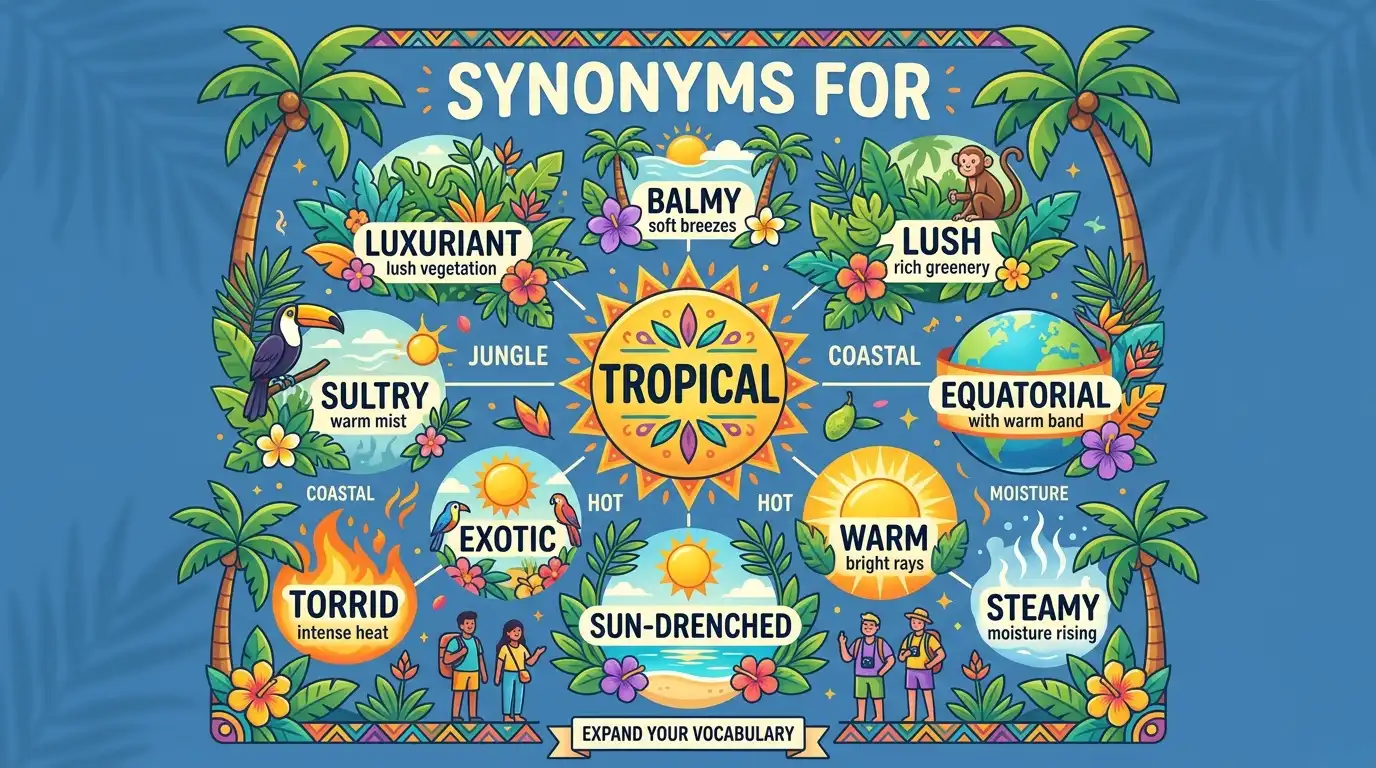
When describing a warm beach, a lush jungle, or hot summer weather, finding the right synonyms for tropical makes your writing shine. Using varied synonyms for tropical helps you avoid repetitive words and paints a vivid picture for your reader. Exploring different synonyms for tropical empowers you to express exact shades of heat, climate, and exotic beauty with ease.
Imagine standing on a warm beach with palm trees swaying softly in the breeze while eating a sweet mango. That warm, bright, and lush feeling is what we call tropical. However, using the same word over and over can make your writing feel dull and predictable.
When you describe a holiday in a travel blog or write a poem for English class, changing your vocabulary adds color and energy. The word tropical comes from warm regions near the equator where plants grow fast and temperatures stay high year-round.
Learning synonyms for tropical helps students write better essays without repeating themselves. Bloggers and content writers can create vivid travel reviews that keep readers scrolling. Daily English users can easily share stories about their summer trips with excitement and flair.
“Words are the paintbrushes of the mind, turning plain thoughts into vibrant landscapes.”
“Expanding your vocabulary opens new doors to clearer expression and creative storytelling.”
Linguistic Breakdown of “Tropical”
Connotative Meaning
- Positive: Warmth, paradise, relaxation, vibrant nature, exotic beauty, lush greenery.
- Negative/Neutral: Extreme heat, heavy humidity, rainstorms, sticky climate.
Etymology
- Origin: Derived from the Late Latin word tropicalis.
- Greek Root: From tropikos, meaning “of or pertaining to a turn or solstice” (from tropos, meaning “turn”).
- Historical Development: Originally referenced the geographic lines where the sun turns back at the solstices, later expanding to describe regions, climates, and features typical of that geographic zone.
Pronunciation
- US IPA: /ˈtrɑː.pɪ.kəl/
- UK IPA: /ˈtrɒp.ɪ.kəl/
Word Structure
- Syllables: 3 (trop-i-cal)
- Affixation Pattern: Root word tropic + Suffix -al (forming an adjective meaning “relating to”).
Comparison Table: “Tropical” vs. Related Words
| Keyword | Meaning | Usage Type | Context |
| Tropical | Relating to the hot area near the equator | Casual / Professional | Travel, climate, nature |
| Equatorial | Located directly on or near the equator | Formal / Academic | Geography, science reports |
| Exotic | Unusually colorful, exciting, or foreign | Emotional / Creative | Fashion, food, destinations |
| Lush | Growing thickly, healthy, and full of green plants | Creative / Descriptive | Gardens, forests, landscapes |
| Sultry | Uncomfortably hot and moist weather | Casual / Literary | Summer nights, weather |
| Balmy | Warm, gentle, and pleasantly soothing weather | Casual / Friendly | Evenings, vacation spots |
50 Synonyms for Tropical
1. Equatorial
- Pronunciation: US: /ˌiː.kwəˈtɔːr.i.əl/ | UK: /ˌek.wəˈtɔː.ri.əl/
- Meaning: Related to regions located directly around the earth’s equator.
- Examples:
- The island has an equatorial climate with warm rain every afternoon.
- Many equatorial animals thrive in hot and wet forests.
2. Exotic
- Pronunciation: US: /ɪɡˈzɑː.t̬ɪk/ | UK: /ɪɡˈzɒt.ɪk/
- Meaning: Originating from a distant foreign country and looking strikingly colorful or unusual.
- Examples:
- She loves collecting exotic flowers from her trips abroad.
- The market was filled with exotic fruits we had never seen before.
3. Lush
- Pronunciation: US: /lʌʃ/ | UK: /lʌʃ/
- Meaning: Growing thickly and healthily with bright green leaves.
- Examples:
- The garden was lush and full of fresh green vines.
- Heavy rainfall made the hillside look rich and lush.
4. Balmy
- Pronunciation: US: /ˈbɑː.mi/ | UK: /ˈbɑː.mi/
- Meaning: Pleasantly warm and gentle weather.
- Examples:
- We enjoyed a long walk in the balmy evening air.
- The gentle balmy breeze made the beach day perfect.
5. Torrid
- Pronunciation: US: /ˈtɔːr.ɪd/ | UK: /ˈtɒr.ɪd/
- Meaning: Very hot and dry or intensely sunny.
- Examples:
- The hikers rested under a tree to escape the torrid sun.
- Summer brings torrid temperatures to the desert region.
6. Sweltering
- Pronunciation: US: /ˈswel.tɚ.ɪŋ/ | UK: /ˈswel.tər.ɪŋ/
- Meaning: Extremely hot in an uncomfortable way.
- Examples:
- Kids bought ice cream to cool down on the sweltering day.
- The heat inside the room was sweltering without a fan.
7. Steamy
- Pronunciation: US: /ˈstiː.mi/ | UK: /ˈstiː.mi/
- Meaning: Hot and full of warm moisture or water vapor.
- Examples:
- We walked slowly through the steamy glass greenhouse.
- The air felt steamy after the heavy afternoon downpour.
8. Humid
- Pronunciation: US: /ˈhjuː.mɪd/ | UK: /ˈhjuː.mɪd/
- Meaning: Containing a high level of water vapor in the air.
- Examples:
- High humidity makes warm weather feel much hotter than it is.
- Coastal towns are often humid during the midsummer months.
9. Sultry
- Pronunciation: US: /ˈsʌl.tri/ | UK: /ˈsʌl.tri/
- Meaning: Hot, humid, and close in air quality.
- Examples:
- They sat on the patio enjoying the sultry night air.
- Sultry weather always reminds me of ocean holidays.
10. Thermal
- Pronunciation: US: /ˈθɝː.məl/ | UK: /ˈθɜː.məl/
- Meaning: Relating to heat or warm temperatures.
- Examples:
- Birds use thermal air currents to glide smoothly through the sky.
- The island is famous for its natural thermal springs.
11. Sun-drenched
- Pronunciation: US: /ˈsʌn.drentʃt/ | UK: /ˈsʌn.drentʃt/
- Meaning: Receiving a large amount of bright sunlight.
- Examples:
- They spent their vacation relaxing on a sun-drenched beach.
- The sun-drenched valley produces sweet and juicy grapes.
12. Verdant
- Pronunciation: US: /ˈvɝː.dənt/ | UK: /ˈvɜː.dənt/
- Meaning: Green with rich grass or other growing vegetation.
- Examples:
- The cows grazed on the verdant hillsides all morning.
- Rain turned the dry landscape into a verdant paradise.
13. Warm
- Pronunciation: US: /wɔːrm/ | UK: /wɔːm/
- Meaning: Having or giving out a pleasant degree of heat.
- Examples:
- Put on a light sweater for the warm evening walk.
- The ocean water felt warm and welcoming to swim in.
14. Muggy
- Pronunciation: US: /ˈmʌɡ.i/ | UK: /ˈmʌɡ.i/
- Meaning: Unpleasantly warm and damp weather.
- Examples:
- It felt muggy outside right before the rain storm hit.
- Opening the window helped clear out the muggy air inside.
15. Rainforest-like
- Pronunciation: US: /ˈreɪn.fɔːr.ɪst laɪk/ | UK: /ˈreɪn.fɒr.ɪst laɪk/
- Meaning: Resembling a thick, warm, and wet forest environment.
- Examples:
- The thick island woods felt completely rainforest-like.
- Tall plants created a shady, rainforest-like canopy.
16. Sunny
- Pronunciation: US: /ˈsʌn.i/ | UK: /ˈsʌn.i/
- Meaning: Bright with sunlight and clear skies.
- Examples:
- We planned a picnic on a bright and sunny morning.
- The resort promises sunny weather almost every month.
17. Subtropical
- Pronunciation: US: /ˌsʌbˈtrɑː.pɪ.kəl/ | UK: /ˌsʌbˈtrɒp.ɪ.kəl/
- Meaning: Bordering on or near the warm tropical zones.
- Examples:
- Citrus trees grow extremely well in subtropical regions.
- Florida has a comfortable subtropical climate in winter.
18. Oceanic
- Pronunciation: US: /ˌoʊ.ʃiˈæn.ɪk/ | UK: /ˌəʊ.ʃiˈæn.ɪk/
- Meaning: Relating to or characteristic of the ocean.
- Examples:
- A cool oceanic breeze refreshed the coastal village.
- The island supports diverse oceanic plant life.
19. Coastal
- Pronunciation: US: /ˈkoʊ.stəl/ | UK: /ˈkəʊ.stəl/
- Meaning: Located on or near the sea coast.
- Examples:
- They drove along the coastal road to view the ocean.
- Coastal towns attract millions of summer visitors each year.
20. Island-like
- Pronunciation: US: /ˈaɪ.lənd laɪk/ | UK: /ˈaɪ.lənd laɪk/
- Meaning: Similar in style or feel to a warm island.
- Examples:
- The backyard pool area had a fun, island-like design.
- Relaxing music gave the restaurant an island-like mood.
21. Heat-laden
- Pronunciation: US: /ˈhiːt.leɪ.dən/ | UK: /ˈhiːt.leɪ.dən/
- Meaning: Filled or heavy with high temperature.
- Examples:
- A heat-laden wind blew across the dusty fields.
- The afternoon air was heat-laden and completely still.
22. Sizzling
- Pronunciation: US: /ˈsɪz.əl.ɪŋ/ | UK: /ˈsɪz.əl.ɪŋ/
- Meaning: Extremely hot or burning with bright heat.
- Examples:
- Remember your sandals when walking on the sizzling sand.
- A sizzling sun beat down on the open playground.
23. Scorching
- Pronunciation: US: /ˈskɔːr.tʃɪŋ/ | UK: /ˈskɔː.tʃɪŋ/
- Meaning: Very hot, enough to burn or dry out things.
- Examples:
- We stayed indoors during the scorching noon hour.
- Scorching heat dried up the small garden pond.
24. Radiant
- Pronunciation: US: /ˈreɪ.di.ənt/ | UK: /ˈreɪ.di.ənt/
- Meaning: Sending out light or shining brightly with heat.
- Examples:
- The radiant summer sun brightened the whole sky.
- Flowers opened quickly under the radiant daylight.
25. Jungle-like
- Pronunciation: US: /ˈdʒʌŋ.ɡəl laɪk/ | UK: /ˈdʒʌŋ.ɡəl laɪk/
- Meaning: Wild, dense, and full of overgrown warm plants.
- Examples:
- Vines made the dense overgrown garden look jungle-like.
- We pushed through jungle-like bushes during our hike.
26. Palm-fringed
- Pronunciation: US: /ˈpɑːm.frɪndʒd/ | UK: /ˈpɑːm.frɪndʒd/
- Meaning: Bordered or lined with graceful palm trees.
- Examples:
- The resort sits right beside a palm-fringed shoreline.
- Tourists took photos along the palm-fringed path.
27. Paradise-like
- Pronunciation: US: /ˈpær.ə.daɪs laɪk/ | UK: /ˈpær.ə.daɪs laɪk/
- Meaning: Extremely beautiful, warm, and peaceful.
- Examples:
- Clear waters made the island feel paradise-like.
- Sitting by the sea was a paradise-like experience.
28. Summer-like
- Pronunciation: US: /ˈsʌm.ɚ laɪk/ | UK: /ˈsʌm.ər laɪk/
- Meaning: Having features or warm temperature typical of summer.
- Examples:
- We enjoyed a surprisingly summer-like day in early spring.
- Warm breezes gave October a pleasant summer-like feel.
29. Moist
- Pronunciation: US: /mɔɪst/ | UK: /mɔɪst/
- Meaning: Slightly wet or damp in a gentle way.
- Examples:
- The soil stays moist under thick forest leaves.
- Warm moist air helped the orchids bloom nicely.
30. Damp
- Pronunciation: US: /dæmp/ | UK: /dæmp/
- Meaning: Slightly wet, often in air or earth.
- Examples:
- Morning fog left the grassy trail slightly damp.
- Plants thrive easily in warm and damp conditions.
31. Sticky
- Pronunciation: US: /ˈstɪk.i/ | UK: /ˈstɪk.i/
- Meaning: Weather that causes perspiration due to heat and high humidity.
- Examples:
- I needed a cold shower after a sticky walk outside.
- High humidity made the afternoon feel hot and sticky.
32. Fiery
- Pronunciation: US: /ˈfaɪ.ri/ | UK: /ˈfaɪə.ri/
- Meaning: Brightly glowing with intense warmth or color.
- Examples:
- We watched the fiery sunset paint the sky red and orange.
- A fiery heat rose off the paved roads in July.
33. Dense
- Pronunciation: US: /dens/ | UK: /dens/
- Meaning: Packed closely together with trees or thick foliage.
- Examples:
- Sunlight could barely touch the floor of the dense forest.
- Pathfinders chopped through dense vegetation to clear a trail.
34. Overgrown
- Pronunciation: US: /ˌoʊ.vɚˈɡroʊn/ | UK: /ˌəʊ.vəˈɡrəʊn/
- Meaning: Covered with plants that have grown thickly without control.
- Examples:
- An overgrown trail led down to a hidden cove.
- Wild ferns made the old backyard look overgrown.
35. Floral
- Pronunciation: US: /ˈflɔːr.əl/ | UK: /ˈflɔː.rəl/
- Meaning: Pertaining to, decorated with, or consisting of sweet flowers.
- Examples:
- A rich floral scent drifted from the island garden.
- She wore a bright floral shirt to the beach party.
36. Bright
- Pronunciation: US: /braɪt/ | UK: /braɪt/
- Meaning: Full of strong light and vivid clear colors.
- Examples:
- Put on sunglasses to protect your eyes from bright light.
- Bright yellow flowers bloomed along the sandy shore.
37. Mild
- Pronunciation: US: /maɪld/ | UK: /maɪld/
- Meaning: Moderately warm and pleasant without harsh climate extremes.
- Examples:
- The island enjoys mild temperatures even during winter.
- A mild sea wind kept the afternoon comfortable.
38. Temperate-warm
- Pronunciation: US: /ˈtem.pɚ.ət wɔːrm/ | UK: /ˈtem.pər.ət wɔːm/
- Meaning: Comfortably warm without reaching dangerous heat levels.
- Examples:
- The valley boasts a temperate-warm climate year-round.
- Tourists love visiting for the temperate-warm autumn days.
39. Sunlit
- Pronunciation: US: /ˈsʌn.lɪt/ | UK: /ˈsʌn.lɪt/
- Meaning: Illuminated brightly by direct rays from the sun.
- Examples:
- Fish swam gracefully in the clear, sunlit ocean water.
- We rested in a cozy, sunlit corner of the garden.
40. Sun-baked
- Pronunciation: US: /ˈsʌn.beɪkt/ | UK: /ˈsʌn.beɪkt/
- Meaning: Exposed to prolonged heat and direct sunshine.
- Examples:
- Lizard species rested peacefully on the sun-baked rocks.
- Clay soil becomes very hard in sun-baked fields.
41. Southern
- Pronunciation: US: /ˈsʌð.ɚn/ | UK: /ˈsʌð.ən/
- Meaning: Situated in or belonging to warm southern lands.
- Examples:
- Many birds migrate to southern islands during winter.
- They enjoyed the warm hospitality of southern coastlines.
42. Wild
- Pronunciation: US: /waɪld/ | UK: /waɪld/
- Meaning: Growing in natural conditions without human control.
- Examples:
- Wild orchids hung naturally from big tree branches.
- The island coast remains completely wild and untouched.
43. Vibrant
- Pronunciation: US: /ˈvaɪ.brənt/ | UK: /ˈvaɪ.brənt/
- Meaning: Full of energy, life, brightness, and vivid colors.
- Examples:
- The coral reef was full of vibrant fish species.
- Bright birds added vibrant color to the green woods.
44. Colorful
- Pronunciation: US: /ˈkʌl.ɚ.fəl/ | UK: /ˈkʌl.ə.fəl/
- Meaning: Possessing many bright hues or interesting features.
- Examples:
- She bought a colorful fruit bowl at the local market.
- Parrots landed gracefully on the colorful flowering branches.
45. Abundant
- Pronunciation: US: /əˈbʌn.dənt/ | UK: /əˈbʌn.dənt/
- Meaning: Existing or available in large, rich quantities.
- Examples:
- Warm rain leads to abundant growth in forest areas.
- Fresh coconuts are abundant across the entire region.
46. Blooming
- Pronunciation: US: /ˈbluː.mɪŋ/ | UK: /ˈbluː.mɪŋ/
- Meaning: Producing fresh flowers and showing healthy growth.
- Examples:
- The valley was blooming with bright red hibiscus.
- Spring brings blooming trees across warm coastal towns.
47. Island
- Pronunciation: US: /ˈaɪ.lənd/ | UK: /ˈaɪ.lənd/
- Meaning: Relating to land surrounded completely by ocean water.
- Examples:
- They enjoyed a relaxed island life during their trip.
- Island weather can change quickly from sunny to rainy.
48. Equatorial-warm
- Pronunciation: US: /ˌiː.kwəˈtɔːr.i.əl wɔːrm/ | UK: /ˌek.wəˈtɔː.ri.əl wɔːm/
- Meaning: Consistently hot due to closeness to the equator.
- Examples:
- The region stays equatorial-warm through every season.
- Bananas thrive easily in equatorial-warm conditions.
49. Sun-kissed
- Pronunciation: US: /ˈsʌn.kɪst/ | UK: /ˈsʌn.kɪst/
- Meaning: Warmed or made attractive by bright sunshine.
- Examples:
- We spent the day resting on sun-kissed sand dunes.
- Sweet sun-kissed oranges fell straight from the tree.
50. Lush-green
- Pronunciation: US: /lʌʃ ɡriːn/ | UK: /lʌʃ ɡriːn/
- Meaning: Deep green and packed with healthy, growing foliage.
- Examples:
- The hills looked lush-green after the seasonal rains.
- We walked along a lush-green path shaded by tall trees.
“A varied vocabulary is the key that transforms simple descriptions into captivating imagery.”
Antonyms of “Tropical”
Understanding opposite terms helps highlight the specific qualities of tropical climates and settings:
- Polar: Related to extreme cold near the North or South Pole.
- Frigid: Extremely cold, freezing, and icy.
- Arctic: Cold, snowy, and characteristic of polar environments.
- Glacial: Icy, freezing, or formed by slow-moving ice glaciers.
- Arid: Extremely dry and lacking rain, unlike wet tropical zones.
- Wintry: Characteristic of cold, snowy, or freezing winter weather.
Prototype Meaning and Categorization of “Tropical”
According to Prototype Theory in cognitive linguistics, people understand words through ideal core examples (prototypes) rather than strict dictionary definitions alone.
- Prototype Core: A warm, sunny island beach with turquoise water, tall palm trees, bright fruits, and humid air.
- Category 1: Climate & Weather (Physical Characteristics): Words like equatorial, humid, sultry, steamy, balmy, torrid.
- Category 2: Flora & Landscape (Visual Elements): Words like lush, verdant, jungle-like, palm-fringed, overgrown, dense.
- Category 3: Mood & Sensory Experience (Emotional Appeal): Words like exotic, sun-drenched, vibrant, paradise-like, sun-kissed.
Frequently Asked Questions (FAQs)
1. What is the best synonym for tropical when writing about travel?
The best choice depends on your focus. For scenery, exotic or sun-drenched works best. For lush nature, verdant or palm-fringed creates strong imagery.
2. Is “equatorial” the exact same as “tropical”?
Not completely. While both describe hot regions, equatorial specifically refers to areas along the equator line, whereas tropical covers the broader band between the Tropics of Cancer and Capricorn.
3. How can I describe tropical heat without repeating “hot”?
You can use descriptive words like sultry, sweltering, steamy, muggy, or torrid depending on whether the heat is wet, dry, or uncomfortable.
4. Can “lush” be used for non-tropical environments?
Yes! Lush refers to any area with thick, green, healthy plant growth, such as a countryside meadow after spring rain.
5. Why should content writers use synonyms for tropical?
Using varied vocabulary improves SEO by targeting related search queries, keeps readers engaged, and prevents your articles from sounding repetitive.
Conclusion
Expanding your vocabulary by discovering new synonyms for tropical transforms how you express yourself in writing and speech. Whether you write travel blogs, complete high school English assignments, or chat with friends about summer plans, using rich descriptive words makes your communication more engaging. Replacing generic words with choices like balmy, exotic, verdant, or sun-drenched brings your descriptions to life.
Practicing these words regularly in your daily emails, academic essays, and casual conversations will build your vocabulary confidence. The more you experiment with nuanced terms, the easier it becomes to paint clear, memorable pictures with your words.
“Precision in speech and writing reflects clarity of thought and depth of imagination.”
“Mastering word choices gives you the power to transport your readers to distant worlds with ease.”

Andrew Powell is a travel writer and nature journalist who has spent over a decade writing about places, landscapes, and the natural world — and thinking carefully about the words that do those subjects justice ( Biography ).