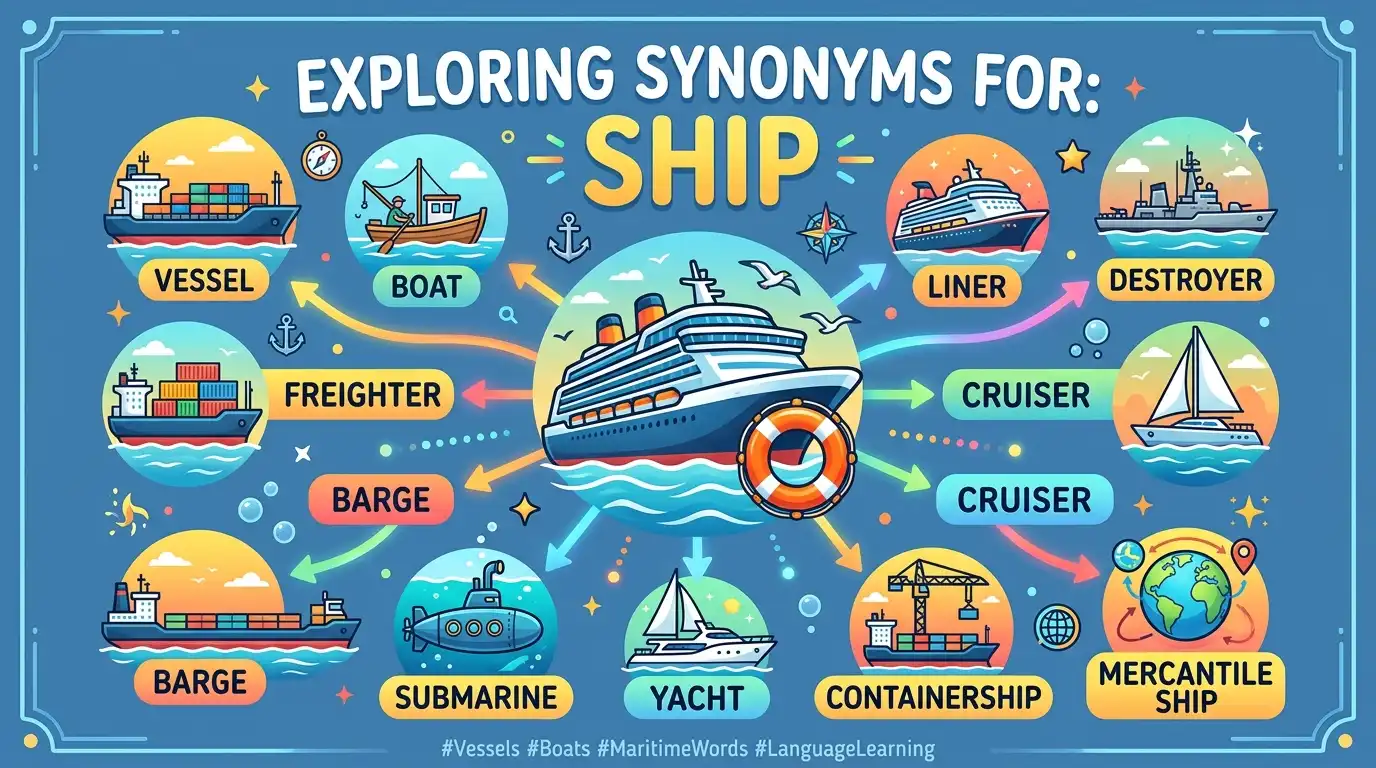
Exploring synonyms for ship gives you precise words to describe maritime vessels, oceanic transport, and delivery methods. Understanding diverse synonyms for ship allows you to describe large ocean liners, small boats, and logistics actions with clarity. Discovering these synonyms for ship helps you enhance your creative stories, business writing, and daily vocabulary across various contexts.
Navigating Words in Daily Communication
Imagine reading an adventure novel set on the open sea. Calling every floating object a ship works, but describing a vessel as a freighter, schooner, craft, or liner creates a vivid picture for your readers. Similarly, in business, saying you will dispatch, transport, or forward a package sounds far more professional than using basic terms.
In very simple English, a ship is a large boat that travels across deep water, or the act of sending goods from one place to another.
Why Word Choice Matters for Communicators
Expanding your vocabulary with these terms offers valuable benefits across many areas:
- For Students: It enhances your creative writing, history reports, and reading comprehension skills.
- For Bloggers: It makes your travel tales, maritime posts, and product reviews engaging and descriptive.
- For Content Writers: It allows you to write professional e-commerce guides, shipping policies, and logistics content effortlessly.
- For Daily English Users: It gives you clear, exact words to discuss travel, online orders, and watercraft.
“The right word can turn a simple voyage into an unforgettable adventure.”
“Precision in descriptive language anchors your ideas and elevates your communication.”
Linguistic Breakdown: Etymology, Connotation, and Structure
Connotative Meaning of “Ship”
The word ship carries strong, adventurous, and practical connotations. As a noun, it evokes images of exploration, trade, and oceanic travel. As a verb, it connotes speed, commerce, delivery, and movement across distances.
Short Etymology
- Origin: Old English scip (noun) and scipian (verb).
- Root: Derived from Proto-Germanic *skipą (vessel, boat), stemming from an ancient root meaning “to cut” or “split” (referring to hollowed-out tree trunks used as early boats).
Pronunciation
- US IPA: /ʃɪp/
- UK IPA: /ʃɪp/
Syllables & Structure
- Syllables: 1 (ship)
- Primary Stress: Monosyllable
- Affixation Pattern: Root word with no prefixes or suffixes.
Comparison Table: Choosing the Right Synonym for Ship
| Keyword | Meaning | Usage Type | Context |
| Ship | A large vessel traveling water, or to send goods | General / Standard | Maritime, commerce, daily life |
| Vessel | Any large craft designed for water travel | Formal / Nautical | Legal, maritime, shipping |
| Craft | A boat, ship, or aircraft of any size | Technical / General | Aviation, navy, trade |
| Freighter | A ship built specifically to carry cargo | Commercial | Global trade, logistics |
| Liner | A large passenger ship traveling regular routes | Elegant / Travel | Cruises, ocean travel |
| Dispatch | To send off goods or messages with speed | Professional | E-commerce, business, mail |
| Transport | To carry or move goods or people across distances | General / Professional | Logistics, travel, fleet |
| Convey | To carry or transmit items from one place to another | Formal | Law, shipping, business |
| Forward | To send goods on to a further destination | Workplace | Mail, order tracking, trade |
| Boat | A small to medium watercraft | Casual / General | Lakes, fishing, casual travel |
50 Synonyms for Ship
1. Vessel
- Pronunciation: US /ˈves.əl/ | UK /ˈves.əl/
- Meaning: Any large floating structure made for traveling on water.
- Examples:
- The naval vessel docked safely at the harbor after sunset.
- Coast guards inspected the incoming cargo vessel for safety.
2. Watercraft
- Pronunciation: US /ˈwɑː.t̬ɚ.kræft/ | UK /ˈwɔː.tə.krɑːft/
- Meaning: Any vehicle designed to travel across water.
- Examples:
- Small watercraft gathered near the marina for the annual parade.
- Safety rules apply to every watercraft operating on the lake.
3. Craft
- Pronunciation: US /kræft/ | UK /krɑːft/
- Meaning: A boat or ship used for navigation.
- Examples:
- The wooden craft glided smoothly across the quiet river.
- Sailors secured their craft to the dock before the rain started.
4. Freighter
- Pronunciation: US /ˈfreɪ.t̬ɚ/ | UK /ˈfreɪ.tə/
- Meaning: A large ship designed to transport goods and cargo.
- Examples:
- The massive freighter carried hundreds of metal shipping containers.
- Workers unloaded heavy crates from the commercial freighter.
5. Liner
- Pronunciation: US /ˈlaɪ.nɚ/ | UK /ˈlaɪ.nə/
- Meaning: A large passenger ship traveling a fixed ocean route.
- Examples:
- The luxury liner set sail for a tropical island tour.
- Passengers enjoyed dining under the stars aboard the ocean liner.
6. Transport
- Pronunciation: US /ˈtræn.spɔːrt/ | UK /ˈtræn.spɔːt/
- Meaning: To carry goods or people from one place to another.
- Examples:
- Trucks will transport the fresh produce to local grocery stores.
- The ferry serves to transport commuters across the bay daily.
7. Dispatch
- Pronunciation: US /dɪˈspætʃ/ | UK /dɪˈspætʃ/
- Meaning: To send off goods or packages promptly to a destination.
- Examples:
- The warehouse team will dispatch your order by tomorrow morning.
- They promise to dispatch emergency supplies to the storm zone quickly.
8. Convey
- Pronunciation: US /kənˈveɪ/ | UK /kənˈveɪ/
- Meaning: To carry or move items from one location to another.
- Examples:
- Ships convey vital goods between trading countries every day.
- Pipeline networks convey water directly to dry farmland areas.
9. Forward
- Pronunciation: US /ˈfɔːr.wɚd/ | UK /ˈfɔː.wəd/
- Meaning: To re-send or move goods along toward their final destination.
- Examples:
- The post office will forward your mail to your new home address.
- Logistics companies forward packages to overseas distribution hubs.
10. Boat
- Pronunciation: US /boʊt/ | UK /bəʊt/
- Meaning: A small or medium vehicle built to float on water.
- Examples:
- We rented a small motor boat to explore the mountain lake.
- The fishermen brought their boat back to shore with a full catch.
11. Cruiser
- Pronunciation: US /ˈkruː.zɚ/ | UK /ˈkruː.zə/
- Meaning: A fast, large ship built for long voyages or defense.
- Examples:
- The naval cruiser patrolled the coastline during routine training.
- Tourists booked a cabin on a luxury sea cruiser for summer.
12. Bark
- Pronunciation: US /bɑːrk/ | UK /bɑːk/
- Meaning: A traditional sailing ship with three or more masts.
- Examples:
- The museum restored an old wooden bark from the eighteenth century.
- Sailors raised tall white sails on the historic bark.
13. Tanker
- Pronunciation: US /ˈtæŋ.kɚ/ | UK /ˈtæŋ.kə/
- Meaning: A large ship designed to carry liquid cargo like oil or water.
- Examples:
- An oil tanker anchored near the harbor entrance for inspection.
- The massive tanker navigated carefully through the shipping canal.
14. Schooner
- Pronunciation: US /ˈskuː.nɚ/ | UK /ˈskuː.nə/
- Meaning: A fast sailing ship with two or more tall masts.
- Examples:
- A graceful schooner raced across the windy bay during the regatta.
- Captain Smith took charge of the two-masted schooner.
15. Frigate
- Pronunciation: US /ˈfrɪɡ.ət/ | UK /ˈfrɪɡ.ət/
- Meaning: A fast naval warship used for escorting other vessels.
- Examples:
- The military frigate escorted merchant ships through dangerous waters.
- Naval crews trained aboard the modern stealth frigate.
16. Galley
- Pronunciation: US /ˈɡæl.i/ | UK /ˈɡæl.i/
- Meaning: An ancient low sea vessel propelled mainly by oars.
- Examples:
- History books show pictures of ancient Greek galley ships.
- Rowers worked in rhythm to move the wooden galley forward.
17. Steamship
- Pronunciation: US /ˈstiːm.ʃɪp/ | UK /ˈstiːm.ʃɪp/
- Meaning: A ship powered by a steam engine rather than sails.
- Examples:
- The historic steamship carried passengers across the river for decades.
- Smoke billowed from the chimneys of the Victorian steamship.
18. Steamer
- Pronunciation: US /ˈstiː.mɚ/ | UK /ˈstiː.mə/
- Meaning: An informal term for a vessel powered by steam.
- Examples:
- Travelers boarded the old steamer for a scenic river tour.
- The river steamer blew its loud horn as it neared the dock.
19. Corvette
- Pronunciation: US /kɔːrˈvet/ | UK /kɔːˈvet/
- Meaning: A small, fast naval warship used for coastal defense.
- Examples:
- The sleek corvette moved quickly to monitor coastal safety.
- Navy engineers designed a modern stealth corvette for patrols.
20. Flagship
- Pronunciation: US /ˈflæɡ.ʃɪp/ | UK /ˈflæɡ.ʃɪp/
- Meaning: The lead vessel in a fleet carrying the commanding officer.
- Examples:
- Admiral Nelson led his fleet from his famous flagship.
- The navy deployed its primary flagship to lead the ocean exercise.
“Clear terminology grounds your storytelling, allowing every reader to chart a vivid mental course.”
21. Barge
- Pronunciation: US /bɑːrdʒ/ | UK /bɑːdʒ/
- Meaning: A long, flat-bottomed boat built to carry heavy goods on rivers.
- Examples:
- A tugboat slowly pulled the heavy grain barge down the river.
- Workers loaded coal onto the flat barge at the riverside dock.
22. Ferry
- Pronunciation: US /ˈfer.i/ | UK /ˈfer.i/
- Meaning: A vessel that carries passengers and vehicles across short waters regularly.
- Examples:
- We boarded the morning ferry to visit the neighboring island.
- The car ferry operates every hour between the two coastal towns.
23. Yacht
- Pronunciation: US /jɑːt/ | UK /jɒt/
- Meaning: A sleek luxury boat used for cruising or racing.
- Examples:
- The wealthy owner anchored his modern yacht in the bay.
- White sails caught the wind as the yacht won the weekend race.
24. Skiff
- Pronunciation: US /skɪf/ | UK /skɪf/
- Meaning: A small, light rowing or sailing boat for one or two people.
- Examples:
- The fisherman rowed his small wooden skiff into the quiet bay.
- We tied the small skiff securely to the wooden pier.
25. Canoe
- Pronunciation: US /kəˈnuː/ | UK /kəˈnuː/
- Meaning: A narrow light boat pointed at both ends, moved by paddles.
- Examples:
- Campers paddled their red canoe across the calm mountain lake.
- He bought a durable fiberglass canoe for river trips.
26. Kayak
- Pronunciation: US /ˈkaɪ.æk/ | UK /ˈkaɪ.æk/
- Meaning: A small enclosed light boat moved with a double-bladed paddle.
- Examples:
- She navigated her sea kayak through gentle ocean waves.
- Beginners practiced steering their kayak near the calm shoreline.
27. Catamaran
- Pronunciation: US /ˌkæt̬.ə.məˈræn/ | UK /ˌkæt.ə.məˈræn/
- Meaning: A boat with two parallel hulls joined by a deck frame.
- Examples:
- The dual-hull catamaran offered a very stable ride across the bay.
- Tourists booked a sunset sailing tour on a spacious catamaran.
28. Hydrofoil
- Pronunciation: US /ˈhaɪ.drə.fɔɪl/ | UK /ˈhaɪ.drə.fɔɪl/
- Meaning: A fast boat equipped with wing-like structures that lift it above water.
- Examples:
- The high-speed hydrofoil skimmed smoothly across the calm sea surface.
- Commuters took the fast hydrofoil to reach the mainland in minutes.
29. Submarine
- Pronunciation: US /ˌsʌb.məˈriːn/ | UK /ˌsʌb.məˈriːn/
- Meaning: A naval vessel capable of operating completely underwater.
- Examples:
- The military submarine dove deep below the ocean surface.
- Scientists boarded an exploration submarine to study deep trenches.
30. Tugboat
- Pronunciation: US /ˈtʌɡ.boʊt/ | UK /ˈtʌɡ.bəʊt/
- Meaning: A small, powerful boat built for towing or guiding larger ships.
- Examples:
- The sturdy tugboat guided the ocean liner safely into the harbor slip.
- Two powerful tugboat vessels pulled the heavy cargo barge upstream.
31. Clipper
- Pronunciation: US /ˈklɪp.ɚ/ | UK /ˈklɪp.ə/
- Meaning: A fast sailing ship with multiple tall masts from the 19th century.
- Examples:
- The famous clipper set a new speed record for carrying tea overseas.
- Tall white sails made the historic clipper look magnificent at sea.
32. Cutter
- Pronunciation: US /ˈkʌt̬.ɚ/ | UK /ˈkʌt.ə/
- Meaning: A small, fast single-masted boat used for patrols or rescue.
- Examples:
- The coast guard cutter responded quickly to the distress call.
- A small single-masted cutter sliced effortlessly through choppy waves.
33. Sloop
- Pronunciation: US /sluːp/ | UK /sluːp/
- Meaning: A small sailing boat with a single mast and two sails.
- Examples:
- He learned basic sailing skills aboard a classic wooden sloop.
- The sailors trimmed sails on their single-masted sloop.
34. Galleon
- Pronunciation: US /ˈɡæl.i.ən/ | UK /ˈɡæl.i.ən/
- Meaning: A large Spanish sailing ship used for trade and war in ancient times.
- Examples:
- Divers discovered gold coins inside the sunken Spanish galleon.
- The historic galleon displayed impressive wooden carvings.
35. Ark
- Pronunciation: US /ɑːrk/ | UK /ɑːk/
- Meaning: A large wooden vessel built to provide safety from floods.
- Examples:
- Storybooks tell how animals found shelter inside the giant wooden ark.
- Builders constructed a massive wooden ark as a historical model.
36. Raft
- Pronunciation: US /ræft/ | UK /rɑːft/
- Meaning: A flat floating structure made of logs or inflatable rubber.
- Examples:
- The adventurers paddled an inflatable rubber raft down river rapids.
- Survivors tied wooden logs together to build a rescue raft.
37. Yawl
- Pronunciation: US /jɑːl/ | UK /jɔːl/
- Meaning: A two-masted sailing boat with a smaller mast near the stern.
- Examples:
- The sailors steered their traditional yawl along the coastal bay.
- He bought an old wooden yawl to restore on weekends.
38. Ketch
- Pronunciation: US /ketʃ/ | UK /ketʃ/
- Meaning: A sailboat with two masts where the main mast is taller.
- Examples:
- The classic ketch handled the rough ocean wind with ease.
- Captain Mary anchored her two-masted ketch in the cove.
39. Windjammer
- Pronunciation: US /ˈwɪndˌdʒæm.ɚ/ | UK /ˈwɪndˌdʒæm.ə/
- Meaning: A large merchant sailing ship propelled entirely by wind.
- Examples:
- The magnificent windjammer sailed around the southern cape smoothly.
- Tourists gathered to watch the old windjammer enter harbor.
40. Outrigger
- Pronunciation: US /ˈaʊtˌrɪɡ.ɚ/ | UK /ˈaʊtˌrɪɡ.ə/
- Meaning: A canoe or boat featuring an external supporting float on its side.
- Examples:
- Island fishermen paddled their traditional outrigger through the reef.
- The wooden outrigger glided steadily over gentle ocean waves.
41. Freight
- Pronunciation: US /freɪt/ | UK /freɪt/
- Meaning: To load and send goods by land, sea, or air.
- Examples:
- Logistics managers freight heavy machinery across international borders regularly.
- Companies choose to freight goods by sea to save transportation costs.
42. Haul
- Pronunciation: US /hɑːl/ | UK /hɔːl/
- Meaning: To carry or transport goods over long distances.
- Examples:
- Cargo ships haul tons of raw materials across global ocean routes.
- Big trucks haul heavy equipment to construction sites daily.
43. Export
- Pronunciation: US /ɪkˈspɔːrt/ | UK /ɪkˈspɔːt/
- Meaning: To send goods or products out to another country for sale.
- Examples:
- Farmers export fresh fruits to international buyers every season.
- Our company plans to export wooden furniture across Asia.
44. Remit
- Pronunciation: US /rɪˈmɪt/ | UK /rɪˈmɪt/
- Meaning: To transmit or send money, documents, or goods to a distant place.
- Examples:
- Banks remit payments across borders electronically within seconds.
- Merchants remit invoice details to suppliers before sending goods.
45. Route
- Pronunciation: US /ruːt/ | UK /ruːt/
- Meaning: To direct and send items along a specific path or channel.
- Examples:
- Logistics systems route deliveries through the fastest highway paths.
- Dispatchers route emergency supplies to affected towns quickly.
46. Consign
- Pronunciation: US /kənˈsaɪn/ | UK /kənˈsaɪn/
- Meaning: To deliver or send goods formally into another party’s care.
- Examples:
- Merchants consign goods to local store managers for public sale.
- The artist chose to consign her paintings to an gallery.
47. Mail
- Pronunciation: US /meɪl/ | UK /meɪl/
- Meaning: To send letters, parcels, or goods through a postal system.
- Examples:
- Remember to mail your thank-you letters before the weekend.
- I will mail the birthday gift package to my cousin today.
48. Post
- Pronunciation: US /poʊst/ | UK /pəʊst/
- Meaning: To dispatch or send items via the official postal service.
- Examples:
- Please post these official documents before five o’clock today.
- She went to the local station to post her holiday greeting cards.
49. Express
- Pronunciation: US /ɪkˈspres/ | UK /ɪkˈspres/
- Meaning: To send goods rapidly using a fast delivery service.
- Examples:
- E-commerce sites express urgent orders to deliver them overnight.
- Couriers express medical samples to laboratories for fast testing.
50. Transmit
- Pronunciation: US /trænsˈmɪt/ | UK /trænzˈmɪt/
- Meaning: To send, pass on, or transfer items or information across space.
- Examples:
- Satellites transmit weather data to ground stations continuously.
- Modern systems transmit digital files securely across global networks.
Antonyms of Ship
To understand a word completely, it is equally helpful to look at its direct opposites. Where ship as a noun means a floating vessel and as a verb means to send goods, its antonyms mean to receive, hold back, or remain grounded:
- Receive: To accept or get goods that someone sent to you.
- Retain: To hold back or keep items instead of sending them out.
- Hold: To keep goods in store rather than dispatching them.
- Landcraft: A ground vehicle designed strictly for land travel rather than water.
- Unload: To remove goods from a vessel rather than shipping them out.
- Keep: To maintain possession of something instead of dispatching it.
Prototype Meaning and Categorization of Ship
In cognitive linguistics, a prototype represents the central, most typical example of a category. The central prototype of the word ship as a noun is a large, ocean-going vessel used for transport or trade, and as a verb, it represents the act of sending goods from one location to another. Depending on the context, synonyms for ship naturally fall into three primary written categories:
1. Maritime Vessels and Ocean Watercraft This category includes terms used to describe floating craft designed for water travel. Words such as vessel, watercraft, craft, freighter, liner, tanker, cruiser, and schooner represent prototype choices in maritime trade, naval history, travel writing, and ocean exploration.
2. Small Boats and Specialized Water Vehicles This group focuses on smaller, specialized, or unique water vehicles designed for sport, leisure, or specific coastal tasks. Synonyms like boat, yacht, barge, ferry, skiff, canoe, kayak, catamaran, submarine, and tugboat are ideal for everyday outdoor discussions, coastal activities, and leisure sports.
3. Delivery and Logistics Actions This category consists of verbs used to describe the act of sending, transporting, or transferring goods and information across distances. Descriptors such as dispatch, transport, convey, forward, freight, haul, export, mail, post, express, and transmit allow writers to create clear business policies, e-commerce guides, and shipping updates.
Frequently Asked Questions (FAQ)
1. What is the difference between a “ship” and a “boat”?
The classic rule of thumb is that a ship is a large ocean vessel that can carry a small boat, whereas a boat is smaller and typically designed for inland or coastal waters.
2. What is the most formal synonym for ship in business logistics?
In business and supply chain management, formal synonyms for ship (as a verb) include dispatch, transport, convey, and consign.
3. Is “vessel” a good synonym for ship in academic essays?
Yes! Vessel is an excellent formal and technical synonym for ship used widely in history, marine biology, and maritime law papers.
4. Can “ship” be used as a verb for digital items?
While ship traditionally means sending physical goods, digital teams often use ship informally to mean releasing or launching new software features.
5. What are lightweight synonyms for ship used in watersports?
Lightweight terms for watercraft used in sports and outdoor recreation include skiff, canoe, kayak, catamaran, and sloop.
Conclusion
Expanding your vocabulary with this rich selection of synonyms for ship is an effective way to improve your writing, storytelling, and communication skills. Whether you choose formal vessel terms like freighter and liner, recreational boat words like yacht and kayak, or active logistics verbs like dispatch and convey, choosing the exact right word instantly sharpens your message.
For students writing creative stories or history papers, using diverse synonyms for ship prevents repetitive language and builds strong imagery, bloggers and content writers, replacing generic terms with precise words keeps your readers engaged and improves the flow of your articles, daily English users, having a broad choice of terms helps you discuss travel, trade, and online deliveries with confidence.
Try practicing two or three of these descriptive new words this week in your emails, essays, or everyday conversations!
“A rich vocabulary provides the sturdy oars needed to navigate complex conversations.”
“Words shape our world, guiding our thoughts across seas of ideas with absolute clarity.”
“Expanding your word choices turns every written piece into a smooth and rewarding journey.”

Andrew Powell is a travel writer and nature journalist who has spent over a decade writing about places, landscapes, and the natural world — and thinking carefully about the words that do those subjects justice ( Biography ).