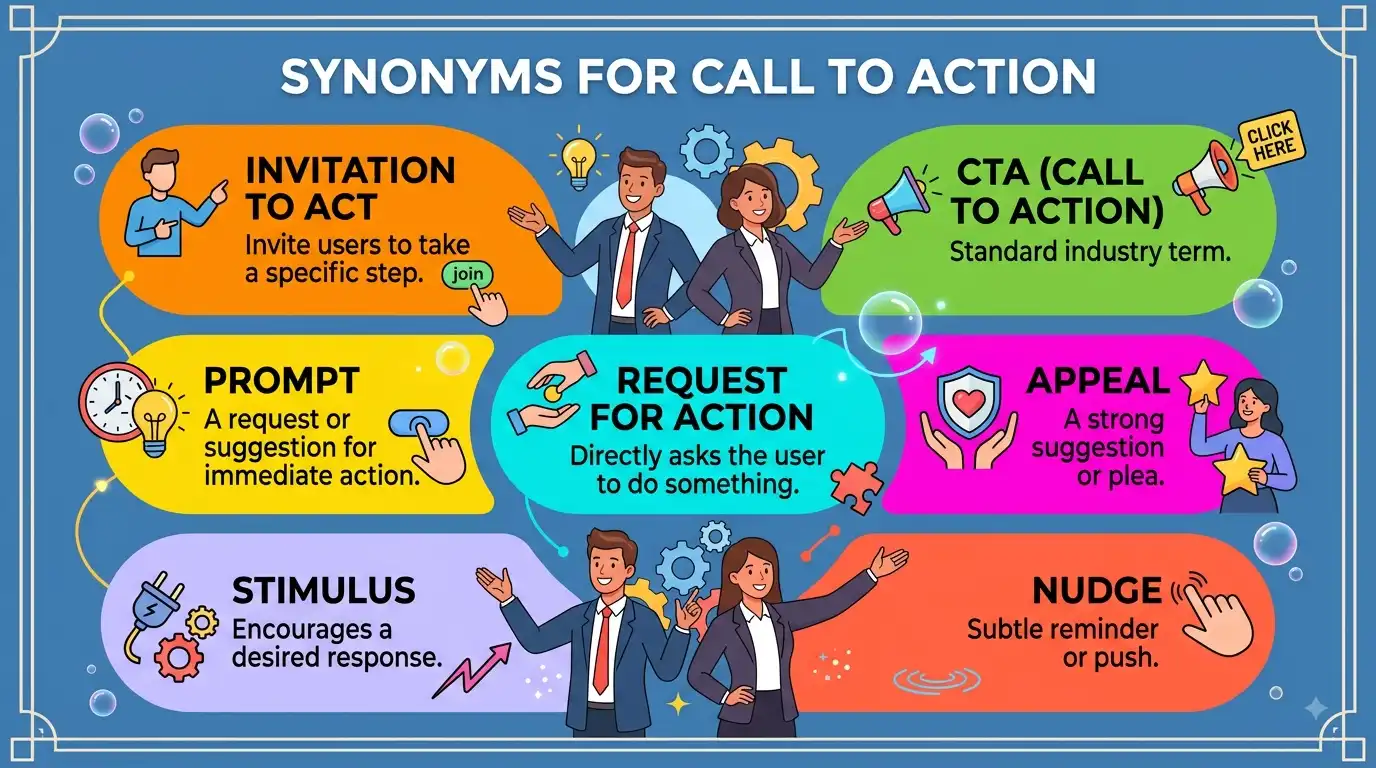
When you study synonyms for call to action, you learn active phrases that urge people to take immediate steps or make positive decisions. Furthermore, exploring various synonyms for call to action allows writers and speakers to invite participation with clarity and persuasive enthusiasm. Consequently, understanding these synonyms for call to action helps you inspire your audience whether you write a school proposal, a club flyer, or a blog post.
Inspiring Real Participation in Everyday Life
Imagine standing in front of your class to organize a park clean-up drive. If you end your presentation by saying, “Please think about joining us,” people might nod politely and forget. However, if you use a direct prompt like, “Sign up today and help us save our trees,” your audience feels motivated to act immediately. For instance, a clear prompt turns quiet interest into real community action.
In very simple words, a call to action is a statement that tells people what to do next.
Why Word Choice Matters for Communicators
Expanding your vocabulary with these active terms offers clear advantages across many areas:
- For Students: It helps you write persuasive essays, campaign speeches, and group project flyers that motivate classmates.
- For Bloggers: It keeps your readers active by encouraging them to leave comments, share posts, or join newsletters.
- For Content Writers: It allows you to guide website visitors smoothly toward downloading guides, trying tools, or subscribing.
- For Daily English Users: It gives you confident, clear phrases to organize events, ask for help, and lead group activities.
“Words that invite action transform quiet ideas into active achievements.”
“Choosing the right phrase to guide your reader builds a clear bridge between inspiration and results.”
Linguistic Breakdown: Etymology, Connotation, and Structure
Connotative Meaning of “Call to Action”
The phrase call to action carries an energetic, persuasive, authoritative, and motivating connotation. In addition, it inspires urgency, focus, and immediate participation.
Short Etymology
- Origin: Modern English rhetoric and marketing terminology (20th century).
- Root: Combines call (from Old Norse kalla, meaning to shout or summon) + to (Old English preposition indicating direction) + action (from Latin actio, meaning a doing or performing).
Pronunciation
- US IPA: /kɑːl tuː ˈæk.ʃən/
- UK IPA: /kɔːl tuː ˈæk.ʃən/
Syllables & Structure
- Syllables: 4 (call – to – ac – tion)
- Primary Stress: Third syllable (ac)
- Affixation Pattern: Root phrase combining monosyllabic verb call + preposition to + noun action (root act + suffix -ion).
Comparison Table: Choosing the Right Synonym for Call to Action
| Keyword | Meaning | Usage Type | Context |
| Call to Action | A direct statement prompting an immediate step | Professional / Marketing | Websites, speeches, essays |
| Prompt | A gentle cue that encourages someone to respond | Casual / Professional | Software, writing, classroom |
| Invitation | A friendly offer asking someone to join an event | Warm / Social | Parties, clubs, newsletters |
| Rallying Cry | An inspiring statement that unites a crowd | Emotional / Inspiring | Sports, campaigns, movements |
| Directive | An official instruction stating what to do next | Formal / Administrative | Workplace, school rules, law |
| Encouragement | Supportive words that inspire someone to act | Warm / Personal | Mentorship, family, sports |
| Urging | Strong advice persuading someone to take steps | Persuasive / Emotional | Advice, debate, leadership |
| Charge | A solemn assignment or duty given to a group | Formal / Inspiring | Graduation, leadership, team |
| Summons | An official call requesting someone’s presence | Formal / Authoritative | Meetings, court, leadership |
| Appeal | An earnest request for help or support | Emotional / Public | Charities, community, petitions |
50 Synonyms for Call to Action
1. Prompt
- Pronunciation: US /prɑːmpt/ | UK /prɒmpt/
- Meaning: A quick statement that encourages someone to act or reply.
- Examples:
- The teacher gave a helpful writing prompt to start the lesson.
- Click the onscreen prompt to save your work safely.
2. Invitation
- Pronunciation: US /ˌɪn.vəˈteɪ.ʃən/ | UK /ˌɪn.vɪˈteɪ.ʃən/
- Meaning: A polite request asking someone to join an activity.
- Examples:
- She sent a cheerful invitation for her birthday party.
- Our club extends an open invitation to all new students.
3. Rallying Cry
- Pronunciation: US /ˈræl.i.ɪŋ kraɪ/ | UK /ˈræl.i.ɪŋ kraɪ/
- Meaning: An inspiring slogan that brings people together for a goal.
- Examples:
- Protect our oceans became the main rallying cry of the march.
- The coach gave an energetic rallying cry before the final game.
4. Appeal
- Pronunciation: US /əˈpiːl/ | UK /əˈpiːl/
- Meaning: A earnest request for help, support, or agreement.
- Examples:
- The charity made a warm appeal for canned food donations.
- She launched a sincere appeal to save the neighborhood park.
5. Directive
- Pronunciation: US /dəˈrek.tɪv/ | UK /daɪˈrek.tɪv/
- Meaning: An official rule or instruction showing what steps to take.
- Examples:
- The principal issued a safety directive for science labs.
- Employees followed the new workplace directive carefully.
6. Encouragement
- Pronunciation: US /ɪnˈkɝː.ɪdʒ.mənt/ | UK /ɪnˈkʌr.ɪdʒ.mənt/
- Meaning: Words that give confidence and hope to take action.
- Examples:
- His mother offered kind encouragement before his music recital.
- Friendly encouragement helps nervous speakers succeed on stage.
7. Urging
- Pronunciation: US /ˈɝː.dʒɪŋ/ | UK /ˈɜː.dʒɪŋ/
- Meaning: Strong persuasion asking someone to do something quickly.
- Examples:
- At his friend’s urging, he tried out for the basketball team.
- With persistent urging, the team finished the science poster on time.
8. Charge
- Pronunciation: US /tʃɑːrdʒ/ | UK /tʃɑːdʒ/
- Meaning: A strong task or duty given to a person or group.
- Examples:
- The principal gave a inspiring charge to the graduating class.
- The captain accepted the charge to lead the squad bravely.
9. Summons
- Pronunciation: US /ˈsʌm.ənz/ | UK /ˈsʌm.ənz/
- Meaning: A formal message telling someone to appear or act.
- Examples:
- The student council sent a summons for a emergency meeting.
- He responded quickly to the captain’s summons on the field.
10. Motivation
- Pronunciation: US /ˌmoʊ.t̬əˈveɪ.ʃən/ | UK /ˌməʊ.tɪˈveɪ.ʃən/
- Meaning: A strong reason or drive that pushes someone to act.
- Examples:
- Winning the trophy served as great motivation for daily practice.
- Her speech provided fresh motivation for the community project.
11. Challenge
- Pronunciation: US /ˈtʃæl.ɪndʒ/ | UK /ˈtʃæl.ɪndʒ/
- Meaning: An invitation to test your skills in a task or contest.
- Examples:
- The teacher announced a fun reading challenge for the summer.
- She accepted the challenge to solve the complex puzzle.
12. Request
- Pronunciation: US /rɪˈkwest/ | UK /rɪˈkwest/
- Meaning: An act of asking politely for something to happen.
- Examples:
- He submitted a written request for extra study materials.
- The club granted her request to lead the art workshop.
13. Exhortation
- Pronunciation: US /ˌeɡ.zɔːrˈteɪ.ʃən/ | UK /ˌeɡ.zɔːˈteɪ.ʃən/
- Meaning: An urgent speech urging people to do good deeds.
- Examples:
- The leader ended her talk with an exhortation to plant trees.
- His exhortation inspired the class to study together for finals.
14. Proposal
- Pronunciation: US /prəˈpoʊ.zəl/ | UK /prəˈpəʊ.zəl/
- Meaning: A formal plan or suggestion put forward for action.
- Examples:
- The class submitted a proposal for a new chess club.
- The council approved our proposal to build a recycling station.
15. Instruction
- Pronunciation: US /ɪnˈstrʌk.ʃən/ | UK /ɪnˈstrʌk.ʃən/
- Meaning: A clear statement that tells you how to do something.
- Examples:
- Follow each step of the instruction to build the model plane.
- The coach gave clear instruction before the match started.
16. Mandate
- Pronunciation: US /ˈmæn.deɪt/ | UK /ˈmæn.deɪt/
- Meaning: An official order giving authority to take specific steps.
- Examples:
- Voters gave the mayor a clear mandate to improve public parks.
- The school issued a mandate regarding computer lab safety.
17. Signal
- Pronunciation: US /ˈsɪɡ.nəl/ | UK /ˈsɪɡ.nəl/
- Meaning: An action or event that shows it is time to act.
- Examples:
- The bell gives a clear signal for students to enter class.
- Her nod acted as a signal to start the music show.
18. Cue
- Pronunciation: US /kjuː/ | UK /kjuː/
- Meaning: A signal that tells an actor or helper to act next.
- Examples:
- The actor waited for his cue before stepping onto the stage.
- Watch the leader for your cue to begin singing.
19. Recommendation
- Pronunciation: US /ˌrek.ə.menˈdeɪ.ʃən/ | UK /ˌrek.ə.menˈdeɪ.ʃən/
- Meaning: A helpful suggestion advising the best choice or action.
- Examples:
- The librarian offered a great book recommendation for history lovers.
- She followed the doctor’s recommendation to rest for two days.
20. Command
- Pronunciation: US /kəˈmænd/ | UK /kəˈmɑːnd/
- Meaning: A firm order given by someone in authority.
- Examples:
- The officer gave a direct command to clear the path.
- Trained dogs follow every command with great care.
“Clear directives guide human energy toward shared goals and great results.”
21. Suggestion
- Pronunciation: US /səˈdʒes.tʃən/ | UK /səˈdʒes.tʃən/
- Meaning: An idea offered for people to consider or try.
- Examples:
- She dropped a helpful suggestion into the club idea box.
- His suggestion made the group game much more fun.
22. Pitch
- Pronunciation: US /pɪtʃ/ | UK /pɪtʃ/
- Meaning: A persuasive talk aimed at convincing people to join or buy.
- Examples:
- The student gave a short pitch to promote the school newspaper.
- Their creative pitch won first prize in the young speaker contest.
23. Plea
- Pronunciation: US /pliː/ | UK /pliː/
- Meaning: An emotional request asking for immediate help.
- Examples:
- The shelter made a plea for pet blankets before winter.
- Her quiet plea convinced her friends to help search for the lost keys.
24. Order
- Pronunciation: US /ˈɔːr.dɚ/ | UK /ˈɔː.də/
- Meaning: An authoritative instruction to carry out a specific task.
- Examples:
- The captain gave an order to drop the anchor near the shore.
- Students followed the safety order during the fire drill.
25. Guideline
- Pronunciation: US /ˈɡaɪd.laɪn/ | UK /ˈɡaɪd.laɪn/
- Meaning: A rule or advice that shows how to complete an action.
- Examples:
- Read every guideline before starting your poster design.
- The teacher explained the project guideline clearly today.
26. Bidding
- Pronunciation: US /ˈbɪd.ɪŋ/ | UK /ˈbɪd.ɪŋ/
- Meaning: An order or request from someone in authority.
- Examples:
- The helpers completed the task at the captain’s bidding.
- She carried out her teacher’s bidding cheerfully.
27. Call
- Pronunciation: US /kɑːl/ | UK /kɔːl/
- Meaning: An invitation or demand asking people to act or assemble.
- Examples:
- The mayor issued a call for community volunteers.
- Everyone answered the call to clean the neighborhood garden.
28. Motion
- Pronunciation: US /ˈmoʊ.ʃən/ | UK /ˈməʊ.ʃən/
- Meaning: A formal proposal made during a group meeting for voting.
- Examples:
- She introduced a motion to extend library hours on Fridays.
- The committee passed the motion unanimously after a short discussion.
29. Push
- Pronunciation: US /pʊʃ/ | UK /pʊʃ/
- Meaning: A strong, organized effort to achieve a goal.
- Examples:
- Our school started a major push to reduce plastic waste.
- The final study push helped everyone score well on tests.
30. Incentive
- Pronunciation: US /ɪnˈsen.t̬ɪv/ | UK /ɪnˈsen.tɪv/
- Meaning: A reward or benefit that encourages someone to work harder.
- Examples:
- Extra recess time served as a great incentive for clean desks.
- The club offers a badge as an incentive for new members.
31. Entreaty
- Pronunciation: US /ɪnˈtriː.t̬i/ | UK /ɪnˈtriː.ti/
- Meaning: A serious and humble request for assistance or kindness.
- Examples:
- She made a sincere entreaty for quiet during the presentation.
- The group listened to his entreaty for teamwork and unity.
32. Reminder
- Pronunciation: US /rɪˈmaɪn.dɚ/ | UK /rɪˈmaɪn.də/
- Meaning: A message that helps you remember to complete a task.
- Examples:
- Set a friendly reminder on your phone to turn in homework.
- The principal sent a reminder about picture day next week.
33. Nudge
- Pronunciation: US /nʌdʒ/ | UK /nʌdʒ/
- Meaning: A gentle push or reminder that encourages action.
- Examples:
- A gentle nudge from her teammate gave her confidence to speak.
- The app sends a daily nudge to drink enough water.
34. Spurring
- Pronunciation: US /ˈspɝː.ɪŋ/ | UK /ˈspɜː.ɪŋ/
- Meaning: An action that encourages someone to move or act faster.
- Examples:
- Her inspiring story provided the spurring we needed to begin.
- Friendly competition gives a helpful spurring to study habits.
35. Instigation
- Pronunciation: US /ˌɪn.stəˈɡeɪ.ʃən/ | UK /ˌɪn.stɪˈɡeɪ.ʃən/
- Meaning: The act of starting or initiating a campaign or action.
- Examples:
- At her instigation, the neighborhood started a book club.
- The new garden project began through student instigation.
36. Beacon
- Pronunciation: US /ˈbiː.kən/ | UK /ˈbiː.kən/
- Meaning: An inspiring light or signal that guides people toward a decision.
- Examples:
- Her dedication served as a guiding beacon for younger students.
- Truth acts as a steady beacon when making tough choices.
37. Spark
- Pronunciation: US /spɑːrk/ | UK /spɑːk/
- Meaning: A sudden event or idea that sets off a larger action.
- Examples:
- Her creative speech provided the spark for our recycling drive.
- A single good idea can act as a spark for major progress.
38. Catalyst
- Pronunciation: US /ˈkæt̬.əl.ɪst/ | UK /ˈkæt.əl.ɪst/
- Meaning: Something that causes an action or change to happen quickly.
- Examples:
- The rainstorm acted as a catalyst for fixing the roof.
- Her speech served as a powerful catalyst for student teamwork.
39. Demand
- Pronunciation: US /dɪˈmænd/ | UK /dɪˈmɑːnd/
- Meaning: A forceful requirement stating that an action must be done.
- Examples:
- The team made a fair demand for equal practice hours.
- Readers supported the demand for more science books in school.
40. Rally
- Pronunciation: US /ˈræl.i/ | UK /ˈræl.i/
- Meaning: A gathering designed to build enthusiasm and inspire action.
- Examples:
- Students organized a pep rally to support the football team.
- The community held a outdoor rally for local wildlife protection.
41. Petition
- Pronunciation: US /pəˈtɪʃ.ən/ | UK /pəˈtɪʃ.ən/
- Meaning: A formal written request signed by many people asking for action.
- Examples:
- Students signed a petition for healthier school cafeteria snacks.
- Neighbors presented a petition to install a new crosswalk.
42. Slogan
- Pronunciation: US /ˈsloʊ.ɡən/ | UK /ˈsləʊ.ɡən/
- Meaning: A short, catchy phrase used to invite interest or action.
- Examples:
- The club created a memorable slogan for their art show.
- A simple slogan helps people remember the main goal easily.
43. Message
- Pronunciation: US /ˈmes.ɪdʒ/ | UK /ˈmes.ɪdʒ/
- Meaning: A key idea or advice sent to guide someone’s choices.
- Examples:
- The speaker delivered an inspiring message about perseverance.
- The video ended with a clear message to conserve water.
44. Advice
- Pronunciation: US /ədˈvaɪs/ | UK /ədˈvaɪs/
- Meaning: Guidance or recommendations offered to help someone make decisions.
- Examples:
- She followed her teacher’s advice and started studying early.
- Good advice helps you avoid common project mistakes.
45. Instruction-step
- Pronunciation: US /ɪnˈstrʌk.ʃən.step/ | UK /ɪnˈstrʌk.ʃən.step/
- Meaning: A specific action point within a list of directions.
- Examples:
- Complete every instruction-step before turning in your exam.
- The manual highlights each instruction-step with clear pictures.
46. Direction
- Pronunciation: US /dəˈrek.ʃən/ | UK /daɪˈrek.ʃən/
- Meaning: Guidance or orders telling you where to go or what to do.
- Examples:
- Under her clear direction, the team finished the science project.
- Follow the teacher’s direction during the museum tour.
47. Trigger
- Pronunciation: US /ˈtrɪɡ.ɚ/ | UK /ˈtrɪɡ.ə/
- Meaning: An event or prompt that causes an immediate response.
- Examples:
- The final whistle acted as a trigger for wild celebration.
- Cold weather serves as a trigger for buying warm coats.
48. Goal-statement
- Pronunciation: US /ɡoʊl.steɪt.mənt/ | UK /ɡəʊl.steɪt.mənt/
- Meaning: A clear declaration describing what a group aims to achieve.
- Examples:
- Our class wrote a goal-statement to read twenty books this term.
- A strong goal-statement keeps team members focused on results.
49. Action-step
- Pronunciation: US /ˈæk.ʃən.step/ | UK /ˈæk.ʃən.step/
- Meaning: A specific, practical task that moves a project forward.
- Examples:
- Writing an outline serves as the first action-step for an essay.
- Assigning roles was a key action-step in our group assignment.
50. Offer
- Pronunciation: US /ˈɑː.fɚ/ | UK /ˈɒf.ə/
- Meaning: An expression of readiness to give something or invite participation.
- Examples:
- The club presented a generous offer of free tutoring sessions.
- Accept this offer to join our weekend coding club today.
Antonyms of Call to Action
To understand this concept completely, it helps to examine contrasting words that describe stopping, delaying, or discouraging steps:
- Discouragement: Words or actions that dissuade someone from moving forward.
- Deterrent: Something that prevents or discourages an action.
- Hindrance: A barrier that slows down or blocks progress.
- Suppression: The act of stopping or holding back an effort.
- Silence: The absence of any direction, prompt, or invitation.
- Inaction: A state of doing nothing or withholding steps.
Prototype Meaning and Categorization of Call to Action
In cognitive linguistics, a prototype represents the central, most typical example of a category. The central prototype of the phrase call to action is an explicit, persuasive request or statement that invites an immediate, practical response from an audience. Depending on the speaker’s tone, context, and intention, synonyms for call to action naturally fall into three primary written categories:
1. Professional and Direct Prompts This category includes structured, official terms used when leaders, writers, or administrators issue clear guidance. Words such as directive, instruction, mandate, proposal, recommendation, and action-step represent prototype choices in business communications, school guidelines, and technical content where clarity and order are essential.
2. Inspiring and Emotional Appeals This group focuses on words that motivate people through passion, values, or shared enthusiasm. Synonyms like rallying cry, appeal, exhortation, charge, motivation, and plea are typically used in public speeches, community campaigns, sports rallies, and persuasive writing to unite listeners behind a meaningful cause.
3. Friendly and Casual Invitations This category consists of light, welcoming words suitable for daily conversations, school clubs, and social posts. Descriptors such as invitation, prompt, nudge, suggestion, reminder, and offer allow speakers to invite participation gently without sounding overly forceful or commanding.
Frequently Asked Questions (FAQ)
1. What is the main purpose of a call to action?
The main purpose of a call to action is to guide your audience toward a clear, immediate next step, such as signing up, leaving a comment, or joining an event.
2. What is a formal synonym for call to action in academic writing?
In formal essays and proposals, effective synonyms for call to action include directive, recommendation, proposal, exhortation, and action-step.
3. What are gentle, casual synonyms for call to action?
Friendly and casual alternatives include nudge, prompt, invitation, suggestion, and reminder.
4. How does using different synonyms for call to action improve blog posts?
Varying your phrasing prevents your writing from sounding like repetitive sales copy, keeping readers engaged while guiding them naturally.
5. Can a “slogan” act as a call to action?
Yes! When a slogan includes an active verb—such as “Protect Our Planet”—it serves as both a catchy brand phrase and a clear call to action.
Conclusion
Expanding your vocabulary with this rich collection of synonyms for call to action is an outstanding way to elevate your communication, writing, and leadership skills. Whether you select structured terms like directive and action-step, inspiring phrases like rallying cry and appeal, or welcoming words like invitation and nudge, choosing the precise phrase helps you lead your audience effectively.
For students writing persuasive essays or campaign speeches, using diverse synonyms for call to action prevents repetitive phrasing and shows a mature command of rhetorical tools, bloggers and content writers, replacing generic buttons with clear, vivid prompts keeps readers active and improves audience response rates, daily speakers, having a broad vocabulary of action-oriented phrases helps you organize events, guide group work, and share ideas confidently.
Try practicing two or three of these engaging new terms today in your essays, emails, or group projects!
“Clear calls to action turn passive listeners into active participants.”
“A persuasive vocabulary gives you the exact tools needed to move ideas into real accomplishment.”
“Mastering active phrasing empowers you to communicate with purpose, clarity, and lasting impact.”

Andrew Powell is a travel writer and nature journalist who has spent over a decade writing about places, landscapes, and the natural world — and thinking carefully about the words that do those subjects justice ( Biography ).