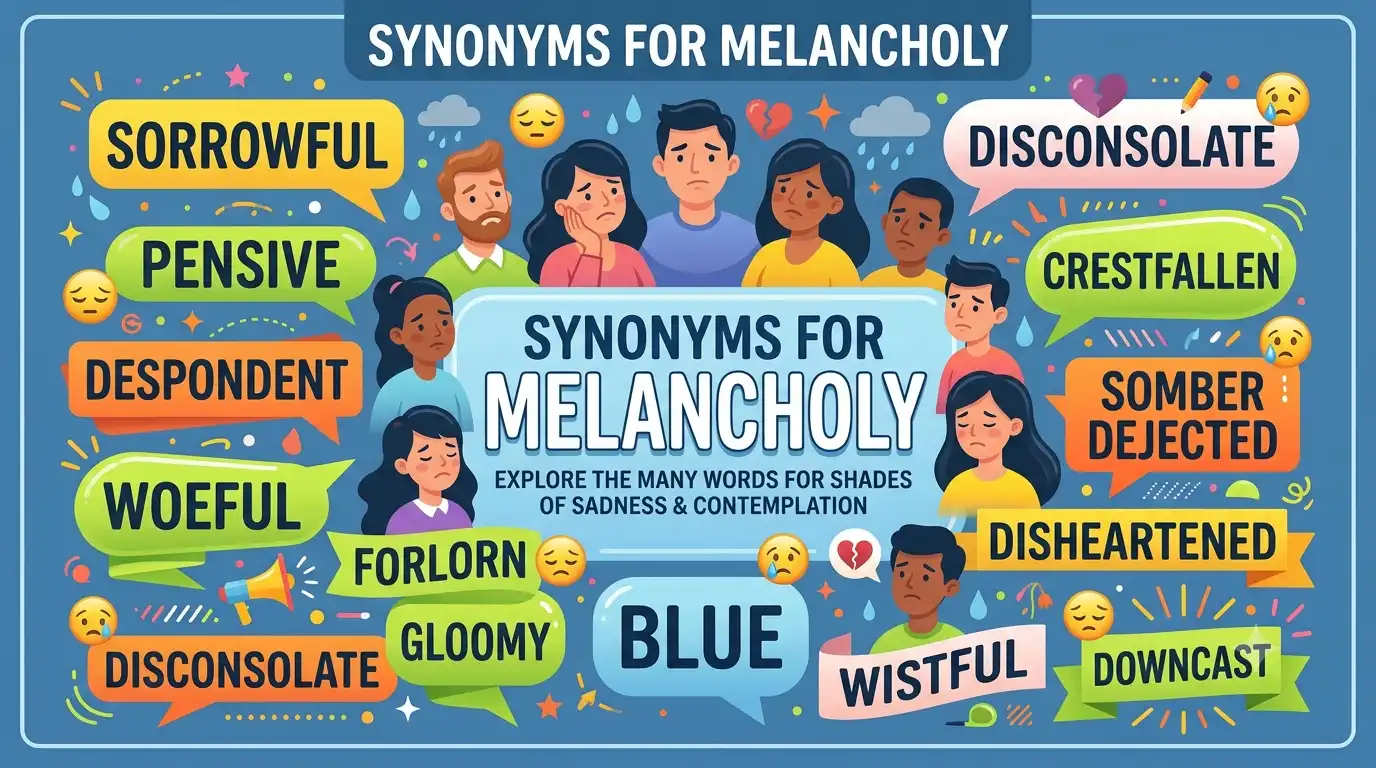
Exploring synonyms for melancholy helps you find the right words to describe gentle sadness, thoughtful quietness, and reflective moods in your writing. Learning various synonyms for melancholy allows you to show deep emotion in stories, poetry, and personal journal entries. Understanding these synonyms for melancholy enables you to express subtle feelings without repeating basic words like sad or blue over and over.
Capturing Gentle Emotions in Stories and Thoughts
Picture sitting by a window on a quiet, rainy afternoon while watching autumn leaves fall softly to the ground. Calling that feeling sad works, but describing the atmosphere as somber, pensive, or wistful paints a far richer emotional picture for your reader. Exploring synonyms for melancholy gives you thoughtful, descriptive, and poetic words to bring these peaceful, reflective moments to life.
In very simple English, melancholy means a gentle, quiet feeling of sadness or deep thought that lasts for a short time.
Why Word Choice Matters for Communicators
Expanding your vocabulary with these expressive emotional terms offers great benefits across all areas:
- For Students: It helps you analyze literary themes, character emotions, and poetic moods clearly in your English essays.
- For Bloggers: It makes your personal stories, reflective journal posts, and book reviews far more engaging for readers.
- For Content Writers: It allows you to write touching marketing narratives, emotional brand stories, and creative scripts with nuance.
- For Daily English Users: It gives you gentle, precise words to share how you feel during quiet or thoughtful moments.
“Words are the quiet mirrors of our deepest feelings, allowing us to share every gentle shade of the human heart.”
“Choosing the right word turns a simple emotion into a memorable picture that touches the reader.”
Linguistic Breakdown: Etymology, Connotation, and Structure
Connotative Meaning of “Melancholy”
The word melancholy carries a quiet, thoughtful, poetic, and reflective connotation. Unlike sharp grief or overwhelming despair, melancholy often describes a soft, gentle sadness blended with peaceful contemplation.
Short Etymology
- Origin: Late Middle English (14th century).
- Root: Derived from Old French melancolie, via Late Latin from Greek melankholia, combining melas (black) + khole (bile). In ancient medicine, people believed a black humor caused quiet, thoughtful moods.
Pronunciation
- US IPA: /ˈmel.ən.kɑːl.i/
- UK IPA: /ˈmel.ən.kəl.i/
Syllables & Structure
- Syllables: 4 (mel – an – chol – y)
- Primary Stress: First syllable (mel)
- Affixation Pattern: Root melan- (black/dark) + Root choly (humor/bile).
Comparison Table: Choosing the Right Synonym for Melancholy
| Keyword | Meaning | Usage Type | Context |
| Melancholy | A gentle, quiet feeling of sadness and thought | Poetic / General | Literature, quiet moments, art |
| Pensive | Thinking deeply about something in a quiet way | Thoughtful / Calm | Study, reflection, writing |
| Somber | Serious, dark, or quiet in mood or tone | Formal / Descriptive | Weather, speeches, ceremonies |
| Wistful | Feeling sad while longing for something past | Emotional / Gentle | Memories, old photos, dreams |
| Gloomy | Dark, dim, or feeling low in spirits | Casual / General | Weather, rooms, bad days |
| Muted | Quiet, soft, and restrained in expression | Subtle / Artistic | Music, feelings, art designs |
| Sorrowful | Full of sadness or deep regret | Emotional / Serious | Stories, personal loss, poetry |
| Dejected | Feeling low because of a minor disappointment | Casual / Personal | Sports, test scores, news |
| Downcast | Looking downward because of quiet sadness | Descriptive / Friendly | Body language, quiet moments |
| Lonesome | Feeling sad because you are alone | Personal / Warm | Travel, quiet evenings, distance |
50 Synonyms for Melancholy
1. Pensive
- Pronunciation: US /ˈpen.sɪv/ | UK /ˈpen.sɪv/
- Meaning: Thinking deeply about something in a quiet and serious way.
- Examples:
- She looked out the window with a pensive expression on her face.
- The quiet music put him in a pensive mood during the evening walk.
2. Somber
- Pronunciation: US /ˈsɑːm.bɚ/ | UK /ˈsɒm.bə/
- Meaning: Serious, quiet, and slightly dark in tone or appearance.
- Examples:
- The rainy afternoon created a somber mood in the quiet classroom.
- Everyone spoke in somber voices during the historic memorial service.
3. Wistful
- Pronunciation: US /ˈwɪst.fəl/ | UK /ˈwɪst.fəl/
- Meaning: Feeling a little sad while wishing for something from the past.
- Examples:
- He gave a wistful smile as he looked at his old childhood photo album.
- She felt a wistful longing for her old summer camp friends.
4. Gloomy
- Pronunciation: US /ˈɡluː.mi/ | UK /ˈɡluː.mi/
- Meaning: Dark, dim, or low in spirits and cheer.
- Examples:
- Dark gray clouds made the morning feel gloomy and cold.
- He tried to smile so he would not feel gloomy on a rainy day.
5. Sorrowful
- Pronunciation: US /ˈsɔːr.oʊ.fəl/ | UK /ˈsɒr.əʊ.fəl/
- Meaning: Full of sadness or deep regret over something lost.
- Examples:
- The poem ended with a sorrowful line about saying goodbye.
- She heard a sorrowful song playing on the old radio.
6. Dejected
- Pronunciation: US /dɪˈdʒek.tɪd/ | UK /dɪˈdʒek.tɪd/
- Meaning: Feeling unhappy or disappointed after a minor set-back.
- Examples:
- He felt dejected when his team missed the final game point.
- She walked home with a dejected look after losing her keys.
7. Downcast
- Pronunciation: US /ˈdaʊn.kæst/ | UK /ˈdaʊn.kɑːst/
- Meaning: Looking downward or feeling low in energy and spirits.
- Examples:
- The quiet student kept her eyes downcast during the presentation.
- His downcast mood lifted after talking with his best friend.
8. Lonesome
- Pronunciation: US /ˈloʊn.səm/ | UK /ˈləʊn.səm/
- Meaning: Feeling sad because you are alone or far from home.
- Examples:
- He felt a bit lonesome on his first night at summer camp.
- A lonesome whistle blew across the quiet valley at midnight.
9. Mournful
- Pronunciation: US /ˈmɔːrn.fəl/ | UK /ˈmɔːn.fəl/
- Meaning: Expressing deep sadness like someone who misses a dear friend.
- Examples:
- The owl made a soft, mournful sound in the high trees.
- She played a mournful tune on her wooden flute.
10. Woeful
- Pronunciation: US /ˈwoʊ.fəl/ | UK /ˈwəʊ.fəl/
- Meaning: Full of trouble, sadness, or unfortunate news.
- Examples:
- He shared a woeful story about losing his favorite jacket.
- The sad play told the woeful tale of two lost travelers.
11. Heavyhearted
- Pronunciation: US /ˌhev.iˈhɑːr.t̬ɪd/ | UK /ˌhev.iˈhɑː.tɪd/
- Meaning: Feeling weighed down by quiet worry or sadness.
- Examples:
- She felt heavyhearted as she packed her bags to move away.
- The team returned home heavyhearted after the loss.
12. Despondent
- Pronunciation: US /dɪˈspɑːn.dənt/ | UK /dɪˈspɒn.dənt/
- Meaning: Feeling low on hope or energy for a short time.
- Examples:
- Do not stay despondent when a project fails on the first try.
- Friendly words helped the boy feel less despondent.
13. Blue
- Pronunciation: US /bluː/ | UK /bluː/
- Meaning: Feeling slightly sad or low in spirits in a daily way.
- Examples:
- She felt a little blue on Sunday evening before school started.
- Cheerful music can help you when you feel blue.
14. Downhearted
- Pronunciation: US /ˌdaʊnˈhɑːr.t̬ɪd/ | UK /ˌdaʊnˈhɑː.tɪd/
- Meaning: Discouraged or lacking cheer for a moment.
- Examples:
- He was downhearted when it rained on park day, but stayed kind.
- Her mom cheered her up whenever she felt downhearted.
15. Crestfallen
- Pronunciation: US /ˈkrest.fɑː.lən/ | UK /ˈkrest.fɔː.lən/
- Meaning: Disappointed and sad because a hope did not come true.
- Examples:
- He looked crestfallen when the ice cream shop was closed.
- She was crestfallen after missing her bus, but took the next one.
16. Subdued
- Pronunciation: US /səbˈduːd/ | UK /səbˈdʒuːd/
- Meaning: Quiet, soft, and calmer than usual in voice or behavior.
- Examples:
- The room remained subdued while the teacher read the quiet story.
- Her cheer was subdued because she was feeling tired.
17. Lugubrious
- Pronunciation: US /ləˈɡuː.bri.əs/ | UK /ləˈɡuː.bri.əs/
- Meaning: Looking or sounding overly sad and serious in a dramatic way.
- Examples:
- The actor adopted a lugubrious voice for his funny theater role.
- He gave a lugubrious sigh when told to clean his desk.
18. Doleful
- Pronunciation: US /ˈdoʊl.fəl/ | UK /ˈdəʊl.fəl/
- Meaning: Expressing grief, sadness, or a gloomy mood.
- Examples:
- The puppy gave a doleful look when his owner left for work.
- She sang a doleful ballad by the campfire.
19. Disconsolate
- Pronunciation: US /dɪsˈkɑːn.sə.lət/ | UK /dɪsˈkɒn.sə.lət/
- Meaning: Very unhappy and unable to be comforted easily.
- Examples:
- The little girl was disconsolate after dropping her balloon.
- He sat disconsolate on the bench until his friend brought a ball.
20. Glum
- Pronunciation: US /ɡlʌm/ | UK /ɡlʌm/
- Meaning: Silent, gloomy, and slightly annoyed or sad.
- Examples:
- Why do you look so glum on this sunny morning?
- He sat with a glum expression while waiting for the train.
“Even the quietest emotional storm carries a gentle lesson about the beauty of quiet thought.”
21. Bleak
- Pronunciation: US /bliːk/ | UK /bliːk/
- Meaning: Cold, bare, or offering little warmth and cheer.
- Examples:
- The winter hill looked bleak under the gray sky.
- Despite the bleak weather, they enjoyed their warm indoor tea.
22. Plaintive
- Pronunciation: US /ˈpleɪn.t̬ɪv/ | UK /ˈpleɪn.tɪv/
- Meaning: Sounding sad and mournful in a sweet or soft way.
- Examples:
- We listened to the plaintive cry of a solitary sea bird.
- The violin played a plaintive melody across the hall.
23. Down in the dumps
- Pronunciation: US /daʊn ɪn ðə dʌmps/ | UK /daʊn ɪn ðə dʌmps/
- Meaning: Feeling sad, discouraged, or low in mood.
- Examples:
- He was down in the dumps after losing his favorite pen.
- A walk in the sunshine helped her stop feeling down in the dumps.
24. Low-spirited
- Pronunciation: US /ˌloʊˈspɪr.ə.t̬ɪd/ | UK /ˌləʊˈspɪr.ɪ.tɪd/
- Meaning: Lacking energy, cheerfulness, or enthusiasm.
- Examples:
- The rainy morning left the class feeling a bit low-spirited.
- A warm smile can help a low-spirited friend feel better.
25. Funereal
- Pronunciation: US /fjʊˈnɪr.i.əl/ | UK /fjʊˈnɪə.ri.əl/
- Meaning: Very solemn, slow, and dark like a quiet ceremony.
- Examples:
- The organ played at a funereal pace during the quiet scene.
- The room had a funereal silence while results were announced.
26. Forlorn
- Pronunciation: US /fɚˈlɔːrn/ | UK /fəˈlɔːn/
- Meaning: Looking sad, lonely, and uncared for in appearance.
- Examples:
- A forlorn little coat was left sitting on the playground park bench.
- He gave a forlorn look as the boat sailed away from the dock.
27. Melancholic
- Pronunciation: US /ˌmel.ənˈkɑː.lɪk/ | UK /ˌmel.ənˈkɒl.ɪk/
- Meaning: Characterized by a habitual soft sadness or quiet reflection.
- Examples:
- The painter loved using melancholic blue tones in his art.
- She wrote a melancholic poem about the end of summer.
28. Heartbroken
- Pronunciation: US /ˈhɑːrtˌbroʊ.kən/ | UK /ˈhɑːtˌbrəʊ.kən/
- Meaning: Suffering from overwhelming sadness or grief.
- Examples:
- The child was heartbroken when his toy tower fell over.
- She felt heartbroken after saying goodbye to her grandmother.
29. Down-in-the-mouth
- Pronunciation: US /daʊn.ɪn.ðə.maʊθ/ | UK /daʊn.ɪn.ðə.maʊθ/
- Meaning: Looking unhappy or wearing a sad expression.
- Examples:
- You look a bit down-in-the-mouth today; is everything okay?
- He was down-in-the-mouth until his sister shared a joke.
30. Morose
- Pronunciation: US /məˈroʊs/ | UK /məˈrəʊs/
- Meaning: Sullen, gloomy, and unwilling to talk much to others.
- Examples:
- He became morose and quiet after making a mistake in the game.
- Sitting alone made him feel even more morose.
31. Sullen
- Pronunciation: US /ˈsʌl.ən/ | UK /ˈsʌl.ən/
- Meaning: Silent and bad-tempered because of feeling upset.
- Examples:
- The boy gave a sullen answer when asked to do his chores.
- She sat in sullen silence during the long car ride home.
32. Heavy
- Pronunciation: US /ˈhev.i/ | UK /ˈhev.i/
- Meaning: Full of serious emotion, sorrow, or quiet importance.
- Examples:
- There was a heavy silence in the room after the news.
- She walked with a heavy heart after her friend moved away.
33. Brooding
- Pronunciation: US /ˈbruː.dɪŋ/ | UK /ˈbruː.dɪŋ/
- Meaning: Showing deep, quiet, and slightly dark thoughts.
- Examples:
- The castle sat on the hill with a brooding shadow.
- He sat in brooding silence while contemplating his choices.
34. Sunless
- Pronunciation: US /ˈsʌn.ləs/ | UK /ˈsʌn.ləs/
- Meaning: Lacking sunlight, brightness, warmth, or joy.
- Examples:
- The sunless winter sky made everyone want to stay indoors.
- Her mood felt sunless until her friends visited her house.
35. Joyless
- Pronunciation: US /ˈdʒɔɪ.ləs/ | UK /ˈdʒɔɪ.ləs/
- Meaning: Lacking happiness, pleasure, or cheerful spirit.
- Examples:
- Working without breaks can feel like a joyless task.
- The old house felt joyless until children filled it with laughter.
36. Cheerless
- Pronunciation: US /ˈtʃɪr.ləs/ | UK /ˈtʃɪə.ləs/
- Meaning: Lacking cheer, comfort, or bright energy.
- Examples:
- The empty room felt cheerless without any decorations.
- A cheerless wind blew through the trees in late November.
37. Dismal
- Pronunciation: US /ˈdɪz.məl/ | UK /ˈdɪz.məl/
- Meaning: Causing a feeling of gloom, sadness, or bad weather.
- Examples:
- The team played through a dismal drizzle of afternoon rain.
- The test result was not as dismal as he had feared.
38. Dreary
- Pronunciation: US /ˈdrɪr.i/ | UK /ˈdrɪə.ri/
- Meaning: Dull, bleak, and depressing in appearance or feeling.
- Examples:
- We stayed inside during the dreary winter afternoon.
- Reading a good story made the dreary trip feel faster.
39. Dark
- Pronunciation: US /dɑːrk/ | UK /dɑːk/
- Meaning: Lacking light, hope, or cheerful thoughts.
- Examples:
- The story took a dark turn before the hero saved the day.
- He had a dark mood until he heard the good news.
40. Moody
- Pronunciation: US /ˈmuː.di/ | UK /ˈmuː.di/
- Meaning: Having feelings or moods that change quickly to sadness.
- Examples:
- The movie used moody lighting to create a quiet mystery.
- He felt a bit moody because he did not get enough sleep.
41. Tearful
- Pronunciation: US /ˈtɪr.fəl/ | UK /ˈtɪə.fəl/
- Meaning: Showing or crying tears of sadness or emotion.
- Examples:
- She gave her best friend a tearful hug before her flight.
- The happy story had a sweet and tearful ending.
42. Unhappy
- Pronunciation: US /ʌnˈhæp.i/ | UK /ʌnˈhæp.i/
- Meaning: Not cheerful, pleased, or glad about a situation.
- Examples:
- He felt unhappy when his ice cream fell on the ground.
- She was unhappy with her drawing and decided to start over.
43. Displeased
- Pronunciation: US /dɪsˈpliːzd/ | UK /dɪsˈpliːzd/
- Meaning: Feeling unhappy or dissatisfied with an outcome.
- Examples:
- The teacher was displeased when students forgot their books.
- He looked displeased after missing the morning bus.
44. Muted
- Pronunciation: US /ˈmjuː.t̬ɪd/ | UK /ˈmjuː.tɪd/
- Meaning: Soft, quiet, and kept low in brightness or tone.
- Examples:
- The artist painted the sunset with muted grey and purple tones.
- Her response was muted, showing she was lost in thought.
45. Disappointed
- Pronunciation: US /ˌdɪs.əˈpɔɪn.t̬ɪd/ | UK /ˌdɪs.əˈpɔɪn.tɪd/
- Meaning: Sad because something was not as good as expected.
- Examples:
- She felt disappointed when the picnic was canceled due to rain.
- He was disappointed by his score, but vowed to study harder.
46. Heartsick
- Pronunciation: US /ˈhɑːrt.sɪk/ | UK /ˈhɑːt.sɪk/
- Meaning: Very sad and longing for home, comfort, or love.
- Examples:
- The traveler felt heartsick after being away for months.
- She was heartsick when her pet dog went missing.
47. Heavy-hearted
- Pronunciation: US /ˌhev.iˈhɑːr.t̬ɪd/ | UK /ˌhev.iˈhɑː.tɪd/
- Meaning: Carrying a deep sense of sadness or care.
- Examples:
- He walked away heavy-hearted after saying his goodbyes.
- The news left everyone in the office feeling heavy-hearted.
48. Sunk
- Pronunciation: US /sʌŋk/ | UK /sʌŋk/
- Meaning: Fallen into a low, sad, or hopeless state of mind.
- Examples:
- His spirits sunk when he saw the long line at the store.
- She sat sunk in deep thought by the quiet fireplace.
49. Down
- Pronunciation: US /daʊn/ | UK /daʊn/
- Meaning: Feeling low in mood or lacking enthusiasm.
- Examples:
- He felt a bit down after losing his favorite game.
- A bright smile helped her feel less down today.
50. Low
- Pronunciation: US /loʊ/ | UK /ləʊ/
- Meaning: Lacking cheer, energy, or bright spirits.
- Examples:
- Her energy was low after a long day of school work.
- He spoke in a low, quiet voice while sharing his thoughts.
Antonyms of Melancholy
To understand a word completely, it is helpful to look at its direct opposites. Where melancholy means quiet, gentle sadness, its antonyms describe brightness, joy, and high spirits:
- Cheerful: Full of happiness, bright energy, and optimism.
- Joyful: Experiencing or expressing great happiness and delight.
- Upbeat: Positive, energetic, and hopeful about life.
- Exuberant: Filled with lively energy, excitement, and enthusiasm.
- Radiant: Shining brightly with happiness, health, or joy.
- Buoyant: Able to stay cheerful and positive even in tough times.
Prototype Meaning and Categorization of Melancholy
In cognitive linguistics, a prototype represents the central, most typical example of a category. The central prototype of the word melancholy is a quiet, reflective, and poetic state of soft sadness, like sitting indoors on a gray afternoon while thinking about the past. Depending on the writer’s intent, synonyms for melancholy naturally fall into three primary written categories:
1. Thoughtful and Reflective Sadness This category includes words that combine gentle sadness with deep, quiet thinking. Words such as pensive, wistful, somber, brooding, subdued, and melancholic represent prototype choices in literature, poetry, and personal journaling where quiet reflection is the main emotion.
2. Disappointment and Low Spirits This group focuses on words that describe temporary unhappiness caused by set-backs, missing out, or minor disappointments. Synonyms like dejected, crestfallen, downcast, disappointed, glum, and blue are typically used in everyday conversations, school stories, and personal blogs to describe a down mood.
3. Atmosphere and Environmental Moods This category consists of descriptive words used to paint a picture of weather, rooms, settings, or art that feel dark or solemn. Descriptors such as gloomy, bleak, dismal, dreary, sunless, and funereal allow writers to build vivid setting details in creative stories and nature descriptions.
Frequently Asked Questions (FAQ)
1. What is the difference between “sadness” and “melancholy”?
While sadness is a general word for feeling unhappy, melancholy specifically describes a quiet, gentle, and reflective type of sadness that often has a thoughtful or poetic feel.
2. What is a good formal or literary synonym for melancholy?
In literature essays and formal writing, terms like pensive, wistful, somber, lugubrious, and sorrowful are excellent choices because they carry rich shade and tone.
3. What are casual synonyms for melancholy in daily talk?
Casual options for everyday speech include feeling blue, down in the dumps, glum, down, or downhearted.
4. Can “melancholy” be used as both a noun and an adjective?
Yes! You can use it as a noun (“A feeling of melancholy came over her”) or as an adjective (“She listened to a melancholy song”).
5. What are gentle synonyms for melancholy to describe weather?
Gentle options for setting descriptions include gloomy, dreary, bleak, somber, and sunless.
Conclusion
Expanding your vocabulary with this thoughtful collection of synonyms for melancholy is a wonderful way to elevate your writing, reading comprehension, and self-expression. Whether you choose gentle, poetic words like wistful and pensive, clear emotional descriptors like dejected and downcast, or atmospheric setting words like gloomy and somber, selecting the precise term brings depth and clarity to your message.
For students writing literary essays and analyzing character choices, using diverse synonyms for melancholy prevents repetitive phrasing and shows a strong command of language, bloggers and creative writers, replacing basic words with nuanced alternatives keeps readers emotionally connected to your story, everyday English speakers, having a broad vocabulary helps you describe your feelings, memories, and observations with confidence and grace.
Try practicing two or three of these expressive new words this week in your personal journal, English essays, or daily conversations!
“Learning new words gives us the exact keys needed to unlock every chamber of human thought.”
“A rich vocabulary turns simple writing into a quiet work of art.”
“Words shape our world, helping us turn fleeting feelings into timeless ideas.”

Andrew Powell is a travel writer and nature journalist who has spent over a decade writing about places, landscapes, and the natural world — and thinking carefully about the words that do those subjects justice ( Biography ).