
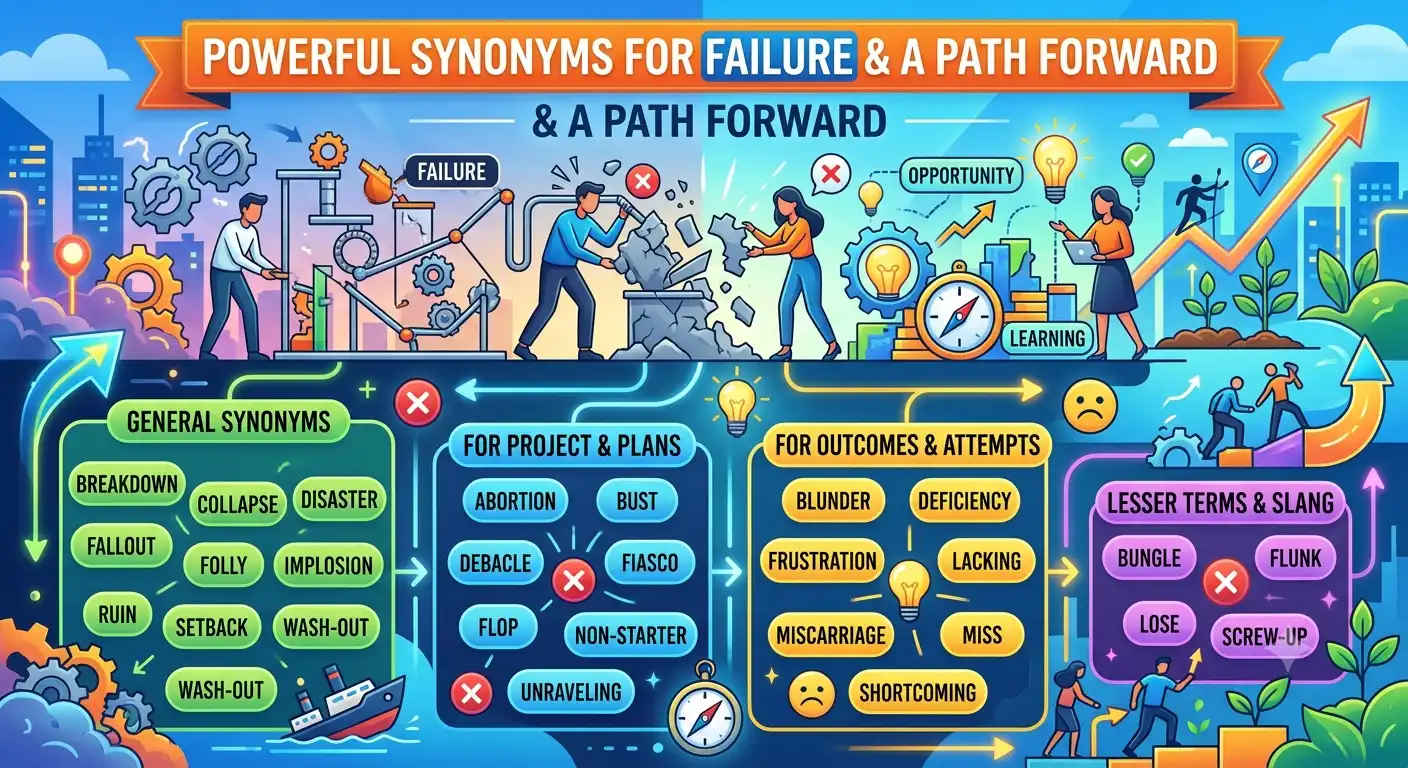
Learning the best synonyms for failure is an outstanding way to improve your writing and speaking skills. When you study different synonyms for failure, you can explain how you face challenges and learn from your mistakes with total confidence. Finding high-quality synonyms for failure helps you show readers how you can overcome an obstacle, handle a loss, or learn a valuable lesson from a tough moment.
Imagine a young baker standing in a warm kitchen looking at a flat, burnt cake. Their feet feel heavy, smoke rises from the pan, and they let out a deep, quiet sigh. This disappointing feeling shows how hard it is when our plans do not work out as we hoped. In very simple English, “failure” means not hitting a goal, making a mistake, or losing a match.
“Failure is simply the opportunity to begin again, this time more intelligently.” — Henry Ford
“Success is stumbling from failure to failure with no loss of enthusiasm.” — Winston S. Churchill
Expanding your range of expression is incredibly helpful for several groups of writers:
- For students: It helps you describe how historical plans failed, how empires fell, and how characters in books made mistakes.
- For bloggers: It keeps your readers fully engaged with emotional, realistic, and active stories that build real trust.
- For content writers: It boosts your search engine rankings by using natural vocabulary variations that search algorithms love to index.
- For daily English users: It helps you write clear emails, share your lessons at work, and talk about your life challenges with absolute clarity.
Connotative Meaning of Failure
The word “failure” carries a negative, heavy, but often educational connotation. It suggests falling short of a goal, making a mistake, or experiencing a loss. However, it is also a word closely tied to growth, showing that a temporary setback can teach us how to do better next time.
Etymology of Failure
- Failure (Root): Formed from the Latin word fallere (meaning “to deceive,” “to escape notice,” or “to trip up”).
- Origin: Derived from the Anglo-French verb failer and Old French faillir (meaning “to fail,” “to fall short,” or “to die out”).
- Evolution: Used since the mid-17th century in English to describe a state of not succeeding, falling short of resources, or breaking down.
Linguistic Profile of Failure
- US Pronunciation (IPA): /ˈfeɪ.ljɚ/
- UK Pronunciation (IPA): /ˈfeɪ.ljər/
- Syllables: 2 syllables (fail-ure)
- Affixation Pattern: A Latin-derived verb root base that combines the verb stem with the noun-forming suffix -ure to show an action, state, or result. It forms the adjective failed and the adverb failingly.
Comparison of Key Synonyms
To help you choose the right word instantly, here is a simple comparison of key synonyms:
| Keyword | Meaning | Usage Type | Context |
|---|---|---|---|
| Flop | A complete failure that misses all expectations. | Casual & Professional | Movies, products, events |
| Setback | A minor delay or problem that slows down progress. | Professional & Casual | Careers, projects, goals |
| Fiasco | A complete, messy, and embarrassing failure. | Emotional & Casual | Parties, plans, meetings |
| Defeat | Losing a game, battle, or hard competition. | Professional & Academic | Sports, wars, debates |
| Slip-up | A very small, accidental mistake that is easily fixed. | Casual & Professional | Typing, talking, small tasks |
| Breakdown | A failure of a machine, system, or communication. | Professional & Casual | Cars, negotiations, bodies |
“I have not failed. I’ve just found 10,000 ways that won’t work.” — Thomas A. Edison
50 Synonyms for Failure
Here is your ultimate list of 50 synonyms to describe losing, falling short, and making mistakes.
1. Defeat
- Pronunciation: US /dɪˈfiːt/ | UK /dɪˈfiːt/
- Meaning: This means losing a game, battle, or hard competition to an opponent.
- Examples:
- The team accepted their defeat with grace and shook hands.
- Our army suffered a major defeat during the rainy season.
2. Loss
- Pronunciation: US /lɔːs/ | UK /lɒs/
- Meaning: This means having less of something or being defeated in a game.
- Examples:
- The store reported a big financial loss this month.
- We felt sad about the loss of our final soccer match.
3. Flop
- Pronunciation: US /flɑːp/ | UK /flɒp/
- Meaning: This means a play, movie, or business plan that fails completely.
- Examples:
- The expensive new movie was a total flop at theaters.
- His first attempt to start a cafe turned out to be a flop.
4. Fiasco
- Pronunciation: US /fiˈæs.koʊ/ | UK /fiˈæs.kəʊ/
- Meaning: This means something that goes wrong in a very messy and embarrassing way.
- Examples:
- The outdoor wedding turned into a complete fiasco when it rained.
- Our dinner party was a fiasco because the stove broke.
5. Bust
- Pronunciation: US /bʌst/ | UK /bʌst/
- Meaning: This means a sudden failure or a business plan that goes completely broke.
- Examples:
- The tech startup was a major bust within its first year.
- Their weekend fishing trip turned out to be a total bust.
6. Dud
- Pronunciation: US /dʌd/ | UK /dʌd/
- Meaning: This means an object or person that does not work or do what it is supposed to do.
- Examples:
- The cheap firework was a dud and did not light up.
- I bought a new battery, but it was a complete dud.
7. Breakdown
- Pronunciation: US /ˈbreɪk.daʊn/ | UK /ˈbreɪk.daʊn/
- Meaning: This means a system, machine, or set of talks that stops working properly.
- Examples:
- A sudden engine breakdown left us stuck on the highway.
- The peace talks suffered a major breakdown yesterday.
8. Collapse
- Pronunciation: US /kəˈlæps/ | UK /kəˈlæps/
- Meaning: This means falling down suddenly or failing completely in a quick way.
- Examples:
- The sudden collapse of the bank shocked the whole town.
- The old bridge faced a total collapse after the storm.
9. Disaster
- Pronunciation: US /dɪˈzæs.tɚ/ | UK /dɪˈzɑː.stər/
- Meaning: This means an event that causes great damage, pain, or total failure.
- Examples:
- My first speech in front of the school was a disaster.
- The holiday dinner ended in a disaster when the dog ate the turkey.
10. Downfall
- Pronunciation: US /ˈdaʊn.fɔːl/ | UK /ˈdaʊn.fɔːl/
- Meaning: This means a sudden loss of power, wealth, or high social position.
- Examples:
- Greed was the main cause of the king’s sudden downfall.
- The bad business deal led to the company’s downfall.
11. Setback
- Pronunciation: US /ˈset.bæk/ | UK /ˈset.bæk/
- Meaning: This means a minor problem that delays your progress or stops you for a short time.
- Examples:
- Rain caused a temporary setback for the construction crew.
- Missing the flight was a small setback for our holiday.
12. Slip-up
- Pronunciation: US /ˈslɪp.ʌp/ | UK /ˈslɪp.ʌp/
- Meaning: This means a very small, accidental mistake that is easily corrected.
- Examples:
- A minor slip-up in the spelling was fixed quickly.
- The kitchen staff made a slip-up with our food order.
13. Misstep
- Pronunciation: US /ˌmɪsˈstep/ | UK /ˌmɪsˈstep/
- Meaning: This means a bad decision or a wrong action that leads to a mistake.
- Examples:
- One political misstep cost the mayor her reelection.
- He apologized for his misstep during the business meeting.
14. Blunder
- Pronunciation: US /ˈblʌn.dɚ/ | UK /ˈblʌn.dər/
- Meaning: This means a very silly, careless, or big mistake that causes problems.
- Examples:
- The goalkeeper made a terrible blunder and let the ball in.
- Sending that private email to everyone was a huge blunder.
15. Mistake
- Pronunciation: US /mɪˈsteɪk/ | UK /mɪˈsteɪk/
- Meaning: This means an action, decision, or opinion that is wrong or incorrect.
- Examples:
- I made a silly mistake on my math homework yesterday.
- It is easy to make a mistake when you are tired.
16. Glitch
- Pronunciation: US /ɡlɪtʃ/ | UK /ɡlɪtʃ/
- Meaning: This means a small, temporary problem that stops a machine or computer from working.
- Examples:
- A minor glitch in the system logged me out of the app.
- The live broadcast stopped for a second due to a glitch.
17. Crash
- Pronunciation: US /kræʃ/ | UK /kræʃ/
- Meaning: This means a sudden and complete failure of a computer, market, or vehicle.
- Examples:
- The sudden market crash caused many businesses to close down.
- My computer suffered a major crash while I was writing.
18. Wreck
- Pronunciation: US /rek/ | UK /rek/
- Meaning: This means something that has been ruined or destroyed completely.
- Examples:
- The heavy storm turned the garden into a total wreck.
- His plans for a quiet weekend became a total wreck.
19. Washout
- Pronunciation: US /ˈwɑːʃ.aʊt/ | UK /ˈwɒʃ.aʊt/
- Meaning: This means an event that is ruined by rain or fails completely.
- Examples:
- The outdoor concert was a complete washout because of the storm.
- Our school picnic turned out to be a total washout.
20. Fizzle
- Pronunciation: US /ˈfɪz.əl/ | UK /ˈfɪz.əl/
- Meaning: This means a failure that starts out well but ends weakly without any success.
- Examples:
- The exciting match ended in a quiet fizzle after the rain.
- Her plan to write a novel ended in a sad fizzle.
21. Meltdown
- Pronunciation: US /ˈmelt.daʊn/ | UK /ˈmelt.daʊn/
- Meaning: This means a sudden, complete breakdown of control, emotions, or a system.
- Examples:
- The toddler had a massive meltdown in the middle of the store.
- The financial system faced a major meltdown during the crisis.
22. Implosion
- Pronunciation: US /ɪmˈploʊ.ʒən/ | UK /ɪmˈpləʊ.ʒən/
- Meaning: This means a sudden and dramatic collapse of a company or system from within.
- Examples:
- Bad management led to the quick implosion of the local shop.
- We watched the sad implosion of our favorite sports team.
23. Botch
- Pronunciation: US /bɑːtʃ/ | UK /bɒtʃ/
- Meaning: This means a badly done piece of work that looks messy or incorrect.
- Examples:
- The mechanic made a complete botch of repairing my car door.
- The bad haircut was a total botch that took weeks to fix.
24. Mess
- Pronunciation: US /mes/ | UK /mes/
- Meaning: This means a situation that is full of problems, confusion, or dirt.
- Examples:
- The schedule change made a huge mess of our travel plans.
- Her desk was a complete mess of papers and old cups.
25. Screw-up
- Pronunciation: US /ˈskruː.ʌp/ | UK /ˈskruː.ʌp/
- Meaning: This means a silly mistake that ruins a plan or causes problems for others.
- Examples:
- A major screw-up at the office delayed the package delivery.
- He admitted that the wrong date was his personal screw-up.
26. Underachievement
- Pronunciation: US /ˌʌn.dɚ.əˈtʃiːv.mənt/ | UK /ˌʌn.dər.əˈtʃiːv.mənt/
- Meaning: This means doing much worse than what people expect you to do.
- Examples:
- His bad grades were a clear sign of deep underachievement.
- The wealthy team struggled with underachievement all season long.
27. Miss
- Pronunciation: US /mɪs/ | UK /mɪs/
- Meaning: This means failing to hit, catch, reach, or see something you wanted.
- Examples:
- The striker made a surprising miss from right in front of the goal.
- Missing the target by an inch was a disappointing miss.
28. Shortcoming
- Pronunciation: US /ˈʃɔːrtˌkʌm.ɪŋ/ | UK /ˈʃɔːtˌkʌm.ɪŋ/
- Meaning: This means a weakness or flaw in someone’s character, plan, or system.
- Examples:
- She was fully aware of every shortcoming in her business plan.
- The new law has a major shortcoming regarding safety rules.
29. Deficiency
- Pronunciation: US /dɪˈfɪʃ.ən.si/ | UK /dɪˈfɪʃ.ən.si/
- Meaning: This means a lack of something necessary, or a state of being incomplete.
- Examples:
- The report pointed out a major deficiency in our school funding.
- A vitamin deficiency can make you feel very tired.
30. Inadequacy
- Pronunciation: US /ɪnˈæd.ə.kwə.si/ | UK /ɪnˈæd.ɪ.kwə.si/
- Meaning: This means the state of not being good enough or strong enough for a task.
- Examples:
- He felt a deep sense of inadequacy during the advanced math class.
- The inadequacy of our old tools made the work take twice as long.
31. Flaw
- Pronunciation: US /flɔː/ | UK /flɔː/
- Meaning: This means a small mark, fault, or mistake that makes something imperfect.
- Examples:
- A tiny flaw in the glass made the window break easily.
- There was a logical flaw in his main argument during the debate.
32. Fault
- Pronunciation: US /fɑːlt/ | UK /fɒlt/
- Meaning: This means a mistake or a bad feature that makes someone responsible for a failure.
- Examples:
- It was my own fault that we arrived late to the show.
- The power cut was due to a technical fault in the wires.
33. Oversight
- Pronunciation: US /ˈoʊ.vɚ.saɪt/ | UK /ˈəʊ.və.saɪt/
- Meaning: This means an accidental mistake made because you did not notice something.
- Examples:
- Leaving your name off the invite list was a simple oversight.
- Due to an oversight, the office door was left unlocked.
34. Clunker
- Pronunciation: US /ˈklʌŋ.kɚ/ | UK /ˈklʌn.kər/
- Meaning: This means an old, broken machine, car, or project that performs badly.
- Examples:
- My old laptop is a slow clunker that crashes constantly.
- The film director’s latest movie was an expensive clunker.
35. Lemon
- Pronunciation: US /ˈlem.ən/ | UK /ˈlem.ən/
- Meaning: This means a vehicle or machine that you buy which turns out to be broken.
- Examples:
- The used car I bought turned out to be a complete lemon.
- This new toaster is a lemon that burns every slice of bread.
36. Bomb
- Pronunciation: US /bɑːm/ | UK /bɒm/
- Meaning: This means an event, play, or product that is a complete and absolute failure.
- Examples:
- The new software was a total bomb with zero downloads.
- Her stand-up comedy act turned into a silent bomb.
37. Turkey
- Pronunciation: US /ˈtɝː.ki/ | UK /ˈtɜː.ki/
- Meaning: This means a theatrical play, show, or idea that fails completely.
- Examples:
- The Broadway show turned out to be a massive turkey.
- His proposal for the new project was a real turkey.
38. Nonperformance
- Pronunciation: US /ˌnɑːn.pɚˈfɔːr.məns/ | UK /ˌnɒn.pəˈfɔː.məns/
- Meaning: This means failing to do a duty, task, or contract that you agreed to do.
- Examples:
- The builder faced legal trouble for nonperformance of the contract.
- We had to cancel the deal due to their nonperformance.
39. Default
- Pronunciation: US /dɪˈfɑːlt/ | UK /dɪˈfɒlt/
- Meaning: This means failing to pay a debt or do what you are legally supposed to do.
- Examples:
- The bank took the house after his default on the loan.
- The team suffered a loss by default because they did not show up.
40. Bankruptcy
- Pronunciation: US /ˈbæŋ.krəpt.si/ | UK /ˈbæŋ.krəp.si/
- Meaning: This means a legal state of having no money left to pay your debts.
- Examples:
- The large retail company declared bankruptcy after years of losses.
- Bad spending habits can quickly lead to personal bankruptcy.
41. Deficit
- Pronunciation: US /ˈdef.ə.sɪt/ | UK /ˈdef.ɪ.sɪt/
- Meaning: This means the amount by which a sum of money falls short of what is needed.
- Examples:
- The city budget had a major deficit of millions of dollars.
- We finished the month with a small deficit in our savings.
42. Decline
- Pronunciation: US /dɪˈklaɪn/ | UK /dɪˈklaɪn/
- Meaning: This means a gradual slide toward a weaker, smaller, or worse state.
- Examples:
- The old town has seen a steady decline in its population.
- Bad habits led to a gradual decline in his physical health.
43. Slide
- Pronunciation: US /slaɪd/ | UK /slaɪd/
- Meaning: This means a movement toward a worse state, lower quality, or cheaper price.
- Examples:
- The company began a slow slide into debt last year.
- Our team had to stop our slide down the league table.
44. Drop-off
- Pronunciation: US /ˈdrɑːp.ɑːf/ | UK /ˈdrɒp.ɒf/
- Meaning: This means a sudden reduction or fall in numbers, interest, or quality.
- Examples:
- The store saw a major drop-off in sales during the winter.
- There was a clear drop-off in student attendance this week.
45. Decay
- Pronunciation: US /dɪˈkeɪ/ | UK /dɪˈkeɪ/
- Meaning: This means the process of gradually breaking down or becoming ruined over time.
- Examples:
- The tooth decay was caused by eating too much sugar.
- We noticed the sad decay of the historic wooden house.
46. Ruin
- Pronunciation: US /ˈruː.ɪn/ | UK /ˈruː.ɪn/
- Meaning: This means the complete destruction, loss, or wreck of a person, project, or place.
- Examples:
- The bad economic news brought financial ruin to many families.
- The heavy rainfall spelled ruin for the local tomato crops.
47. Reversal
- Pronunciation: US /rɪˈvɝː.səl/ | UK /rɪˈvɜː.səl/
- Meaning: This means a sudden change in fortune from a good state to a bad state.
- Examples:
- The company suffered a sharp reversal in profits this quarter.
- Losing the key account was a major reversal for the team.
48. Miscarriage
- Pronunciation: US /ˌmɪsˈker.ɪdʒ/ | UK /ˌmɪsˈkær.ɪdʒ/
- Meaning: This means the failure of a plan, system, or justice process to work correctly.
- Examples:
- Putting the innocent man in prison was a miscarriage of justice.
- The deal fell through due to a miscarriage of the plans.
49. Defection
- Pronunciation: US /dɪˈfek.ʃən/ | UK /dɪˈfek.ʃən/
- Meaning: This means the act of leaving a country, group, or cause to join an enemy.
- Examples:
- The army was weakened by the defection of several key soldiers.
- Her defection to a rival company shocked the whole office.
50. Neglect
- Pronunciation: US /nɪˈɡlekt/ | UK /nɪˈɡlekt/
- Meaning: This means failing to take care of something or ignoring your duties.
- Examples:
- The garden died because of constant neglect during the hot summer.
- Leaving the baby alone was a dangerous act of parental neglect.
Antonyms of Failure
To understand “failure” completely, it is highly useful to look at its direct opposites. In communication and daily life, these words represent winning, rising up, or reaching goals:
- Success: Achieving a wealth, respect, or a planned goal successfully.
- Victory: Winning a game, fight, or a hard struggle.
- Achievement: Doing something very good or successful using your own skills.
- Triumph: A great victory or achievement that brings immense joy.
- Accomplishment: Finishing a difficult task or reaching a great goal.
Prototype Meaning and Categorization of Synonyms for Failure
The fifty synonyms for failure can be easily divided into four main categories:
- The Total Disasters (Big Failures): Words like flop, fiasco, collapse, meltdown, and disaster that focus on complete, messy, and highly embarrassing failures.
- The Small Slips (Minor Mistakes): Terms like slip-up, misstep, glitch, blunder, and oversight that represent small, accidental mistakes that can be easily fixed.
- The Bad Products (Useless Things): Words like dud, lemon, clunker, bomb, and turkey that show physical machines or projects that do not perform well at all.
- The Downward Slopes (Loss of Power): Phrases like decline, slide, decay, deficit, and downfall that show a gradual loss of success, wealth, or power.
FAQ about Synonyms for Failure
1. What is the difference between “failure” and “setback”?
A failure is the complete end of a plan where you do not reach your goal. A setback is a minor delay or problem that slows down your progress but does not stop you completely.
2. Can “miss” be used as both a noun and a verb?
Yes! As a noun, it means a failure to hit a target (e.g., “The striker made a surprising miss”). As a verb, it means the act of failing to hit something (e.g., “I do not want to miss the target”). The spelling remains the same.
3. What is a formal synonym for failure to use in a history paper?
In formal or academic environments, words like downfall, decline, or nonperformance sound much more polished, professional, and authoritative.
4. Is “screw-up” too informal for an academic essay?
Yes, screw-up is a casual slang phrase. For an academic essay, you should use formal words like “error,” “oversight,” or “misstep” instead.
5. How does using different synonyms for failure help my blog’s SEO?
Using diverse synonyms stops search engines from flagging your content for keyword stuffing. Natural vocabulary variations help search engines understand your topic better and rank you higher.
6. What is the origin of the word “failure”?
The word comes from the Latin root fallere, which means “to deceive” or “to trip up.” It originally described failing to complete a duty or falling short of a resource.
Conclusion
Expanding your vocabulary with fifty unique synonyms for failure is a powerful way to make your communication much more engaging. When you select the exact word that fits your situation, your writing gains immediate emotional depth and impact. Rather than repeating the same common verbs, bloggers can craft highly active articles, students can write persuasive historical essays, and business professionals can make their marketing messages clear and professional. Using active vocabulary keeps your readers curious and ensures that your unique voice sounds completely authentic.
We encourage you to practice using these terms as you write your school papers, draft work emails, or chat with your friends. By paying attention to the small differences in these words, you can match your tone to your specific audience perfectly. Do not be afraid to experiment with new terms in your next conversation. With regular practice, choosing the right synonym will become completely natural, helping you share your thoughts, challenges, and lessons with confidence. Every time you swap a dull word for a dynamic one, you take a big step forward as a writer. Your voice will sound brighter, and your ideas will carry much more weight. Keep exploring the beauty of the English language, and watch how quickly your sentences begin to shine.
“There is no failure except in no longer trying.” — Elbert Hubbard
“Failure is another steppingstone to greatness.” — Oprah Winfrey

Andrew Powell is a travel writer and nature journalist who has spent over a decade writing about places, landscapes, and the natural world — and thinking carefully about the words that do those subjects justice ( Biography ).