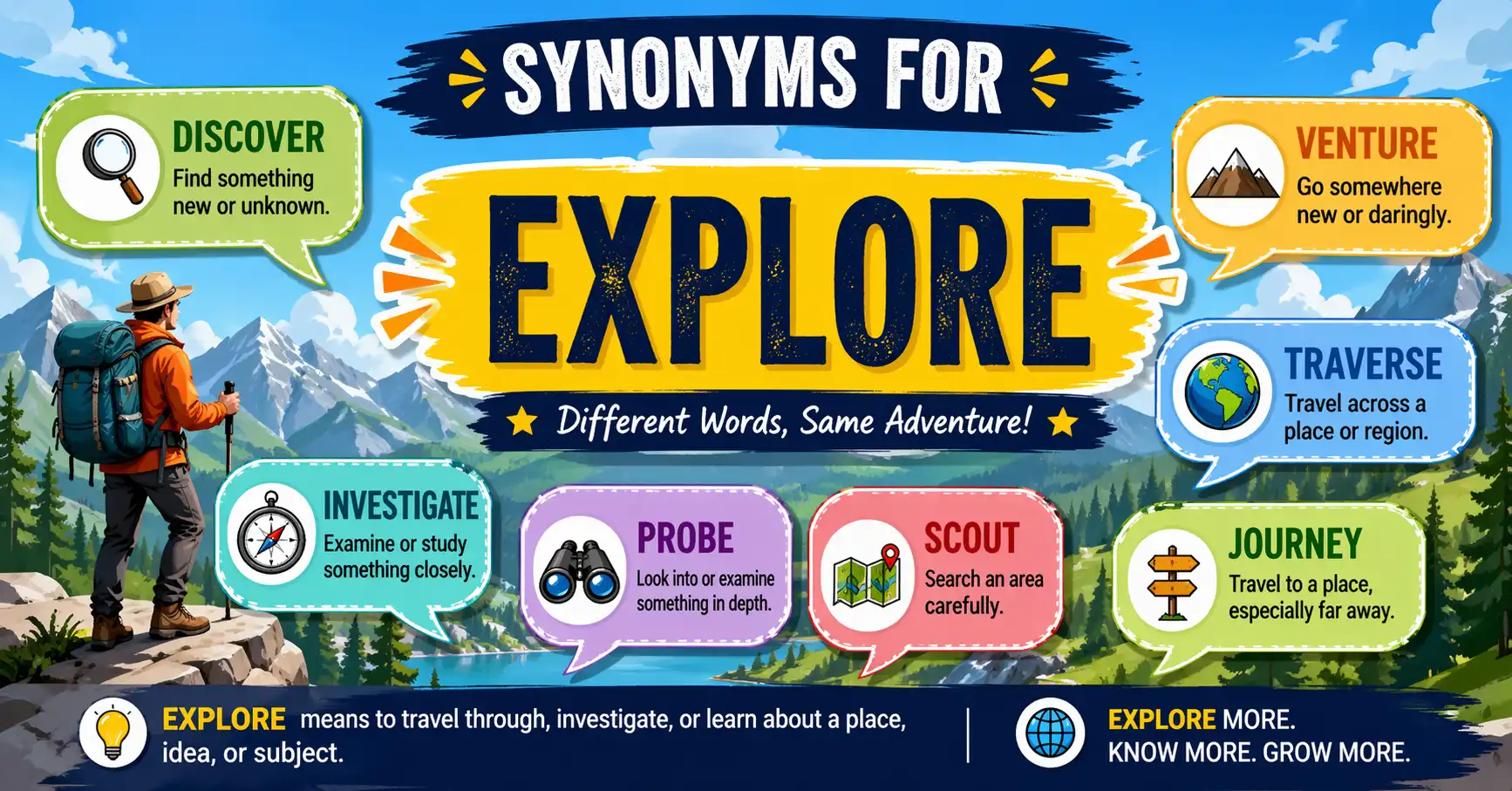
Have you ever wanted to pack your bags and go to a place you have never seen before? That exciting feeling of discovery makes life wonderful. For example, you might walk through a new park to see what is there. To explore simply means to look around a new place or study a new idea to learn more about it.
But repeating the same word in your work can make it very boring. Are you looking for the best synonyms for explore to boost your vocabulary? Learning synonyms for explore is highly useful for everyone. Students can write better essays for school. Bloggers and content writers can make their posts more exciting to read. Daily English users can describe their weekend trips clearly to friends. Let us check out these fifty amazing synonyms for explore!
1. Investigate
Meaning: To find out the truth about something or search for facts.
Examples:
- The police want to investigate the strange noise in the yard.
- We need to investigate why the computer is not turning on.
2. Search
Meaning: To look carefully for something that is lost or hidden.
Examples:
- I need to search my room to find my house keys.
- They will search the forest for the missing dog.
3. Examine
Meaning: To look at something very closely to see how it works.
Examples:
- The doctor will examine your throat to see if you are sick.
- Please examine this contract before you sign your name.
4. Discover
Meaning: To find something new that you did not know about before.
Examples:
- We hope to discover a shortcut to the beach today.
- Scientists want to discover new plants in the deep jungle.
5. Study
Meaning: To spend time learning about a subject in detail.
Examples:
- She likes to study how stars move in the night sky.
- We must study the map before we start our long drive.
6. Analyze
Meaning: To study something carefully to understand its different parts.
Examples:
- The team will analyze the data to find the best answer.
- You should analyze your mistakes to do better next time.
7. Inspect
Meaning: To look at something closely to make sure it is safe.
Examples:
- The city worker came to inspect our water pipes yesterday.
- You must inspect your car tires before a long trip.
8. Travel
Meaning: To go from one place to another, especially far away.
Examples:
- My family wants to travel to Europe next summer.
- He loves to travel by train through the green mountains.
9. Tour
Meaning: To visit a new place and look at all its famous sights.
Examples:
- We plan to tour the old castle when we visit the city.
- The guide will tour the museum with us this morning.
10. Scout
Meaning: To look ahead at an area to gather information.
Examples:
- He went ahead to scout the best spot for our camp.
- The team sent a runner to scout the path for danger.
11. Hunt
Meaning: To search hard for something you want or need.
Examples:
- We had to hunt for a parking spot at the busy mall.
- The children love to hunt for seashells on the wet sand.
12. Survey
Meaning: To look at a large area or ask many people for opinions.
Examples:
- They will survey the land before they build the new school.
- We want to survey the students about their favorite lunch.
13. Seek
Meaning: To try to find or get something.
Examples:
- You should seek help if you get lost in the city.
- They seek a quiet place to read their books.
14. Probe
Meaning: To ask deep questions or search into something secret.
Examples:
- The reporter began to probe into the mayor’s past.
- He used a stick to probe the deep mud for his shoe.
15. Venture
Meaning: To go into a new place that might be dangerous.
Examples:
- Do not venture into the dark woods after sunset.
- The brave sailors decided to venture across the unknown sea.
16. Journey
Meaning: To travel a long distance to a new destination.
Examples:
- We will journey across the desert to reach the ancient city.
- They want to journey to the top of the high mountain.
17. Navigate
Meaning: To find the right way to travel through a place.
Examples:
- It is hard to navigate the old city streets without a map.
- The captain will navigate the ship through the storm safely.
18. Check
Meaning: To look at something to make sure it is correct or safe.
Examples:
- Please check your homework for mistakes before you turn it in.
- I need to check the oven to see if the cake is ready.
19. Test
Meaning: To try something out to see how well it works.
Examples:
- The driver wants to test the new car on the track.
- We should test the water to make sure it is clean.
20. Research
Meaning: To study a topic using books or computers to find facts.
Examples:
- I need to research sharks for my science project.
- She spent hours at the library to research her family history.
21. Inquire
Meaning: To ask someone for information about something.
Examples:
- We should inquire at the desk about the train schedule.
- He called the shop to inquire about the price of the bike.
22. Scan
Meaning: To look over something quickly to find a specific part.
Examples:
- You can scan the book index to find the right page.
- She began to scan the crowd to look for her sister.
23. Track
Meaning: To follow footprints or clues to find a person or animal.
Examples:
- The guide can track wild animals through the thick snow.
- We tried to track where the water leak was coming from.
24. Traverse
Meaning: To move across or travel over a wide area.
Examples:
- The hikers had to traverse a deep valley to get home.
- We watched the train traverse the long bridge over the river.
25. Map
Meaning: To make a drawing or plan of an area to learn about it.
Examples:
- The explorers wanted to map the layout of the cave system.
- We need to map our route before we start walking.
26. Wander
Meaning: To walk around slowly without a clear goal or direction.
Examples:
- I love to wander through the quiet streets of old towns.
- The cows wander around the green field all day long.
27. Roam
Meaning: To travel over a large area with complete freedom.
Examples:
- Wild deer roam free in this beautiful national park.
- We let the dog roam around the large backyard.
28. Audit
Meaning: To examine business records carefully to check for errors.
Examples:
- The expert will audit the bank accounts next week.
- We need to audit our food supplies before winter starts.
29. Review
Meaning: To look at something again to study or judge it.
Examples:
- You should review your notes before the big test tomorrow.
- The teacher will review our essays to give us feedback.
30. Question
Meaning: To ask someone things to find out the truth.
Examples:
- The detective decided to question the witness again.
- Do not be afraid to question things that seem wrong.
31. Observe
Meaning: To watch someone or something very carefully.
Examples:
- We like to observe the birds that visit our garden.
- Students can observe how the chemicals change color.
32. Detect
Meaning: To notice or discover something that is hard to see.
Examples:
- The machine can detect small metal pieces in the ground.
- I think I detect a faint smell of smoke in the air.
33. Dig
Meaning: To move earth or search deep to find hidden facts.
Examples:
- We must dig into the old files to find the letter.
- The reporter decided to dig for the true story.
34. Sift
Meaning: To search through a pile of things to find what you need.
Examples:
- You must sift through the papers to find your receipt.
- We had to sift the sand to find the lost ring.
35. Delve
Meaning: To search deeply for information in books or records.
Examples:
- She wanted to delve into the history of the old house.
- The students will delve into the science book today.
36. View
Meaning: To look at or watch something carefully.
Examples:
- We went to the hill to view the beautiful sunrise.
- You can view the art pieces in the main hall.
37. Look
Meaning: To direct your eyes toward something to see it.
Examples:
- Look at the colorful butterfly on the big flower.
- We must look around the store to find a gift.
38. Trace
Meaning: To follow a line or history back to its beginning.
Examples:
- They can trace the river back to its mountain source.
- She wants to trace her family line back many years.
39. Browse
Meaning: To look at things in a shop or online without buying yet.
Examples:
- I like to browse the bookshelves on rainy days.
- We can browse the web to find a good recipe.
40. Patrol
Meaning: To guard an area by moving around it regularly.
Examples:
- The guard will patrol the building during the night.
- Police officers patrol the streets to keep us safe.
41. Scrutinize
Meaning: To look at something with very close attention to detail.
Examples:
- The judge will scrutinize every movement of the dancers.
- You should scrutinize the bill to make sure it is correct.
42. Assess
Meaning: To judge the value, size, or quality of something.
Examples:
- We must assess the damage to the roof after the storm.
- The teacher will assess our reading skills this afternoon.
43. Evaluate
Meaning: To study something carefully to see how good it is.
Examples:
- The coach will evaluate the players during the practice game.
- We need to evaluate our progress on this project.
44. Uncover
Meaning: To find or show something that was hidden.
Examples:
- They dug in the garden to uncover old stone steps.
- The news will uncover the truth about the event.
45. Peer
Meaning: To look very closely at something that is hard to see.
Examples:
- She had to peer through the thick fog to see the road.
- He would peer through the window to look for his friend.
46. Screen
Meaning: To check people or things to see if they are suitable.
Examples:
- The company will screen all workers before hiring them.
- They screen the luggage at the airport for safety.
47. Look into
Meaning: To find out more about a problem to solve it.
Examples:
- The manager promised to look into our complaint.
- We need to look into cheap flights for our vacation.
48. Seek out
Meaning: To search hard for a specific person or thing.
Examples:
- You should seek out advice from wise people.
- We want to seek out new opportunities in the city.
49. Dig into
Meaning: To start investigating a topic with a lot of energy.
Examples:
- Let us dig into this math problem together.
- He loves to dig into old books about ships.
50. Chase
Meaning: To follow something quickly to catch or study it.
Examples:
- Scientists sometimes chase storms to learn how they work.
- The cat loves to chase leaves that blow in the wind.
Conclusion
Learning different synonyms for explore is a fantastic way to improve your writing, blogging, and speaking. When you use a variety of words, your communication becomes much stronger and more interesting. We encourage you to practice these fifty words in your next school essays, work emails, and daily conversations. The more you use them, the more natural they will feel. Keep practicing and watch your English skills grow!

Andrew Powell is a travel writer and nature journalist who has spent over a decade writing about places, landscapes, and the natural world — and thinking carefully about the words that do those subjects justice ( Biography ).