Learning the best synonyms for ecosystem is an outstanding way to improve your writing and speaking skills. When you study different synonyms for ecosystem, you can explain how living things and systems work together with total confidence. Finding high-quality synonyms for ecosystem helps you show readers how plants, animals, or even business parts connect and survive as a group.
Imagine a quiet pond in the middle of a green forest. Tiny frogs sit on wet lily pads, fish swim below the dark water, and bright dragonflies dance in the warm air. This busy little world shows how every single part needs the other to stay alive and healthy. In very simple English, an “ecosystem” means a group of living things and non-living things that live and work together in one place.
“In nature, nothing exists alone.” — Rachel Carson
“The environment is everything that isn’t me.” — Albert Einstein
Expanding your range of expression is incredibly helpful for several groups of writers:
- For students: It helps you describe biological structures, science topics, and how different historical groups interacted with their surroundings.
- For bloggers: It keeps your readers fully engaged with colorful, natural, and active stories about nature, tech platforms, or business networks.
- For content writers: It boosts your search engine rankings by using natural vocabulary variations that search algorithms love to index.
- For daily English users: It helps you write clear emails, share your ideas at work, and talk about your favorite hobbies with absolute clarity.
Connotative Meaning of Ecosystem
The word “ecosystem” carries a positive, balanced, and highly organized connotation. It suggests harmony, connection, and a delicate balance where every single part plays a vital role. However, it can also describe complex human structures, like a digital network or a business market, showing that different parts must work together to succeed.
Etymology of Ecosystem
- Eco- (Prefix): Derived from the Ancient Greek word oikos (meaning “house,” “dwelling,” or “household”).
- System (Root): Derived from the Greek word systema (meaning “whole compounded of several parts” or “placed together”).
- Evolution: Coined in 1935 by the British ecologist Arthur Tansley to describe the interactive system between living organisms and their physical environment.
Linguistic Profile of Ecosystem
- US Pronunciation (IPA): /ˈiː.koʊˌsɪs.təm/
- UK Pronunciation (IPA): /ˈiː.kəʊˌsɪs.təm/
- Syllables: 4 syllables (e-co-sys-tem)
- Affixation Pattern: Formed by combining the Greek prefix eco- with the Greek-derived noun system to create a compound noun. It forms the adjective ecosystemic.
Comparison of Key Synonyms
To help you choose the right word instantly, here is a simple comparison of key synonyms:
| Keyword | Meaning | Usage Type | Context |
|---|---|---|---|
| Environment | The natural world or conditions in which things live. | Professional & Academic | Nature, cities, workplaces |
| Habitat | The specific natural home of an animal or plant. | Academic & Casual | Wildlife, science reports |
| Network | A group of interconnected people, computers, or things. | Professional & Casual | Business, technology, social |
| Milieu | The social or cultural environment that surrounds someone. | Academic & Professional | Art, history, sociology |
| Biome | A large community of plants and animals in a specific climate. | Academic | Science class, geography |
| Niche | A specialized or comfortable role or place for something. | Casual & Professional | Careers, marketing, nature |
“Ecosystems are the beautiful web of life where every thread counts.” — Unknown
50 Synonyms for Ecosystem
Here is your ultimate list of 50 synonyms to describe communities, networks, and connected environments.
1. Environment
- Pronunciation: US /ɪnˈvaɪ.rən.mənt/ | UK /ɪnˈvaɪ.rən.mənt/
- Meaning: This means the air, water, land, and overall surroundings where people and animals live.
- Examples:
- We must do our best to protect the natural environment.
- A quiet study room is the perfect environment for learning.
2. Habitat
- Pronunciation: US /ˈhæb.ə.tæt/ | UK /ˈhæb.ɪ.tæt/
- Meaning: This means the specific natural place where a wild animal or plant usually lives.
- Examples:
- The thick forest is the natural habitat of the brown bear.
- Pollution can easily destroy the underwater habitat of colorful fish.
3. Ecology
- Pronunciation: US /iˈkɑː.lə.dʒi/ | UK /iˈkɒl.ə.dʒi/
- Meaning: This means the scientific relationship between living creatures and their physical surroundings.
- Examples:
- The students studied the delicate desert ecology during their field trip.
- Oil spills can cause terrible damage to ocean ecology.
4. Biome
- Pronunciation: US /ˈbaɪ.oʊm/ | UK /ˈbaɪ.əʊm/
- Meaning: This means a very large area of the world with special plants, animals, and weather.
- Examples:
- The dry sandy desert is a very harsh biome for most plants.
- We learned about the cold tundra biome in our science class today.
5. Biosphere
- Pronunciation: US /ˈbaɪ.oʊ.sfɪr/ | UK /ˈbaɪ.əʊ.sfɪə/
- Meaning: This means the entire part of the earth where living things can exist.
- Examples:
- Every living creature on Earth belongs to the same global biosphere.
- Scientists study the biosphere to understand climate changes.
6. Network
- Pronunciation: US /ˈnet.wɝːk/ | UK /ˈnet.wɜːk/
- Meaning: This means a group of connected things, computers, or people that work together.
- Examples:
- The company built a large computer network to share files easily.
- She has a great network of friends who support her business.
7. System
- Pronunciation: US /ˈsɪs.təm/ | UK /ˈsɪs.təm/
- Meaning: This means a set of connected things or parts forming a complex whole.
- Examples:
- The human body has an amazing system for digesting food.
- The local train system helps thousands of people travel every morning.
8. Community
- Pronunciation: US /kəˈmjuː.nə.t̬i/ | UK /kəˈmjuː.nə.ti/
- Meaning: This means a group of living things that reside in the same physical area.
- Examples:
- The pond community includes frogs, insects, and tall green reeds.
- Our local neighborhood community organized a park cleanup day.
9. Complex
- Pronunciation: US /ˈkɑːm.pleks/ | UK /ˈkɒm.pleks/
- Meaning: This means a large group of connected parts or buildings that fit together.
- Examples:
- The shopping complex has twenty different stores and a movie theater.
- This cell is a complex structure that performs many jobs.
10. Matrix
- Pronunciation: US /ˈmeɪ.trɪks/ | UK /ˈmeɪ.trɪks/
- Meaning: This means a surrounding substance or situation in which something else originates or develops.
- Examples:
- The bones are held together inside a strong matrix of tissue.
- Rome was the historical matrix of many modern laws.
11. Milieu
- Pronunciation: US /miːlˈjɜː/ | UK /miːlˈjɜː/
- Meaning: This means the social or cultural environment that surrounds a person.
- Examples:
- The young painter grew up in a highly artistic milieu.
- Traveling to new countries can change your cultural milieu completely.
12. Microcosm
- Pronunciation: US /ˈmaɪ.krə.kɑː.zəm/ | UK /ˈmaɪ.krə.kɒ.zəm/
- Meaning: This means a very small place or situation that shows all the qualities of a much larger one.
- Examples:
- Our small school playground is a microcosm of the whole world.
- The tiny terrarium acts as a microcosm of a real rainforest.
13. Web
- Pronunciation: US /web/ | UK /web/
- Meaning: This means a complex, connected pattern of lines, ideas, or living connections.
- Examples:
- The spider spun a beautiful, sticky web between two tree branches.
- The food web shows how energy passes from plants to wild animals.
14. Realm
- Pronunciation: US /relm/ | UK /relm/
- Meaning: This means a specific area of interest, activity, or royal power.
- Examples:
- The king ruled his peaceful forest realm for fifty long years.
- Virtual reality opens up a whole new realm of fun gaming.
15. Domain
- Pronunciation: US /doʊˈmeɪn/ | UK /dəʊˈmeɪn/
- Meaning: This means an area of land, knowledge, or activity controlled by a specific group.
- Examples:
- The wild lions defended their grassy domain from other predators.
- Science is a fascinating domain of study for curious minds.
16. Sphere
- Pronunciation: US /sfɪr/ | UK /sfɪə/
- Meaning: This means a particular area of activity, interest, or influence.
- Examples:
- Tech companies have a huge influence in the economic sphere.
- She wanted to expand her social sphere by joining a book club.
17. Landscape
- Pronunciation: US /ˈlænd.skeɪp/ | UK /ˈlænd.skeɪp/
- Meaning: This means a wide view of scenery, or the overall layout of an industry.
- Examples:
- The snowy mountain landscape looked beautiful in the morning sun.
- The business landscape is changing quickly due to new technology.
18. Framework
- Pronunciation: US /ˈfreɪm.wɝːk/ | UK /ˈfreɪm.wɜːk/
- Meaning: This means a supporting structure or system around which something is built.
- Examples:
- The wooden framework of the new house was finished yesterday.
- Our constitution provides a strong framework for national laws.
19. Structure
- Pronunciation: US /ˈstrʌk.tʃɚ/ | UK /ˈstrʌk.tʃər/
- Meaning: This means the way that parts are arranged and put together.
- Examples:
- The complex structure of the beehive keeps the honey safe.
- We studied the sentence structure of the long poem.
20. Neighborhood
- Pronunciation: US /ˈneɪ.bɚ.hʊd/ | UK /ˈneɪ.bə.hʊd/
- Meaning: This means a small area of a town or a localized community of living things.
- Examples:
- Many birds build nests in our leafy neighborhood during spring.
- Everyone in our friendly neighborhood helps keep the streets clean.
21. Surroundings
- Pronunciation: US /səˈraʊn.dɪŋz/ | UK /səˈraʊn.dɪŋz/
- Meaning: This means the specific objects, buildings, and nature around you.
- Examples:
- The wild animals blended perfectly into their forest surroundings.
- It is pleasant to work in clean, bright surroundings.
22. Setting
- Pronunciation: US /ˈset̬.ɪŋ/ | UK /ˈset.ɪŋ/
- Meaning: This means the time, place, and environment where something happens.
- Examples:
- The old castle was the perfect setting for a scary movie.
- The peaceful lake provided a lovely setting for our family picnic.
23. Context
- Pronunciation: US /ˈkɑːn.tekst/ | UK /ˈkɒn.tekst/
- Meaning: This means the situation, background, or environment in which something happens.
- Examples:
- You must look at the historical context to understand the old war.
- Taking his words out of context made him look very mean.
24. Nexus
- Pronunciation: US /ˈnek.səs/ | UK /ˈnek.səs/
- Meaning: This means an important central link or connection point between things.
- Examples:
- The busy airport is the main nexus for international travel.
- The library is the academic nexus of our entire college campus.
25. Grid
- Pronunciation: US /ɡrɪd/ | UK /ɡrɪd/
- Meaning: This means a pattern of straight lines that cross each other, or an energy system.
- Examples:
- The power grid was damaged during the heavy lightning storm.
- The city streets are laid out in a simple, easy-to-follow grid.
26. Circle
- Pronunciation: US /ˈsɝː.kəl/ | UK /ˈsɜː.kəl/
- Meaning: This means a group of people or things that are connected by shared interests.
- Examples:
- She has a close circle of business partners who work together.
- The scientific circle discussed the new discovery during the meeting.
27. Platform
- Pronunciation: US /ˈplæt.fɔːrm/ | UK /ˈplæt.fɔːm/
- Meaning: This means a system or digital space where apps, businesses, or ideas can run.
- Examples:
- The online platform allows users to share photos with friends.
- This new smartphone operating system is a highly stable platform.
28. Cosmos
- Pronunciation: US /ˈkɑːz.moʊs/ | UK /ˈkɒz.mɒs/
- Meaning: This means the whole universe seen as an orderly and connected system.
- Examples:
- Astronomers use powerful telescopes to explore the vast cosmos.
- She wondered if other living beings existed out in the quiet cosmos.
29. World
- Pronunciation: US /wɝːld/ | UK /wɜːld/
- Meaning: This means a particular environment, area of life, or the entire planet.
- Examples:
- The deep ocean is a dark world full of strange creature life.
- She decided to enter the competitive world of fashion design.
30. Macrocosm
- Pronunciation: US /ˈmæk.rəˌkɑː.zəm/ | UK /ˈmæk.rəˌkɒ.zəm/
- Meaning: This means a large system that contains many smaller, connected parts.
- Examples:
- The solar system is a grand macrocosm containing many planets.
- The national economy is a macrocosm made of small local businesses.
31. Microenvironment
- Pronunciation: US /ˌmaɪ.kroʊ.ɪnˈvaɪ.rən.mənt/ | UK /ˌmaɪ.krəʊ.ɪnˈvaɪ.rən.mənt/
- Meaning: This means a very small, specific environment that surrounds a tiny organism.
- Examples:
- The underside of a damp log has its own unique microenvironment.
- Greenhouses create a warm microenvironment for sensitive plants.
32. Niche
- Pronunciation: US /nɪtʃ/ | UK /niːʃ/
- Meaning: This means a specific, comfortable place or job that is perfect for you.
- Examples:
- The red squirrel found its ecological niche in the pine forest.
- He carved out a successful niche selling handmade wooden toys online.
33. Biota
- Pronunciation: US /baɪˈoʊ.t̬ə/ | UK /baɪˈəʊ.tə/
- Meaning: This means all the plant and animal life belonging to a specific region.
- Examples:
- Scientists documented the diverse river biota after the rain.
- The island’s unique biota evolved without any outside contact.
34. Nature
- Pronunciation: US /ˈneɪ.tʃɚ/ | UK /ˈneɪ.tʃər/
- Meaning: This means the physical world including plants, animals, landscapes, and natural forces.
- Examples:
- Spending time out in nature helps reduce mental stress.
- We should respect the power of nature and keep beaches clean.
35. Synergy
- Pronunciation: US /ˈsɪn.ɚ.dʒi/ | UK /ˈsɪn.ə.dʒi/
- Meaning: This means the extra energy or success created when different parts work together.
- Examples:
- Teamwork creates a natural synergy that helps us finish projects faster.
- There was a great synergy between the two local businesses.
36. Interaction
- Pronunciation: US /ˌɪn.t̬ɚˈæk.ʃən/ | UK /ˌɪn.təˈræk.ʃən/
- Meaning: This means the process of things or people talking, touching, or affecting each other.
- Examples:
- The busy playground was full of fun interaction among the kids.
- We studied the chemistry interaction between water and metal.
37. Circuit
- Pronunciation: US /ˈsɝː.kɪt/ | UK /ˈsɜː.kɪt/
- Meaning: This means a complete path or loop that electricity or energy flows along.
- Examples:
- A broken wire in the electrical circuit caused the lights to blink.
- The nutrient circuit keeps the soil healthy for farming.
38. Interplay
- Pronunciation: US /ˈɪn.t̬ɚ.pleɪ/ | UK /ˈɪn.tə.pleɪ/
- Meaning: This means the way in which two or more things affect each other.
- Examples:
- We enjoy watching the playful interplay of light and shadow on the hills.
- The economy depends on the complex interplay of buying and selling.
39. Organization
- Pronunciation: US /ˌɔːr.ɡən.əˈzeɪ.ʃən/ | UK /ˌɔː.ɡən.aɪˈzeɪ.ʃən/
- Meaning: This means a structured group of people or a highly neat arrangement of things.
- Examples:
- The human brain has a brilliant level of sensory organization.
- He works for a global organization that helps save wild animals.
40. Life-zone
- Pronunciation: US /ˈlaɪf.zoʊn/ | UK /ˈlaɪf.zəʊn/
- Meaning: This means a specific region of land characterized by its unique animal and plant life.
- Examples:
- The alpine life-zone is too cold for tall trees to grow.
- Different animals inhabit each distinct mountain life-zone.
41. Workspace
- Pronunciation: US /ˈwɝːk.speɪs/ | UK /ˈwɜːk.speɪs/
- Meaning: This means the physical area or digital system where work is completed.
- Examples:
- I organized my office workspace to keep things neat and clean.
- The online workspace lets remote employees collaborate on projects.
42. Territory
- Pronunciation: US /ˈter.ə.tɔːr.i/ | UK /ˈter.ɪ.tər.i/
- Meaning: This means an area of land that is controlled by a person, animal, or country.
- Examples:
- Wolves will fight to protect their hunting territory from others.
- The arctic territory is covered in thick ice all year.
43. Chain
- Pronunciation: US /tʃeɪn/ | UK /tʃeɪn/
- Meaning: This means a series of connected things, links, or biological events.
- Examples:
- Humans are situated at the very top of the local food chain.
- A fast chain of events led to the startup’s massive success.
44. Unit
- Pronunciation: US /ˈjuː.nɪt/ | UK /ˈjuː.nɪt/
- Meaning: This means a single, complete thing that is part of a larger group.
- Examples:
- The family is the basic unit of a healthy society.
- Each apartment unit has its own small balcony and kitchen.
45. Pattern
- Pronunciation: US /ˈpæt̬.ɚn/ | UK /ˈpæt.ən/
- Meaning: This means a regular, repeating way in which something happens or is done.
- Examples:
- The weather pattern has been very dry and hot this summer.
- We noticed a steady growth pattern in the young plant’s leaves.
46. Assembly
- Pronunciation: US /əˈsem.bli/ | UK /əˈsem.bli/
- Meaning: This means a group of people or parts gathered together in one place.
- Examples:
- The school assembly gathered in the gym to hear the principal speak.
- The biological assembly of cells creates living, breathing tissue.
47. Field
- Pronunciation: US /fiːld/ | UK /fiːld/
- Meaning: This means an open area of land, or a specific branch of study and work.
- Examples:
- Cows grazed peacefully in the wide grassy field near the farm.
- Medicine is a very challenging field that requires years of study.
48. Configuration
- Pronunciation: US /kənˌfɪɡ.jəˈreɪ.ʃən/ | UK /kənˌfɪɡ.jəˈreɪ.ʃən/
- Meaning: This means the specific arrangement of parts or elements in a system.
- Examples:
- The technical configuration of the computer network took several hours.
- The chemical configuration of water includes two hydrogen atoms.
49. Arrangement
- Pronunciation: US /əˈreɪndʒ.mənt/ | UK /əˈreɪndʒ.mənt/
- Meaning: This means the plan, design, or order in which things are placed.
- Examples:
- The floral arrangement on the dining table looked absolutely beautiful.
- We made an arrangement to meet at the coffee shop at noon.
50. Union
- Pronunciation: US /ˈjuː.njən/ | UK /ˈjuː.njən/
- Meaning: This means the state of being joined together in a cooperative, unified way.
- Examples:
- The union of different companies created a powerful business network.
- The perfect union of rain and sun made the garden grow quickly.
Antonyms of Ecosystem
To understand “ecosystem” completely, it is highly useful to look at its direct opposites. In communication and daily life, these words represent division, isolation, or single, disconnected parts:
- Isolation: The state of being completely alone, separated, and cut off from others.
- Disconnection: A total lack of connection, association, or relationship between things.
- Fragment: A small, broken part that is completely separated from the main whole.
- Individual: A single, separate organism or person viewed apart from a group.
- Entity: Something that exists as a single, independent, and self-contained unit.
Prototype Meaning and Categorization of Synonyms for Ecosystem
The fifty synonyms for ecosystem can be easily divided into four main categories:
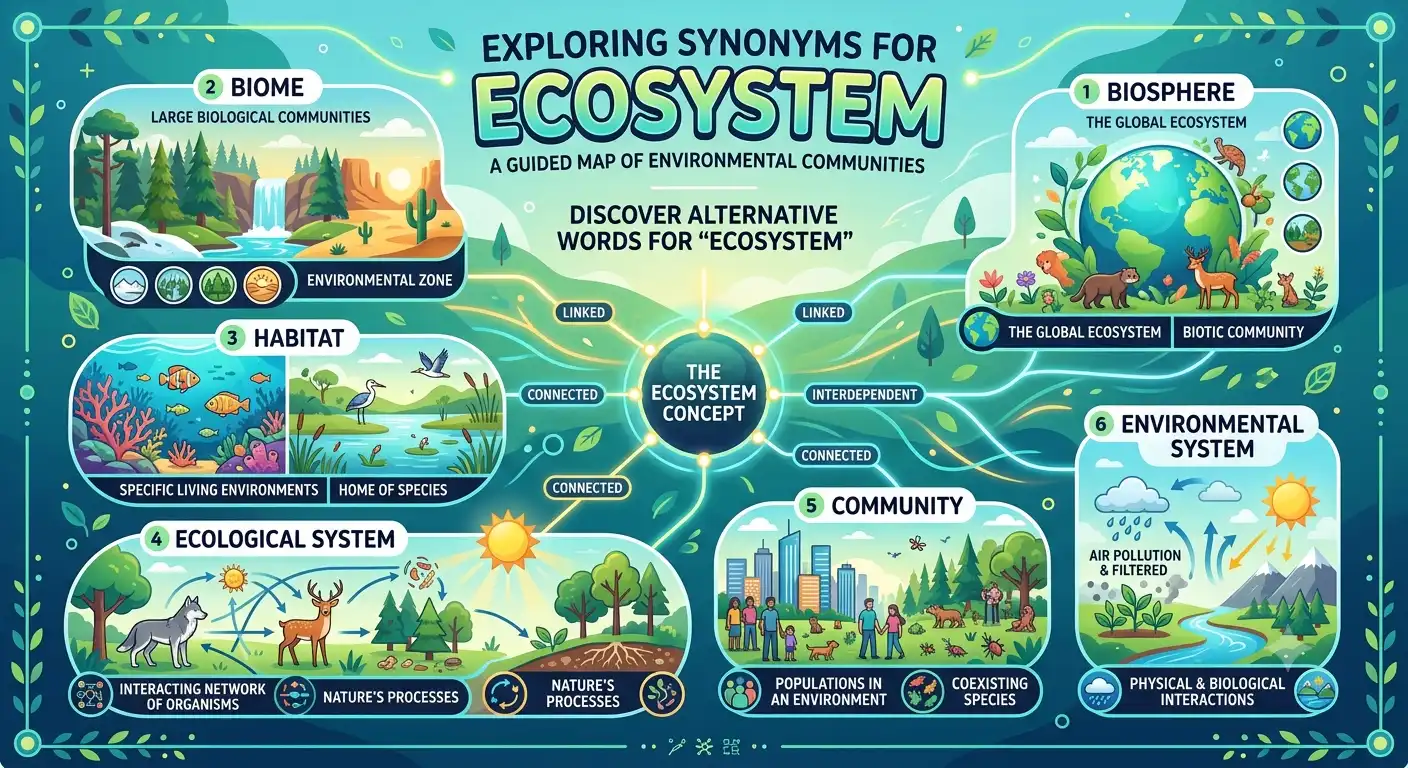
- The Natural Zones (Biological Systems): Words like habitat, biome, biosphere, ecology, and life-zone that focus strictly on nature, wildlife, and natural living systems.
- The Structured Layouts (Physical Frameworks): Terms like matrix, grid, structure, configuration, and framework that represent how physical things are arranged and locked together.
- The Human and Social Circles (Surrounding Milieus): Words like milieu, neighborhood, setting, surroundings, and context that show the cultural or social environment around us.
- The Connected Networks (Collaborative Platforms): Phrases like network, system, platform, nexus, and synergy that show how different parts communicate, trade, or work as one machine.
FAQ about Synonyms for Ecosystem
1. What is the difference between “ecosystem” and “habitat”?
An ecosystem includes all the living organisms and non-living elements interacting with each other in an area. A habitat is simply the specific, physical home where a single plant or animal species lives.
2. Can “platform” be used as a synonym for ecosystem?
Yes! In technology and modern business, a platform (like iOS or Android) acts as a digital ecosystem because it connects developers, users, apps, and hardware within a single system.
3. What is a formal synonym for ecosystem to use in an academic essay?
In formal scientific or academic papers, words like biosphere, biota, microenvironment, or ecological complex sound much more authoritative and polished.
4. Is “neighborhood” too casual to describe a natural system?
While neighborhood is casual, it is a highly relatable, friendly synonym that bloggers use to help daily readers visualize a local community of animals and plants.
5. How does using diverse synonyms for ecosystem benefit my website’s SEO?
Using diverse synonyms stops search engines from flagging your writing for keyword stuffing. Natural vocabulary variations help search engines understand your topic better, allowing you to rank higher.
6. What is the origin of the word “ecosystem”?
The term was created in 1935 by Arthur Tansley, a British ecologist. He combined the prefix eco- (meaning house) with system to describe how physical environments and living creatures interact.
Conclusion
Expanding your vocabulary with fifty unique synonyms for ecosystem is a powerful way to make your communication much more engaging. When you select the exact word that fits your situation, your writing gains immediate emotional depth and impact. Rather than repeating the same common words, bloggers can craft highly active articles, students can write persuasive scientific essays, and business professionals can make their marketing messages clear and professional. Using active vocabulary keeps your readers curious and ensures that your unique voice sounds completely authentic.
We encourage you to practice using these terms as you write your school papers, draft work emails, or chat with your friends. By paying attention to the small differences in these words, you can match your tone to your specific audience perfectly. Do not be afraid to experiment with new terms in your next conversation. With regular practice, choosing the right synonym will become completely natural, helping you share your thoughts, connections, and system structures with confidence. Every time you swap a repetitive word for a dynamic one, you take a big step forward as a writer. Your voice will sound brighter, and your ideas will carry much more weight. Keep exploring the beauty of the English language, and watch how quickly your sentences begin to shine.
“The earth is what we all have in common.” — Wendell Berry
“Look deep into nature, and then you will understand everything better.” — Albert Einstein

Andrew Powell is a travel writer and nature journalist who has spent over a decade writing about places, landscapes, and the natural world — and thinking carefully about the words that do those subjects justice ( Biography ).