When you want to describe moving around without a clear plan, you look for synonyms for roam. Using synonyms for roam can make your writing much more exciting. Learning these synonyms for roam helps you show people how animals, travelers, or thoughts move freely.
Imagine a young dog named Buster. He escaped his yard on a sunny morning. Buster did not run in a straight line. Instead, he wanted to explore every bush, sidewalk, and fire hydrant in town. He went where his nose led him. He was enjoying his free time to roam. Like Buster, we all experience moments where we wander without a set goal. Knowing the right words for these moments makes our stories come alive.
“To roam is to let your soul breathe the fresh air of the world.”
“The best stories are found when we walk without a map.”
This guide is designed to help four main groups of people:
- Students: Write better school papers and get higher grades on essays.
- Bloggers: Keep your readers happy with simple, active words that paint pictures.
- Content Writers: Write top-ranking articles with great keyword variety for search engines.
- Daily English Users: Speak with clear confidence at work, school, and home.
Linguistic Profile of the Focus Keyword
- Connotative Meaning: The feeling of complete freedom, natural curiosity, peaceful adventure, or traveling without stress or time limits.
- Etymology of the Core Word (Roam):
- It comes from the Middle English word romen, which means to walk or travel about.
- It may be related to the Old English word ramian, which means to stretch out or strive.
- Pronunciation (US & UK – IPA):
- US: /roʊm/
- UK: /rəʊm/
- Syllables: roam (1 syllable)
- Affixation Pattern: Root word (roam) can take suffixes like -s (roams), -ed (roamed), or -ing (roaming).
Comparison Table
| Keyword | Meaning | Usage Type | Context |
|---|---|---|---|
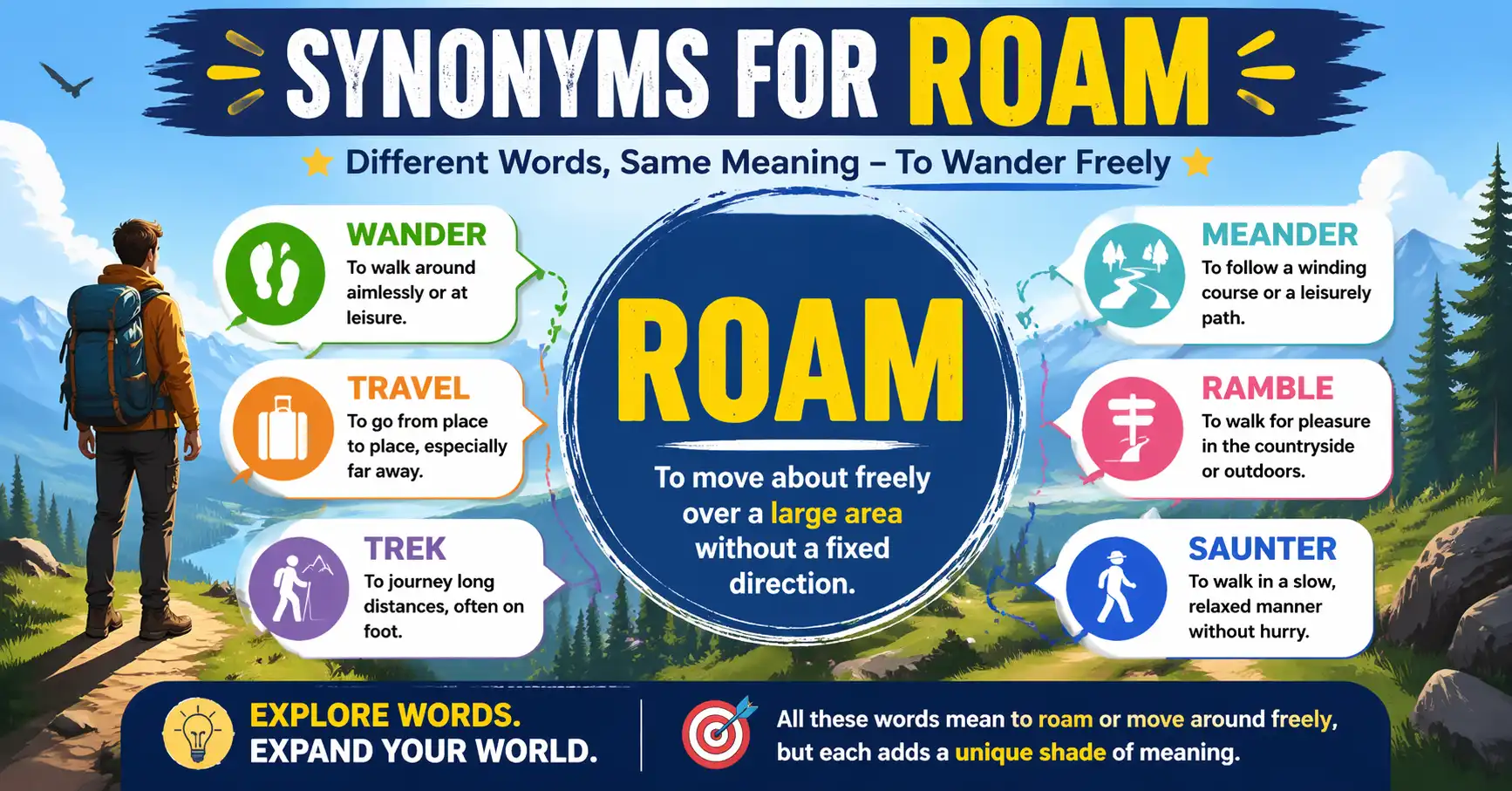
| Wander | To walk slowly without any plan. | Casual | Walking in a park, thinking about life. |
| Rove | To travel across a large space looking for adventure. | Formal | Animals hunting, travelers crossing seas. |
| Ramble | To walk for pleasure in the countryside. | Casual | Hiking, talking for a long time. |
| Meander | To follow a winding, slow path. | Descriptive | Rivers flowing, walking in a market. |
| Drift | To move slowly with the wind or water. | Emotional | Clouds moving, feeling sleepy. |
| Stroll | To walk in a relaxed, happy way. | Casual | Date nights, morning walks with family. |
50 Synonyms for Roam
1. Wander
- Pronunciation: US /ˈwɑːn.dɚ/ & UK /ˈwɒn.də/
- Meaning: To walk slowly without any plan or clear direction.
- Examples:
- The sheep like to wander around the grassy hills.
- I want to wander through the city streets today.
2. Rove
- Pronunciation: US /roʊv/ & UK /rəʊv/
- Meaning: To travel over a wide area with plenty of energy.
- Examples:
- Wild tigers rove through the dark jungle to hunt.
- He spent his youth trying to rove across Europe.
3. Ramble
- Pronunciation: US /ˈræm.bəl/ & UK /ˈræm.bəl/
- Meaning: To walk a long way in nature for pure fun.
- Examples:
- We like to ramble in the woods on weekends.
- They went to ramble near the mountain stream.
4. Meander
- Pronunciation: US /miˈæn.dɚ/ & UK /miˈæn.də/
- Meaning: To follow a curved or slow path with no hurry.
- Examples:
- The narrow river will meander through the flat valley.
- We watched the shoppers meander down the market aisle.
5. Drift
- Pronunciation: US /drɪft/ & UK /drɪft/
- Meaning: To move along slowly without any power or effort.
- Examples:
- The dry leaves drift across the cold sidewalk.
- We let our small boat drift on the quiet lake.
6. Stroll
- Pronunciation: US /stroʊl/ & UK /strəʊl/
- Meaning: To walk at an easy pace to enjoy the view.
- Examples:
- Couples love to stroll along the beach at sunset.
- Let us stroll through the park before lunch.
7. Saunter
- Pronunciation: US /ˈsɑːn.tɚ/ & UK /ˈsɔːn.tə/
- Meaning: To walk in a slow, proud, and relaxed way.
- Examples:
- He would saunter into the classroom with a big smile.
- The actors saunter down the red carpet.
8. Prowl
- Pronunciation: US /praʊl/ & UK /praʊl/
- Meaning: To move quietly and carefully to find something.
- Examples:
- Black cats prowl around the dark garden at night.
- The guard had to prowl the empty building floors.
9. Range
- Pronunciation: US /reɪndʒ/ & UK /reɪndʒ/
- Meaning: To move around a large open land to find food.
- Examples:
- Big herds of cows range over the green plains.
- The wild horses range across the rocky mountains.
10. Stray
- Pronunciation: US /streɪ/ & UK /streɪ/
- Meaning: To move away from the correct group or path.
- Examples:
- Do not stray from the main trail during our hike.
- A few small sheep managed to stray from the flock.
11. Traipse
- Pronunciation: US /treɪps/ & UK /treɪps/
- Meaning: To walk around for a long time until you feel tired.
- Examples:
- We had to traipse all over the mall to find shoes.
- I do not want to traipse through the muddy yard.
12. Gallivant
- Pronunciation: US /ˈɡæl.ə.vænt/ & UK /ˈɡæl.ɪ.vænt/
- Meaning: To go to many places to have fun and make friends.
- Examples:
- She likes to gallivant around town on her school break.
- He did not want to work, he just wanted to gallivant.
13. Gad
- Pronunciation: US /ɡæd/ & UK /ɡæd/
- Meaning: To travel from place to place looking for excitement.
- Examples:
- They love to gad about the country every summer.
- She is always on the gad when the weather is warm.
14. Walk
- Pronunciation: US /wɔːk/ & UK /wɔːk/
- Meaning: To move forward by putting one foot before the other.
- Examples:
- We can walk to the library after school ends.
- My grandfather likes to walk a mile every morning.
15. Hike
- Pronunciation: US /haɪk/ & UK /haɪk/
- Meaning: To take a long walk in nature or on mountains.
- Examples:
- They plan to hike up the tall hill tomorrow.
- You should wear strong boots when you hike.
16. Travel
- Pronunciation: US /ˈtræv.əl/ & UK /ˈtræv.əl/
- Meaning: To go from your home to a distant place.
- Examples:
- We want to travel to Japan next spring.
- He has to travel for his job every month.
17. Trek
- Pronunciation: US /trek/ & UK /trek/
- Meaning: To go on a very long and difficult journey on foot.
- Examples:
- The climbers will trek across the cold snow.
- It was a hard trek through the thick jungle woods.
18. Traverse
- Pronunciation: US /trəˈvɝːs/ & UK /trəˈvɜːs/
- Meaning: To travel completely across a wide piece of land.
- Examples:
- We must traverse the dry valley to reach the town.
- The train will traverse the high mountain bridge.
19. Vagabond
- Pronunciation: US /ˈvæɡ.ə.bɑːnd/ & UK /ˈvæɡ.ə.bɒnd/
- Meaning: To live a life of wandering with no permanent home.
- Examples:
- He chose to vagabond around the world for two years.
- They like to vagabond from one small camp to another.
“Not all those who wander are lost, but they are surely finding themselves.”
20. Journey
- Pronunciation: US /ˈdʒɝː.ni/ & UK /ˈdʒɜː.ni/
- Meaning: To make a long trip to a brand new place.
- Examples:
- They will journey to the deep south this winter.
- We love to journey across the blue sea.
21. Cruise
- Pronunciation: US /kruːz/ & UK /kruːz/
- Meaning: To travel smoothly at a steady and easy speed.
- Examples:
- We can cruise down the open highway with music playing.
- The white ship will cruise around the warm islands.
22. Voyage
- Pronunciation: US /ˈvɔɪ.ɪdʒ/ & UK /ˈvɔɪ.ɪdʒ/
- Meaning: To take a very long trip by water or through space.
- Examples:
- The early sailors had to voyage for months to find land.
- Spaceships will voyage to distant stars in the future.
23. Amble
- Pronunciation: US /ˈæm.bəl/ & UK /ˈæm.bəl/
- Meaning: To walk in a slow and easy way like a gentle horse.
- Examples:
- The old man will amble down to the corner store.
- We can amble through the garden to look at flowers.
24. Mooch
- Pronunciation: US /muːtʃ/ & UK /muːtʃ/
- Meaning: To walk slowly with no goal because you are bored.
- Examples:
- Do not just mooch around the house all day long.
- The kids like to mooch around the playground.
25. Dawdle
- Pronunciation: US /ˈdɑː.dəl/ & UK /ˈdɔː.dəl/
- Meaning: To move very slowly and waste precious time.
- Examples:
- If you dawdle, we will miss the school bus.
- She likes to dawdle in front of shop windows.
26. Mope
- Pronunciation: US /moʊp/ & UK /məʊp/
- Meaning: To walk around slowly because you feel sad or disappointed.
- Examples:
- He began to mope around when his team lost.
- Do not mope in your room on a sunny day.
27. Straggle
- Pronunciation: US /ˈstræɡ.əl/ & UK /ˈstræɡ.əl/
- Meaning: To grow or move in an uneven, messy line.
- Examples:
- A few runners began to straggle far behind the pack.
- The wild vines straggle over the old wooden fence.
28. Mill
- Pronunciation: US /mɪl/ & UK /mɪl/
- Meaning: To move around in a confused crowd without direction.
- Examples:
- Guests will mill about the lobby before the show.
- The sheep mill around the pen during feeding time.
29. Tramp
- Pronunciation: US /træmp/ & UK /træmp/
- Meaning: To walk with heavy, noisy steps over a long distance.
- Examples:
- We had to tramp through the deep, wet mud.
- The soldiers tramp along the dusty dirt road.
30. Explore
- Pronunciation: US /ɪkˈsplɔːr/ & UK /ɪkˈsplɔː/
- Meaning: To travel through a new place to learn all about it.
- Examples:
- The young kids love to explore the backyard woods.
- We want to explore the history of this old castle.
31. Scout
- Pronunciation: US /skaʊt/ & UK /skaʊt/
- Meaning: To look around an area to find useful information.
- Examples:
- The campers will scout the forest for dry wood.
- Go ahead and scout the best path for our group.
32. Tour
- Pronunciation: US /tʊr/ & UK /tʊə/
- Meaning: To travel around an area to see all the sights.
- Examples:
- We plan to tour the historical museums in the city.
- The band will tour five countries this summer.
33. Ride
- Pronunciation: US /raɪd/ & UK /raɪd/
- Meaning: To travel on a horse, bicycle, or in a vehicle.
- Examples:
- I want to ride my red bike to the park.
- They can ride the city bus to save time.
34. Drive
- Pronunciation: US /draɪv/ & UK /draɪv/
- Meaning: To guide and control a car along a road.
- Examples:
- He loves to drive his car through the quiet hills.
- She will drive us to the beach tomorrow morning.
35. Fly
- Pronunciation: US /flaɪ/ & UK /flaɪ/
- Meaning: To move through the air using wings or a plane.
- Examples:
- The birds will fly south when the weather gets cold.
- We can fly to London in just a few hours.
36. Float
- Pronunciation: US /floʊt/ & UK /fləʊt/
- Meaning: To move slowly and softly on water or in the air.
- Examples:
- Bright red balloons float up to the high ceiling.
- Small sticks float down the gentle stream.
37. Navigate
- Pronunciation: US /ˈnæv.ə.ɡeɪt/ & UK /ˈnæv.ɪ.ɡeɪt/
- Meaning: To find the correct path using a map or tools.
- Examples:
- Sailors must navigate the ship through the storm.
- It is hard to navigate the busy city subway lines.
38. Pass
- Pronunciation: US /pæs/ & UK /pɑːs/
- Meaning: To move past a place or through a small opening.
- Examples:
- We will pass by your house on our way home.
- Please let me pass so I can reach my seat.
39. Cross
- Pronunciation: US /krɑːs/ & UK /krɒs/
- Meaning: To go from one side of an area directly to the other.
- Examples:
- Look both ways before you cross the busy street.
- We must cross the old bridge to reach the school.
40. Bypass
- Pronunciation: US /ˈbaɪ.pæs/ & UK /ˈbaɪ.pɑːs/
- Meaning: To go around a busy area to save some time.
- Examples:
- We can bypass the heavy city traffic by taking this lane.
- Use this dirt path to bypass the deep mud.
41. Detour
- Pronunciation: US /ˈdiː.tʊr/ & UK /ˈdiː.tʊə/
- Meaning: To go a different way because the main road is closed.
- Examples:
- The road had a block, so we had to detour through town.
- We must detour around the flooded creek.
42. Weave
- Pronunciation: US /wiːv/ & UK /wiːv/
- Meaning: To move in and out of obstacles very quickly.
- Examples:
- The bicycle rider had to weave through the cars.
- Watch the soccer player weave past the defenders.
43. Thread
- Pronunciation: US /θred/ & UK /θred/
- Meaning: To pass carefully through a very tight or crowded space.
- Examples:
- She had to thread her way through the busy crowd.
- The small car had to thread between the parked trucks.
44. Dodge
- Pronunciation: US /dɑːdʒ/ & UK /dɒdʒ/
- Meaning: To jump quickly to the side to avoid getting hit.
- Examples:
- He had to dodge the falling ball during the game.
- She managed to dodge the rain puddles on the walk.
45. Run
- Pronunciation: US /rʌn/ & UK /rʌn/
- Meaning: To move your feet very fast along a path.
- Examples:
- The kids run around the playground to play tag.
- You must run fast to catch the morning train.
46. Swim
- Pronunciation: US /swɪm/ & UK /swɪm/
- Meaning: To move through water by moving your arms and legs.
- Examples:
- The gold fish swim in circles inside the bowl.
- We love to swim across the cool lake in summer.
47. Climb
- Pronunciation: US /klaɪm/ & UK /klaɪm/
- Meaning: To move upward toward the top of a high place.
- Examples:
- The cats love to climb the tall wooden fence.
- We had to climb the steep stairs to the roof.
48. Row
- Pronunciation: US /roʊ/ & UK /rəʊ/
- Meaning: To move a boat through water using wooden oars.
- Examples:
- We had to row the boat back to the wooden dock.
- He will row across the pond to catch fish.
49. Sail
- Pronunciation: US /seɪl/ & UK /seɪl/
- Meaning: To travel across the water using wind power.
- Examples:
- We want to sail around the island this Sunday.
- The big white boat will sail across the ocean.
50. March
- Pronunciation: US /mɑːrtʃ/ & UK /mɑːtʃ/
- Meaning: To walk with regular, strong, and even steps like a soldier.
- Examples:
- The school band will march down the main street.
- We saw the ants march in a straight line.
Antonyms of the Focus Keyword (Roam)
- Stay: To remain in one place and not leave.
- Settle: To make a permanent home in one specific spot.
- Stop: To halt all movement completely.
- Dwell: To live in a single house or area for a long time.
- Linger: To stay in one spot longer than you should.
Prototype Meaning and Categorization
- Domain: Travel, Geography, Nature, Daily Human Activity.
- Semantic Category: Spatial physical movement, path-finding, freedom of motion.
- Grammatical Category: Verb (used to show physical action or mental wandering).
Frequently Asked Questions
1. Can animals roam and wander at the same time?
Yes. Both words mean to move without a set plan. However, we usually say animals “roam” when they look for food over a massive piece of wild land.
2. Is “saunter” a formal word to use in writing?
No. Saunter is a friendly, casual word. It is perfect for stories when you want to show someone walking with lots of confidence and style.
3. What is the difference between “stray” and “roam”?
Roam is a positive or neutral word about moving freely. Stray means you made a mistake and left the safe path or got lost from your main group.
4. Which synonym for roam is best for digital screens?
“Navigate” or “traverse” are great choices. You can navigate a website menu, or traverse a computer network to find files.
5. Can I use “drift” for a person’s mind?
Yes. It is very common to say someone’s thoughts began to drift when they were bored or tired in a classroom.
6. Why is “ramble” sometimes used for talking?
If someone talks for a long time without making a clear point, they are rambling. The word shows their thoughts are wandering like a country walk.
Conclusion
Learning different synonyms for roam is a very fast way to make your language much more beautiful. When you replace simple words with active verbs, your writing immediately shines. For bloggers, using a wide variety of these terms keeps your web content fresh and helps your site rank higher on modern search engines. For students, it stops your essays from sounding boring and repetitive to your teachers. You can easily find the perfect word for every situation once you understand these gentle differences. Use “saunter” to show confidence, “stroll” for a quiet morning, or “prowl” for a mysterious adventure.
We encourage you to practice these active words today. Try writing one of them in your next school essay, business email, or chat with a friend. The more you use them, the more natural they will feel in your mind. Go ahead and let your vocabulary grow!
“A single word can open a new door to a beautiful journey.”
“Let your voice travel far, and let your words roam free.”

Andrew Powell is a travel writer and nature journalist who has spent over a decade writing about places, landscapes, and the natural world — and thinking carefully about the words that do those subjects justice ( Biography ).