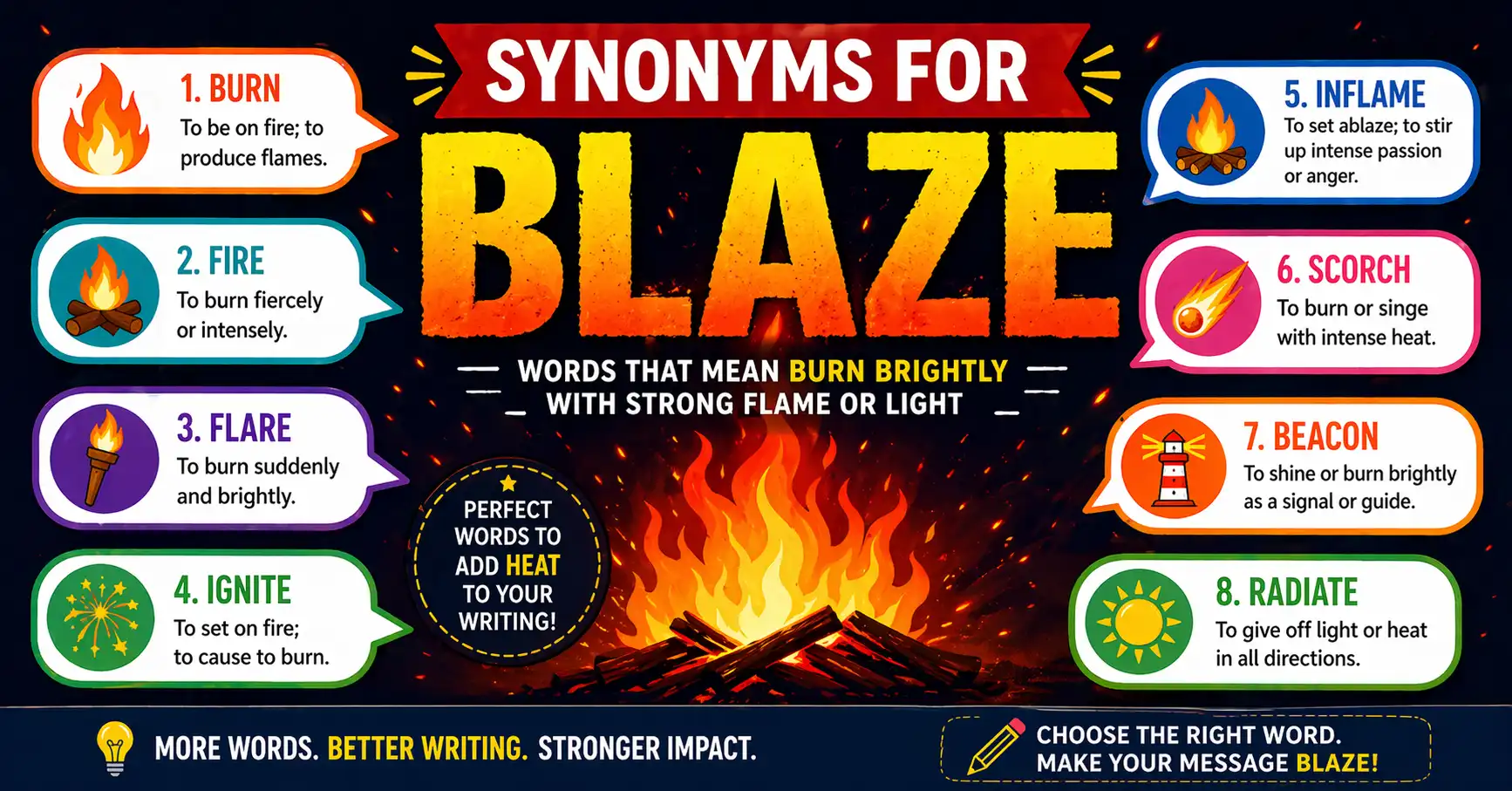
Have you ever tried to describe a roaring campfire or a bright, sunny day but felt stuck using the same basic words? Imagine writing a story about a dark night suddenly lit up by a massive fire. You might call this bright fire a blaze. In very simple English, a blaze is a very bright fire or a strong light.
Using the exact same word over and over can make your writing feel repetitive. That is why learning Synonyms for blaze is so important. For students, bloggers, content writers, and daily English users, growing your vocabulary makes your work exciting to read. It helps you paint vivid pictures with your words. Let us explore these fifty wonderful synonyms for blaze to give your writing a huge boost today!
1. Fire
Meaning: A bright, hot force that burns things and gives off light. Examples:
- The cozy fire kept us warm all night.
- We watched the fire burn the dry wood.
2. Flame
Meaning: A single hot stream of bright, burning gas from a fire. Examples:
- The tiny candle flame danced in the dark room.
- A bright yellow flame shot up from the campfire.
3. Flare
Meaning: A sudden, brief burst of bright light. Examples:
- The captain used a flare to signal the rescue boat.
- We saw a bright flare in the night sky.
4. Glow
Meaning: A soft, steady light that comes from something warm. Examples:
- The warm glow of the heater felt nice on my hands.
- Her face had a healthy glow after the long run.
5. Flash
Meaning: A very quick and sudden burst of bright light. Examples:
- A sudden flash of lightning lit up the dark forest.
- The camera flash made us blink during the photo.
6. Spark
Meaning: A tiny, glowing piece of hot coal or metal that flies off a fire. Examples:
- A tiny spark flew out of the fireplace and hit the rug.
- You need a small spark to start the camp stove.
7. Gleam
Meaning: A small, bright light that shines from a clean surface. Examples:
- I saw a friendly gleam of light in her eyes.
- The clean kitchen floor had a beautiful gleam.
8. Shine
Meaning: A bright and steady light that comes from a source. Examples:
- The bright shine of the sun woke me up early.
- He gave his shoes a quick shine before the meeting.
9. Glint
Meaning: A quick flash of light reflected off something shiny. Examples:
- I saw a glint of gold in the river sand.
- The sun created a bright glint on the car window.
10. Beam
Meaning: A long, straight line of light coming from a source. Examples:
- The flashlight sent a strong beam of light into the cave.
- A warm beam of sunlight came through the window.
11. Glitter
Meaning: Many tiny, bright flashes of light on a surface. Examples:
- The fresh snow had a lovely glitter in the morning.
- She added some silver glitter to her art project.
12. Glimmer
Meaning: A faint, weak light that shines unsteadily. Examples:
- We saw a tiny glimmer of light from a distant cabin.
- There is still a glimmer of hope that we can win.
13. Sparkle
Meaning: A series of quick, bright flashes of light. Examples:
- The clear lake has a beautiful sparkle in the afternoon.
- Her new diamond ring has a lot of sparkle.
14. Bonfire
Meaning: A very large outdoor fire made for fun or a celebration. Examples:
- We roasted sweet marshmallows over the big bonfire.
- Our friends gathered around the beach bonfire to sing songs.
15. Inferno
Meaning: A very large and dangerous fire that is out of control. Examples:
- The old warehouse turned into a massive inferno within minutes.
- Firefighters worked hard to put out the forest inferno.
16. Wildfire
Meaning: A giant fire that spreads very quickly through a forest. Examples:
- The dry summer wind made the wildfire spread fast.
- Families evacuated their homes to escape the dangerous wildfire.
17. Conflagration
Meaning: A massive and destructive fire that burns a large area. Examples:
- The historic city suffered a terrible conflagration in the past.
- Strong winds turned the small campfire into a huge conflagration.
18. Radiance
Meaning: A warm and beautiful light that glows brightly. Examples:
- The morning sun filled the room with a warm radiance.
- We admired the soft radiance of the full moon.
19. Brilliance
Meaning: An extreme brightness or smartness of light. Examples:
- The absolute brilliance of the diamond amazed everyone.
- The summer sun shone with great brilliance over the desert.
20. Glare
Meaning: A harsh, strong light that hurts your eyes to look at. Examples:
- The glare from the snowy road made it hard to drive.
- I wore dark sunglasses to block the morning glare.
21. Shimmer
Meaning: A soft light that seems to shake or wave gently. Examples:
- The hot air created a strange shimmer on the road.
- We loved the quiet shimmer of the lake at night.
22. Flicker
Meaning: A light that shines unsteadily and goes on and off quickly. Examples:
- The screen gave a sudden flicker before turning off.
- We watched the candle flicker in the soft breeze.
23. Twinkle
Meaning: A quick, bright light that flashes on and off. Examples:
- I love to watch the twinkle of the stars at night.
- There was a playful twinkle in the child’s eyes.
24. Ray
Meaning: A single narrow line of light. Examples:
- A warm ray of light found its way through the leaves.
- Keep this plant in a bright ray of sunshine.
25. Burning
Meaning: The hot state of being on fire. Examples:
- The burning leaves filled the yard with thick smoke.
- I could feel the burning heat of the desert sand.
26. Heat
Meaning: The warm or hot feeling that comes from a fire or sun. Examples:
- You should not stand too close to the heat of the fire.
- The intense heat of the oven baked the bread quickly.
27. Warmth
Meaning: A gentle, comfortable heat that feels nice. Examples:
- We enjoyed the cozy warmth of the small fireplace.
- The heavy wool blanket gave him plenty of warmth.
28. Light
Meaning: The bright energy that allows people to see things. Examples:
- Turn on the desk light so you can read your book.
- The morning light came slowly through the thick trees.
29. Illumination
Meaning: The light that makes a dark place bright and clear. Examples:
- The street lamps provide great illumination at night.
- We need more illumination in this dark hallway.
30. Beacon
Meaning: A bright light used to guide or warn people. Examples:
- The tall lighthouse serves as a safe beacon for ships.
- The campfire was a beacon for the lost hikers.
31. Flare-up
Meaning: A sudden burst of bright fire or anger. Examples:
- The campfire had a quick flare-up when we added dry pine needles.
- The sudden flare-up of the stove surprised the cook.
32. Burst
Meaning: A sudden and powerful release of light or energy. Examples:
- A sudden burst of sunlight broke through the heavy grey clouds.
- We heard a loud burst of laughter from the other room.
33. Outburst
Meaning: A sudden and powerful release of action or light. Examples:
- The active volcano had a sudden outburst of hot lava.
- Her sudden outburst of joy surprised her friends.
34. Sheen
Meaning: A soft, smooth shine on the surface of something. Examples:
- The healthy horse had a beautiful sheen on its coat.
- The polished wood desk had a lovely satin sheen.
35. Luster
Meaning: A gentle glow that comes from a clean or smooth surface. Examples:
- The pearl necklace had a soft, expensive luster.
- Regular cleaning keeps the metal sink’s luster bright.
36. Ember
Meaning: A glowing piece of wood or coal left in a dying fire. Examples:
- A single hot ember burned brightly in the ashes.
- He used the glowing ember to start a new fire.
37. Pyre
Meaning: A large pile of wood used for burning something outdoors. Examples:
- They built a dry wooden pyre for the holiday celebration.
- The large pyre burned brightly under the starry sky.
38. Furnace
Meaning: An enclosed container where a very hot fire is made. Examples:
- The metal factory uses a giant furnace to melt iron.
- Our basement furnace keeps the entire house warm in winter.
39. Hearth
Meaning: The stone floor of a fireplace where the fire sits. Examples:
- The sleepy dog curled up on the warm hearth.
- We decorated the brick hearth with green plants.
40. Torch
Meaning: A stick with a burning end that you carry for light. Examples:
- The tour guide held a bright torch in the dark cave.
- We used a battery torch to find our way in the dark.
41. Firestorm
Meaning: A massive fire that is grown larger by strong winds. Examples:
- The high winds turned the dry grass fire into a dangerous firestorm.
- The village was saved from the fast-moving firestorm.
42. Sunbeam
Meaning: A single beam of bright light from the sun. Examples:
- The lazy cat slept directly inside the warm sunbeam.
- A golden sunbeam lit up the dusty living room.
43. Starlight
Meaning: The soft, gentle light that comes from stars. Examples:
- We walked along the beach under the quiet starlight.
- The starlight was bright enough to see the path.
44. Daylight
Meaning: The natural light that comes from the sun during the day. Examples:
- We should finish our long hike before daylight fades away.
- The bright daylight made it easy to read outside.
45. Combustion
Meaning: The chemical process of catching fire and burning. Examples:
- The engine relies on rapid combustion to move the car.
- Oxygen is required for the combustion of wood.
46. Halo
Meaning: A bright circle of light around an object. Examples:
- The bright streetlights had a soft halo of mist around them.
- The moon was surrounded by a beautiful white halo.
47. Corona
Meaning: A bright circle of light seen around the sun or moon. Examples:
- We saw the sun’s beautiful corona during the solar eclipse.
- A soft corona of light appeared around the streetlamp in the fog.
48. Luminescence
Meaning: A soft light produced without heat. Examples:
- The deep sea fish glows with a strange green luminescence.
- The watch hands had a bright luminescence in the dark.
49. Signal
Meaning: A bright light or action used to send information. Examples:
- The tower sent a bright signal to the incoming train.
- He used a bright flashlight to send a rescue signal.
50. Campfire
Meaning: A small outdoor fire used for warmth, light, or cooking. Examples:
- We sat close to the warm campfire to share scary stories.
- He cooked fresh fish over the hot campfire coals.
Conclusion
Learning diverse synonyms for blaze is a great way to improve your writing, blogging, speaking, and everyday communication. Using a variety of bright words keeps your readers interested and makes your ideas clear. Try using these fifty words in your school essays, work emails, and daily conversations. The more you practice, the easier it will be to shine!

Andrew Powell is a travel writer and nature journalist who has spent over a decade writing about places, landscapes, and the natural world — and thinking carefully about the words that do those subjects justice ( Biography ).