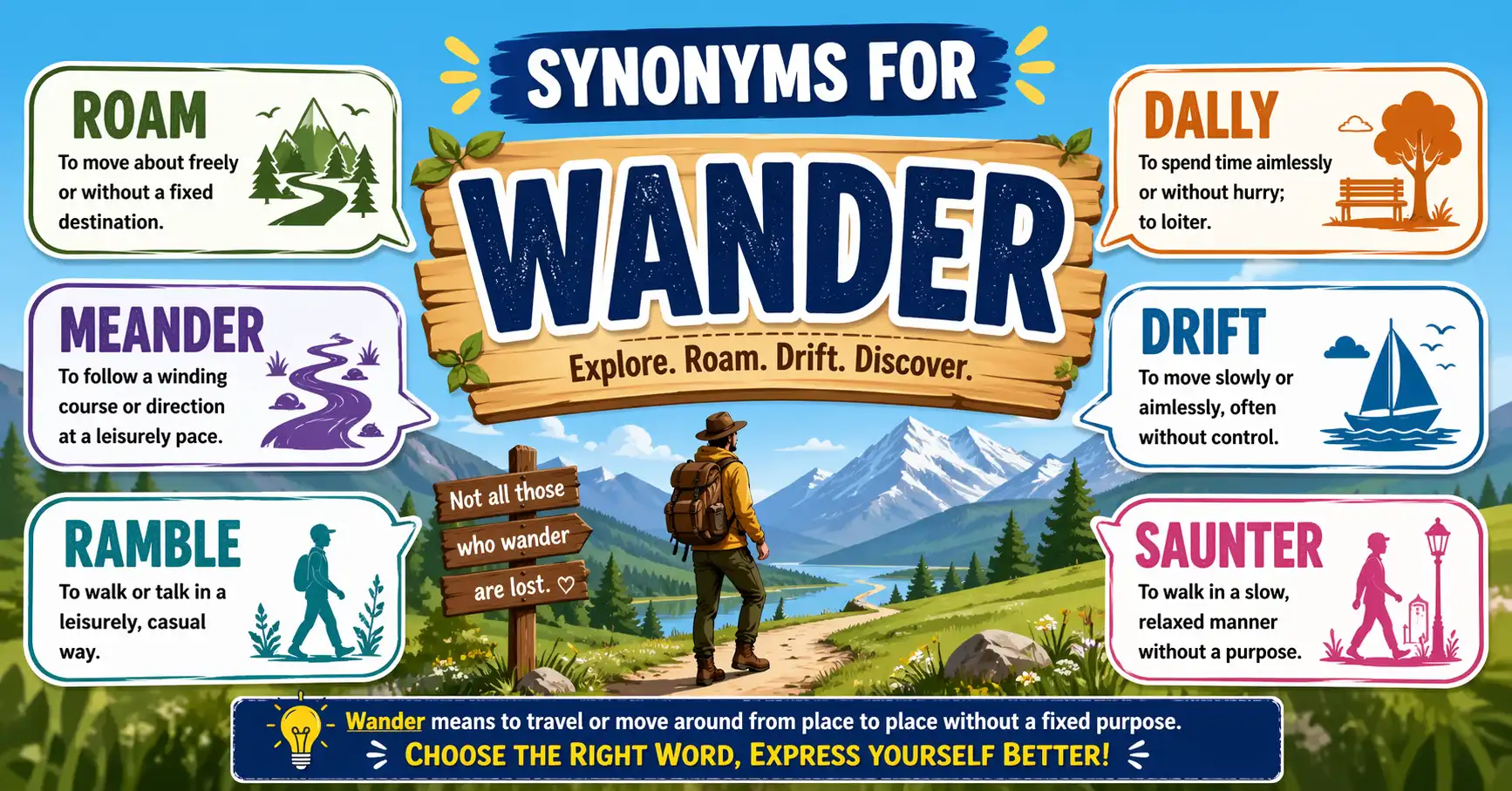
Have you ever gone for a walk in a park without looking at a map? You just walk slowly to look at the trees and enjoy the day. This relaxed way of moving is what it means to wander. But if you write the same word over and over, your readers will get bored. Are you searching for the best synonyms for wander to make your writing shine?
To wander means to walk or move around slowly with no clear goal or plan. Knowing different synonyms for wander is highly useful for everyone. Students can write better school essays to get top grades. Bloggers and content writers can keep their readers excited and hooked. Daily English users can sound more natural when talking with friends. Let us explore these fifty excellent words to upgrade your vocabulary!
1. Roam
Meaning: To walk or travel around a large area with no real plan.
Examples:
- Wild cows roam across the open green fields.
- I love to roam around new cities on my days off.
2. Stroll
Meaning: To walk in a slow, happy, and relaxed way.
Examples:
- We like to stroll through the park after we eat dinner.
- The happy couple will stroll along the quiet beach.
3. Ramble
Meaning: To walk for fun in the countryside or talk for a long time.
Examples:
- They love to ramble through the deep woods on weekends.
- My grandpappy tends to ramble about his old school days.
4. Meander
Meaning: To follow a path that has many twists and turns.
Examples:
- The wide river will meander slowly through the valley.
- We watched the dirt path meander up the tall hill.
5. Drift
Meaning: To move slowly with the wind or water currents.
Examples:
- The white clouds drift across the bright blue sky.
- Dry leaves drift down the slow river.
6. Stray
Meaning: To move away from the right path or group.
Examples:
- Do not stray away from your hiking group.
- The little puppy began to stray from its mother.
7. Amble
Meaning: To walk at a very slow and easy pace.
Examples:
- The giant elephants amble toward the watering hole.
- We amble through the street market to see the toys.
8. Rove
Meaning: To travel or look around a wide area.
Examples:
- Bandits used to rove through these dry hills.
- Her eyes began to rove around the busy room.
9. Saunter
Meaning: To walk in a slow, proud, and confident way.
Examples:
- He would saunter into the classroom with a smile.
- They saunter down the road on warm summer days.
10. Traipse
Meaning: To walk around when you are tired or busy.
Examples:
- I had to traipse all over town to find a gift.
- We traipse through the wet grass to find the ball.
11. Gallivant
Meaning: To go from place to place to have fun.
Examples:
- She likes to gallivant around the city with her friends.
- He is always off to gallivant in different countries.
12. Range
Meaning: To move or live over a wide open area.
Examples:
- Wolves range across the snowy mountains.
- These farm chickens range free to find food.
13. Explore
Meaning: To travel through a new place to learn about it.
Examples:
- We want to explore the old cave near the river.
- Kids love to explore the backyard during playtime.
14. Tour
Meaning: To travel around a place to see its famous sights.
Examples:
- The family decided to tour the big museum today.
- We will tour the historic city on a red bus.
15. Plod
Meaning: To walk slowly with heavy and tired steps.
Examples:
- The tired horses plod along the muddy road.
- I have to plod through this long book for school.
16. Trudge
Meaning: To walk slowly and with great effort.
Examples:
- We had to trudge through the deep winter snow.
- The hikers trudge up the steep mountain path.
17. Shuffle
Meaning: To walk by dragging your feet along the floor.
Examples:
- Please do not shuffle your feet when you walk.
- The sleepy boy would shuffle into the kitchen.
18. Loiter
Meaning: To stand or walk slowly around a place with no goal.
Examples:
- It is not good to loiter near the store door.
- The teens like to loiter by the park benches.
19. Gad
Meaning: To travel from one place to another looking for fun.
Examples:
- They gad about the town every single weekend.
- She loves to gad around to different coffee shops.
20. Walk
Meaning: To move on foot at a normal and steady speed.
Examples:
- Let us walk to the corner store together.
- I walk my dog every morning before breakfast.
21. Trek
Meaning: To go on a very long and hard journey.
Examples:
- They plan to trek across the hot desert.
- We had to trek for miles to find help.
22. Hike
Meaning: To take a long and healthy walk in nature.
Examples:
- We will hike up the green trail tomorrow morning.
- My family loves to hike in the national parks.
23. Cruise
Meaning: To travel slowly and easily for fun.
Examples:
- We like to cruise down the road with open windows.
- The big boat will cruise around the quiet lake.
24. Glide
Meaning: To move smoothly and easily without much work.
Examples:
- The ice skaters glide across the cold ice.
- Large birds glide silently through the clean air.
25. Coast
Meaning: To slide down a hill without using any power.
Examples:
- We can coast down the street on our skateboards.
- The car will coast to a stop near the tree.
26. Float
Meaning: To move slowly through the air or on water.
Examples:
- The yellow balloon will float up to the ceiling.
- Dry wood logs float easily on the river.
27. Promenade
Meaning: To walk in a public place so people can see you.
Examples:
- People promenade down the grand street in the evening.
- We watched the guests promenade around the garden.
28. March
Meaning: To walk with firm, steady, and loud steps.
Examples:
- The brave soldiers march in a straight line.
- The kids march around the yard playing drums.
29. Step
Meaning: To lift your foot and put it down to move.
Examples:
- Be careful not to step on the wet paint.
- You must step over the small puddle.
30. Pace
Meaning: To walk back and forth in a small area.
Examples:
- The worried dad began to pace in the hallway.
- I pace around the room when I speak on the phone.
31. Tread
Meaning: To walk or put your foot down on a surface.
Examples:
- We must tread softly so we do not wake the baby.
- Do not tread on the fresh green grass.
32. Prowl
Meaning: To move around very quietly and secretly.
Examples:
- Black cats like to prowl through the garden at night.
- The lions prowl around the tall yellow grass.
33. Creep
Meaning: To move slowly and quietly so no one hears you.
Examples:
- I try to creep past the sleeping dog.
- The spiders creep slowly up the bedroom wall.
34. Slide
Meaning: To move smoothly over a wet or icy surface.
Examples:
- The kids love to slide down the snowy hill.
- The glass cup began to slide off the wet table.
35. Slip
Meaning: To slide by accident or move very quickly.
Examples:
- Watch out so you do not slip on the ice.
- He tried to slip out of the room quietly.
36. Sneak
Meaning: To move secretly so that nobody sees you.
Examples:
- I like to sneak into the kitchen for a midnight snack.
- The cat tried to sneak up on the little bird.
37. Slink
Meaning: To move quietly because you are scared or bad.
Examples:
- The bad dog will slink away when you yell.
- I saw him slink out the back door of the house.
38. Steal
Meaning: To move very quietly and softly.
Examples:
- She tried to steal a glance at his paper.
- We watch the shadows steal across the dark room.
39. Toddle
Meaning: To walk with short, shaky steps like a baby.
Examples:
- The sweet baby began to toddle toward her toys.
- The small ducks toddle behind their mother.
40. Waddle
Meaning: To walk with short steps while swaying side to side.
Examples:
- The fat penguins waddle across the white snow.
- I saw a heavy goose waddle near the lake.
41. Limp
Meaning: To walk with difficulty because your leg hurts.
Examples:
- The hurt player had to limp off the field.
- My sore foot made me limp all day yesterday.
42. Hobble
Meaning: To walk in an uneven and awkward way.
Examples:
- The old man had to hobble with his wooden cane.
- We watched the injured bird hobble to the bush.
43. Stagger
Meaning: To walk unsteadily as if you are about to fall.
Examples:
- The heavy box made the worker stagger a bit.
- He would stagger when the strong wind blew.
44. Stumble
Meaning: To hit your foot and almost fall while walking.
Examples:
- Do not stumble over the rocks on the path.
- I always stumble when I walk in the dark.
45. Totter
Meaning: To walk or stand in a very shaky way.
Examples:
- The tall tower of blocks began to totter.
- Old people sometimes totter on slippery floors.
46. Lurch
Meaning: To make a sudden and unsteady movement forward.
Examples:
- The school bus will lurch when it starts to move.
- I felt the small boat lurch in the big waves.
47. Swerve
Meaning: To turn aside very quickly to miss something.
Examples:
- The driver had to swerve to miss the small rock.
- I will swerve my bike if a cat runs out.
48. Veer
Meaning: To change your direction very suddenly.
Examples:
- The heavy wind will veer to the east tonight.
- The birds veer away when they see the tree.
49. Deviate
Meaning: To turn away from your main path or rule.
Examples:
- We must not deviate from our travel plan.
- Do not deviate from the cooking instructions.
50. Diverge
Meaning: To split and go in different directions.
Examples:
- The two roads diverge near the red barn.
- Our paths will diverge at the end of the school year.
Conclusion
Learning different synonyms for wander is an easy way to make your writing, blogging, and daily speaking much better. When you use these words, your English becomes interesting and clear. We encourage you to try these fifty terms in your next school essays, work emails, and chats. The more you use them, the more natural they will feel to you. Keep practicing and watch your English skills grow today!

Andrew Powell is a travel writer and nature journalist who has spent over a decade writing about places, landscapes, and the natural world — and thinking carefully about the words that do those subjects justice ( Biography ).