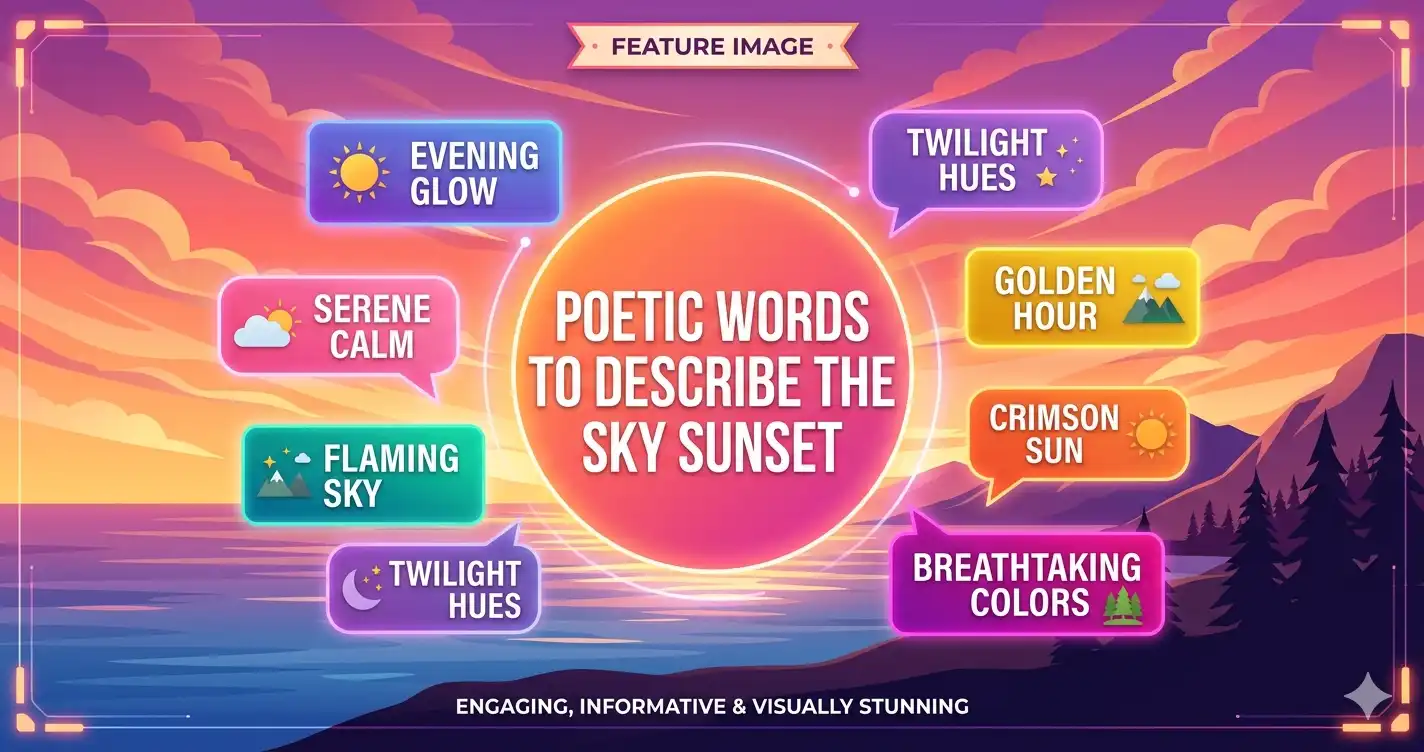
There is a moment every evening when the world holds its breath. The sun, tired from its long journey across the sky, begins to sink below the horizon — and the sky erupts in a breathtaking display of color, light, and emotion. Whether you are a poet searching for the perfect line, a novelist painting a scene, or simply someone who wants a beautiful Instagram caption, finding the right poetic words to describe the sky at sunset can feel almost as magical as the sunset itself.
This guide brings together over 100 carefully chosen poetic words, vivid adjectives, powerful metaphors, lyrical similes, and expressive phrases — all in one place. Read on, and let the sky speak through your words.
Why Words Matter When Describing a Sunset Sky
A sunset is never just a sunset. It is a farewell. A transformation. A silent poem written in color across the dome of the world. Yet capturing that feeling in language is one of the most beautiful challenges a writer can face.
Ordinary words fall short. Saying “the sky was orange and pink” describes a fact, but it does not create a feeling. That is why poets and writers have always turned to richer vocabulary — to adjectives that glow, metaphors that burn, and similes that make the reader see and feel the sky the way you did.
When you use poetic language to describe a sunset sky, you do more than inform — you transport. You make the reader stand beside you, eyes lifted, hearts open.
Poetic Adjectives to Describe the Sky at Sunset
Adjectives are the colors on a writer’s palette. Here are the most expressive and poetic ones for a sunset sky, grouped by the emotion or color they evoke:
Adjectives for Color and Light
- Aureate — rich, golden, glowing like pure gold
- Vermillion — a deep, vivid red-orange
- Incarnadine — blood-red, with dramatic intensity
- Amber — warm, honey-toned golden orange
- Cerise — a bright cherry-red pink
- Cinnabar — a fiery, mercury-red tone
- Saffron — deep golden yellow, rich and warm
- Magenta — a vivid pinkish-purple
- Indigo — deep blue-violet fading at the horizon’s edge
- Ochre — earthy, golden-yellow warmth
- Carmine — a rich, deep crimson
- Tawny — warm brownish-orange, like a lion at dusk
- Opalescent — shimmering with shifting rainbow colors
- Iridescent — glowing with multiple colors at once
- Burnished — polished, gleaming like hammered metal
Adjectives for Mood and Atmosphere
- Ethereal — delicate, otherworldly, almost unreal
- Resplendent — brilliant and glorious to the eye
- Luminous — radiating soft, pure light
- Transcendent — beyond ordinary beauty, almost divine
- Melancholic — tinged with beautiful sadness
- Ephemeral — brief, fleeting, heartbreakingly temporary
- Sublime — awe-inspiring, almost terrifying in its beauty
- Serene — calm, peaceful, undisturbed
- Majestic — grand, powerful, commanding wonder
- Gossamer — thin and delicate, like silk threads of light
- Poignant — deeply moving, touched with emotion
- Smoldering — burning low, with hidden heat and intensity
- Languorous — slow, dreamy, beautifully unhurried
- Hushed — quiet, as if the world is holding its breath
- Bittersweet — beautiful precisely because it cannot last
For Texture and Form
- Molten — as if the sky were liquid, glowing metal
- Velveteen — soft and rich like velvet fabric
- Diaphanous — thin and translucent, letting light through
- Filmy — delicate, gauzy, soft-edged
- Suffused — washed through with warm, spreading color
- Dappled — scattered with patches of light and shadow
- Blazing — intensely bright and fiery
- Smeared — broad, bold strokes of color across the sky
- Layered — stacked in bands of deepening color
- Bruised — deep purple-blue, tender and dramatic
Powerful Metaphors for the Sunset Sky
Metaphors transform a sunset from a fact into an experience. Instead of describing what the sky looks like, metaphors tell us what the sky is — and that changes everything.
Classic and Timeless Metaphors
- The sky is a painter’s final canvas — the whole day has been preparation for this one masterpiece.
- The horizon wears a burning crown — the edge of the earth glows with orange and crimson royalty.
- The sunset is God’s farewell letter — signed in gold and sealed with twilight.
- The sky is a cathedral of fire — vast, soaring, inspiring reverence.
- The clouds are dying embers — still glowing, but slowly fading to ash.
- The sun is a melting coin of gold — slipping below the horizon, spending its last light.
- The sky is a curtain of silk on fire — grand, theatrical, closing the day’s performance.
- The sunset is the world’s last exhale — a long, warm sigh before the night breathes in.
- The horizon is a wound in the sky — bleeding beauty, rich reds and purples seeping outward.
- The sky is a chalice of wine — deep crimson, poured across the heavens.
Creative and Contemporary Metaphors
- The sky is nature’s screensaver — impossibly perfect, as if designed by an artist.
- The sunset is a symphony’s final movement — building, swelling, then fading into silence.
- The horizon is a smoldering hearth — warm, safe, and deeply comforting.
- The sky is a treasure chest thrown open — spilling rubies, topaz, and liquid gold.
- The clouds are the sun’s love letters — written in crimson and left behind as it departs.
- The sunset is the day’s curtain call — one last bow before the night takes the stage.
Beautiful Similes for the Sunset Sky
Similes use “like” or “as” to create vivid comparisons. They are more gentle than metaphors — an invitation rather than a declaration — and can be extraordinarily poetic.
Similes That Capture Color
- The sky blazed like a cathedral of stained glass lit from within.
- The horizon glowed like the last ember in a dying hearth.
- The clouds burned like silk soaked in flame.
- The sunset spread like ink dropped into water — slow, inevitable, breathtaking.
- The sky flushed like a rose opening for the last time.
- The light fell like liquid amber poured across the hills.
- The horizon shimmered like a bronze mirror catching fire.
Similes That Capture Emotion
- The sky felt like a whispered secret between the sun and the earth.
- The sunset lingered like a lover reluctant to say goodbye.
- The fading light moved like a sigh of perfect contentment.
- The dusk descended like velvet drawn slowly across a window.
- The sky glowed like the face of someone remembering something beautiful.
Poetic Phrases and Descriptive Lines for the Sunset Sky
Sometimes what a writer needs is not a single word but a ready-made phrase — a complete image they can adapt, build upon, or use as a spark of inspiration.
Short Poetic Phrases
- The sky in its dying glory
- Twilight’s amber benediction
- The horizon’s last confession
- A wound of light across the west
- The sky’s slow blush toward darkness
- Dusk’s painted surrender
- The evening’s crimson requiem
- A cathedral of fleeting fire
- The day’s final, golden breath
- Heaven set quietly ablaze
Longer Descriptive Lines (Ready to Use)
- “The sky burned with the colors of every emotion — orange for joy, crimson for longing, and violet for the peace that follows.”
- “Above the horizon, the last light spread like a prayer no one had words for.”
- “The clouds caught fire one by one, glowing then fading, as if the sky itself was learning to let go.”
- “Dusk came softly, draping the world in shades of amber and rose, the way a mother draws a blanket over a sleeping child.”
- “The sun did not simply set — it descended like a king, slow and magnificent, trailing crimson robes across the sky.”
Literary Devices to Elevate Your Sunset Writing
Google’s E-E-A-T (Experience, Expertise, Authoritativeness, Trustworthiness) guidelines reward content that goes deeper than a simple list. Understanding why these words work makes you a better writer and your content more genuinely valuable.
Personification
Give the sun and sky human qualities to create warmth and intimacy:
- “The sun bid a lingering farewell, reluctant to leave.”
- “The sky blushed pink, embarrassed by so much beauty.”
- “The horizon breathed out in shades of gold and rose.”
Synesthesia (Mixing the Senses)
Describe the sunset in terms of sound, touch, or taste to make it unforgettable:
- “The sunset tasted of warm honey and woodsmoke.”
- “The light had the texture of warm velvet against the skin.”
- “The sky hummed with orange and gold, a low, resonant note.”
Chiasmus and Paradox
Some of the most beautiful sunset lines contain a paradox — a beautiful contradiction:
- “The sky burned brightest just before it went dark.”
- “In ending, the day was never more alive.”
- “The beauty of a sunset lies in what it takes away.”
Tips for Using Poetic Sunset Words Effectively
Knowing the words is one thing. Using them well is another. Here are a few principles that separate good sunset writing from truly memorable writing:
1. Choose specificity over generality. “Vermillion” is more powerful than “red.” “Aureate” is more evocative than “golden.” The more specific the word, the more vivid the image.
2. Combine senses. The greatest sunset descriptions do not just describe what the eye sees — they capture what the body feels, what the heart hears, what the soul almost tastes.
3. Let the sunset mean something. In literature, sunsets have always symbolized endings, transitions, and the bittersweet passage of time. Let your language carry that emotional weight.
4. Avoid cliché — or subvert it. “The sky was on fire” is a cliché. “The sky burned like a secret it could no longer keep” is fresh. Take the familiar and twist it into something new.
5. Less is often more. A single perfectly chosen poetic word — smoldering, incarnadine, ephemeral — can do more work than five ordinary ones.
Frequently Asked Questions
What are the best single words to describe a sunset sky?
The most poetic single words are: ethereal, resplendent, luminous, smoldering, vermillion, aureate, ephemeral, and sublime. Each carries rich emotional and visual meaning.
How do poets describe a sunset?
Poets use metaphor, simile, personification, and sensory language to transform a sunset from a visual event into an emotional experience. They focus not just on color but on what the sunset feels like — what it means, what it evokes, what it makes you remember.
What words describe sunset colors?
The most evocative words for sunset colors include: amber, vermillion, cinnabar, cerise, saffron, carmine, indigo, ochre, magenta, aureate, and tawny.
Can I use these words for Instagram captions?
Absolutely. Short poetic phrases like “twilight’s amber benediction” or “the sky in its dying glory” make stunning, original Instagram captions that stand out far above clichés.
Conclusion — Let the Sky Speak
The sky at sunset has been inspiring human language for as long as humans have had words. From ancient Sanskrit poetry to Shakespeare’s sonnets to today’s Instagram captions, we keep returning to this one perfect moment — the day dissolving into night in a blaze of color and light.
With the words in this guide — the adjectives that glow, the metaphors that burn, the similes that shimmer — you now have everything you need to capture that moment in language worthy of the sky itself.
The sunset will always be fleeting. But your words can make it last forever.

Andrew Powell is a travel writer and nature journalist who has spent over a decade writing about places, landscapes, and the natural world — and thinking carefully about the words that do those subjects justice ( Biography ).