Every nature writer eventually hits the same wall.
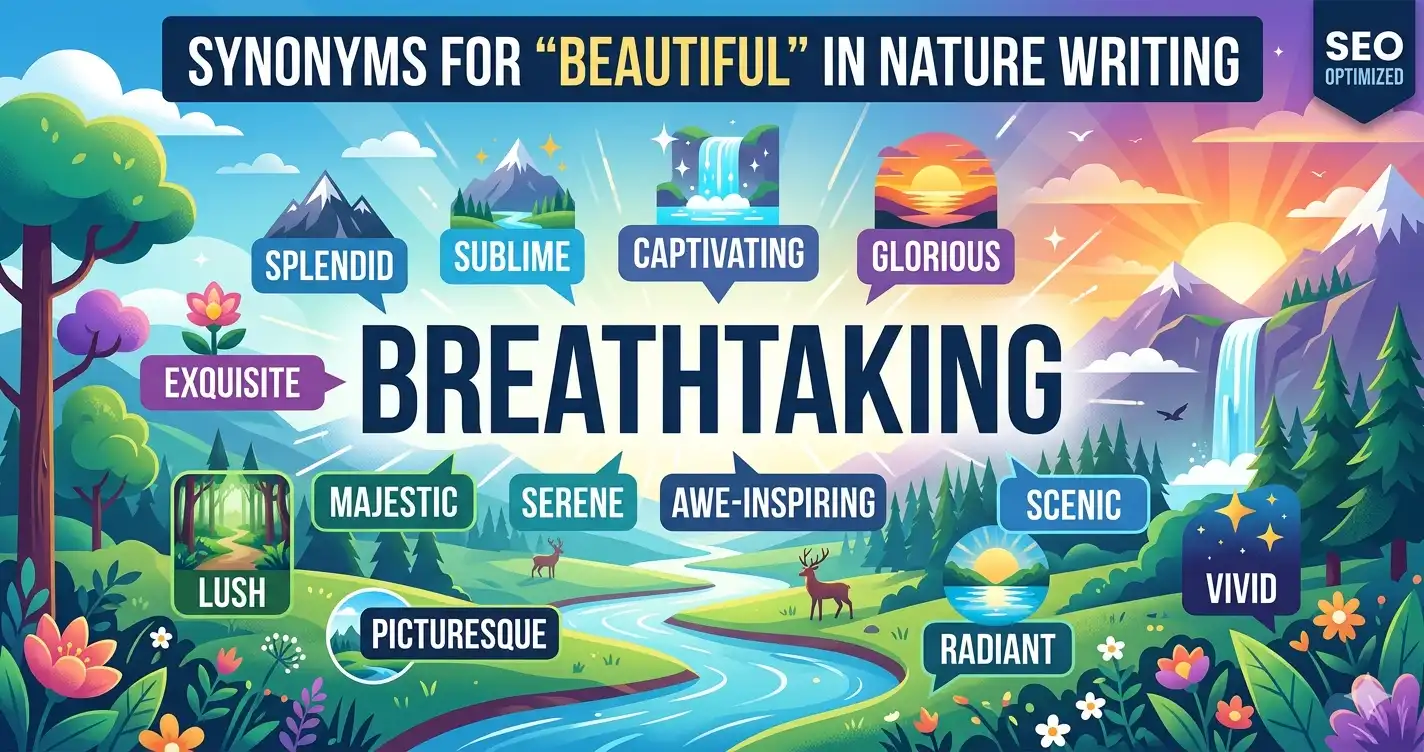
You are describing a sunrise over mist-covered mountains, a quiet lake at dusk, or a forest floor covered in wet moss — and the only word that comes to mind is beautiful. It feels right. It feels true. But it is also the most overused word in the English language. To truly capture the majesty of the outdoors, a writer needs to look for specific synonyms for beautiful in nature writing that reflect the unique light, scale, and atmosphere of the wild.
The problem with “beautiful” is not that it is wrong. It is that it is empty ,tells the reader nothing specific, does no sensory work. It asks the reader to imagine beauty without showing them what kind.
The best nature writers — from Annie Dillard to John Muir to Robin Wall Kimmerer — rarely use the word beautiful at all. They choose words that create beauty in the reader’s mind rather than simply announcing it.
This guide gives you 50+ precise synonyms for beautiful specifically selected for nature writing, organized by scene type, with real sentence examples you can model immediately.
Why “Beautiful” Weakens Nature Writing
Before we get to the words, it is worth understanding why replacing “beautiful” matters so much in this specific genre.
It Is Too Abstract to Create an Image
When you write “the meadow was beautiful,” the reader supplies their own image of beauty — which may be completely different from what you experienced. Words like luminous, verdant, or resplendent force a specific visual response in the reader’s mind.
It Does Not Engage the Senses
Nature writing lives in the senses. A word like gossamer suggests both the sight and feel of thin morning light through spider silk. The word beautiful engages nothing.
It Signals a Lack of Observation
Great nature writing comes from close, patient attention to the natural world. When a writer defaults to “beautiful,” it often signals that they stopped observing before finding the right word. Specific language proves that you actually looked.
Synonyms for Beautiful Organized by Scene Type
Unlike other synonym lists, this guide organizes words by the type of natural scene you are describing. This makes it immediately useful when you are writing.
Words for Mountains, Cliffs, and Vast Landscapes
These words carry weight and scale. Use them when describing scenes that inspire awe or make the human feel small.
Sublime — Beauty so grand it produces awe rather than simple pleasure. The sublime ridge stretched before us, indifferent to our smallness.
Majestic — Grand and impressive; commanding respect through sheer presence. The majestic peaks wore their snow like crowns no human hand had made.
Panoramic — Describing a sweeping, wide view that unfolds in all directions. From the summit, a panoramic silence opened up that no photograph could hold.
Towering — Suggesting both height and emotional magnitude. Towering granite walls rose on either side, cutting the sky into a narrow blue ribbon.
Rugged — Beauty that comes from rawness and untamed edges. The rugged coastline had a power that polished scenery never possesses.
Breathtaking — So striking that it disrupts the breath; use sparingly for maximum effect. The first glimpse of the canyon was genuinely breathtaking — I stood there simply unable to speak.
Words for Forests, Trees, and Green Landscapes
These words carry life, growth, and the particular quality of deep green light.
Verdant — Lush green; rich with living vegetation. From Latin viridare, to grow green. The verdant hillside held every shade of green that light can find.
Sylvan — Relating to the forest; having a deep, wooded quality. A literary favourite. A sylvan quiet settled over the path as we moved deeper into the trees.
Lush — Abundantly rich in vegetation; almost overflowing with green life. The lush undergrowth pressed against the trail on both sides, alive with moisture.
Bucolic — Peacefully rural; evoking an idealized countryside. The bucolic valley below looked like a painting that had not yet dried.
Flourishing — Full of vigorous, active growth; thriving in all directions. A flourishing canopy arched overhead, filtering the light into moving gold.
Primeval — Ancient, as if unchanged since the world’s first days. The primeval forest pressed close, older than any human memory.
Words for Water — Rivers, Lakes, Oceans, and Rain
Water needs words that carry movement, light, and sound.
Luminous — Giving off soft, glowing light; as if lit from within. The luminous surface of the lake held the pink sky long after sunset had passed.
Pellucid — Transparently clear; allowing light to pass through without distortion. The pellucid stream ran over white stones, each one magnified and distinct.
Gossamer — Thin, delicate, light as spider silk — especially for mist and soft water light. Gossamer veils of mist drifted above the surface of the pond in the early morning.
Iridescent — Showing shifting colours as light changes; like a soap bubble or a dragonfly wing. The iridescent skin of the river changed from grey to copper to gold as the sun moved.
Serene — Calm, untroubled, radiating peace — particularly effective for still water. The serene lake held the mountains upside down, perfectly still and wordless.
Shimmering — Giving off soft, quivering light, as if the surface is slightly alive. The shimmering ocean stretched to the horizon, too vast and too bright to hold in the mind.
Words for Skies, Light, and Atmospheric Beauty
Sky and light are the most transient beauties in nature — they need precise words.
Ethereal — Delicate, otherworldly; seeming to belong to another, lighter realm. The ethereal glow of the aurora moved across the sky like something dreaming.
Resplendent — Brilliantly bright; dazzling with colour and light. The resplendent sunset lasted only minutes, but left a brightness behind the eyes.
Incandescent — Glowing intensely with heat or inner light. The clouds turned incandescent at the horizon, lit by a sun already gone.
Translucent — Allowing light to pass through, softened and diffused. The translucent morning fog made the treeline look like a watercolour not quite dry.
Crepuscular — Relating to twilight — the strange, soft light that belongs to neither day nor night. The crepuscular hour draped everything in violet, and the birds grew quiet.
Dappled — Marked with spots or patches of light filtered through leaves. Dappled light fell across the mossy ground, moving with the movement of branches overhead.
Rare and Literary Words Worth Knowing
These are the words that make readers pause and look up — used carefully, they elevate nature writing significantly.
Pellucid — Translucently clear; often used for water or light.
Numinous — Having a strong spiritual or awe-inspiring quality, as if the divine is present. Standing in the ancient grove had a numinous quality that made speaking feel wrong.
Resplendent — Brilliantly coloured and adorned; magnificently striking.
Ineffable — Too beautiful or moving to be expressed in words — use when you want to gesture toward what language cannot fully hold. The beauty of the valley at first light was ineffable; it made the pen feel useless.
Pristine — Pure, uncorrupted, exactly as nature made it. The pristine snowfield had not yet held a single footprint.
Idyllic — Perfectly peaceful and picturesque — the word carries nostalgia and gentle longing. The idyllic farmhouse at the valley’s end looked as if time had simply forgotten it.
Before and After — Seeing the Difference in Practice
The fastest way to understand the power of precise synonyms is to see them replace “beautiful” in real sentences.
| Original Sentence | Revised Sentence |
| The mountain was beautiful in the morning light. | The mountain stood resplendent in the morning light, its snowfields burning gold. |
| The forest was beautiful and quiet. | The sylvan quiet of the forest settled over us like something we hadn’t known we needed. |
| The lake looked beautiful at sunset. | The luminous lake held the last of the sunset long after the sky itself had gone dark. |
| It was a beautiful, misty morning. | Gossamer mist clung to the hillside, softening the world into watercolour. |
| The sky was beautiful after the storm. | The post-storm sky blazed with an incandescent clarity that made everything look newly made. |
Notice what happens in each revision: the reader sees something specific. The sentence does sensory work instead of simply announcing that beauty was present.
How to Choose the Right Synonym — A Simple Guide
Not every word works in every context. Here is a quick framework for choosing:
Match the Emotional Register
- Awe and vastness → sublime, majestic, panoramic, resplendent
- Peace and stillness → serene, idyllic, pristine, pellucid
- Mystery and otherworldliness → ethereal, numinous, crepuscular, gossamer
- Life and growth → verdant, flourishing, lush, sylvan
- Light and colour → luminous, iridescent, incandescent, dappled, shimmering
Consider Your Reader’s Vocabulary
For general audiences writing travel blogs or personal essays, choose words like luminous, serene, and breathtaking — recognized but more precise than “beautiful.” For literary essays and nature writing with a more sophisticated readership, words like numinous, pellucid, and crepuscular add texture and distinction.
One Rule Above All Else
Never use a synonym just because it sounds impressive. Use it because it is accurate. The goal is not a more beautiful word — it is the correct word. A lake at midnight is not verdant. A meadow in sunlight is not crepuscular. Precision always wins over decoration.
Frequently Asked Questions
What is the best synonym for beautiful in nature writing?
It depends on what you are describing. For landscapes, sublime and majestic are the most powerful, water and light, luminous and pellucid are especially effective. For forest settings, sylvan and verdant carry the right quality.
What words do professional nature writers use instead of beautiful?
Writers like Annie Dillard use luminous, pellucid, and pristine. John Muir favored sublime, resplendent, and majestic. Robin Wall Kimmerer often uses verdant and numinous. The pattern is specificity — each word earns its place by doing sensory or emotional work that “beautiful” cannot.
Is it wrong to use the word “beautiful” in nature writing?
Not wrong — but it should be used rarely and deliberately. When every other word has been exhausted and “beautiful” is the only honest word left, use it. Its power is restored by rarity.
What are some rare words for natural beauty?
Numinous (spiritually awe-inspiring), pellucid (crystal clear), gossamer (delicate and filmy), crepuscular (relating to twilight), and ineffable (beyond words) are among the most distinctive choices available to nature writers.
How many synonyms for beautiful should I use in one piece of writing?
Choose two or three that fit your specific landscape and use them with purpose. A piece of writing saturated with unusual vocabulary becomes exhausting to read. The goal is elevation, not decoration.
Quick Reference: Synonyms for Beautiful in Nature Writing
Grandeur and Scale: sublime, majestic, panoramic, towering, rugged, breathtaking, monumental, sweeping, resplendent, magnificent
Green and Growing: verdant, sylvan, lush, bucolic, flourishing, primeval, blooming, teeming, idyllic, pastoral
Water and Light: luminous, pellucid, gossamer, iridescent, serene, shimmering, glistening, sparkling, translucent, radiant
Sky and Atmosphere: ethereal, incandescent, crepuscular, dappled, celestial, glowing, suffused, burnished, lambent, gilded
Rare and Literary: numinous, ineffable, pristine, picturesque, enchanting, transcendent, unspoiled, hallowed, immaculate, timeless
Final Thought
The landscape does not ask to be called beautiful. It asks to be seen. The writer’s job is to find the exact word that forces the reader to see what the writer saw — and feel what the writer felt standing there.
That is what precise language does. That is why verdant matters more than green, why numinous matters more than spiritual, and why pellucid matters more than clear.
Use these words not to decorate your sentences, but to make them do their work. The right word does not show off. It disappears into the landscape it describes — and suddenly, the reader is standing there too.
Note: This guide was developed with reference to published nature writing by Annie Dillard, John Muir, and Robin Wall Kimmerer, as well as standard literary reference works on vocabulary and style.

Andrew Powell is a travel writer and nature journalist who has spent over a decade writing about places, landscapes, and the natural world — and thinking carefully about the words that do those subjects justice ( Biography ).