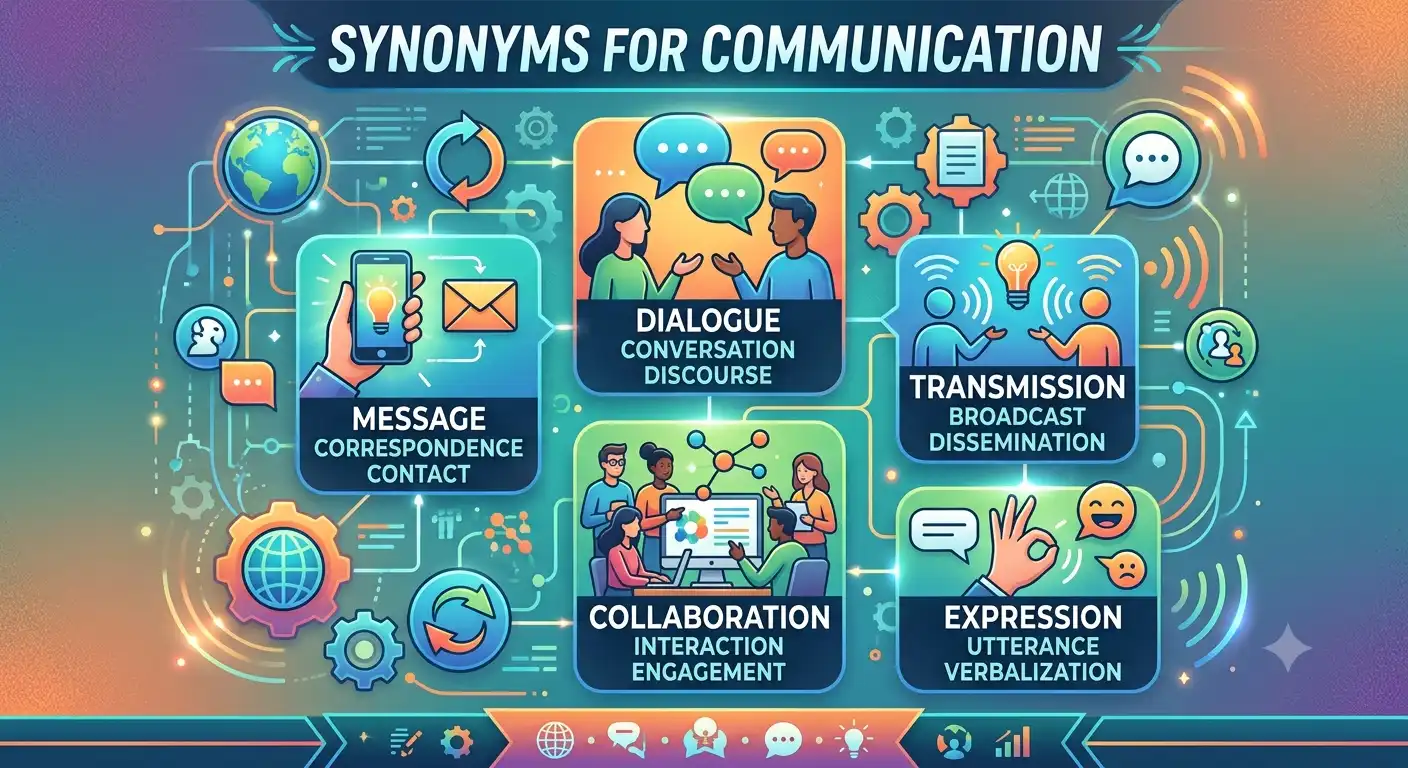
If you want to share your thoughts clearly, finding the right synonyms for communication is important. Using different synonyms for communication helps you sound smart and keeps your readers interested. When you learn these synonyms for communication, you can express yourself in many exciting ways.
Imagine sitting at a dinner table trying to explain a great idea, but you only use the word “talk” over and over again. It gets boring very fast. A simple shift in your vocabulary changes everything and makes people pay attention. For example, instead of saying “We had a communication,” you can say “We had a lively chat.”
“The art of communication is the language of leadership.” — James Humes
In very simple English, communication means sharing thoughts, feelings, or news with other people. You can do this by speaking, writing, or using your body.
Learning new words for this concept is highly useful for different groups:
- Students: Helps you write better school essays and get higher grades.
- Bloggers: Keeps your readers happy, engaged, and reading your posts longer.
- Content Writers: Helps you avoid repeating words so your articles rank higher on Google.
- Daily English Users: Allows you to make friends easily and express exactly how you feel.
“Wise men speak because they have something to say; fools because they have to say something.” — Plato
Word Profile: Communication
Connotative Meaning
The word communication has a highly positive and collaborative connotation. It implies connection, mutual understanding, safety, and the active bridging of gaps between people.
Etymology
- Root: Latin communicare (meaning “to share” or “to make common”).
- Origin: Derived from communis (meaning “common” or “public”).
- History: Entered Old French as comunicacion before finding its way into Middle English in the late 14th century.
Pronunciation (US & UK – IPA)
- US Pronunciation: /kəˌmjuːnɪˈkeɪʃən/
- UK Pronunciation: /kəˌmjuːnɪˈkeɪʃən/
Syllables
- Syllable Breakdown: com-mu-ni-ca-tion (5 syllables)
- Primary Stress: ca (fourth syllable)
Affixation Pattern
- Base Word: Communicate (verb)
- Suffix: -ation (used to change a verb into a noun that shows an action or state)
Synonym Comparison Table
| Keyword | Meaning | Usage Type | Context |
|---|---|---|---|
| Conversation | Talk between two or more people. | Casual / Friendly | Daily life and social meetups |
| Dialogue | A formal talk to solve a problem. | Professional | Business, politics, and books |
| Correspondence | Letters or emails sent back and forth. | Formal | Work and legal matters |
| Chitchat | Easy talk about small things. | Casual | Social events and breaks |
| Broadcast | Sending out information to many people. | Professional | Radio, TV, and news |
| Dispatch | A quick, official written message. | Formal | Emergency services and military |
| Rapport | A friendly relationship of understanding. | Emotional | Relationships and counseling |
50 Synonyms for Communication
1. Conversation
Pronunciation: US: /ˌkɑːnvərˈseɪʃən/, UK: /ˌkɒnvəˈseɪʃən/
Meaning: A friendly talk where people share thoughts and ideas together.
Examples:
- We had a long conversation about our favorite movies last night.
- Her warm conversation made the long train ride fly by.
2. Dialogue
Pronunciation: US: /ˈdaɪəlɔːɡ/, UK: /ˈdaɪəlɒɡ/
Meaning: A formal discussion between two groups to solve a problem.
Examples:
- The two countries started a dialogue to end the war.
- We need an open dialogue to fix this team issue.
3. Discussion
Pronunciation: US: /dɪˈskʌʃən/, UK: /dɪˈskʌʃən/
Meaning: A talk where people share different ideas about a specific topic.
Examples:
- Our class had a great discussion about saving the planet.
- Let us have a quick discussion about the new project rules.
4. Talk
Pronunciation: US: /tɔːk/, UK: /tɔːk/
Meaning: A simple act of speaking to share information.
Examples:
- I need to have a serious talk with my brother today.
- Her talk about bees was very interesting to watch.
5. Chat
Pronunciation: US: /tʃæt/, UK: /tʃæt/
Meaning: A friendly, informal, and relaxed conversation.
Examples:
- Let us meet up for a quick chat and a cup of sweet tea.
- I love having a late-night chat with my best friend.
6. Correspondence
Pronunciation: US: /ˌkɔːrəˈspɑːndəns/, UK: /ˌkɒrɪˈspɒndəns/
Meaning: The act of writing letters or emails to someone.
Examples:
- The lawyer kept all the written correspondence in a blue folder.
- My grandmother loved her daily correspondence with her old friends.
7. Interaction
Pronunciation: US: /ˌɪntərˈækʃən/, UK: /ˌɪntərˈækʃən/
Meaning: The way people talk and react to each other.
Examples:
- Playing games helps kids build better social interaction.
- I enjoyed my short interaction with the helpful shop keeper.
8. Exchange
Pronunciation: US: /ɪksˈtʃeɪndʒ/, UK: /ɪksˈtʃeɪndʒ/
Meaning: Giving and receiving ideas or messages at the same time.
Examples:
- The quick exchange of ideas helped us finish the poster.
- We had a funny exchange of looks when the lights went out.
9. Connection
Pronunciation: US: /kəˈnekʃən/, UK: /kəˈnekʃən/
Meaning: A feeling of understanding and bond between people.
Examples:
- The two sisters share a very deep emotional connection.
- A good phone connection helps us speak without any noise.
10. Contact
Pronunciation: US: /ˈkɑːntækt/, UK: /ˈkɒntækt/
Meaning: The state of communicating or touching base with someone.
Examples:
- Please stay in contact with us while you travel.
- I finally made contact with my cousin in Spain.
“Good communication is just as stimulating as black coffee, and just as hard to sleep after.” — Anne Morrow Lindbergh
11. Discourse
Pronunciation: US: /ˈdɪskɔːrs/, UK: /ˈdɪskɔːs/
Meaning: A long and formal speech or piece of writing.
Examples:
- The professor gave a deep discourse on ancient history.
- We must keep our political discourse polite and respectful.
12. Interchange
Pronunciation: US: /ˈɪntərtʃeɪndʒ/, UK: /ˈɪntətʃeɪndʒ/
Meaning: Sharing or swapping things like ideas or words.
Examples:
- This group allows a free interchange of creative thoughts.
- The rapid interchange of data keeps the system running fast.
13. Message
Pronunciation: US: /ˈmesɪdʒ/, UK: /ˈmesɪdʒ/
Meaning: A short piece of information sent to another person.
Examples:
- She left a sweet message on the kitchen table for me.
- I received a text message about the meeting time.
14. Signal
Pronunciation: US: /ˈsɪɡnəl/, UK: /ˈsɪɡnəl/
Meaning: A movement or sound that tells someone to do something.
Examples:
- He gave a nod as a signal to start the show.
- A red light is a signal that means you must stop.
15. Transmission
Pronunciation: US: /trænzˈmɪʃən/, UK: /trænzˈmɪʃən/
Meaning: The act of sending out signals, messages, or energy.
Examples:
- The radio transmission was weak because of the rain.
- We watched the live transmission of the football game.
16. Expression
Pronunciation: US: /ɪkˈspreʃən/, UK: /ɪkˈspreʃən/
Meaning: Showing your feelings or thoughts using words or art.
Examples:
- Painting is a beautiful expression of a person’s soul.
- She had a happy expression on her face when she won.
17. Link
Pronunciation: US: /lɪŋk/, UK: /lɪŋk/
Meaning: Something that connects two or more things together.
Examples:
- The police found a link between the two missing bags.
- This web link will take you to the homepage.
18. Information
Pronunciation: US: /ˌɪnfərˈmeɪʃən/, UK: /ˌɪnfəˈmeɪʃən/
Meaning: Facts or details about a person, place, or thing.
Examples:
- The website provides helpful information about wild birds.
- I need more information before I buy this car.
19. Announcement
Pronunciation: US: /əˈnaʊnsmənt/, UK: /əˈnaʊnsmənt/
Meaning: A public statement that shares important news with everyone.
Examples:
- The school principal made an announcement about the holiday.
- We listened to the train announcement at the busy station.
20. Broadcast
Pronunciation: US: /ˈbrɔːdkæst/, UK: /ˈbrɔːdkɑːst/
Meaning: Sending out programs on radio, television, or internet.
Examples:
- The live broadcast of the concert starts at eight.
- They will broadcast the news across the whole country.
21. Disclosure
Pronunciation: US: /dɪsˈkloʊʒər/, UK: /dɪsˈkləʊʒə/
Meaning: Making new or secret information known to the public.
Examples:
- The full disclosure of the truth made everyone feel better.
- The company made a public disclosure about their sales.
22. Notification
Pronunciation: US: /ˌnoʊtɪfɪˈkeɪʃən/, UK: /ˌnəʊtɪfɪˈkeɪʃən/
Meaning: An official notice or message that tells you something.
Examples:
- I got a notification on my phone about a new email.
- The school sent a notification about the bad weather.
23. Report
Pronunciation: US: /rɪˈpɔːrt/, UK: /rɪˈpɔːt/
Meaning: A written or spoken description of an event.
Examples:
- He wrote a long report about the science project.
- The weather report says it will rain tomorrow morning.
24. Dispatch
Pronunciation: US: /dɪˈspætʃ/, UK: /dɪˈspætʃ/
Meaning: An official message sent quickly to someone far away.
Examples:
- The general read the secret dispatch from the front line.
- The news dispatch arrived early in the morning.
25. Briefing
Pronunciation: US: /ˈbriːfɪŋ/, UK: /ˈbriːfɪŋ/
Meaning: A short meeting where people get instructions or facts.
Examples:
- The captain gave a quick briefing before the mission.
- We attended the safety briefing at the construction site.
26. Conference
Pronunciation: US: /ˈkɑːnfrəns/, UK: /ˈkɒnfərəns/
Meaning: A formal meeting where people discuss a main topic.
Examples:
- Thousands of doctors attended the medical conference this year.
- We had a video conference with our team in Japan.
27. Consultation
Pronunciation: US: /ˌkɑːnslˈteɪʃən/, UK: /ˌkɒnslˈteɪʃən/
Meaning: A meeting with an expert to get advice.
Examples:
- I booked a medical consultation with a skin doctor.
- The design consultation helped us choose the room colors.
28. Meeting
Pronunciation: US: /ˈmiːtɪŋ/, UK: /ˈmiːtɪŋ/
Meaning: An event where people come together to talk.
Examples:
- Let us schedule a meeting for Monday morning.
- The family meeting helped us plan our summer trip.
29. Gossip
Pronunciation: US: /ˈɡɑːsɪp/, UK: /ˈɡɒsɪp/
Meaning: Informal talk about other people’s private lives.
Examples:
- She does not like to listen to office gossip.
- They sat on the porch sharing local gossip all day.
30. Chatter
Pronunciation: US: /ˈtʃætər/, UK: /ˈtʃætə/
Meaning: Quick, friendly talk that is usually not serious.
Examples:
- The constant chatter of the birds woke me up.
- I could hear the happy chatter of children nearby.
31. Speech
Pronunciation: US: /spiːtʃ/, UK: /spiːtʃ/
Meaning: A formal talk given to a large crowd.
Examples:
- The president gave an inspiring speech on television today.
- His graduation speech made many people cry happy tears.
32. Bulletin
Pronunciation: US: /ˈbʊlətɪn/, UK: /ˈbʊlətɪn/
Meaning: A short, official public news update.
Examples:
- The radio news bulletin told us about the storm.
- I read the weekly bulletin on the church board.
33. Feedback
Pronunciation: US: /ˈfiːdbæk/, UK: /ˈfiːdbæk/
Meaning: Helpful comments about how well a job was done.
Examples:
- The teacher gave me positive feedback on my drawing.
- Customer feedback helps us make our food much better.
34. Response
Pronunciation: US: /rɪˈspɑːns/, UK: /rɪˈspɒns/
Meaning: A spoken or written answer to a question.
Examples:
- I am waiting for her response to my email.
- His quick response saved us a lot of time.
35. Input
Pronunciation: US: /ˈɪnpʊt/, UK: /ˈɪnpʊt/
Meaning: Ideas, advice, or opinions given to a group.
Examples:
- We need your expert input to finish this design.
- Thank you for your valuable input during the class.
36. Statement
Pronunciation: US: /ˈsteɪtmənt/, UK: /ˈsteɪtmənt/
Meaning: Something that you say or write in an official way.
Examples:
- The police officer took a written statement from the witness.
- The actor released a short statement about his new movie.
37. Conveyance
Pronunciation: US: /kənˈveɪəns/, UK: /kənˈveɪəns/
Meaning: The act of carrying or sending something to a place.
Examples:
- The clear conveyance of ideas is key to teaching.
- This pipe is used for the conveyance of clean water.
38. Communion
Pronunciation: US: /kəˈmjuːnjən/, UK: /kəˈmjuːnjən/
Meaning: Sharing deep, quiet thoughts and feelings with someone.
Examples:
- He lived in close communion with nature in the woods.
- They shared a silent communion as they watched the sunset.
39. Communique
Pronunciation: US: /kəˈmjuːnɪkeɪ/, UK: /kəˈmjuːnɪkeɪ/
Meaning: An official report given to the news media.
Examples:
- The leaders issued a joint communique after the summit.
- We read the peace communique in the morning paper.
40. Interactivity
Pronunciation: US: /ˌɪntərækˈtɪvəti/, UK: /ˌɪntərækˈtɪvəti/
Meaning: Two-way flow of information between people or computers.
Examples:
- This new video game has great player interactivity.
- High interactivity makes online learning much more fun.
41. Colloquy
Pronunciation: US: /ˈkɑːləkwi/, UK: /ˈkɒləkwi/
Meaning: A high-level, formal conversation or conference.
Examples:
- The scholars held a colloquy to study the old book.
- Their secret colloquy lasted for more than three hours.
42. Confabulation
Pronunciation: US: /kənˌfæbjəˈleɪʃən/, UK: /kənˌfæbjʊˈleɪʃən/
Meaning: An informal, friendly talk or chat.
Examples:
- The kids had a fun confabulation under the big oak tree.
- I joined their small confabulation in the office hallway.
43. Chitchat
Pronunciation: US: /ˈtʃɪttʃæt/, UK: /ˈtʃɪttʃæt/
Meaning: Small talk about things that are not very important.
Examples:
- We spent an hour in useless chitchat at the party.
- I do not have time for idle chitchat today.
44. Letter
Pronunciation: US: /ˈletər/, UK: /ˈletə/
Meaning: A written message sent to someone by post.
Examples:
- I wrote a long letter to my pen pal in Canada.
- He received an official letter from the city hall.
45. Memo
Pronunciation: US: /ˈmemoʊ/, UK: /ˈmeməʊ/
Meaning: A short written note sent to people in an office.
Examples:
- The boss sent a memo about the new office hours.
- Please read the memo before you start your work.
46. Sign
Pronunciation: US: /saɪn/, UK: /saɪn/
Meaning: A mark or shape that gives information or warning.
Examples:
- A skull on the bottle is a sign of danger.
- He waved his hand as a sign of goodbye.
47. Word
Pronunciation: US: /wɜːrd/, UK: /wɜːd/
Meaning: News, information, or a promise sent to someone.
Examples:
- We received word that our package has arrived safely.
- He gave me his word that he would help us move.
48. Cable
Pronunciation: US: /ˈkeɪbəl/, UK: /ˈkeɪbəl/
Meaning: An old-fashioned telegram sent by wires.
Examples:
- They sent a quick cable to announce the baby’s birth.
- The old office used to receive cables from overseas.
49. Note
Pronunciation: US: /noʊt/, UK: /nəʊt/
Meaning: A short, informal written message.
Examples:
- He left a tiny note on the fridge saying he went out.
- She took a quick note during the history lecture.
50. Rapport
Pronunciation: US: /ræˈpɔːr/, UK: /ræˈpɔː/
Meaning: A close relationship where people understand each other’s feelings.
Examples:
- The teacher built a wonderful rapport with her new students.
- It is easy to work when you have a good rapport with your partner.
Antonyms of Communication
While it is great to know words for connection, it is also useful to know their opposites:
- Silence: Complete quiet with no words spoken.
- Isolation: Being completely cut off from other people.
- Secrecy: Keeping facts hidden away from others.
- Quietude: A peaceful state of being calm and silent.
- Noncommunication: A complete failure to share ideas.
Prototype Meaning and Categorization
In cognitive linguistics, communication belongs to the domain of Social Interaction and Information Transfer.
Its prototype meaning is the intentional, two-way sharing of mental states between conscious agents. It is categorized as an active, dynamic process rather than a static object.
FAQs About Synonyms for Communication
1. What is the best synonym for communication in a business email?
The best synonyms to use in a professional setting are correspondence, dialogue, or discussion. These words sound polite and clear.
2. Can I use “chitchat” in an essay?
No, “chitchat” is too casual for academic writing. It is better to use words like conversation or discourse in school papers.
3. What is the difference between “dialogue” and “discussion”?
A dialogue is usually a structured talk between two parties to reach an agreement. A discussion is a broader talk where multiple people share opinions on a topic.
4. Is “rapport” a direct synonym for communication?
“Rapport” is a close relative of communication. It refers to the deep mutual understanding and connection that comes from good communication.
5. Why is communication important in writing?
Good vocabulary prevents your text from sounding repetitive. Using varied words keeps your readers focused and improves your search engine rankings.
Conclusion
Learning a wide variety of synonyms for communication is one of the easiest ways to improve your daily life. When you expand your vocabulary, your personal writing becomes colorful, your blogging gets more clicks, your public speaking sounds professional, and your overall communication grows stronger. It allows you to say exactly what you mean without sounding repetitive.
Try to practice using these fresh words in your school essays, work emails, and daily conversations. Swap out the word “talk” for “dialogue” or “chat” today, and watch how people react. Expanding your word bank is a lifelong adventure that pays off every single day!
“To communicate is to connect, and to connect is to understand.” — Unknown
“Words are, of course, the most powerful drug used by mankind.” — Rudyard Kipling

Andrew Powell is a travel writer and nature journalist who has spent over a decade writing about places, landscapes, and the natural world — and thinking carefully about the words that do those subjects justice ( Biography ).