
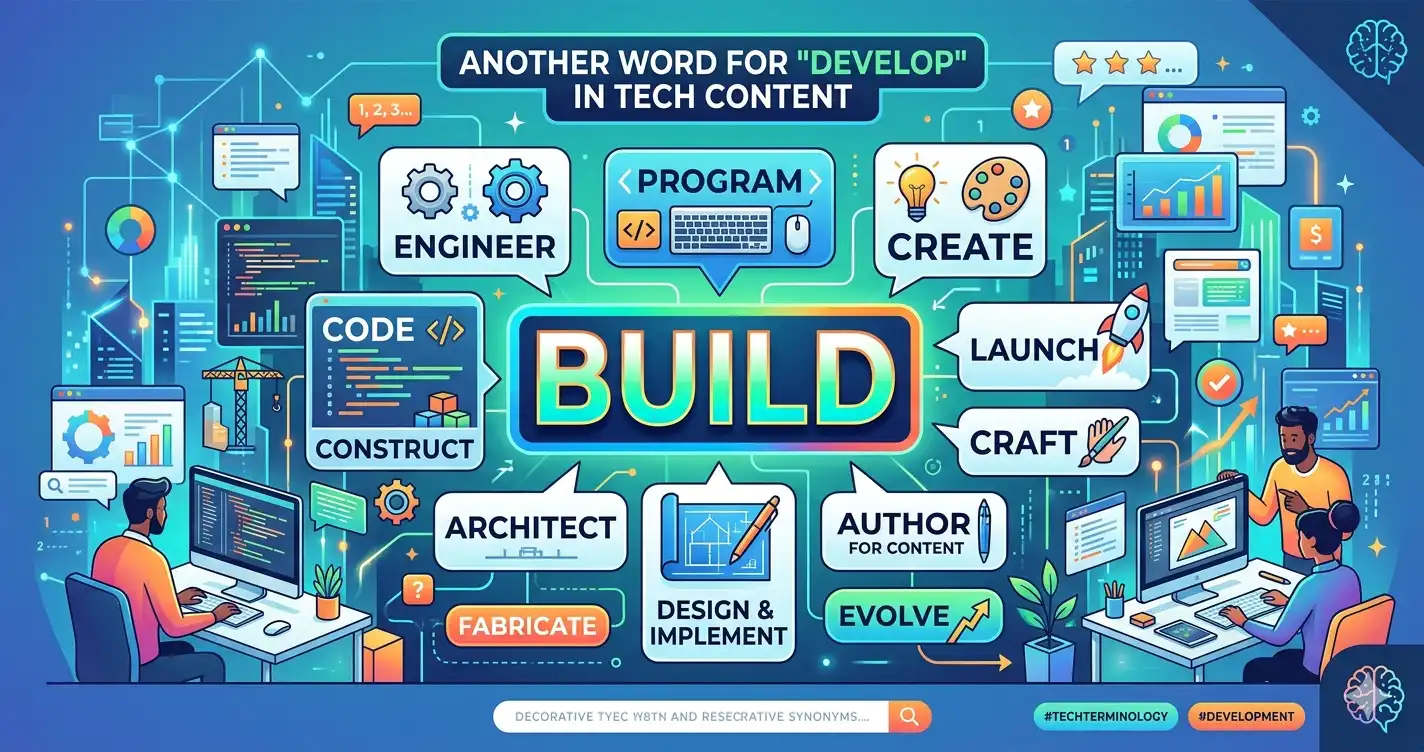
In the world of technical communication, precision is the difference between a high-authority whitepaper and a generic blog post. If you find yourself repeatedly typing the another word for develop in tech content—as in “developing an app,” “developing a strategy,” or “developing a feature”—you are missing out on a massive opportunity to enhance your content’s E-E-A-T (Experience, Expertise, Authoritativeness, and Trustworthiness).
The word “develop” is a linguistic “catch-all.” While it is grammatically correct, it is often too vague for specialized tech content. Does “developing” an API mean you are writing the initial code, designing the architecture, or simply deploying it to a production environment? By replacing this overused verb with context-specific alternatives, you provide your readers with clearer insights and establish yourself as a subject matter expert who understands the nuances of the software development life cycle (SDLC).
In this comprehensive guide, we will explore the best synonyms for “develop” tailored specifically for tech content, documentation, and marketing. We will break down when to use each term, provide a side-by-side comparison, and answer the most frequently asked questions about technical word choice.
Quick Answer: What is another word for develop in tech content?
The best synonym depends entirely on the context:
- For Coding: Build, Engineer, Implement, Script, Code.
- For Planning: Architect, Design, Conceptualize, Orchestrate.
- For Improving: Refine, Optimize, Iterate, Enhance, Mature.
- For Launching: Deploy, Roll out, Ship, Execute.
Why Word Choice Matters in Tech
Google’s Search Quality Evaluator Guidelines emphasize Expertise. An expert developer doesn’t just “develop” a database; they schema-design or provision it. Using specific terminology signals to both Google’s algorithms and human readers that the content is written by someone with real-world experience.
When you use “Develop” too much, your writing feels repetitive and “thin.” Transitioning to more descriptive verbs improves the scannability and professionalism of your technical documentation or SaaS landing pages.
Top Synonyms Categorized by Context
1. Creation & Engineering (The “Building” Phase)
When you are talking about the actual act of creating something new from scratch.
- Engineer: Use this when emphasizing the technical complexity or structural integrity of a solution.
- Construct: Best for physical hardware or large-scale cloud infrastructures.
- Build: The most common and reliable alternative for software and apps.
- Fabricate: Usually reserved for hardware components or synthetic data.
- Compose: Excellent for talking about microservices or modular code.
2. Strategy & Architecture (The “Design” Phase)
When the focus is on the thinking and planning behind the tech.
- Architect: Use this when discussing the high-level structure of a system.
- Conceptualize: Perfect for the ideation stage before any code is written.
- Formulate: Use this for algorithms, logic, or security policies.
- Map out: Great for user journeys or data flow diagrams.
- Orchestrate: Use this for complex systems where multiple parts must work together (like Kubernetes).
3. Execution & Integration (The “Implementation” Phase)
When the plan is being put into action or connected to other systems.
- Implement: The gold standard for turning a design into a functional reality.
- Deploy: Specifically for moving code to a server or environment.
- Integrate: Use when “developing” a connection between two different platforms.
- Execute: Best for running scripts or carrying out a predefined plan.
- Instantiate: A highly technical term for creating an instance of an object or service.
4. Improvement & Evolution (The “Growth” Phase)
When you are making an existing product better.
- Refine: Making small, precise improvements to code or UI.
- Optimize: Improving performance, speed, or resource usage.
- Iterate: Emphasizing the repetitive process of testing and improving.
- Enhance: Adding new features or value to an existing system.
- Modernize: Updating legacy codebases to current standards.
When and When NOT to Use “Develop”
| Context | Recommended Synonym | Why? | When to avoid “Develop” |
| New Software | Build / Engineer | Sounds more proactive and skilled. | When the process is highly technical. |
| User Interfaces | Design / Craft | UI is visual; “develop” sounds too “back-end.” | When talking about UX/UI aesthetics. |
| Fixing Bugs | Resolve / Patch | You don’t “develop” a fix; you solve a problem. | When describing maintenance. |
| API Connections | Integrate / Bridge | It describes the relationship between two things. | When talking about connectivity. |
| Database Logic | Model / Schema | It shows you understand data structures. | When the task is about data organization. |
Comparison Table: Develop vs. Technical Alternatives
| Word | Nuance | Best Used In… |
| Develop | General growth/creation | High-level summaries. |
| Engineer | Scientific/Structured creation | Backend, Systems, Security. |
| Architect | Structural planning | Cloud, Infrastructure, Database. |
| Ship | Final delivery | Product Updates, Release Notes. |
| Iterate | Repetitive improvement | Agile/Scrum environments. |
| Provision | Setting up resources | DevOps, Server management. |
Advanced Writing Tips for Tech Content Creators
To truly outrank your competitors, you need to go beyond just replacing words. You need to structure your content for the “Modern Tech Reader.”
- Use Action-Oriented Language: Instead of “We are developing a new feature,” use “We are engineering a high-throughput API.”
- Match the Tone to the Audience: If you are writing for CTOs, use “Architect” and “Orchestrate.” If you are writing for junior developers, “Build” and “Implement” are more approachable.
- Avoid Nominalization: Don’t say “The development of the app took six months.” Say “We built the app in six months.” Strong verbs are always better than weak nouns.
- Incorporate “Search Intent” Keywords: People searching for synonyms often want to know how to use them. Include example sentences (as we have done above).
FAQs (Frequently Asked Questions)
Q1: Is “develop” a bad word to use in tech writing?
No, it is not “bad,” but it is overused. Using it too frequently makes your writing look amateur. Swapping it for specific terms like “deploy” or “refine” adds professional depth.
Q2: What is a professional way to say “developing a website”?
Depending on your role, you could say “Designing the frontend,” “Architecting the backend,” or “Building a responsive web application.”
Q3: Can I use “code” as a synonym for “develop”?
Yes, in informal or developer-centric content. However, in formal documentation, “implement” or “engineer” is often preferred.
Q4: How does word choice affect SEO?
Google uses Latent Semantic Indexing (LSI). By using synonyms like “SDLC,” “architecture,” and “implementation,” you help Google understand the topical authority of your page, which can improve your rankings.
Conclusion
Mastering your vocabulary is the fastest way to elevate your tech content from “good” to “authoritative.” While “develop” will always have a place in your writing, the alternatives—like engineer, architect, refine, and deploy—provide the clarity that technical audiences crave.
By applying the synonyms and strategies in this guide, you won’t just be “developing” content; you will be crafting high-impact, SEO-optimized authority pieces that resonate with readers and search engines alike. Start auditing your latest draft today—how many “develops” can you turn into something more powerful?

Andrew Powell is a travel writer and nature journalist who has spent over a decade writing about places, landscapes, and the natural world — and thinking carefully about the words that do those subjects justice ( Biography ).