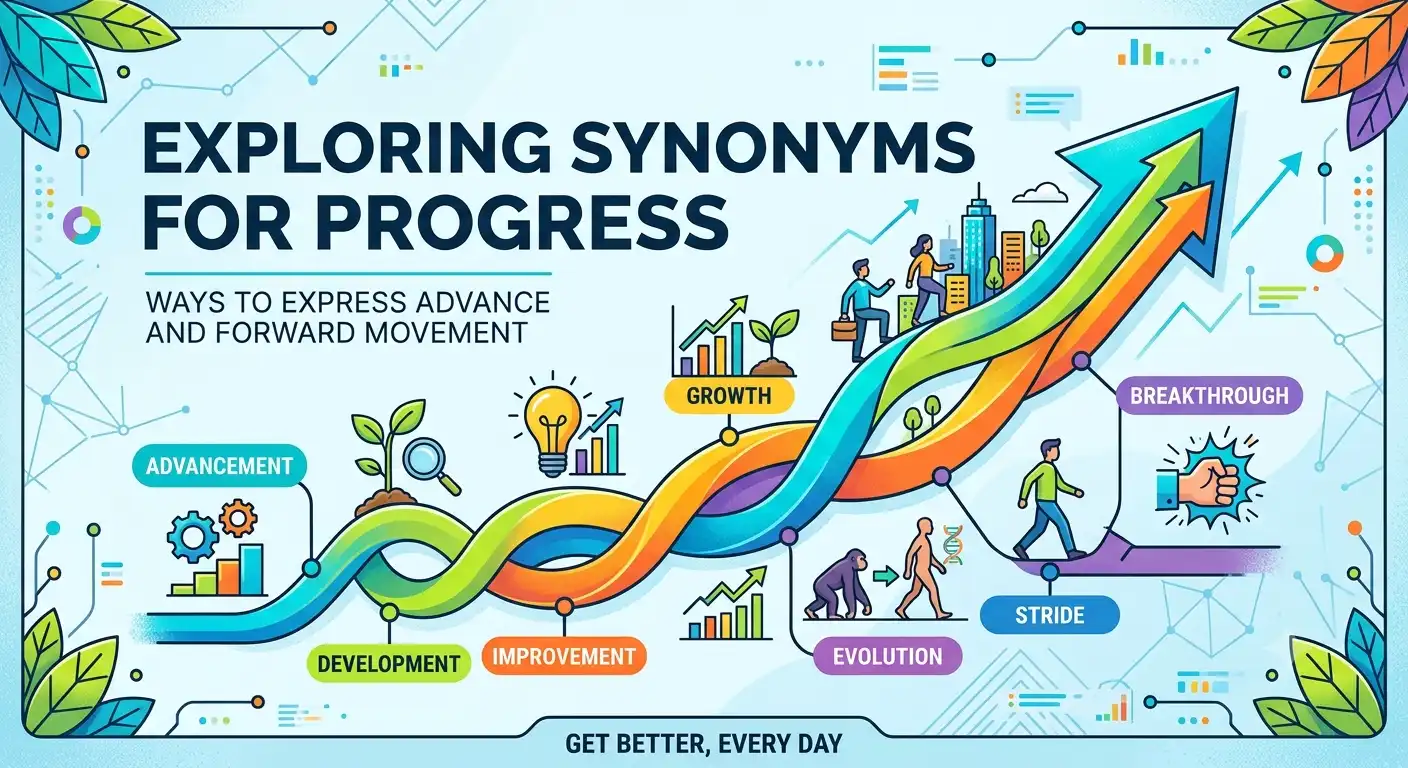
Learning the best synonyms for progress is an outstanding way to improve your writing and speaking skills. When you study different synonyms for progress, you can explain how you move forward and make things better with total confidence. Finding high-quality synonyms for progress helps you show readers how you can complete a project, grow a business, or reach a personal goal.
Imagine a young gardener planting a tiny tomato seed in a small plastic pot on a sunny morning. Every single day, they water the dry soil and watch for a tiny green leaf to break through the dark dirt. This slow, steady change shows how beautiful it is when life moves forward and gets stronger. In very simple English, “progress” means to move forward, to get better, or to get closer to finishing a task.
“Progress is not in enhancing what is, but in moving toward what will be.” — Khalil Gibran
“Without continual growth and progress, such words as improvement, achievement, and success have no meaning.” — Benjamin Franklin
Expanding your range of expression is incredibly helpful for several groups of writers:
- For students: It helps you describe how empires grew, how science improved, and how your skills get better in your school essays.
- For bloggers: It keeps your readers fully engaged with positive, active, and exciting action words that build trust.
- For content writers: It boosts your search engine rankings by using natural vocabulary variations that search algorithms love to index.
- For daily English users: It helps you write clear emails, share your career updates at work, and talk about your life goals with absolute clarity.
Connotative Meaning of Progress
The word “progress” carries a very positive, hopeful, and forward-looking connotation. It suggests hard work, constant motion, and active building. It is a word about making things better than they were before and never giving up on your goals.
Etymology of Progress
- Progress (Root): Formed from the Latin word progressus (meaning “an advancement” or “a going forward”).
- Origin: Made of the prefix pro- (meaning “forward”) and gradi (meaning “to step” or “to walk”).
- Evolution: Used since the early 15th century to mean an official state journey made by a royal person, which later grew in the 16th century to mean general movement forward, growth, or improvement.
Linguistic Profile of Progress
- US Pronunciation (IPA): /ˈprɑː.ɡres/ (noun) | /prəˈɡres/ (verb)
- UK Pronunciation (IPA): /ˈprəʊ.ɡres/ (noun) | /prəˈɡres/ (verb)
- Syllables: 2 syllables (pro-gress)
- Affixation Pattern: A Latin-derived prefix verb and noun that combines the direction prefix pro- with the root base gress. It forms the past tense progressed and the adjective progressive.
Comparison of Key Synonyms
To help you choose the right word instantly, here is a simple comparison of key synonyms:
| Keyword | Meaning | Usage Type | Context |
|---|---|---|---|
| Advance | To move forward physically or make steps toward a goal. | Professional & Academic | Tech upgrades, science research, moving forward |
| Growth | The natural process of getting bigger, stronger, or older. | Casual & Professional | Small businesses, plants, personal skills |
| Improvement | The act of making something look, work, or feel better. | Casual & Professional | Home repairs, test scores, health habits |
| Development | The slow process of growing or building a complex system. | Professional & Academic | City planning, software projects, child growth |
| Breakthrough | A sudden, major discovery or success after hard work. | Emotional & Professional | Medical science, solving mysteries, personal goals |
| Headway | Slow but steady movement forward against a difficult task. | Casual & Professional | Doing chores, sailing ships, finishing projects |
“The secret of making progress is to get started.” — Mark Twain
50 Synonyms for Progress
Here is your ultimate list of 50 synonyms to describe moving forward, growing stronger, and making things better.
1. Advance
- Pronunciation: US /ədˈvæns/ | UK /ədˈvɑːns/
- Meaning: This means to move forward physically or make steps toward a goal.
- Examples:
- The army will advance slowly through the deep valley.
- Our technology plans continue to advance every single year.
2. Growth
- Pronunciation: US /ɡroʊθ/ | UK /ɡrəʊθ/
- Meaning: This means the process of getting bigger, stronger, or older.
- Examples:
- The warm rain helped the growth of the garden plants.
- Our company experienced huge growth in sales this summer.
3. Improvement
- Pronunciation: US /ɪmˈpruːv.mənt/ | UK /ɪmˈpruːv.mənt/
- Meaning: This means the act of making something look, work, or feel better.
- Examples:
- He showed a big improvement in his English test scores.
- This new paint is a great improvement for the living room.
4. Development
- Pronunciation: US /dɪˈvel.əp.mənt/ | UK /dɪˈvel.əp.mənt/
- Meaning: This means the slow process of growing or building a complex system.
- Examples:
- The town spent money on the development of new parks.
- Reading books is important for the development of a child’s mind.
5. Breakthrough
- Pronunciation: US /ˈbreɪk.θruː/ | UK /ˈbreɪk.θruː/
- Meaning: This means a sudden, major discovery or success after hard work.
- Examples:
- The scientists made a major breakthrough in finding a cure.
- I finally had a creative breakthrough with my art project.
6. Headway
- Pronunciation: US /ˈhed.weɪ/ | UK /ˈhed.weɪ/
- Meaning: This means slow but steady movement forward against a difficult task.
- Examples:
- We are finally making some headway with this messy room.
- The ship made slow headway through the thick ice.
7. Evolution
- Pronunciation: US /ˌev.əˈluː.ʃən/ | UK /ˌiː.vəˈluː.ʃən/
- Meaning: This means the slow, natural change of something over a very long time.
- Examples:
- We studied the evolution of birds from dinosaurs in class.
- The evolution of mobile phones has changed how we live.
8. Betterment
- Pronunciation: US /ˈbet̬.ɚ.mənt/ | UK /ˈbet.ə.mənt/
- Meaning: This means making a situation, place, or person much better.
- Examples:
- She worked hard for the betterment of her local school.
- We must focus on the betterment of our daily health habits.
9. Progression
- Pronunciation: US /prəˈɡreʃ.ən/ | UK /prəˈɡreʃ.ən/
- Meaning: This means a steady movement from one step or stage to the next.
- Examples:
- The book shows a clear progression from simple to hard lessons.
- There is a natural progression of seasons from spring to summer.
10. Rise
- Pronunciation: US /raɪz/ | UK /raɪz/
- Meaning: This means an increase in power, success, status, or position.
- Examples:
- We watched the rise of the young singer to global fame.
- The sudden rise in temperature melted all the thick snow.
11. Upgrade
- Pronunciation: US /ˈʌp.ɡreɪd/ | UK /ˈʌp.ɡreɪd/
- Meaning: This means to change something to a newer, better, or more powerful version.
- Examples:
- I need to upgrade my computer to run this new game.
- The hotel gave us a free upgrade to a larger room.
12. Boost
- Pronunciation: US /buːst/ | UK /buːst/
- Meaning: This means an action or event that helps something grow or improve quickly.
- Examples:
- A warm cup of tea gave her a big energy boost.
- The good news was a great boost to team spirit.
13. Gain
- Pronunciation: US /ɡeɪn/ | UK /ɡeɪn/
- Meaning: This means to get more of something useful, like power, weight, or speed.
- Examples:
- The runner began to gain speed as she reached the hill.
- You will gain useful experience by working this summer.
14. Climb
- Pronunciation: US /klaɪm/ | UK /klaɪm/
- Meaning: This means to go upward or increase in value, rank, or position.
- Examples:
- The price of fresh fruit began to climb in the winter.
- He worked hard to climb to the top of the company.
15. Expansion
- Pronunciation: US /ɪkˈspæn.ʃən/ | UK /ɪkˈspæn.ʃən/
- Meaning: This means the act of becoming larger in size, area, or amount.
- Examples:
- The store owner planned the expansion of his small shop.
- The rapid expansion of the city surprised many local families.
16. Promotion
- Pronunciation: US /prəˈmoʊ.ʃən/ | UK /prəˈməʊ.ʃən/
- Meaning: This means a move to a more important job, rank, or position.
- Examples:
- She received a big promotion to manager after her hard work.
- The teacher cheered for the promotion of her favorite student.
17. Flourishing
- Pronunciation: US /ˈflɜːr.ɪ.ʃɪŋ/ | UK /ˈflʌr.ɪ.ʃɪŋ/
- Meaning: This means growing, developing, or succeeding very quickly and healthily.
- Examples:
- The florist owned a flourishing business in the city center.
- We saw a flourishing community of birds near the lake.
18. Maturation
- Pronunciation: US /ˌmætʃ.əˈreɪ.ʃən/ | UK /ˌmætʃ.ʊəˈreɪ.ʃən/
- Meaning: This means the process of becoming fully grown, ripe, or mature.
- Examples:
- The maturation of green apples takes a few warm weeks.
- We watched the emotional maturation of the main character.
19. Momentum
- Pronunciation: US /moʊˈmen.t̬əm/ | UK /məʊˈmen.təm/
- Meaning: This means the force or speed that keeps a moving object going forward.
- Examples:
- The rolling ball gathered momentum as it ran down the hill.
- Our project gained momentum after we got more help.
20. Leap
- Pronunciation: US /liːp/ | UK /liːp/
- Meaning: This means a sudden, very large jump forward or increase in quality.
- Examples:
- This new phone is a giant leap in technology.
- Her reading skills took a big leap over the school break.
21. Push
- Pronunciation: US /pʊʃ/ | UK /pʊʃ/
- Meaning: This means a strong, planned effort to achieve a specific goal.
- Examples:
- The school made a big push to clean up the local park.
- We need one final push to finish our group project tonight.
22. Drive
- Pronunciation: US /draɪv/ | UK /draɪv/
- Meaning: This means a strong energy, effort, or motivation to succeed.
- Examples:
- Her strong drive helped her win the science race.
- The team has the drive to win the championship game.
23. March
- Pronunciation: US /mɑːrtʃ/ | UK /mɑːtʃ/
- Meaning: This means a steady, unstoppable movement forward of time or events.
- Examples:
- No one can stop the steady march of time.
- We must continue our march toward a cleaner planet.
24. Movement
- Pronunciation: US /ˈmuːv.mənt/ | UK /ˈmuːv.mənt/
- Meaning: This means the act of changing physical location or progressing.
- Examples:
- There was a sudden movement in the dark bushes.
- We need more movement on this task before Friday.
25. Shift
- Pronunciation: US /ʃɪft/ | UK /ʃɪft/
- Meaning: This means a change in position, direction, opinion, or policy.
- Examples:
- There was a major shift in public opinion about the law.
- The warm wind caused a shift in the local weather.
26. Strides
- Pronunciation: US /straɪdz/ | UK /straɪdz/
- Meaning: This means long steps or significant pieces of progress toward a goal.
- Examples:
- Our medical team has made great strides in research.
- He is making rapid strides in learning how to play piano.
27. Transition
- Pronunciation: US /trænˈzɪʃ.ən/ | UK /trænˈzɪʃ.ən/
- Meaning: This means the process of changing from one style or state to another.
- Examples:
- The transition from winter to spring is very beautiful.
- She made a smooth transition to her brand new school.
28. Recovery
- Pronunciation: US /rɪˈkʌv.ɚ.i/ | UK /rɪˈkʌv.ər.i/
- Meaning: This means the process of returning to a normal, healthy, or strong state.
- Examples:
- The doctor was very happy with his fast recovery from illness.
- Our local business area is making a strong economic recovery.
29. Success
- Pronunciation: US /səkˈses/ | UK /səkˈses/
- Meaning: This means achieving a wealth, respect, or a planned goal successfully.
- Examples:
- The school play was a huge success for the young kids.
- Hard work is the main secret to success in life.
30. Profit
- Pronunciation: US /ˈprɑː.fɪt/ | UK /ˈprɒf.ɪt/
- Meaning: This means a financial gain or general benefit received from an action.
- Examples:
- The small toy shop made a nice profit this year.
- You will profit greatly from reading good books daily.
31. Benefit
- Pronunciation: US /ˈben.ə.fɪt/ | UK /ˈben.ɪ.fɪt/
- Meaning: This means an advantage, improvement, or helpful effect gained from something.
- Examples:
- Regular exercise offers a huge benefit to your body.
- One major benefit of warm weather is playing outside.
32. Enrichment
- Pronunciation: US /ɪnˈrɪtʃ.mənt/ | UK /ɪnˈrɪtʃ.mənt/
- Meaning: This means the act of making something richer, better, or more valuable.
- Examples:
- The art classes provided great enrichment for the students.
- Soil enrichment is necessary for growing giant vegetables.
33. Refinement
- Pronunciation: US /rɪˈfaɪn.mənt/ | UK /rɪˈfaɪn.mənt/
- Meaning: This means a small change that improves a process, idea, or object.
- Examples:
- The engine design underwent years of careful refinement.
- She spoke with great politeness and social refinement.
34. Cultivation
- Pronunciation: US /ˌkʌl.təˈveɪ.ʃən/ | UK /ˌkʌl.tɪˈveɪ.ʃən/
- Meaning: This means the act of growing crops or developing a personal skill.
- Examples:
- The cultivation of rice requires plenty of fresh water.
- He focused on the cultivation of good study habits.
35. Bloom
- Pronunciation: US /bluːm/ | UK /bluːm/
- Meaning: This means a state of healthy, beautiful growth, or opening like a flower.
- Examples:
- The red roses are in full bloom this week.
- Her musical talent began to bloom in high school.
36. Heading
- Pronunciation: US /ˈhed.ɪŋ/ | UK /ˈhed.ɪŋ/
- Meaning: This means moving or directing your course toward a specific place or goal.
- Examples:
- The ship is heading toward the safe southern port.
- Our team is heading in the right direction now.
37. Flow
- Pronunciation: US /floʊ/ | UK /fləʊ/
- Meaning: This means a smooth, continuous movement of a liquid, air, or ideas.
- Examples:
- The steady flow of the river kept the water clean.
- A good workspace improves the flow of creative ideas.
38. Course
- Pronunciation: US /kɔːrs/ | UK /kɔːs/
- Meaning: This means the direction, path, or natural development of an event.
- Examples:
- The river changed its course after the heavy storm.
- We must stay on course to finish the work today.
39. Run
- Pronunciation: US /rʌn/ | UK /rʌn/
- Meaning: This means a continuous series of successful events or a pathway.
- Examples:
- The theater group had a long run of successful shows.
- The salmon made their yearly run up the river.
40. Step
- Pronunciation: US /step/ | UK /step/
- Meaning: This means a single action or stage in a larger process or plan.
- Examples:
- Cleaning your desk is the first step to staying focused.
- She took a big step forward by applying for the job.
41. Spread
- Pronunciation: US /spred/ | UK /spred/
- Meaning: This means growth that covers a larger physical area or reaches more people.
- Examples:
- The spread of green grass made the hill look beautiful.
- We watched the spread of new ideas across the internet.
42. Forwarding
- Pronunciation: US /ˈfɔːr.wɚ.dɪŋ/ | UK /ˈfɔː.wə.dɪŋ/
- Meaning: This means the act of helping an idea, plan, or item move onward.
- Examples:
- He is responsible for the forwarding of the package.
- She worked hard toward the forwarding of her scientific plans.
43. Advancement
- Pronunciation: US /ədˈvæns.mənt/ | UK /ədˈvɑːns.mənt/
- Meaning: This means progress or promotion in your career, education, or society.
- Examples:
- He studied at night for the advancement of his career.
- Technology advancement has made global communication very easy.
44. Procession
- Pronunciation: US /prəˈseʃ.ən/ | UK /prəˈseʃ.ən/
- Meaning: This means a line of people or vehicles moving forward in an orderly way.
- Examples:
- The colorful festival procession moved slowly down the street.
- A long procession of cars followed the police vehicle.
45. Pace
- Pronunciation: US /peɪs/ | UK /peɪs/
- Meaning: This means the speed at which someone walks, runs, or makes progress.
- Examples:
- We walked at a comfortable pace through the green park.
- The rapid pace of the class was hard for some kids.
46. Speeding
- Pronunciation: US /ˈspiːd.ɪŋ/ | UK /ˈspiːd.ɪŋ/
- Meaning: This means moving or progressing at a very fast rate of speed.
- Examples:
- The train was speeding along the steel tracks.
- The project is speeding toward its final completion date.
47. Flowering
- Pronunciation: US /ˈflaʊ.ɚ.ɪŋ/ | UK /ˈflaʊ.ər.ɪŋ/
- Meaning: This means reaching a highly developed, beautiful, and successful stage.
- Examples:
- The city saw a flowering of art and music in summer.
- The cold weather delayed the flowering of the apple trees.
48. Journey
- Pronunciation: US /ˈdʒɝː.ni/ | UK /ˈdʒɜː.ni/
- Meaning: This means the act of traveling from one place or stage to another.
- Examples:
- The long train journey across the country took three days.
- Learning a new language is a beautiful personal journey.
49. Passage
- Pronunciation: US /ˈpæs.ɪdʒ/ | UK /ˈpæs.ɪdʒ/
- Meaning: This means the movement forward of time or a physical path through a place.
- Examples:
- The rapid passage of time surprised the old friends.
- The dark passage led to a beautiful secret garden.
50. Graduation
- Pronunciation: US /ˌɡrædʒ.uˈeɪ.ʃən/ | UK /ˌɡrædʒ.uˈeɪ.ʃən/
- Meaning: This means successfully completing a stage of school or progressing to a new level.
- Examples:
- Her family took many photos during her high school graduation.
- There was a graduation of tones from light blue to dark.
Antonyms of Progress
To understand “progress” completely, it is highly useful to look at its direct opposites. In communication and daily life, these words represent stopping, moving backward, or losing ground:
- Regression: Returning to a worse, older, or less developed state.
- Stagnation: A state of staying completely still without any growth or activity.
- Decline: A continuous decrease in quality, strength, power, or value.
- Delay: A situation where something is slowed down or made late.
- Failure: Failing to achieve a planned goal or stop working.
Prototype Meaning and Categorization of Synonyms for Progress
The fifty synonyms for progress can be easily divided into four main categories:
- The Fast Climbers (Rapid Advancements): Words like breakthrough, leap, boost, speeding, and climb that focus on sudden, major jumps forward and quick successes.
- The Slow Growers (Natural Development): Terms like growth, evolution, maturation, cultivation, and flowering that show organic, steady growth over time.
- The Lifters (Making Things Better): Words like improvement, betterment, upgrade, refinement, and enrichment that focus on polishing, repairing, and increasing value.
- The Travelers (Steady Paths): Phrases like headway, progression, pace, journey, and march that show continuous, ongoing movement toward a final destination.
FAQ about Synonyms for Progress
1. What is the difference between “progress” and “improvement”?
To make progress means moving closer to completing a task or journey. To make an improvement specifically means making something better in quality, appearance, or function than it was before.
2. Can “progress” be used as both a noun and a verb?
Yes! As a noun, it means the movement forward (e.g., “We made great progress”). As a verb, it means the act of moving forward (e.g., “We need to progress with our plans”). Note that the pronunciation changes slightly depending on the usage.
3. What is a formal synonym for progress to use in a business report?
In formal or professional environments, words like advancement, progression, or development sound much more polished and authoritative.
4. Is “leap” too informal for an academic essay?
No, leap (as in “a giant leap in technology”) is acceptable in academic writing when describing a major, sudden advancement. However, terms like “breakthrough” or “significant advance” are often preferred.
5. How does using different synonyms for progress help my SEO?
Using diverse synonyms stops search engines from flagging your content for repeating “progress” too many times. Keyword variety improves readability, which keeps human readers on your site longer.
6. What is the origin of the word “progress”?
The word comes from the Latin root progressus, which combines the prefix pro- (forward) with the root gradi (to step or walk). It originally described an official royal journey.
Conclusion
Expanding your vocabulary with fifty unique synonyms for progress is a powerful way to make your communication much more engaging. When you select the exact word that fits your situation, your writing gains immediate emotional depth and impact. Rather than repeating the same common verbs, bloggers can craft highly active articles, students can write persuasive historical essays, and business professionals can make their marketing messages clear and professional. Using active vocabulary keeps your readers curious and ensures that your unique voice sounds completely authentic.
We encourage you to practice using these terms as you write your school papers, draft work emails, or chat with your friends. By paying attention to the small differences in these words, you can match your tone to your specific audience perfectly. Do not be afraid to experiment with new terms in your next conversation. With regular practice, choosing the right synonym will become completely natural, helping you share your thoughts, challenges, and successes with confidence. Every time you swap a dull word for a dynamic one, you take a big step forward as a writer. Your voice will sound brighter, and your ideas will carry much more weight. Keep exploring the beauty of the English language, and watch how quickly your sentences begin to shine.
“To stumble is not bad; it shows you are moving forward.” — Unknown
“Little by little, one travels far.” — J.R.R. Tolkien

Andrew Powell is a travel writer and nature journalist who has spent over a decade writing about places, landscapes, and the natural world — and thinking carefully about the words that do those subjects justice ( Biography ).