If you want to describe how someone used their eyes, finding strong synonyms for looked is a game-changer. Using fresh synonyms for looked helps you paint clear pictures in your reader’s mind. When you learn these synonyms for looked, your stories and essays immediately become more exciting and professional.
Picture yourself writing a classic story where a brave detective enters a dark, dusty room. If you write, “He looked at the floor, and then he looked at the window,” your writing feels flat. Instead, writing “He scanned the floor, and then he stared at the window” brings the scene to life. This tiny shift makes your story feel highly professional and interesting.
“The eye is the jewel of the body.” — Henry David Thoreau
In very simple English, “looked” means turning your eyes toward something so you can see it.
Expanding your vocabulary to include different ways of expressing this concept is highly useful for different groups:
- Students: Helps you write creative essays that stand out to your teachers.
- Bloggers: Keeps your readers hooked on your articles from start to finish.
- Content Writers: Boosts your SEO rankings by avoiding boring, repetitive word patterns.
- Daily English Users: Helps you express your thoughts and describe your day with more emotion.
“The real voyage of discovery consists not in seeking new landscapes, but in having new eyes.” — Marcel Proust
Word Profile: Looked
Connotative Meaning
The word looked is generally neutral on its own. However, it is highly adaptable. It can quickly take on a curious, intense, suspicious, or loving tone depending entirely on the surrounding words and context.
Etymology
- Root: Proto-Germanic lōgijan (meaning “to look” or “to spy”).
- Origin: West Germanic lōkōn.
- History: Developed into the Old English verb lōcian before evolving into Middle English loken and finally taking its modern past-tense form.
Pronunciation (US & UK – IPA)
- US Pronunciation: /lʊkt/
- UK Pronunciation: /lʊkt/
Syllables
- Syllable Breakdown: looked (1 syllable)
- Primary Stress: looked (single-syllable word)
Affixation Pattern
- Base Word: Look (verb)
- Suffix: -ed (inflectional suffix used to form the past tense)
Synonym Comparison Table
| Keyword | Meaning | Usage Type | Context |
|---|---|---|---|
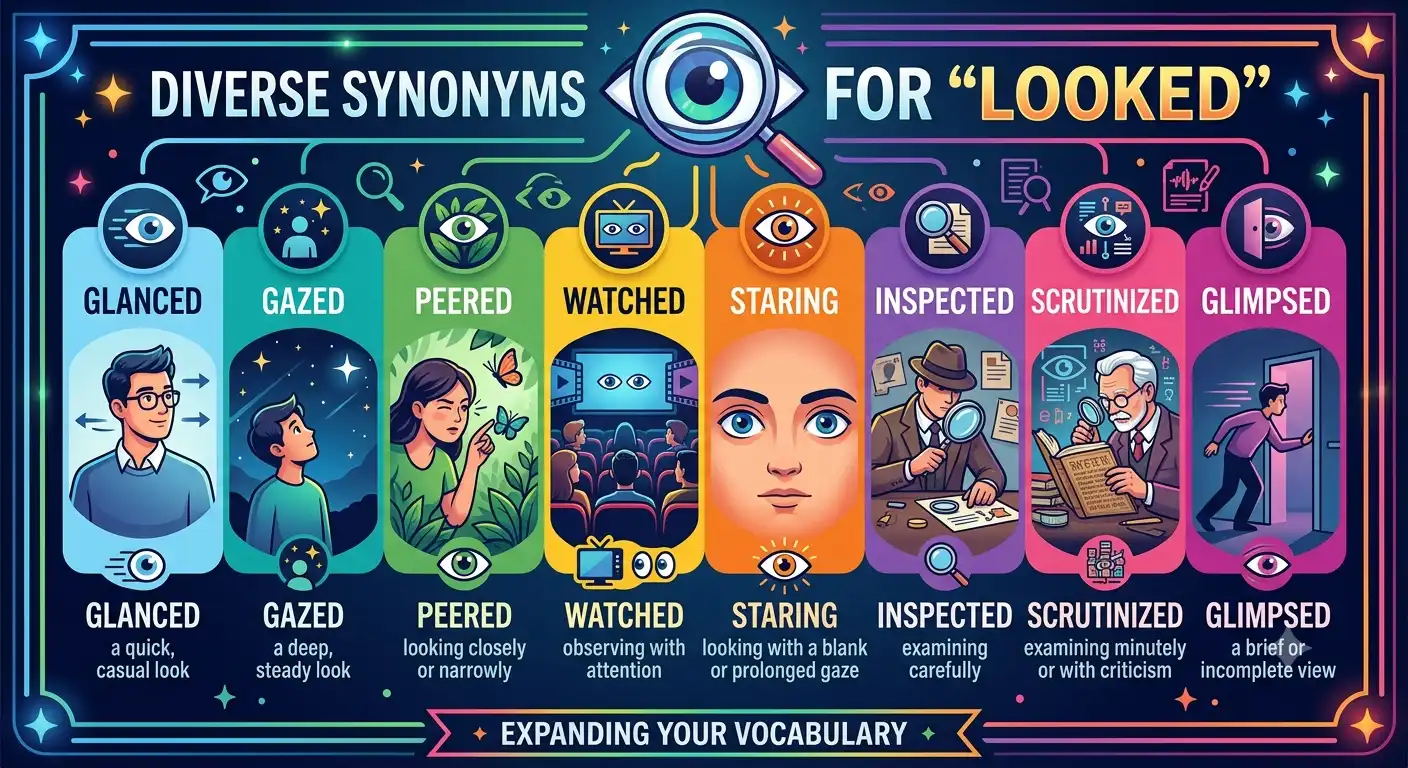
| Glanced | Looked very quickly. | Casual | Reading a clock, passing a car |
| Stared | Looked for a long time without blinking. | Emotional | Shock, surprise, or anger |
| Peered | Looked closely or with difficulty. | Descriptive | Searching in the dark or through a keyhole |
| Scrutinized | Examined something with extreme care. | Professional | Studying a contract, grading a paper |
| Glimpsed | Saw something for just a brief moment. | Casual | Catching a passing train or animal |
| Observed | Watched something slowly to learn from it. | Professional | Scientific studies, watching behavior |
| Glared | Looked with an angry expression. | Emotional | Arguments, tense standoffs |
50 Synonyms for Looked
1. Glanced
Pronunciation: US: /ɡlænst/, UK: /ɡlɑːnst/
Meaning: To look at something very quickly and then look away.
Examples:
- She glanced at her watch to check the time.
- He glanced out the window as the car drove by.
2. Stared
Pronunciation: US: /sterd/, UK: /steəd/
Meaning: To look at something for a long time with wide eyes.
Examples:
- The little boy stared at the giant toy in the shop.
- She stared in disbelief when she heard the wild news.
3. Peered
Pronunciation: US: /pɪrd/, UK: /pɪəd/
Meaning: To look very closely at something that is hard to see.
Examples:
- He peered through the thick fog to find the street sign.
- The cat peered under the sofa to look for its toy mouse.
4. Gazed
Pronunciation: US: /ɡeɪzd/, UK: /ɡeɪzd/
Meaning: To look steadily and calmly at something beautiful or peaceful.
Examples:
- We sat on the beach and gazed at the stars all night.
- She gazed at the beautiful painting on the museum wall.
5. Scanned
Pronunciation: US: /skænd/, UK: /skænd/
Meaning: To look across a wide area quickly to find something.
Examples:
- The lifeguard scanned the pool to keep everyone safe.
- I scanned the menu to find the cheapest food.
6. Observed
Pronunciation: US: /əbˈzɜːrvd/, UK: /əbˈzɜːvd/
Meaning: To watch someone or something carefully to learn about them.
Examples:
- The scientist observed the birds to see how they build nests.
- She observed how her mother baked the sweet apple pie.
7. Examined
Pronunciation: US: /ɪɡˈzæmɪnd/, UK: /ɪɡˈzæmɪnd/
Meaning: To look at something very closely to check its condition.
Examples:
- The doctor examined my sore throat with a small light.
- He examined the old coin to see if it was real.
8. Scrutinized
Pronunciation: US: /ˈskruːtənaɪzd/, UK: /ˈskruːtɪnaɪzd/
Meaning: To inspect something in great detail to find any mistakes.
Examples:
- The lawyer scrutinized every page of the new contract.
- She scrutinized the photo to see who was standing in the back.
9. Glimpsed
Pronunciation: US: /ɡlɪmpst/, UK: /ɡlɪmpst/
Meaning: To see something for a very short moment by chance.
Examples:
- I glimpsed a deer running through the green trees.
- He only glimpsed the thief before the man ran away.
10. Watched
Pronunciation: US: /wɑːtʃt/, UK: /wɒtʃt/
Meaning: To look at action or movement for a period of time.
Examples:
- We watched a funny movie together on the big screen.
- The dog watched the front door, waiting for its owner.
11. Viewed
Pronunciation: US: /vjuːd/, UK: /vjuːd/
Meaning: To look at or inspect a specific scene or object.
Examples:
- Millions of people viewed the live space launch online.
- They viewed several houses before buying their favorite one.
12. Spied
Pronunciation: US: /spaɪd/, UK: /spaɪd/
Meaning: To catch sight of something hidden or secret.
Examples:
- The pirate spied a small island in the distance.
- I spied a small bird hiding in the rose bush.
13. Peeked
Pronunciation: US: /piːkt/, UK: /piːkt/
Meaning: To look quickly and secretly from a hiding place.
Examples:
- She peeked inside the gift box when no one was looking.
- The shy child peeked out from behind his father’s coat.
14. Leered
Pronunciation: US: /lɪrd/, UK: /lɪəd/
Meaning: To look at someone with an unpleasant or mean smile.
Examples:
- The villain leered at the hero from across the dark room.
- He felt uncomfortable when the stranger leered at him.
15. Eyed
Pronunciation: US: /aɪd/, UK: /aɪd/
Meaning: To look at someone with interest, curiosity, or suspicion.
Examples:
- The hungry dog eyed the steak on the kitchen counter.
- She eyed the new student with a friendly smile.
16. Inspected
Pronunciation: US: /ɪnˈspektɪd/, UK: /ɪnˈspektɪd/
Meaning: To look at something officially to make sure it is safe.
Examples:
- The officer inspected the car before the long race started.
- We inspected the hotel room to ensure it was clean.
17. Glared
Pronunciation: US: /ɡlerd/, UK: /ɡleəd/
Meaning: To look at someone with a very angry face.
Examples:
- He glared at his brother for breaking his favorite toy.
- The teacher glared at the noisy classroom until it went quiet.
18. Squinted
Pronunciation: US: /ˈskwɪntɪd/, UK: /ˈskwɪntɪd/
Meaning: To partly close your eyes to see something more clearly.
Examples:
- She squinted in the bright sunlight to read the road sign.
- He squinted at the tiny print in the old book.
19. Surveyed
Pronunciation: US: /sərˈveɪd/, UK: /səˈveɪd/
Meaning: To look at a whole area or situation to understand it.
Examples:
- The general surveyed the land before building the camp.
- She surveyed the messy room and started to clean up.
20. Beheld
Pronunciation: US: /bɪˈheld/, UK: /bɪˈheld/
Meaning: To see something amazing, beautiful, or impressive.
Examples:
- They beheld the grand waterfall as they reached the mountain top.
- He stood still as he beheld the beautiful sunrise.
21. Noticed
Pronunciation: US: /ˈnoʊtɪst/, UK: /ˈnəʊtɪst/
Meaning: To become aware of something by seeing it.
Examples:
- I noticed a small stain on my favorite blue shirt.
- She noticed that the front gate was wide open.
22. Spotted
Pronunciation: US: /spɑːtɪd/, UK: /spɒtɪd/
Meaning: To see or find something that is hard to find.
Examples:
- We spotted a colorful frog near the garden pond.
- He spotted his friend in the middle of the huge crowd.
23. Regarded
Pronunciation: US: /rɪˈɡɑːrdɪd/, UK: /rɪˈɡɑːdɪd/
Meaning: To look at someone in a particular way.
Examples:
- The old man regarded the playful puppy with a warm smile.
- She regarded the difficult puzzle as a fun challenge.
24. Witnessed
Pronunciation: US: /ˈwɪtnəst/, UK: /ˈwɪtnəst/
Meaning: To see an event or accident happen in real life.
Examples:
- Many people witnessed the car crash on the main road.
- She witnessed her best friend win the first-place medal.
25. Studied
Pronunciation: US: /ˈstʌdid/, UK: /ˈstʌdid/
Meaning: To look at something for a long time to learn its details.
Examples:
- The artist studied the face before starting to paint.
- He studied the map carefully to plan the safest route.
“The eye sees only what the mind is prepared to comprehend.” — Robertson Davies
26. Contemplated
Pronunciation: US: /ˈhɑːntəmpleɪtɪd/, UK: /ˈhɒntəmpleɪtɪd/
Meaning: To look at something while thinking deeply about it.
Examples:
- He contemplated the beautiful sea as he made his decision.
- She contemplated her reflection in the quiet pool of water.
27. Gaped
Pronunciation: US: /ɡæpt/, UK: /ɡeɪpt/
Meaning: To look at something with your mouth wide open in surprise.
Examples:
- The crowd gaped at the amazing tricks of the magician.
- I gaped at the sheer height of the city skyscrapers.
28. Ogled
Pronunciation: US: /ˈoʊɡəld/, UK: /ˈəʊɡəld/
Meaning: To look at someone with greedy or too much interest.
Examples:
- The shoppers ogled the delicious cakes in the bakery window.
- He disliked the way the strangers ogled his new car.
29. Scouted
Pronunciation: US: /skaʊtɪd/, UK: /skaʊtɪd/
Meaning: To look around an area to find information or path.
Examples:
- The soldiers scouted the dark forest before moving ahead.
- We scouted the town to find a great place to eat lunch.
30. Reconnoitered
Pronunciation: US: /ˌriːkəˈnɔɪtərd/, UK: /ˌrekəˈnɔɪtəd/
Meaning: To make a quick military or official check of an area.
Examples:
- The helicopter reconnoitered the area after the big flood.
- They reconnoitered the building before starting the work.
31. Checked
Pronunciation: US: /tʃekt/, UK: /tʃekt/
Meaning: To look at something to make sure it is correct or safe.
Examples:
- He checked his pockets to make sure his keys were there.
- She checked the clock twice to ensure she was not late.
32. Reviewed
Pronunciation: US: /rɪˈvjuːd/, UK: /rɪˈvjuːd/
Meaning: To look over something again to study or judge it.
Examples:
- The teacher reviewed my essay and gave me good feedback.
- He reviewed the math notes before the big test started.
33. Perused
Pronunciation: US: /pəˈruːzd/, UK: /pəˈruːzd/
Meaning: To read or look through something in a relaxed way.
Examples:
- She perused the morning newspaper while drinking her warm tea.
- He perused the books on the shelf to find a story.
34. Monitored
Pronunciation: US: /ˈmɑːnɪtərd/, UK: /ˈmɒnɪtəd/
Meaning: To watch a situation closely over time to check its progress.
Examples:
- The nurse monitored the patient’s heartbeat all night long.
- They monitored the security cameras to keep the store safe.
35. Noted
Pronunciation: US: /noʊtɪd/, UK: /nəʊtɪd/
Meaning: To look at something and pay special attention to it.
Examples:
- She noted the change in his voice when he spoke.
- He noted down the phone number on a small scrap of paper.
36. Sighted
Pronunciation: US: /saɪtɪd/, UK: /saɪtɪd/
Meaning: To see something you were looking for from far away.
Examples:
- The sailors finally sighted land after three long weeks.
- We sighted a rare eagle flying high up in the blue sky.
37. Tracked
Pronunciation: US: /trækt/, UK: /trækt/
Meaning: To watch or follow the path of someone or something.
Examples:
- The hunter tracked the animal footprints through the cold snow.
- She tracked the delivery package on her smart phone.
38. Focused
Pronunciation: US: /ˈfoʊkəst/, UK: /ˈfəʊkəst/
Meaning: To direct your full attention or gaze on one thing.
Examples:
- He focused his camera lens on the small red flower.
- She focused her eyes on the teacher during the class.
39. Read
Pronunciation: US: /red/, UK: /red/
Meaning: To look at written words and understand their meaning.
Examples:
- I read a wonderful adventure book during my summer vacation.
- She read the warning sign before entering the deep pool.
40. Scowled
Pronunciation: US: /skaʊld/, UK: /skaʊld/
Meaning: To look down or at someone with a very angry frown.
Examples:
- The grumpy customer scowled at the slow service.
- He scowled at his messy desk before cleaning it up.
41. Eyeballed
Pronunciation: US: /ˈaɪbɔːld/, UK: /ˈaɪbɔːld/
Meaning: To look at something directly or measure it with your eyes.
Examples:
- He eyeballed the distance before jumping across the wide creek.
- The chef eyeballed the ingredients instead of using a scale.
42. Goggled
Pronunciation: US: /ˈɡɑːɡəld/, UK: /ˈɡɒɡəld/
Meaning: To look with wide, rolling eyes in amazement or shock.
Examples:
- They goggled at the massive size of the blue whale.
- She goggled when she saw the amount on her bill.
43. Browsed
Pronunciation: US: /braʊzd/, UK: /braʊzd/
Meaning: To look through items in a shop or online without a plan.
Examples:
- We browsed the bookshop for an hour on Saturday afternoon.
- She browsed the internet to look at different holiday spots.
44. Investigated
Pronunciation: US: /ɪnˈvestɪɡeɪtɪd/, UK: /ɪnˈvestɪɡeɪtɪd/
Meaning: To look into a matter or object to find the truth.
Examples:
- The police officer investigated the broken window in the shop.
- He investigated the strange noise coming from the kitchen.
45. Audited
Pronunciation: US: /ˈɔːdɪtɪd/, UK: /ˈɔːdɪtɪd/
Meaning: To look over accounts or records to make sure they are correct.
Examples:
- The expert audited the company’s money files last week.
- She audited the school library records to find missing books.
46. Supervised
Pronunciation: US: /ˈsuːpərvaɪzd/, UK: /ˈsuːpəvaɪzd/
Meaning: To watch over people to make sure they do their work right.
Examples:
- The manager supervised the workers as they built the new wall.
- She supervised the children while they played on the swings.
47. Searched
Pronunciation: US: /sɜːrtʃt/, UK: /sɜːtʃt/
Meaning: To look through a place very carefully to find something.
Examples:
- He searched the whole house to find his lost wallet.
- We searched the beach for pretty shells to collect.
48. Detected
Pronunciation: US: /dɪˈtektɪd/, UK: /dɪˈtektɪd/
Meaning: To discover or see something that is hard to notice.
Examples:
- The machine detected a small error in the system code.
- She detected a faint smell of smoke in the old cabin.
49. Guarded
Pronunciation: US: /ɡɑːrdɪd/, UK: /ɡɑːdɪd/
Meaning: To watch over something to protect it from danger.
Examples:
- The fierce dog guarded the yard from stray animals.
- The soldiers guarded the palace gates day and night.
50. Admired
Pronunciation: US: /ədˈmaɪərd/, UK: /ədˈmaɪəd/
Meaning: To look at someone or something with respect and pleasure.
Examples:
- He admired the clean design of the brand-new car.
- She stood quietly and admired the beautiful mountain view.
Antonyms of Looked
Knowing the opposites of looking can help you describe states of inattention or avoidance:
- Ignored: Intentionally chose not to look at or pay attention to something.
- Overlooked: Failed to see or notice something.
- Missed: Passed by without seeing.
- Disregarded: Paid no attention to what was seen.
- Neglected: Failed to look after or care for something.
Prototype Meaning and Categorization
In cognitive linguistics, the verb looked belongs to the core domain of Visual Perception and Attention.
Its prototype meaning is the intentional direction of physical gaze toward an object to gather visual details. It is categorized as an active sensory action, distinguishing it from passive seeing (which does not require focus or intent).
FAQs About Synonyms for Looked
1. What is the most common synonym for looked?
The most common synonyms are glanced (for quick actions) and stared (for long, intense focus).
2. Can I use “stared” instead of “looked” in all situations?
No. “Stared” implies shock, anger, or deep surprise. If you use it for a casual glance, it will make your character sound strange or rude.
3. What is a professional synonym for looked to use on a resume?
On resumes and business emails, use inspected, observed, surveyed, supervised, or reviewed. These words sound highly professional.
4. What is the difference between “glanced” and “glimpsed”?
To glance is an active choice to look quickly. To glimpse is a passive event where you catch sight of something for a brief moment by chance.
5. How do I choose the best synonym for looked for creative writing?
Think about your character’s emotion. If they are angry, they glared, If they are curious, they peered. If they are amazed, they gaped. Match the word to the feeling!
6. Is “eyed” a formal word?
No, “eyed” is relatively casual and descriptive. It works wonderfully in stories and descriptive essays but should be avoided in formal scientific papers.
Conclusion
Expanding your visual vocabulary with different synonyms for looked is a simple yet powerful way to elevate your everyday English. When you swap basic words for descriptive alternatives, your storytelling becomes lively, your blogs get more engagement, your speeches sound authoritative, and your daily communication is greatly enhanced. It empowers you to describe exactly how a person behaves using just a single, precise verb.
Try to practice these fresh words in your daily life. Swap out “looked” for “peered,” “scanned,” or “glanced” in your next school essay, work email, or casual conversation, and see how much stronger your sentences sound. Building your vocabulary is an exciting journey that instantly improves your writing!
“Look closely at the present you are constructing; it should look like the future you are dreaming.” — Alice Walker
“The soul, fortunately, has an interpreter – often an unconscious but still a faithful interpreter – in the eye.” — Charlotte Brontë

Andrew Powell is a travel writer and nature journalist who has spent over a decade writing about places, landscapes, and the natural world — and thinking carefully about the words that do those subjects justice ( Biography ).