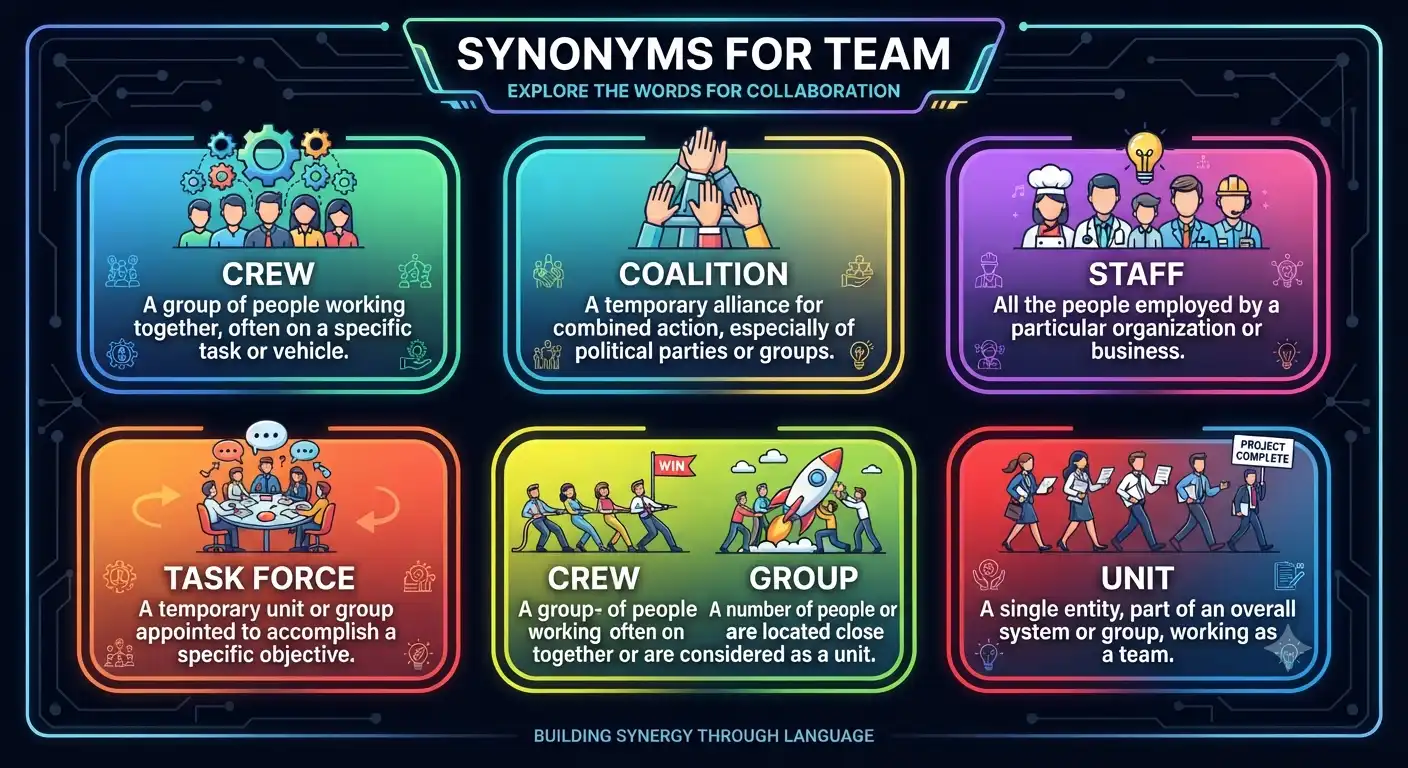
When you write about groups working together, discovering the best synonyms for team can elevate your writing. Learning different synonyms for team helps you avoid repeating the same word. Using these synonyms for team makes your text sound polished, professional, and highly engaging.
Imagine a captain standing in front of a group of highly trained specialists. If the captain keeps calling everyone “my team” over and over, the speech feels flat and uninspiring. But when the captain addresses them as a “crew,” a “squad,” or an “alliance,” the energy in the room instantly shifts. A single word can completely change how people cooperate. In very simple words, a team is a group of people who work together to do a job or win a game.
This guide is highly useful for everyone. Students can write better group project reports and improve their grades. Bloggers can keep readers hooked with fresh and colorful vocabulary. Content writers can describe business collaborations without sounding repetitive. Daily English users can express themselves with more variety and confidence.
“Finding the perfect word is like assembling the right team—every part must fit perfectly.” — Unknown
“Unity is strength, but vocabulary is the tool that gives that strength a voice.” — Unknown
Linguistic Overview of “Team”
To help you fully master this concept, let us look closely at the linguistic background and structure of our primary term.
- Connotative Meaning: Generally highly positive, suggesting unity, cooperation, joint effort, support, shared goals, and harmony.
- Etymology:
- Origin: From the Middle English noun teme, which comes from Old English tēam.
- Root: Derived from the Proto-Germanic root tau(g)m- (meaning to draw or pull, originally referring to a draft animal set of oxen or horses yoked together).
- History: Entered English in the medieval period to describe a group of animals working together to pull a cart, later expanding in the 16th century to describe people working or playing together.
- Pronunciation:
- US IPA: /tiːm/
- UK IPA: /tiːm/
- Syllables: team (1 syllable)
- Affixation Pattern:
- Root: team (noun/verb)
- Suffixes: -mate (teammate – noun), -work (teamwork – noun), -ed (teamed – past tense verb), -ing (teaming – present participle verb)
- Prefixes: multi- (multiteam – adjective, though rare)
Comparison Table
| Keyword | Meaning | Usage Type | Context |
|---|---|---|---|
| Team | A group of people working or playing together. | Neutral | General, sports, and daily work tasks. |
| Squad | A small group organized for a specific task. | Casual | Sports, military, and informal friendship groups. |
| Crew | A group of people who work on a ship, plane, or project. | Professional | Maritime, aviation, film sets, and construction. |
| Alliance | An agreement between groups to work together. | Formal | Politics, international business, and treaties. |
| Unit | A single group that is part of a larger organization. | Professional | Military, hospitals, and corporate departments. |
| Coalition | A temporary group formed for a single common goal. | Formal | Politics, community action, and corporate mergers. |
| Syndicate | A business group formed to carry out a project. | Formal | Finance, media distribution, and real estate. |
| Troop | A group of people or soldiers moving together. | Neutral | Military, youth scouting, and performing arts. |
| Gang | An informal group of friends or workers. | Casual | Informal gatherings, manual labor, or street groups. |
| League | a group of people or sports clubs joined together. | Professional | Sports organizations, historic unions, and gaming. |
“No individual can win a game by themselves; it takes a cohesive group to achieve greatness.” — Elite Coach
50 Synonyms for Team
1. Squad
- Pronunciation: US: /skwɑːd/ | UK: /skwɒd/
- Meaning: A small group of people organized for a specific task or sport.
- Examples:
- The local police department sent a special rescue squad to help.
- Our soccer squad won the championship game last night.
2. Crew
- Pronunciation: US: /kruː/ | UK: /kruː/
- Meaning: A group of people who work closely together on a ship, plane, or project.
- Examples:
- The film crew arrived early to set up the cameras.
- A friendly cabin crew welcomed us onto the flight.
3. Alliance
- Pronunciation: US: /əˈlaɪ.əns/ | UK: /əˈlaɪ.əns/
- Meaning: A group of countries, companies, or people who agree to work together.
- Examples:
- The two tech companies formed an alliance to build a new app.
- Our school created an alliance with the local library to share books.
4. Unit
- Pronunciation: US: /ˈjuː.nɪt/ | UK: /ˈjuː.nɪt/
- Meaning: A single group of people that is part of a larger organization.
- Examples:
- She works as a nurse in the intensive care unit.
- The police unit was sent to control the busy traffic.
5. Coalition
- Pronunciation: US: /ˌkoʊ.əˈlɪʃ.ən/ | UK: /ˌkəʊ.əˈlɪʃ.ən/
- Meaning: A temporary group of different people or political parties working together.
- Examples:
- Several environmental groups formed a coalition to clean up the river.
- The two political parties created a coalition government after the election.
6. Syndicate
- Pronunciation: US: /ˈsɪn.dɪ.kət/ | UK: /ˈsɪn.dɪ.kət/
- Meaning: A group of people or businesses working together to make money.
- Examples:
- A powerful banking syndicate funded the construction of the skyscraper.
- The newspaper syndicate bought the rights to publish the famous comic strip.
7. Troop
- Pronunciation: US: /truːp/ | UK: /truːp/
- Meaning: A organized group of soldiers, scouts, or performers.
- Examples:
- Our local scout troop went camping in the deep forest.
- A troop of actors traveled from town to town performing plays.
8. Gang
- Pronunciation: US: /ɡæŋ/ | UK: /ɡæŋ/
- Meaning: An informal group of friends who spend a lot of time together.
- Examples:
- The whole gang gathered at the diner for a Friday night dinner.
- A gang of road workers repaired the street outside my house.
9. League
- Pronunciation: US: /liːɡ/ | UK: /liːɡ/
- Meaning: A group of sports teams or people who join together for a purpose.
- Examples:
- He joined a local bowling league to meet new people.
- The league of nations worked hard to maintain peace.
10. Force
- Pronunciation: US: /fɔːrs/ | UK: /fɔːs/
- Meaning: A group of people organized for a particular activity or job.
- Examples:
- The company hired a large sales force to sell their new product.
- A special rescue force was sent to search the mountain.
11. Club
- Pronunciation: US: /klʌb/ | UK: /klʌb/
- Meaning: A group of people who meet to do a shared activity together.
- Examples:
- She joined the school chess club to improve her skills.
- Our gardening club meets every Saturday to plant flowers.
12. Association
- Pronunciation: US: /əˌsoʊ.siˈeɪ.ʃən/ | UK: /əˌsəʊ.siˈeɪ.ʃən/
- Meaning: A group of people organized for a joint business or professional goal.
- Examples:
- The teachers’ association held a big meeting to discuss classroom budgets.
- He is a proud member of the local medical association.
13. Partnership
- Pronunciation: US: /ˈpɑːrt.nɚ.ʃɪp/ | UK: /ˈpɑːt.nə.ʃɪp/
- Meaning: A group of two or more people who run a business together.
- Examples:
- The two lawyers formed a successful partnership last year.
- This creative partnership produced some of the best art in the city.
14. Collective
- Pronunciation: US: /kəˈlek.tɪv/ | UK: /kəˈlek.tɪv/
- Meaning: A group of individuals who share resources and work together.
- Examples:
- The artists formed a collective to share a large studio space.
- This farm is run by a collective of local families.
15. Band
- Pronunciation: US: /bænd/ | UK: /bænd/
- Meaning: A small group of people who have the same interest or job.
- Examples:
- A small band of travelers crossed the hot desert.
- The rock band practiced their songs in the garage.
16. Party
- Pronunciation: US: /ˈpɑːr.ṭi/ | UK: /ˈpɑː.ti/
- Meaning: A group of people doing an activity together, like traveling or playing.
- Examples:
- A search party looked for the lost dog in the woods.
- Our dinner party enjoyed a beautiful meal together.
17. Assembly
- Pronunciation: US: /əˈsem.bli/ | UK: /əˈsem.bli/
- Meaning: A group of people gathered together for a clear reason.
- Examples:
- The school assembly gathered in the gym to hear the principal speak.
- A large assembly of citizens protested the high taxes.
18. Circle
- Pronunciation: US: /ˈsɝː.kəl/ | UK: /ˈsɜː.kəl/
- Meaning: A group of people who are connected by family, work, or hobbies.
- Examples:
- She has a very close circle of friends from college.
- He is well-known within the city’s literary circle.
19. Clan
- Pronunciation: US: /klæn/ | UK: /klæn/
- Meaning: A large group of people who are related to each other.
- Examples:
- The entire Smith clan gathered for a big family reunion.
- High in the mountains, the ancient clan lived together peacefully.
20. Faction
- Pronunciation: US: /ˈfæk.ʃən/ | UK: /ˈfæk.ʃən/
- Meaning: A small, opposing group of people inside a larger group.
- Examples:
- A rebellious faction wanted to change the club rules.
- The political party split into three different factions after the debate.
21. Union
- Pronunciation: US: /ˈjuː.njən/ | UK: /ˈjuː.njən/
- Meaning: A group of workers joined together to protect their jobs and rights.
- Examples:
- The factory workers voted to join a strong trade union.
- This credit union helps local families borrow money safely.
22. Outfit
- Pronunciation: US: /ˈaʊt.fɪt/ | UK: /ˈaʊt.fɪt/
- Meaning: An informal name for a group of people working as a business or team.
- Examples:
- He joined a small construction outfit to learn how to build houses.
- That comedy outfit makes the funniest videos online.
23. Bunch
- Pronunciation: US: /bʌntʃ/ | UK: /bʌntʃ/
- Meaning: A friendly, informal group of people who are together.
- Examples:
- My coworkers are a great bunch of people to work with.
- A bunch of kids played tag in the neighborhood park.
24. Ring
- Pronunciation: US: /rɪŋ/ | UK: /rɪŋ/
- Meaning: A group of people who work together secretly or in business.
- Examples:
- The police caught a criminal ring that was stealing expensive cars.
- A small spy ring operated in the capital city during the war.
25. Network
- Pronunciation: US: /ˈnet.wɝːk/ | UK: /ˈnet.wɜːk/
- Meaning: A large, connected group of people who share information and help.
- Examples:
- She built a great network of professional contacts in the city.
- Our national network of volunteers helps people after storms.
26. Crowd
- Pronunciation: US: /kraʊd/ | UK: /kraʊd/
- Meaning: A large group of people who have gathered in one place.
- Examples:
- A massive crowd waited outside the concert hall doors.
- He does not like standing out in a large crowd.
27. Pack
- Pronunciation: US: /pæk/ | UK: /pæk/
- Meaning: A group of animals or people who travel together.
- Examples:
- A pack of wild wolves ran through the snow.
- The pack of runners crossed the starting line together.
28. Fleet
- Pronunciation: US: /fliːt/ | UK: /fliːt/
- Meaning: A group of ships, buses, or cars working under one control.
- Examples:
- The delivery company owns a fleet of bright blue trucks.
- A fleet of fishing boats sailed out into the deep ocean.
29. Body
- Pronunciation: US: /ˈbɑː.di/ | UK: /ˈbɒd.i/
- Meaning: A group of people who work together as an official organization.
- Examples:
- The student governing body voted to change the school mascot.
- An independent advisory body gave advice to the city mayor.
30. Commission
- Pronunciation: US: /kəˈmɪʃ.ən/ | UK: /kəˈmɪʃ.ən/
- Meaning: A group of people officially chosen to investigate or do a job.
- Examples:
- The government set up a commission to study the traffic problems.
- She serves on the local planning commission for the parks.
31. Committee
- Pronunciation: US: /kəˈmɪt̬.i/ | UK: /kəˈmɪt.i/
- Meaning: A small group chosen from a larger organization to make decisions.
- Examples:
- The dance committee met to choose the decorations for the prom.
- Our neighborhood committee decided to build a community garden.
32. Consortium
- Pronunciation: US: /kənˈsɔːr.t̬i.əm/ | UK: /kənˈsɔː.ti.əm/
- Meaning: A group of companies or banks that join to complete a massive project.
- Examples:
- An international consortium built the huge underground railway.
- The university consortium shared funding for the scientific study.
33. Federation
- Pronunciation: US: /ˌfed.əˈreɪ.ʃən/ | UK: /ˌfed.əˈreɪ.ʃən/
- Meaning: A group of clubs, states, or organizations joined by an agreement.
- Examples:
- The national chess federation organized the grand tournament.
- He represented our country at the international trade federation.
34. Guild
- Pronunciation: US: /ɡɪld/ | UK: /ɡɪld/
- Meaning: A group of people who do the same craft or skilled job.
- Examples:
- The woodcarving guild held a show to sell their handmade chairs.
- She is an active member of the local writers’ guild.
35. Gathering
- Pronunciation: US: /ˈɡæð.ɚ.ɪŋ/ | UK: /ˈɡæð.ər.ɪŋ/
- Meaning: A group of people who meet together for social or family reasons.
- Examples:
- We had a small gathering of friends to celebrate his birthday.
- The annual family gathering took place at our grandmother’s farm.
36. Horde
- Pronunciation: US: /hɔːrd/ | UK: /hɔːd/
- Meaning: A very large, noisy, and active group of people.
- Examples:
- A horde of excited shoppers rushed into the store on Black Friday.
- We saw a horde of tourists walking through the historic square.
37. Mob
- Pronunciation: US: /mɑːb/ | UK: /mɒb/
- Meaning: A large, angry, or wild group of people.
- Examples:
- An angry mob gathered outside the courthouse demanding justice.
- The pop star was quickly surrounded by a mob of fans.
38. Platoon
- Pronunciation: US: /pləˈtuːn/ | UK: /pləˈtuːn/
- Meaning: A small military group commanded by a lieutenant.
- Examples:
- The platoon marched back to the base after their training.
- He served with a brave infantry platoon in the army.
39. Regiment
- Pronunciation: US: /ˈredʒ.ə.mənt/ | UK: /ˈredʒ.ɪ.mənt/
- Meaning: A large military group made of several smaller units.
- Examples:
- The historic armored regiment paraded through the town streets.
- She joined the local artillery regiment after finishing college.
40. Staff
- Pronunciation: US: /stæf/ | UK: /stɑːf/
- Meaning: The group of people who work for a school, business, or shop.
- Examples:
- The hotel staff made sure we had clean towels every morning.
- Our school has a dedicated staff of thirty helpful teachers.
41. Host
- Pronunciation: US: /hoʊst/ | UK: /həʊst/
- Meaning: A very large number of people or things gathered together.
- Examples:
- A host of golden daffodils danced gently in the warm spring wind.
- The presenter answered a host of interesting questions from the audience.
42. Cohort
- Pronunciation: US: /ˈkoʊ.hɔːrt/ | UK: /ˈkəʊ.hɔːt/
- Meaning: A group of people who share a common feature or experience.
- Examples:
- The new cohort of medical students began their classes today.
- This study followed a cohort of children born in the year 2010.
43. Company
- Pronunciation: US: /ˈkʌm.pə.ni/ | UK: /ˈkʌm.pə.ni/
- Meaning: A group of actors, dancers, or travelers who perform together.
- Examples:
- The local theater company performed a beautiful musical last night.
- We had a wonderful company of friends over for dinner.
44. Division
- Pronunciation: US: /dɪˈvɪʒ.ən/ | UK: /dɪˈvɪʒ.ən/
- Meaning: A large, organized department within a business or military force.
- Examples:
- He was promoted to manager of the international sales division.
- The army division crossed the border during the training exercise.
45. Panel
- Pronunciation: US: /ˈpæn.əl/ | UK: /ˈpæn.əl/
- Meaning: A small group of experts chosen to discuss a topic or judge a contest.
- Examples:
- A panel of medical experts answered questions about the new medicine.
- The judging panel selected her painting as the first-place winner.
46. Taskforce
- Pronunciation: US: /ˈtæsk.fɔːrs/ | UK: /ˈtɑːsk.fɔːs/
- Meaning: A group set up for a short time to solve a specific problem.
- Examples:
- The city created a special taskforce to clean up the public parks.
- A police taskforce was formed to reduce neighborhood crime.
47. Trust
- Pronunciation: US: /trʌst/ | UK: /trʌst/
- Meaning: A group of people who manage money or property for someone else.
- Examples:
- The charitable trust donated millions of dollars to build the hospital.
- The local land trust protects the forest from home builders.
48. Workgroup
- Pronunciation: US: /ˈwɝːk.ɡruːp/ | UK: /ˈwɜːk.ɡruːp/
- Meaning: A small group of workers who do a specific task together.
- Examples:
- The project workgroup met in the conference room to plan the project.
- She led a small workgroup focused on improving product safety.
49. Cabal
- Pronunciation: US: /kəˈbɑːl/ | UK: /kəˈbæl/
- Meaning: A small, secret group of people who plan together to take power.
- Examples:
- The secret cabal plotted to overthrow the king during the winter.
- A small political cabal controlled the party from behind the scenes.
50. Lineup
- Pronunciation: US: /ˈlaɪn.ʌp/ | UK: /ˈlaɪn.ʌp/
- Meaning: A group of people or players chosen to perform in an event.
- Examples:
- The coach announced the starting lineup for the big championship game.
- This music festival has an amazing lineup of popular singers.
Antonyms of “Team”
To help you understand the full range of this vocabulary, here are the most common antonyms for our focus term:
- Individual: A single person, separate from any group.
- Soloist: A person who performs a song, dance, or task completely alone.
- Loner: A person who prefers to be, work, and live by themselves.
- Competitor: A person or group that tries to win against another.
- Opponent: Someone who plays or fights against you in a contest.
- Maverick: A person who thinks and acts independently instead of following a group.
Prototype Meaning and Categorization
At its core, team is a collective entity of multiple individuals cooperating to achieve a common goal. Linguists place this word under the category of social structures and cooperative action.
It is split into three main categories:
- Task-Oriented Cooperation: Professional groups like workgroups, divisions, and squads formed to do a specific job.
- Affiliation and Social Bonds: Informal groups like circles, bands, and gangs that gather for friendship or social reasons.
- Structured Institutions: Large, formal groups like alliances, federations, and leagues that operate with strict rules.
Frequently Asked Questions
What is the most common synonym for team?
The most common everyday synonyms for team are group, crew, and squad. In casual conversation, people often use the word squad when talking about friends, and crew when referring to coworkers.
What is the difference between a team and a group?
A team works together toward a shared, common goal, relying on each other to succeed. A group is simply a collection of people who may be in the same place but do not necessarily share a joint purpose or work together.
What is a professional synonym for team to use on a resume?
Terms like unit, division, collective, or workgroup are excellent to use on a professional resume. These terms sound polished and show that you understand corporate organization.
Why are synonyms for team useful in SEO writing?
Using various search-friendly terms like squad, alliance, and coalition keeps your articles from sounding repetitive. It also helps search engines match your writing to many different related search terms.
Can ‘gang’ be used as a positive synonym for team?
Yes, but only in highly casual settings. While gang often refers to street criminals, it is also used in friendly, daily English to describe a close group of friends hanging out together (e.g., “The whole gang is here!”).
When should I use ‘crew’ instead of ‘squad’?
Use crew when the group is working on a technical or physical job, like a film, flight, or construction project. Use squad for sports, small military units, or close-knit friendship circles.
Conclusion
Learning to use different synonyms for team is one of the easiest ways to improve your general writing, blogging, public speaking, and daily communication. When you swap out repetitive words for precise, engaging terms, you paint a vivid picture for your audience. Your words instantly become more exciting to read and listen to.
We highly encourage you to start practicing these new words today. Try using words like “alliance,” “collective,” or “squad” in your business emails, school essays, and daily conversations. You will quickly notice how much more professional, confident, and persuasive you sound to others.
“To speak with variety is to think with clarity.” — Unknown
“The words we choose to describe our unity define the strength of our connection.” — Unknown

Andrew Powell is a travel writer and nature journalist who has spent over a decade writing about places, landscapes, and the natural world — and thinking carefully about the words that do those subjects justice ( Biography ).