
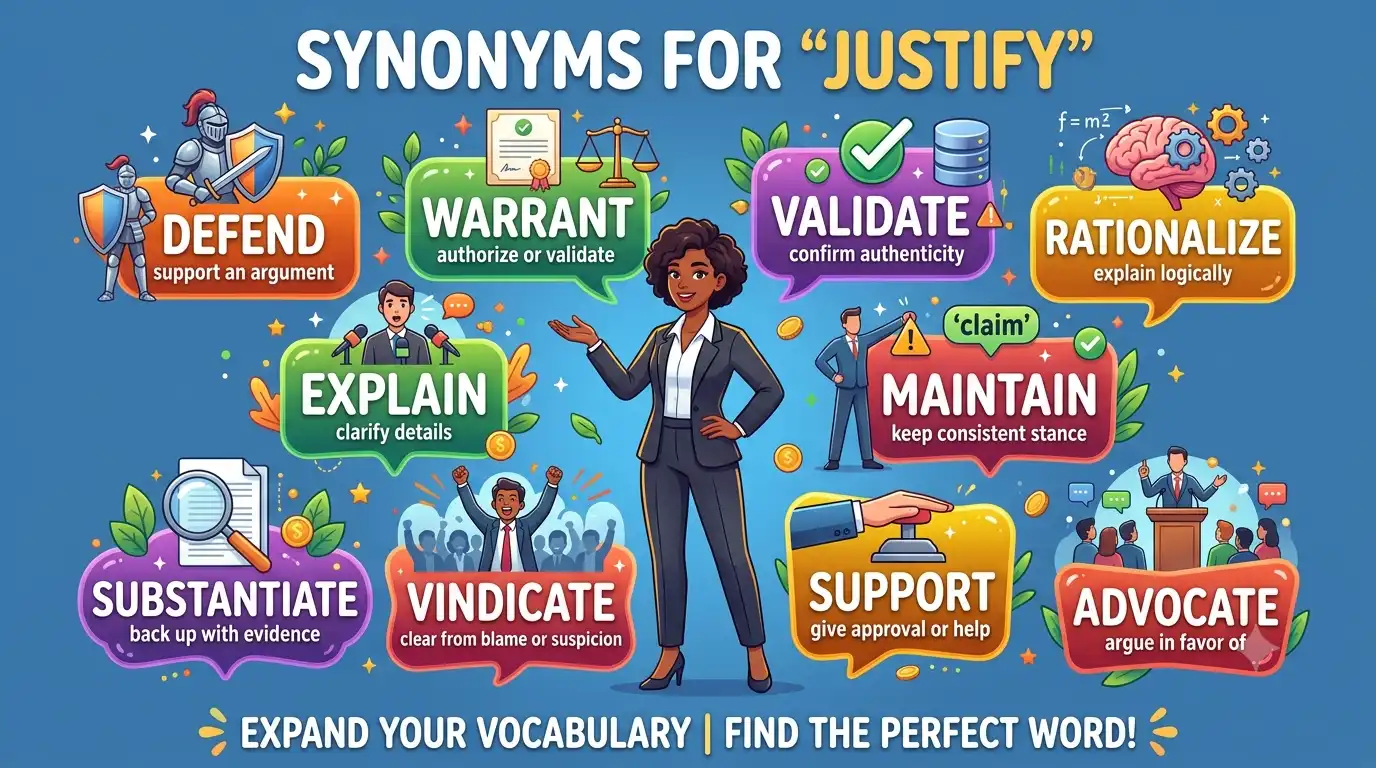
Learning various synonyms for justify allows you to explain your choices, defend your arguments, and give good reasons for your actions clearly. When you search for synonyms for justify, you look for words that mean to show that something is reasonable, correct, fair, or necessary. Exploring these synonyms for justify helps you build stronger essays, communicate persuasively at work, and express your thoughts with confidence.
Explaining Your Choices with Precision
Imagine explaining to your teacher why you chose a specific topic for your history project, or showing a friend why a house rule makes sense. Simply saying you can justify your choice works, but stating that you can defend, validate, or substantiate your decision makes your reasoning far more convincing. Learning synonyms for justify empowers you to express exact levels of proof, explanation, and logic in any situation.
In very simple English, to justify means to show or prove that an action, belief, or decision is right, fair, or sensible.
Why Word Choice Matters for Communicators
Expanding your vocabulary with these persuasive terms offers great benefits across every field:
- For Students: It upgrades your academic writing, helping you support essay thesis statements and debate points effectively.
- For Bloggers: It improves your article structure, keeping readers convinced and engaged through clear logical transitions.
- For Content Writers: It enables you to craft compelling product guides, case studies, and brand strategies that build reader trust.
- For Daily English Users: It gives you polite, expressive words to explain your decisions, clear up misunderstandings, and share your perspective.
“Clear reasoning combined with the right words turns simple ideas into undeniable truth.”
“Expressing why a decision is right builds the foundation for trust and understanding.”
Linguistic Breakdown: Etymology, Connotation, and Structure
Connotative Meaning of “Justify”
The word justify carries a rational, formal, and defensive connotation. It implies providing evidence, sound reasoning, or moral proof to show that an action or thought is right. Depending on the context, its tone can range from legal or academic proof to personal explanation.
Short Etymology
- Origin: Late Middle English (14th century).
- Root: Derived from Old French justifier and Latin justificare (“to act justly toward” or “to make righteous”), combining justus (“just, right”) and -ficare (from facere, “to make or do”).
Pronunciation
- US IPA:
/ˈdʒʌs.tə.faɪ/ - UK IPA:
/ˈdʒʌs.tɪ.faɪ/
Syllables & Structure
- Syllables: 3 (
jus–ti–fy) - Primary Stress: First syllable (
jus) - Affixation Pattern: Root just (fair/right) + Verbal Suffix -ify (to make, show, or cause to be).
Comparison Table: Choosing the Right Synonym for Justify
| Keyword | Meaning | Usage Type | Context |
|---|---|---|---|
| Justify | To show or prove that something is right or reasonable | General / Formal | Essays, debates, decision-making |
| Defend | To protect an idea or choice with strong arguments | Persuasive | Discussions, speeches, courtrooms |
| Validate | To confirm that something is acceptable or sound | Professional | Data, feelings, research |
| Substantiate | To provide solid evidence to prove a statement | Academic / Formal | Science papers, reports, investigations |
| Explain | To make something clear by describing it | Casual / General | Classroom, family talk, daily use |
| Vindicate | To clear someone from blame or prove them right | Emotional / Legal | Disputes, history, personal honor |
| Rationalize | To give plausible reasons for an action | Reflective | Personal choices, psychology |
| Warrant | To justify or make an action necessary | Authoritative | Rules, major actions, news |
| Legitimize | To make something seem legal, proper, or acceptable | Formal | Policy, societal standards, business |
| Uphold | To support or maintain a rule, decision, or truth | Formal / Legal | Leadership, legal rulings, principles |
50 Synonyms for Justify
1. Defend
- Pronunciation: US
/dɪˈfend/| UK/dɪˈfend/ - Meaning: To speak or write in support of an idea or choice.
- Examples:
- She was ready to defend her science project during the presentation.
- The lawyer stood up to defend the client in court.
2. Validate
- Pronunciation: US
/ˈvæl.ə.deɪt/| UK/ˈvæl.ɪ.deɪt/ - Meaning: To prove or check that something is true and correct.
- Examples:
- Real experimental results help to validate a scientist’s theory.
- Hearing his friend’s kind words helped validate his feelings.
3. Explain
- Pronunciation: US
/ɪkˈspleɪn/| UK/ɪkˈspleɪn/ - Meaning: To make an idea clear so others understand it easily.
- Examples:
- Please explain your answer using simple steps.
- The teacher took extra time to explain the math rule.
4. Vindicate
- Pronunciation: US
/ˈvɪn.də.keɪt/| UK/ˈvɪn.dɪ.keɪt/ - Meaning: To clear someone of blame or prove an idea was right all along.
- Examples:
- Finding the lost receipt helped vindicate her story.
- New research will vindicate the original discovery.
5. Support
- Pronunciation: US
/səˈpɔːrt/| UK/səˈpɔːt/ - Meaning: To agree with and give facts to back up an opinion.
- Examples:
- Use clear facts to support your essay statement.
- My parents always support my creative hobbies.
6. Substantiate
- Pronunciation: US
/səbˈstæn.ʃi.eɪt/| UK/səbˈstæn.ʃi.eɪt/ - Meaning: To provide facts or proof to show that something is true.
- Examples:
- The reporter needed more data to substantiate the news claim.
- You must substantiate your budget request with receipts.
7. Rationalize
- Pronunciation: US
/ˈræʃ.ən.əl.aɪz/| UK/ˈræʃ.ən.əl.aɪz/ - Meaning: To give good or logical reasons for a choice made.
- Examples:
- He tried to rationalize spending money on a new bicycle.
- She attempted to rationalize her late arrival at the meeting.
8. Warrant
- Pronunciation: US
/ˈwɔːr.ənt/| UK/ˈwɒr.ənt/ - Meaning: To give a sufficient reason for an action to happen.
- Examples:
- Minor mistakes do not warrant canceling the entire plan.
- Her hard work and dedication certainly warrant a reward.
9. Legitimize
- Pronunciation: US
/ləˈdʒɪt̬.ə.maɪz/| UK/ləˈdʒɪt.ɪ.maɪz/ - Meaning: To make an action look legal, right, or acceptable.
- Examples:
- Passing the official test helped legitimize his new business.
- Public support can legitimize a new community rule.
10. Prove
- Pronunciation: US
/pruːv/| UK/pruːv/ - Meaning: To show that something is true by giving facts and evidence.
- Examples:
- Clear clues helped the detective prove who solved the mystery.
- Practice is the best way to prove your skills.
11. Maintain
- Pronunciation: US
/meɪnˈteɪn/| UK/meɪnˈteɪn/ - Meaning: To continue declaring that a statement or belief is true.
- Examples:
- The author continues to maintain that her book is accurate.
- He chose to maintain his position despite the disagreement.
12. Uphold
- Pronunciation: US
/ʌpˈhoʊld/| UK/ʌpˈhəʊld/ - Meaning: To support, preserve, or defend a rule, law, or decision.
- Examples:
- Judges work hard to uphold fairness in the courtroom.
- Our school works to uphold high standards of honesty.
13. Confirm
- Pronunciation: US
/kənˈfɝːm/| UK/kənˈfɝːm/ - Meaning: To state or show that a thought or plan is definite.
- Examples:
- Laboratory tests helped confirm the doctor’s initial diagnosis.
- Please send an email to confirm your attendance at the workshop.
14. Excuse
- Pronunciation: US
/ɪkˈskjuːz/| UK/ɪkˈskjuːz/ - Meaning: To give a valid reason for a minor fault or delay.
- Examples:
- Bad traffic helped excuse his late arrival to the movie.
- Nothing can fully excuse rude behavior during a lesson.
15. Verify
- Pronunciation: US
/ˈver.ə.faɪ/| UK/ˈver.ɪ.faɪ/ - Meaning: To double-check and make sure that facts are accurate.
- Examples:
- Writers must verify their information before publishing an article.
- The guard asked to verify her student badge at the door.
16. Advocate
- Pronunciation: US
/ˈæd.və.keɪt/| UK/ˈæd.və.keɪt/ - Meaning: To speak publicly in favor of a cause or idea.
- Examples:
- She chose to advocate for cleaner parks in her town.
- Teachers often advocate for more reading time in class.
17. Bear out
- Pronunciation: US
/ber aʊt/| UK/beər aʊt/ - Meaning: To show that a story or fact is true by matching it.
- Examples:
- The new evidence will bear out what she said yesterday.
- The test results bear out our original hypothesis.
18. Back
- Pronunciation: US
/bæk/| UK/bæk/ - Meaning: To give support, help, or agreement to a person or plan.
- Examples:
- My teammates decided to back my idea for the new play.
- Investors came forward to back the school’s science fair.
19. Back up
- Pronunciation: US
/bæk ʌp/| UK/bæk ʌp/ - Meaning: To provide facts that prove a statement or claim.
- Examples:
- Always back up your written arguments with solid proof.
- Her friends were ready to back up her story.
20. Clarify
- Pronunciation: US
/ˈklær.ə.faɪ/| UK/ˈklær.ɪ.faɪ/ - Meaning: To make an idea clear and easy for everyone to understand.
- Examples:
- The teacher added a diagram to clarify the main point.
- Asking questions can help clarify tricky instructions.
“Giving clear reasons for our choices opens the door to honest communication.”
21. Champion
- Pronunciation: US
/ˈtʃæm.pi.ən/| UK/ˈtʃæm.pi.ən/ - Meaning: To strongly defend and fight for an idea or cause.
- Examples:
- She loves to champion equal access to library books for all kids.
- Our club works to champion green recycling habits.
22. Demonstrate
- Pronunciation: US
/ˈdem.ən.streɪt/| UK/ˈdem.ən.streɪt/ - Meaning: To show clearly how something works or why it is true.
- Examples:
- The experiment helped demonstrate how plants drink water.
- He used a chart to demonstrate the growth in reading scores.
23. Establish
- Pronunciation: US
/ɪˈstæb.lɪʃ/| UK/ɪˈstæb.lɪʃ/ - Meaning: To show or prove a fact so clearly that it is accepted.
- Examples:
- Facts helped establish the truth behind the historic event.
- The study helped establish a link between sleep and focus.
24. Account for
- Pronunciation: US
/əˈkaʊnt fɔːr/| UK/əˈkaʊnt fɔː/ - Meaning: To explain the reason or cause for something happening.
- Examples:
- Heavy rain helped account for the delay in afternoon sports.
- The student was asked to account for the missing homework page.
25. Corroborate
- Pronunciation: US
/kəˈrɑː.bə.reɪt/| UK/kəˈrɒb.ə.reɪt/ - Meaning: To support a story or statement by giving matching details.
- Examples:
- The security video helped corroborate his account of the event.
- Two witnesses came forward to corroborate the report.
26. Exonerate
- Pronunciation: US
/ɪɡˈzɑː.nə.reɪt/| UK/ɪɡˈzɒn.ə.reɪt/ - Meaning: To show that someone is free from blame or wrongdoing.
- Examples:
- New evidence served to exonerate the falsely accused worker.
- The official report helped exonerate the driver from fault.
27. Absolve
- Pronunciation: US
/əbˈzɑːlv/| UK/əbˈzɒlv/ - Meaning: To state formally that someone is free from guilt or responsibility.
- Examples:
- The investigation helped absolve him of any responsibility for the mistake.
- Her honest explanation served to absolve her from blame.
28. Clear
- Pronunciation: US
/klɪr/| UK/klɪə/ - Meaning: To prove that someone is innocent of a mistake or accusation.
- Examples:
- Finding the lost key helped clear her name.
- The detailed log helped clear up any doubts about the project timeline.
29. Pardon
- Pronunciation: US
/ˈpɑːr.dən/| UK/ˈpɑː.dən/ - Meaning: To forgive a mistake or accept a reasonable explanation for it.
- Examples:
- The coach chose to pardon the minor delay due to bad weather.
- Please pardon my interruption while I share an important update.
30. Sustain
- Pronunciation: US
/səˈsteɪn/| UK/səˈsteɪn/ - Meaning: To support or approve a claim or decision as valid.
- Examples:
- The judge chose to sustain the lawyer’s valid objection.
- Facts helped sustain the argument throughout the debate.
31. Endorse
- Pronunciation: US
/ɪnˈdɔːrs/| UK/ɪnˈdɔːs/ - Meaning: To express public approval or support for a plan or idea.
- Examples:
- The principal was happy to endorse the new reading program.
- Community members met to endorse the park cleanup plan.
32. Sanction
- Pronunciation: US
/ˈsæŋk.ʃən/| UK/ˈsæŋk.ʃən/ - Meaning: To give official permission or approval for an action.
- Examples:
- The school board voted to sanction the new after-school club.
- Only authorized teachers can sanction outdoor field trips.
33. Authorize
- Pronunciation: US
/ˈɑː.θɚ.aɪz/| UK/ˈɔː.θə.raɪz/ - Meaning: To give official permission or power for something to happen.
- Examples:
- The supervisor had to authorize buying new science equipment.
- Sign the form to authorize joining the sports team.
34. Favor
- Pronunciation: US
/ˈfeɪ.vɚ/| UK/ˈfeɪ.və/ - Meaning: To prefer or support one choice because it makes good sense.
- Examples:
- Most students favor having a longer lunch break.
- The panel tends to favor well-researched project entries.
35. Affirm
- Pronunciation: US
/əˈfɝːm/| UK/əˈfɝːm/ - Meaning: To state strongly that an idea or truth is correct.
- Examples:
- The study results affirm that sleep helps memory.
- She took a moment to affirm her commitment to the team goals.
36. Attest
- Pronunciation: US
/əˈtest/| UK/əˈtest/ - Meaning: To state or show that something is true based on experience.
- Examples:
- Her teacher can attest to her hard work and focus.
- Neighbor reviews attest to the quality of the new bakery.
37. Certify
- Pronunciation: US
/ˈsɝː.t̬ə.faɪ/| UK/ˈsɜː.tɪ.faɪ/ - Meaning: To confirm officially that a statement or document is true.
- Examples:
- An expert came to certify that the building was safe.
- The school will certify your completion of the course.
38. Vouch for
- Pronunciation: US
/vaʊtʃ fɔːr/| UK/vaʊtʃ fɔː/ - Meaning: To express personal trust and confidence that something is true.
- Examples:
- I can personally vouch for her honesty and kindness.
- My old coach offered to vouch for my soccer skills.
39. Stand up for
- Pronunciation: US
/stænd ʌp fɔːr/| UK/stænd ʌp fɔː/ - Meaning: To support and defend an idea or friend when questioned.
- Examples:
- It takes courage to stand up for what is fair.
- She stepped in to stand up for her classmate’s project.
40. Argue for
- Pronunciation: US
/ˈɑːrɡ.juː fɔːr/| UK/ˈɑːɡ.juː fɔː/ - Meaning: To present reasons showing why an action should be taken.
- Examples:
- The essay will argue for protecting forest habitats.
- He rose to argue for better recycling bins in school.
41. Make a case for
- Pronunciation: US
/meɪk ə keɪs fɔːr/| UK/meɪk ə keɪs fɔː/ - Meaning: To combine facts and reasons to persuade people about an idea.
- Examples:
- We hope to make a case for starting a chess club.
- Her report helps make a case for updating the computer room.
42. Give grounds for
- Pronunciation: US
/ɡɪv ɡraʊndz fɔːr/| UK/ɡɪv ɡraʊndz fɔː/ - Meaning: To provide good reasons or evidence that justify an action.
- Examples:
- Strong research data will give grounds for new safety rules.
- His consistent work helps give grounds for an award.
43. Ground
- Pronunciation: US
/ɡraʊnd/| UK/ɡraʊnd/ - Meaning: To base an argument or belief on solid facts and logic.
- Examples:
- It is best to ground your opinions on reliable facts.
- The author chose to ground the story in real history.
44. Motivate
- Pronunciation: US
/ˈmoʊ.t̬ə.veɪt/| UK/ˈməʊ.tɪ.veɪt/ - Meaning: To provide a clear reason or incentive for doing something.
- Examples:
- A desire to help others can motivate great community work.
- What factors helped motivate your choice for this project?
45. Answer for
- Pronunciation: US
/ˈæn.sɚ fɔːr/| UK/ˈɑːn.sə fɔː/ - Meaning: To explain and take responsibility for your choices or actions.
- Examples:
- Leaders must be ready to answer for the decisions they make.
- He was prepared to answer for his team’s final choices.
46. Speak for
- Pronunciation: US
/spiːk fɔːr/| UK/spiːk fɔː/ - Meaning: To serve as evidence that proves the value of something.
- Examples:
- Her high test results speak for her dedicated study habits.
- The team’s trophies speak for their hard work this season.
47. Shield
- Pronunciation: US
/ʃiːld/| UK/ʃiːld/ - Meaning: To protect an idea or person from unfair blame by giving reasons.
- Examples:
- Clear facts helped shield the team from unfair criticism.
- Good preparation will shield your work against doubts.
48. Reaffirm
- Pronunciation: US
/ˌriː.əˈfɝːm/| UK/ˌriː.əˈfɜːm/ - Meaning: To state again strongly that a decision or belief is right.
- Examples:
- The principal spoke to reaffirm the school’s core values.
- Today’s meeting helped reaffirm our project schedule.
49. Assure
- Pronunciation: US
/əˈʃʊr/| UK/əˈʃɔː/ - Meaning: To tell someone confidently that something is true or safe.
- Examples:
- The guide spoke to assure us that the path was safe.
- Clear data helped assure the team that the plan would work.
50. Reassure
- Pronunciation: US
/ˌriː.əˈʃʊr/| UK/ˌriː.əˈʃɔː/ - Meaning: To make someone feel less worried by explaining facts clearly.
- Examples:
- Her calm words helped reassure everyone before the big test.
- Facts helped reassure parents about school bus safety.
Antonyms of Justify
To master the word justify, it helps to look at contrasting terms that mean failing to give good reasons, accusing, or showing that something is wrong:
- Disprove: To show that a statement or belief is false or incorrect.
- Invalidate: To make an argument or document legally or logically unsound.
- Condemn: To express strong disapproval of an action or choice.
- Blame: To state that a person or action is responsible for a fault or mistake.
- Refute: To prove an argument to be wrong by using logic or evidence.
- Undermine: To weaken the backing or proof of an idea over time.
Prototype Meaning and Categorization of Justify
In cognitive linguistics, a prototype represents the central, most typical example of a category. The central prototype of the word justify is providing logical reasons, solid evidence, or moral proof to show that an action, decision, or belief is fair and proper. Depending on the speaker’s context, audience, and intent, synonyms for justify naturally fall into three primary written categories:
1. Academic and Formal Proof This category includes formal vocabulary used when research, data, or structured evidence is required to back up claims. Words such as substantiate, validate, corroborate, demonstrate, establish, and verify represent prototype choices in science reports, history essays, and debate speeches where objective proof is expected.
2. Persuasive Defense and Advocacy This group focuses on active words used to support ideas, protect choices, or stand up for decisions in public settings. Synonyms like defend, advocate, champion, uphold, make a case for, and argue for are ideal for speeches, team meetings, opinion articles, and persuasive writing where convincing an audience is the goal.
3. Practical Explanation and Personal Reason This category consists of clear, friendly words suited for everyday conversations, classroom discussions, and personal reflection. Descriptors such as explain, account for, rationalize, back up, clarify, and vouch for allow speakers to describe their choices naturally without sounding overly strict or legalistic.
Frequently Asked Questions (FAQ)
1. What is the difference between “justify” and “explain”?
While explain simply means to make an idea clear so others understand it, justify goes a step further by giving reasons that show why the choice was right, fair, or necessary.
2. What is a good formal synonym for justify in school essays?
In academic papers, excellent synonyms for justify include substantiate, validate, corroborate, demonstrate, and uphold.
3. What are casual synonyms for justify in everyday speech?
In daily conversations, words like explain, back up, account for, and make sense of work smoothly and naturally.
4. Can “rationalize” mean the exact same thing as justify?
They are very close, but rationalize can sometimes imply making up plausible excuses after an action has already occurred, whereas justify usually relies on genuine logic or evidence.
5. How does learning synonyms for justify improve debate skills?
Using varied synonyms for justify helps you match your language to your evidence—whether you are providing scientific proof (substantiating), supporting a team idea (advocating), or clarifying your stance (defending).
Conclusion
Expanding your vocabulary with this rich collection of synonyms for justify is a wonderful way to sharpen your writing, strengthen your debate skills, and communicate your ideas clearly. Whether you select formal terms like substantiate and validate, persuasive options like defend and advocate, or simple everyday words like explain and back up, choosing the exact right word gives your reasoning real strength.
For students crafting persuasive essays or science reports, using diverse synonyms for justify prevents repetitive phrasing and demonstrates strong critical thinking, bloggers and content writers, replacing generic words with precise choices keeps your articles logical, easy to follow, and convincing, everyday speakers, having a broad selection of vocabulary helps you express your views politely, clear up confusion, and stand up for your choices with confidence.
Try practicing two or three of these persuasive new words this week in your class assignments, debate sessions, or daily conversations!
“A well-chosen synonym brings strength to your arguments and clarity to your thoughts.”
“Expressing reason with precision transforms everyday opinions into powerful statements.”
“The art of communication lies in choosing words that make your logic clear and undeniable.”

Andrew Powell is a travel writer and nature journalist who has spent over a decade writing about places, landscapes, and the natural world — and thinking carefully about the words that do those subjects justice ( Biography ).