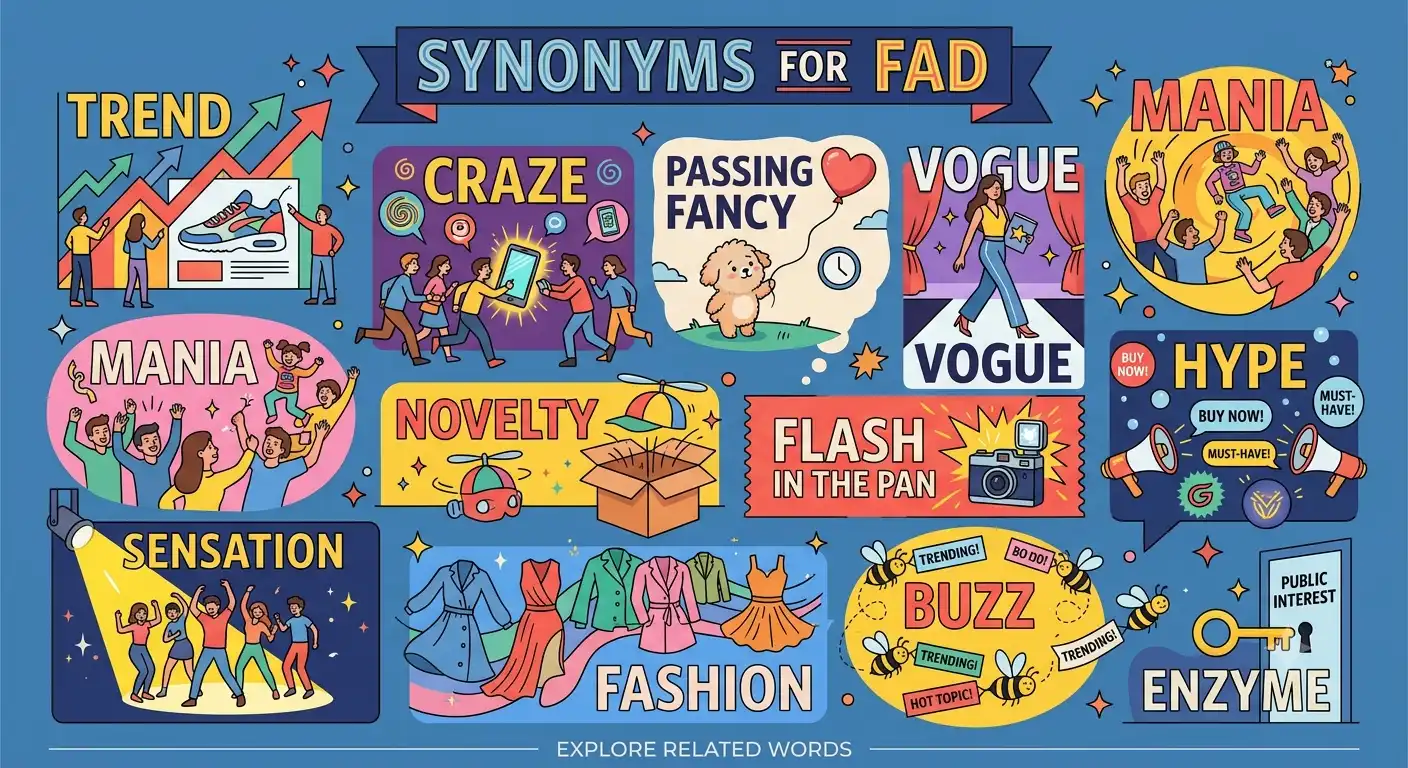
When you explore synonyms for fad, you discover a rich variety of words that describe short-lived trends, temporary crazes, and quick pop-culture sensations. Learning these synonyms for fad helps you talk about popular social media challenges, short-term viral ideas, and temporary fashion styles with precision and flair.
Remember when fidget spinners or specific dance challenges suddenly appeared everywhere online and then vanished a few months later? That quick burst of intense popularity is a classic example of a temporary trend. In simple terms, a fad is something that becomes very popular very quickly, but only stays popular for a short time. Understanding diverse synonyms for fad allows you to describe whether a trend is a playful obsession, a silly craze, or a sudden social media movement.
Why Word Choice Matters in Real Life
Using the right vocabulary makes your writing far more engaging and specific. Instead of calling every short-lived trend a simple trend, calling it a fleeting craze, a passing mania, or a viral sensation paints a vivid picture for your readers.
Key Benefits for Writers and Communicators
Learning these vocabulary variations gives you a distinct advantage across different writing and speaking situations:
- For Students: It enhances your social science and English essays with precise analytical terms.
- For Bloggers: It keeps your commentary fresh, exciting, and modern when writing about pop culture or internet trends.
- For Content Writers: It helps you capture market trends and consumer behavior with dynamic, natural phrasing.
- For Daily English Users: It lets you share fun stories about viral movements and changing fashions with friends.
“Language is the mirror of culture; as trends come and go, our words capture the spirit of the moment.”
“Choosing the exact synonym transforms simple observation into powerful storytelling.”
Linguistic Breakdown: Etymology, Connotation, and Structure
Connotative Meaning of “Fad”
The word fad carries an informal, energetic, and slightly critical connotation. It implies high enthusiasm that lacks long-term value, durability, or staying power.
Short Etymology
- Origin: 19th-century English slang (circa 1834).
- Root: Shortened form of faddle (to trifle or play with) or linked to the French word fadaise (a silly or trifling thing).
Pronunciation
- US IPA: /fæd/
- UK IPA: /fæd/
Syllables & Structure
- Syllables: 1 (fad)
- Primary Stress: Single-syllable word
- Affixation Pattern: Root word without prefixes or suffixes.
Comparison Table: Choosing the Right Synonym for Fad
| Keyword | Meaning | Usage Type | Context |
| Fad | A short-lived craze or temporary passion | Casual / Daily | Social media, fashion, pop culture |
| Craze | An intense enthusiasm that sweeps through a group | Casual / Energetic | Toys, dance trends, entertainment |
| Trend | A general direction in which something is changing | Professional / Neutral | Market patterns, fashion, tech |
| Vogue | A prevailing fashion or style at a given time | Professional / Stylish | Fashion industry, design, culture |
| Mania | An extreme or obsessive excitement for something | Emotional / Dramatic | Public behavior, media events |
| Sensation | A state of widespread excitement or interest | Enthusiastic | News, entertainment, viral videos |
| Novelty | Something new, original, or unusual | Neutral / Descriptive | Products, gadgets, gifts |
| Enthusiasm | Strong excitement or active interest | Positive / Personal | Hobbies, sports, team projects |
| Fashion | A popular style of clothing, behavior, or art | General / Cultural | Apparel, lifestyle, habits |
| Gimmick | A trick or feature designed to attract attention | Critical / Commercial | Marketing, sales, advertising |
50 Synonyms for Fad
1. Craze
- Pronunciation: US /kreɪz/ | UK /kreɪz/
- Meaning: An intense interest that many people share for a short time.
- Examples:
- The new smartphone puzzle game became a sudden craze among students.
- Collecting those colorful toy cards was a huge craze last summer.
2. Mania
- Pronunciation: US /ˈmeɪ.ni.ə/ | UK /ˈmeɪ.ni.ə/
- Meaning: An extreme level of excitement or enthusiasm shared by many people.
- Examples:
- Concert tickets sold out in minutes due to fan mania for the band.
- The city experienced a baseball mania during the championship series.
3. Trend
- Pronunciation: US /trend/ | UK /trend/
- Meaning: A general direction in which fashion or interest is moving.
- Examples:
- Neon jacket colors are a popular style trend this winter season.
- She loves following the latest healthy breakfast trend on social media.
4. Vogue
- Pronunciation: US /voʊɡ/ | UK /vəʊɡ/
- Meaning: The current fashion or popular acceptance of a style.
- Examples:
- Vintage sunglasses are back in vogue among young adults this year.
- Wooden furniture is currently in high vogue for home design.
5. Fashion
- Pronunciation: US /ˈfæʃ.ən/ | UK /ˈfæʃ.ən/
- Meaning: A popular style of clothing, hair, or behavior at a specific time.
- Examples:
- Wide jeans are returning to popular fashion across college campuses.
- His clean haircut was in line with modern fashion choices.
6. Rage
- Pronunciation: US /reɪdʒ/ | UK /reɪdʒ/
- Meaning: A widespread and eager enthusiasm for a new fashion or item.
- Examples:
- Electric scooters are the latest rage in city transportation.
- High-top sneakers were all the rage when my older brother was in school.
7. Sensation
- Pronunciation: US /senˈseɪ.ʃən/ | UK /senˈseɪ.ʃən/
- Meaning: Something that causes great public excitement and interest.
- Examples:
- The young singer became a national sensation after her video went viral.
- The new bakery created a local sensation with its unique pastries.
8. Obsession
- Pronunciation: US /əbˈseʃ.ən/ | UK /əbˈseʃ.ən/
- Meaning: An interest or activity that fills someone’s mind completely.
- Examples:
- My sister has a fun obsession with collecting movie posters.
- The new fantasy card game became an instant obsession for the group.
9. Novelty
- Pronunciation: US /ˈnɑː.vəl.ti/ | UK /ˈnɒv.əl.ti/
- Meaning: The quality of being new, unique, or interesting for a short period.
- Examples:
- The glow-in-the-dark pen was a fun novelty that wore off quickly.
- Flying a drone felt like an exciting novelty during his first week.
10. Gimmick
- Pronunciation: US /ˈɡɪm.ɪk/ | UK /ˈɡɪm.ɪk/
- Meaning: A unique trick or feature used to attract quick public interest.
- Examples:
- The restaurant used a giant mascot as a marketing gimmick to draw crowds.
- Free prize stickers proved to be a clever gimmick for selling cereal.
11. Fancy
- Pronunciation: US /ˈfæn.si/ | UK /ˈfæn.si/
- Meaning: A sudden or temporary liking for something specific.
- Examples:
- She took a sudden fancy to painting watercolors on weekends.
- He followed his fancy and bought a brightly colored bicycle.
12. Whim
- Pronunciation: US /wɪm/ | UK /wɪm/
- Meaning: A sudden desire or impulse to do something without a clear reason.
- Examples:
- We decided on a whim to take a road trip to the beach.
- Buying that large hat was just a passing whim during vacation.
13. Impulse
- Pronunciation: US /ˈɪm.pʌls/ | UK /ˈɪm.pʌls/
- Meaning: A sudden strong urge or desire to act quickly.
- Examples:
- She bought the bright shoes on a quick impulse at the mall.
- Try to resist the impulse to buy snacks while standing in line.
14. Passion
- Pronunciation: US /ˈpæʃ.ən/ | UK /ˈpæʃ.ən/
- Meaning: A strong feeling of enthusiasm or excitement for an activity.
- Examples:
- Baking fresh bread became her main creative passion during the winter.
- He plays basketball with endless energy and real passion.
15. Enthusiasm
- Pronunciation: US /ɪnˈθuː.zi.æz.əm/ | UK /ɪnˈθjuː.zi.æz.əm/
- Meaning: Strong warmth and excitement felt for an idea or subject.
- Examples:
- The students showed great enthusiasm for the upcoming science fair.
- Her natural enthusiasm for reading inspired her younger classmates.
16. Cult
- Pronunciation: US /kʌlt/ | UK /kʌlt/
- Meaning: A small group of devoted fans who strongly admire a specific thing.
- Examples:
- The old animated movie developed a loyal cult following online.
- This retro video game created a massive cult fanbase over time.
17. Infatuation
- Pronunciation: US /ɪnˌfætʃ.uˈeɪ.ʃən/ | UK /ɪnˌfætʃ.uˈeɪ.ʃən/
- Meaning: A short passion or strong love for something that quickly fades.
- Examples:
- His interest in learning the ukulele was just a brief infatuation.
- Her short-lived infatuation with roller skating ended after two weeks.
18. Craving
- Pronunciation: US /ˈkreɪ.vɪŋ/ | UK /ˈkreɪ.vɪŋ/
- Meaning: A strong and sudden desire for a specific item or experience.
- Examples:
- Cold bubble tea became a daily craving during the hot summer months.
- He felt a sudden craving to watch classic funny videos on his phone.
19. Fever
- Pronunciation: US /ˈfiː.vɚ/ | UK /ˈfiː.və/
- Meaning: A state of heightened enthusiasm shared by a crowd or community.
- Examples:
- World Cup soccer fever spread quickly across every neighborhood.
- Tournament fever swept through the school during spirit week.
20. Hype
- Pronunciation: US /haɪp/ | UK /haɪp/
- Meaning: Intensive public excitement generated by media or word of mouth.
- Examples:
- The new superhero movie completely lived up to all the online hype.
- Be careful not to buy products just because of clever social media hype.
“Understanding the nature of temporary enthusiasm helps writers explain how culture evolves.”
21. Trendiness
- Pronunciation: US /ˈtren.di.nəs/ | UK /ˈtren.di.nəs/
- Meaning: The state of being popular, fashionable, and modern right now.
- Examples:
- The café gained popularity due to the trendiness of its decor.
- Young shoppers often look for quick trendiness in streetwear clothes.
22. Boom
- Pronunciation: US /buːm/ | UK /buːm/
- Meaning: A sudden period of rapid growth and popular demand for something.
- Examples:
- The city experienced a real estate boom over the last two years.
- Home gardening saw a huge boom during the spring season.
23. Movement
- Pronunciation: US /ˈmuːv.mənt/ | UK /ˈmuːv.mənt/
- Meaning: A series of organized activities working toward a popular trend or goal.
- Examples:
- The local food movement encourages people to buy from neighborhood farms.
- The youth art movement brought colorful murals to city walls.
24. Shift
- Pronunciation: US /ʃɪft/ | UK /ʃɪft/
- Meaning: A change in position, opinion, style, or general direction.
- Examples:
- We noticed a clear shift toward eco-friendly paper packaging.
- There was a sudden shift in music tastes among teenage listeners.
25. Wave
- Pronunciation: US /weɪv/ | UK /weɪv/
- Meaning: A sudden rise or widespread surge of a specific activity.
- Examples:
- A new wave of digital art gained popularity among young creators.
- The hot weather brought a huge wave of ice cream sales across town.
26. Custom
- Pronunciation: US /ˈkʌs.təm/ | UK /ˈkʌs.təm/
- Meaning: An accepted way of doing things in a particular group or time.
- Examples:
- Dressing up for midnight movie shows became a fun local custom.
- Exchanging colorful friendship bracelets is a sweet summer camp custom.
27. Style
- Pronunciation: US /staɪl/ | UK /staɪl/
- Meaning: A distinct manner of expression, design, or appearance.
- Examples:
- Minimalist home style focuses on simple lines and clean spaces.
- Her unique artistic style caught the attention of local gallery owners.
28. Mode
- Pronunciation: US /moʊd/ | UK /məʊd/
- Meaning: A prevailing fashion, custom, or style of living.
- Examples:
- Walking to work became the primary mode of travel for residents.
- Pastel colors are the popular mode for spring clothing collections.
29. Flavor
- Pronunciation: US /ˈfleɪ.vɚ/ | UK /ˈfleɪ.və/
- Meaning: A special quality, mood, or temporary theme of the moment.
- Examples:
- Tropical house music is the current flavor of the summer festival scene.
- Spicy snacks are the popular flavor of choice in school cafeterias today.
30. Taste
- Pronunciation: US /teɪst/ | UK /teɪst/
- Meaning: A person’s preference or liking for a particular style or activity.
- Examples:
- Popular taste in comedy movies has changed over the last decade.
- She has excellent taste in picking catchy background music for videos.
31. Tendency
- Pronunciation: US /ˈten.dən.si/ | UK /ˈten.dən.si/
- Meaning: An inclination or natural likelihood to follow a particular direction.
- Examples:
- Consumers show a strong tendency to buy products with clean packaging.
- Modern sports shoes have a tendency to feature brighter fluorescent colors.
32. Phase
- Pronunciation: US /feɪz/ | UK /feɪz/
- Meaning: A temporary period or stage in a person’s development or interests.
- Examples:
- Wearing only black clothes was just a short phase in high school.
- Learning to skateboard turned out to be a fun summer phase.
33. Spree
- Pronunciation: US /spriː/ | UK /spriː/
- Meaning: A short period of intense activity of a specific kind.
- Examples:
- The holiday shopping spree filled the malls with bustling crowds.
- She went on a reading spree and finished three novels in one weekend.
34. Burst
- Pronunciation: US /bɝːst/ | UK /bɜːst/
- Meaning: A sudden, brief period of intense activity, emotion, or popularity.
- Examples:
- A sudden burst of applause greeted the band as they walked on stage.
- The garden produced a colorful burst of flowers early in the spring.
35. Flash
- Pronunciation: US /flæʃ/ | UK /flæʃ/
- Meaning: A brief, intense period of popularity or activity that quickly ends.
- Examples:
- His sudden fame turned out to be a quick flash in the pan.
- The bright rainbow gave a colorful flash before disappearing behind clouds.
36. Flare
- Pronunciation: US /fler/ | UK /fleə/
- Meaning: A sudden, bright, but brief outburst of interest or activity.
- Examples:
- A sudden flare of interest in retro board games brought families together.
- The news story sparked a brief flare of public discussion online.
37. Buzz
- Pronunciation: US /bʌz/ | UK /bʌz/
- Meaning: Excited talk, rumor, or activity surrounding a new event or product.
- Examples:
- The trailer for the new action game generated huge online buzz.
- There was a happy buzz in the air during the opening of the new park.
38. Surge
- Pronunciation: US /sɝːdʒ/ | UK /sɜːdʒ/
- Meaning: A sudden and strong increase or forward movement of popularity.
- Examples:
- Online learning tools saw a dramatic surge in usage this year.
- The bakery experienced a surge in orders before the weekend holiday.
39. Upsurge
- Pronunciation: US /ˈʌp.sɝːdʒ/ | UK /ˈʌp.sɜːdʒ/
- Meaning: A notable and rapid increase in activity, interest, or quantity.
- Examples:
- We observed a sudden upsurge in community volunteers this spring.
- The town saw an upsurge in visitors after the article was published.
40. Rush
- Pronunciation: US /rʌʃ/ | UK /rʌʃ/
- Meaning: A sudden rapid movement or eager demand by many people.
- Examples:
- There was a big rush to buy fresh fruit at the morning market.
- The shoe store faced an afternoon rush when the sale began.
41. Splash
- Pronunciation: US /splæʃ/ | UK /splæʃ/
- Meaning: A striking or sudden impression that attracts widespread attention.
- Examples:
- The new fashion line made a huge splash at the annual runway show.
- Her debut art exhibit created a memorable splash in the gallery scene.
42. Drift
- Pronunciation: US /drɪft/ | UK /drɪft/
- Meaning: A slow, continuous movement or gradual shift in style or opinion.
- Examples:
- There is a steady drift toward using digital notes instead of paper notebooks.
- The music group experienced a slight drift toward pop sound styles.
43. Current
- Pronunciation: US /ˈkɝː.ənt/ | UK /ˈkʌr.ənt/
- Meaning: A flowing movement or prevailing force of thought and opinion.
- Examples:
- The underlying current of modern design favors simplicity and light.
- Strong public current swung in favor of building new cycling paths.
44. Tide
- Pronunciation: US /taɪd/ | UK /taɪd/
- Meaning: A powerful surge or turning direction of public sentiment or fashion.
- Examples:
- The tide of popular opinion changed quickly after the announcement.
- Surfing gear saw a rising tide of sales during the warm summer.
45. Stream
- Pronunciation: US /striːm/ | UK /striːm/
- Meaning: A continuous flow of social trends, ideas, or online content.
- Examples:
- A steady stream of viral cooking short videos flooded the app.
- The festival attracted a continuous stream of excited visitors.
46. Habit
- Pronunciation: US /ˈhæb.ɪt/ | UK /ˈhæb.ɪt/
- Meaning: A settled or regular tendency and practice within a culture.
- Examples:
- Taking quick photos of restaurant meals became a common dining habit.
- Carrying reusable water bottles is now a daily eco-friendly habit.
47. Practice
- Pronunciation: US /ˈpræk.tɪs/ | UK /ˈpræk.tɪs/
- Meaning: A customary or widespread way of doing something in society.
- Examples:
- Sharing recipe videos online is a popular modern cooking practice.
- Offering digital receipts has become a standard retail practice.
48. Sensation-seeking
- Pronunciation: US /senˈseɪ.ʃən ˈsiː.kɪŋ/ | UK /senˈseɪ.ʃən ˈsiː.kɪŋ/
- Meaning: The tendency to pursue new, exciting, and viral experiences.
- Examples:
- Extreme sports challenges cater to sensation-seeking audiences online.
- Viral video channels appeal to the sensation-seeking nature of viewers.
49. Viral trend
- Pronunciation: US /ˈvaɪ.rəl trend/ | UK /ˈvaɪ.rəl trend/
- Meaning: An idea, clip, or activity that spreads rapidly across the internet.
- Examples:
- The funny cat video sparked a massive viral trend across social platforms.
- Participating in the community dance challenge became a global viral trend.
50. Passing fancy
- Pronunciation: US /ˈpæs.ɪŋ ˈfæn.si/ | UK /ˈpɑː.sɪŋ ˈfæn.si/
- Meaning: A brief, temporary liking for something that does not last long.
- Examples:
- His interest in learning magic tricks was just a passing fancy.
- Buying bright yellow boots turned out to be a passing fancy for her.
Antonyms of Fad
To master the concept of a temporary trend, it helps to look at words that mean the opposite—things that last a long time, remain stable, or stay permanent:
- Classic: Something that remains popular, high quality, and respected for decades.
- Tradition: A long-established custom or belief passed down through generations.
- Permanent fixture: An element or habit that stays fixed and unchanged over time.
- Staple: A basic, necessary, and enduring item or practice in daily life.
- Mainstay: A central, reliable component that stays consistently popular.
- Enduring style: A fashion or practice that never goes out of popularity.
Prototype Meaning and Categorization
To select the most accurate term from among all synonyms for fad, it is helpful to categorize them based on intensity and duration:
┌──────────────────────────┐
│ SYNONYMS FOR FAD │
└─────────────┬────────────┘
│
┌─────────────────────────────────┼─────────────────────────────────┐
▼ ▼ ▼
┌───────────────┐ ┌───────────────┐ ┌───────────────┐
HIGH INTENSITY GENERAL TREND SHORT-LIVED
& EXCITEMENT & STYLE & IMPULSE
Craze Trend Whim
Mania Vogue Passing fancy
Rage Fashion Novelty
Hype Movement Flash
└───────────────┘ └───────────────┘ └───────────────┘
- High Intensity & Excitement: Words used when enthusiasm is passionate, noisy, and rapidly sweeping through a group.
- Examples: Craze, Mania, Rage, Hype, Sensation, Fever.
- General Trend & Style: Terms suited for broader cultural shifts, fashion choices, and modern aesthetic directions.
- Examples: Trend, Vogue, Fashion, Movement, Style, Mode.
- Short-Lived & Impulse: Terms that describe brief personal phases, sudden ideas, or quick temporary novelties.
- Examples: Whim, Passing fancy, Novelty, Flash, Phase, Impulse.
Frequently Asked Questions (FAQ)
1. What is the difference between a trend and a fad?
A trend develops gradually, lasts longer, and often leads to permanent cultural or market changes (like smartphone usage). A fad appears suddenly, spreads with intense enthusiasm, and disappears quickly without leaving lasting changes (like fidget spinners).
2. What is a popular synonym for fad on social media?
On social platforms, common synonyms for fad include viral trend, hype, craze, and challenge. These words highlight how quickly content spreads across the internet.
3. Can a fad become a long-term fashion?
Yes! Occasionally, something that starts as a quick fad or temporary craze catches on deeply with the public and evolves into a lasting classic or permanent fashion.
4. Is “gimmick” the exact same as “fad”?
Not quite. A fad refers to the widespread enthusiasm people feel for a temporary item or activity. A gimmick is a specific trick or feature designed by marketers to draw quick attention.
5. What are formal synonyms for fad in academic writing?
In academic papers, essay writers often replace informal words like fad with terms such as transitory phenomenon, ephemeral trend, passing phase, or temporary surge.
Conclusion
Expanding your vocabulary with this rich list of synonyms for fad is a fantastic way to elevate your speaking and writing skills. Whether you select energetic terms like craze and mania, stylish words like vogue and trend, or brief descriptors like whim and passing fancy, using precise terminology brings your commentary to life.
For students crafting essays, using descriptive alternatives to describe social trends demonstrates strong critical thinking and vocabulary depth, bloggers and content creators, choosing dynamic words keeps your articles lively and engaging for readers, everyday language users, having a broad selection of terms allows you to share observations about fast-moving pop culture with humor, clarity, and confidence.
Make it a habit to practice using two or three new synonyms each week in your daily conversations, school projects, or journal entries!
“A vibrant vocabulary turns simple descriptions into vivid pictures of the world around us.”
“Learning new words allows us to express subtle shades of meaning with precision and confidence.”
“Communication becomes an art form when you select the exact right word for every moment.”

Andrew Powell is a travel writer and nature journalist who has spent over a decade writing about places, landscapes, and the natural world — and thinking carefully about the words that do those subjects justice ( Biography ).