
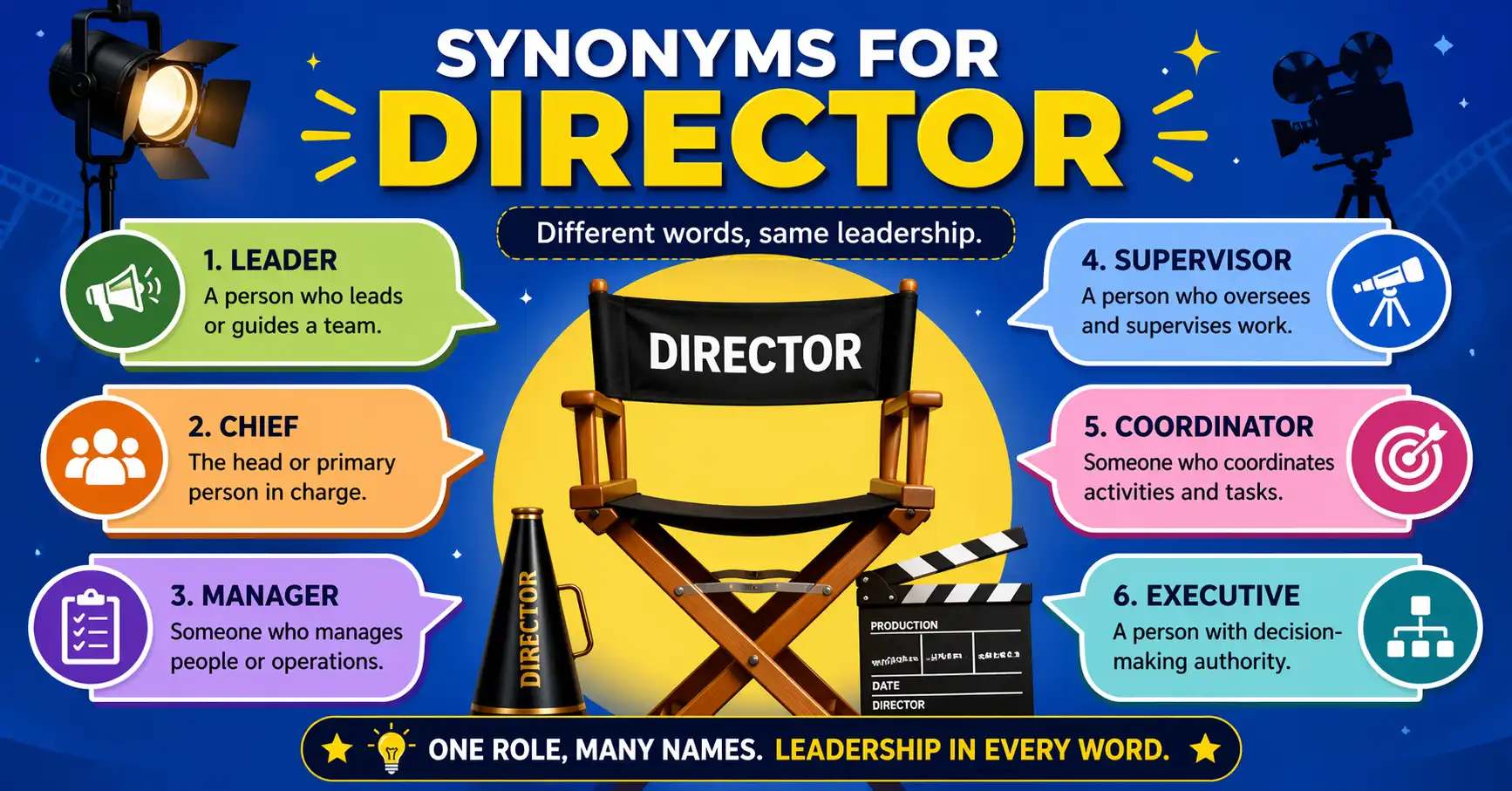
Have you ever written a work email and used the word “director” five times in one paragraph? It starts to feel repetitive and boring. Good writers know how to switch things up.
Imagine you are writing about your company’s leadership team. Instead of saying “the director said this” and “the director did that” — you could say “the manager approved it” or “the chief announced the plan.” It sounds so much better.
The word director simply means a person who is in charge of something — a team, a film, a school, or a company. Learning synonyms for director helps you write more clearly and sound more professional.
Students, bloggers, content writers, and daily English users all benefit from knowing these words. This list of synonyms for director will make your writing stronger today.
50 Synonyms for Director
1. Manager
Meaning: A person who is in charge of a team or a place of work.
Examples:
- The manager called a meeting to discuss the new project plan.
- She became the manager of the sales department last month.
2. Chief
Meaning: The most important or senior person in a group or organization.
Examples:
- The chief gave the final approval on the budget.
- He was elected chief of the entire department by his peers.
3. Head
Meaning: The person at the top of a group, school, or company.
Examples:
- The head of the school announced new rules this morning.
- She is the head of marketing at a large tech company.
4. Leader
Meaning: A person who guides or leads others toward a goal.
Examples:
- The team leader organized everyone before the deadline.
- A great leader always listens before making decisions.
5. Supervisor
Meaning: A person who watches over and guides the work of others.
Examples:
- The supervisor checked each report before it was submitted.
- My supervisor helped me improve my presentation skills.
6. Commander
Meaning: A person who has full control and authority over a group or operation.
Examples:
- The commander ordered the team to move to the next location.
- She was the commander of a rescue operation in the mountains.
7. Administrator
Meaning: A person who manages the day-to-day operations of an organization.
Examples:
- The administrator handled all the paperwork for the event.
- Our school administrator is very organized and efficient.
8. Executive
Meaning: A senior person in a company who makes important decisions.
Examples:
- The executive signed off on the new marketing strategy.
- She became a top executive at the firm within five years.
9. Controller
Meaning: A person who manages or directs something with authority.
Examples:
- The air traffic controller guided the planes safely to the runway.
- He acted as the controller of all financial decisions in the firm.
10. Coordinator
Meaning: A person who organizes people and activities to work well together.
Examples:
- The event coordinator made sure everything ran on schedule.
- She worked as a project coordinator for a nonprofit organization.
11. Overseer
Meaning: A person who watches and supervises the work of others closely.
Examples:
- The overseer made sure the construction work met safety standards.
- He acted as the overseer of the entire production process.
12. Principal
Meaning: The main person in charge, especially of a school or organization.
Examples:
- The principal addressed the students at the morning assembly.
- She is the principal of one of the top schools in the city.
13. Superintendent
Meaning: A person who manages a large organization, department, or building.
Examples:
- The superintendent visited every school in the district last week.
- Our building superintendent fixed the elevator in one hour.
14. Boss
Meaning: The person who is in charge and gives instructions to others.
Examples:
- My boss approved my request for a week off work.
- She spoke directly to the boss about the new project idea.
15. President
Meaning: The highest-ranking person in a company, club, or country.
Examples:
- The president of the company addressed all employees at the annual meeting.
- She was elected president of the student council unanimously.
16. Chairman
Meaning: The person who leads a board, committee, or meeting.
Examples:
- The chairman opened the board meeting with a brief statement.
- He served as chairman of the finance committee for three years.
17. Governor
Meaning: A person who officially governs or manages a region or institution.
Examples:
- The governor of the province launched a new education program.
- She served as the governor of the central bank for a decade.
18. Rector
Meaning: The head of a university, college, or religious institution.
Examples:
- The rector welcomed all new students at the opening ceremony.
- He was appointed rector of the university after years of teaching.
19. Dean
Meaning: The head of a faculty or department in a college or university.
Examples:
- The dean of the law school announced a new scholarship program.
- She met with the dean to discuss her academic progress.
20. Foreman
Meaning: A person who supervises workers, especially on a construction site or in a factory.
Examples:
- The foreman made sure all workers wore safety helmets on site.
- He worked his way up from laborer to foreman in three years.
21. Captain
Meaning: The person in command of a ship, aircraft, sports team, or group.
Examples:
- The captain led the football team to victory in the final game.
- She became the captain of the debate team in her senior year.
22. Ruler
Meaning: A person who has power and control over a country or group.
Examples:
- The ancient ruler built grand temples across the kingdom.
- Every ruler must listen to the needs of their people.
23. Steward
Meaning: A person who manages and looks after something on behalf of others.
Examples:
- The steward managed the estate while the owner was abroad.
- She acted as the steward of the company’s environmental policies.
24. Warden
Meaning: A person who is in charge of a place, such as a prison or park.
Examples:
- The warden implemented new rehabilitation programs for inmates.
- The park warden guided tourists through the protected forest area.
25. Curator
Meaning: A person who manages and organizes a museum, gallery, or collection.
Examples:
- The curator arranged a stunning new art exhibition downtown.
- She worked as a curator at the national history museum for years.
26. Organizer
Meaning: A person who plans and arranges activities or events efficiently.
Examples:
- The organizer ensured every speaker arrived on time for the conference.
- He was the main organizer of the community charity fundraiser.
27. Planner
Meaning: A person who thinks ahead and makes detailed plans for others.
Examples:
- The event planner decorated the hall beautifully for the wedding.
- She works as a city planner who designs public spaces.
28. Helmsman
Meaning: A person who steers and guides something — often used as a metaphor for a leader.
Examples:
- The CEO was seen as the helmsman who steered the company through hard times.
- As the helmsman of the project, he kept everyone focused and on track.
29. Pioneer
Meaning: A person who leads the way and is the first to do something new.
Examples:
- She was a pioneer in digital marketing before it became popular.
- The pioneer of this movement inspired thousands of followers worldwide.
30. Figurehead
Meaning: A person who holds the title of leader but may not have real power.
Examples:
- The king was mostly a figurehead with little political authority.
- She served as a figurehead while the board made real decisions.
31. Moderator
Meaning: A person who controls and guides a discussion or meeting.
Examples:
- The moderator kept the debate fair and within the time limit.
- She volunteered as the moderator of the online community forum.
32. Facilitator
Meaning: A person who makes a process or meeting easier and more effective.
Examples:
- The facilitator helped the two teams reach a compromise quickly.
- She trained as a professional facilitator for corporate workshops.
33. Chairperson
Meaning: The person in charge of running a meeting or organization.
Examples:
- The chairperson called the meeting to order at nine o’clock sharp.
- He was elected chairperson of the community development board.
34. Maestro
Meaning: A highly skilled and respected leader, especially in the arts or music.
Examples:
- The maestro conducted the orchestra with grace and precision.
- She is considered a maestro of fashion design in her industry.
35. Strategist
Meaning: A person who plans and directs actions in a smart, long-term way.
Examples:
- The marketing strategist came up with a plan that tripled sales.
- He is the lead strategist behind the company’s global expansion.
36. Pilot
Meaning: A person who leads or guides something through a difficult process.
Examples:
- She piloted the new education reform through the school system.
- He acted as the pilot of the company’s digital transformation.
37. Custodian
Meaning: A person who is responsible for taking care of something important.
Examples:
- The custodian of the archive carefully preserved historical documents.
- She saw herself as the custodian of her team’s culture and values.
38. Regulator
Meaning: A person or body that controls and enforces rules within a system.
Examples:
- The financial regulator issued new guidelines for banking institutions.
- He served as the main regulator of safety standards in the factory.
39. Architect
Meaning: A person who designs and builds systems, plans, or organizations from scratch.
Examples:
- She was the architect of the company’s five-year growth strategy.
- He is widely seen as the architect of modern public health policy.
40. Visionary
Meaning: A person with bold, creative ideas who leads others toward the future.
Examples:
- The visionary CEO transformed a small startup into a global brand.
- She was praised as a visionary leader in renewable energy.
41. Pathfinder
Meaning: A person who finds new ways forward and leads others through challenges.
Examples:
- The young entrepreneur was a pathfinder in the mobile app industry.
- As a pathfinder, she opened doors that others didn’t even know existed.
42. Mentor
Meaning: An experienced person who guides and teaches someone less experienced.
Examples:
- My mentor helped me land my first job in the publishing industry.
- She acted as a mentor to dozens of young women in her field.
43. Trustee
Meaning: A person given authority to manage an organization or property for others.
Examples:
- The trustee managed the charity’s funds with full transparency.
- He was appointed as a trustee of the university’s endowment board.
44. Arbiter
Meaning: A person who has the power to judge and make final decisions.
Examples:
- The arbiter settled the dispute between the two companies fairly.
- She served as the arbiter of editorial decisions at the magazine.
45. Delegate
Meaning: A person given authority to act or speak on behalf of others.
Examples:
- The delegate represented his country at the international trade summit.
- She was sent as a delegate to the annual education conference.
46. Ringmaster
Meaning: A person who controls and directs a complex or lively situation or show.
Examples:
- He was the ringmaster of the entire product launch event.
- The creative director acted as the ringmaster of the ad campaign.
47. Overseer
Meaning: Someone who watches over work and ensures it is done correctly.
Examples:
- The factory overseer walked the floor every hour to check progress.
- She was appointed as overseer of the regional development project.
48. Taskmaster
Meaning: A person who assigns tasks and demands high standards of performance.
Examples:
- The taskmaster pushed every team member to exceed their targets.
- She had a reputation as a tough but fair taskmaster in the newsroom.
49. Controller
Meaning: A person who directs and manages the flow of operations or finances.
Examples:
- The financial controller reviewed all expenses before approval.
- He acted as the quality controller for the entire production line.
50. Luminary
Meaning: A person who inspires others and shines as a respected leader in their field.
Examples:
- The luminary of the tech world gave a keynote speech at the summit.
- She is a true luminary whose work changed the face of public education.
Conclusion
Learning synonyms for director makes your writing more powerful and interesting. It helps you avoid repeating the same word again and again. Better vocabulary means better essays, stronger emails, and smarter conversations.
Pick five words from this list today. Use them in your next email or blog post. Practice them when you speak to colleagues or friends. Small steps lead to big improvements. The more words you know, the more confident and professional you sound — in writing and in life.
Meta Description:

Andrew Powell is a travel writer and nature journalist who has spent over a decade writing about places, landscapes, and the natural world — and thinking carefully about the words that do those subjects justice ( Biography ).