
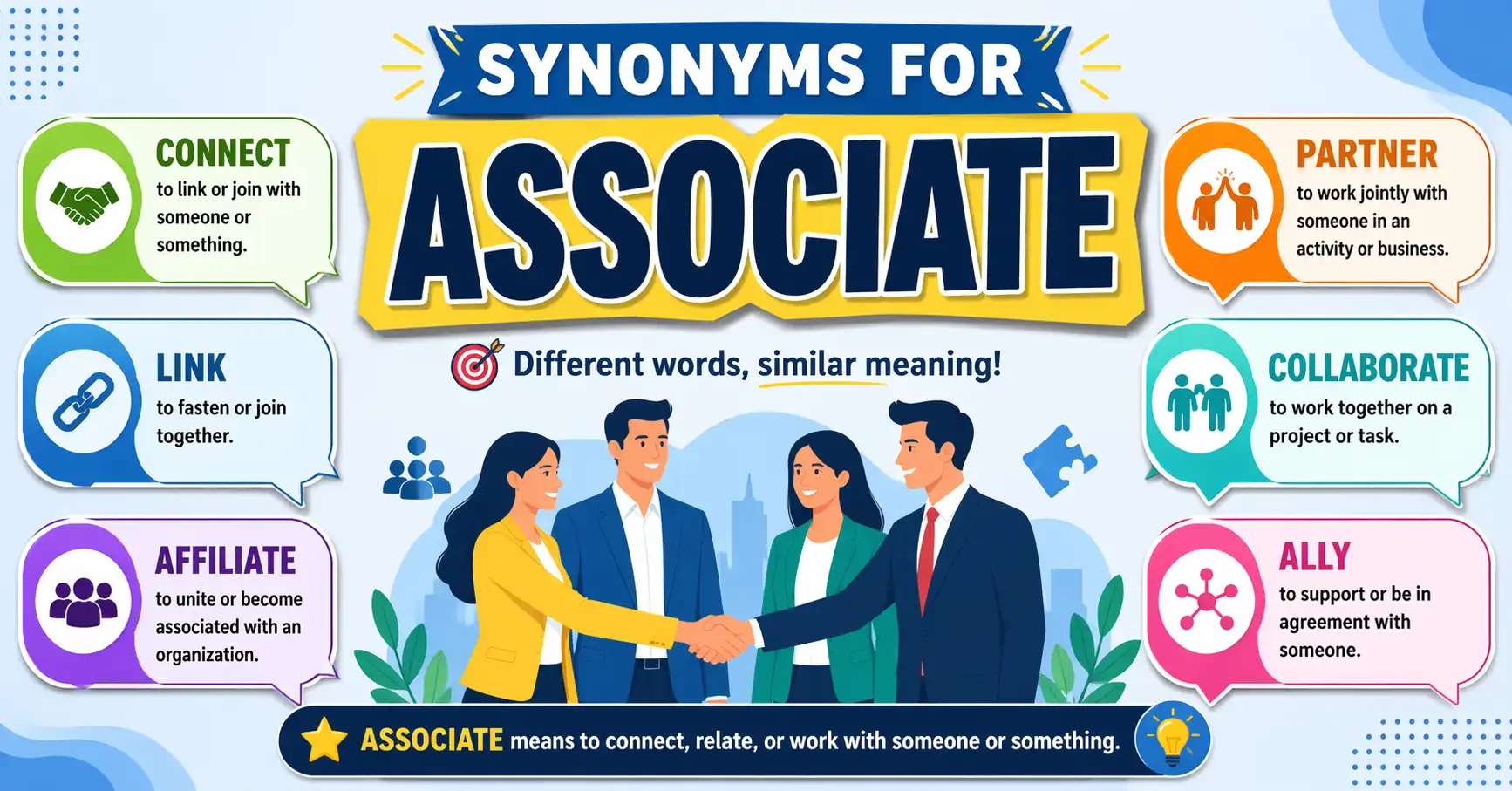
Have you ever tried to describe a coworker or connect two ideas but felt stuck using the same word over and over? Think about introducing a business partner to a client, or linking the smell of cookies to your childhood. In both cases, you might use the word “associate.”
In very simple English, an associate is a person you work with, or it means to connect two things in your mind. Using the exact same word repeatedly can make your essays and posts feel very dull. That is why learning synonyms for associate is so helpful. For students, bloggers, content writers, and daily English users, changing up your vocabulary makes your work shine. Let us explore these wonderful synonyms for associate to give your writing a massive boost today!
1. Colleague
Meaning: A person you work with in a professional job. Examples:
- My colleague helped me design the new website.
- She invited her colleague out for a cup of coffee.
2. Partner
Meaning: Someone who shares a task or a business with you. Examples:
- My science partner helped me finish the lab report.
- She found a great partner to open the new bakery.
3. Coworker
Meaning: A person who works at the same place as you. Examples:
- My coworker brought delicious donuts to the office today.
- I asked a friendly coworker for help with the scanner.
4. Ally
Meaning: A friend or group that helps you in a difficult time. Examples:
- She is a great ally when you need to solve a hard problem.
- The two nations became allies to win the peace.
5. Peer
Meaning: A person who is equal to you in age or position. Examples:
- It is important to get feedback from your peers at school.
- The young scientist wanted approval from his peers.
6. Companion
Meaning: A friend who travels or spends a lot of time with you. Examples:
- My dog is a wonderful companion on long walks.
- She found a nice travel companion for her trip to Rome.
7. Comrade
Meaning: A trusted friend who shares your activities or struggles. Examples:
- The soldiers treated each other like close comrades.
- He met his old comrades at the school reunion.
8. Collaborator
Meaning: A person who works with others to create something. Examples:
- He is a frequent collaborator on my music projects.
- She found a great collaborator to write the movie script.
9. Teammate
Meaning: A member of the same sports team or work group. Examples:
- My teammate passed me the ball just in time.
- Every teammate worked hard to win the trophy.
10. Assistant
Meaning: A person who helps someone else do a job. Examples:
- The busy manager hired an assistant to answer emails.
- My teaching assistant graded the spelling tests.
11. Helper
Meaning: A person who gives help or support to someone. Examples:
- My little helper did a great job cleaning the living room.
- She is looking for a helper to carry the heavy books.
12. Aide
Meaning: An assistant to an important leader. Examples:
- The mayor’s aide answered all of my questions.
- He works as a medical aide at the local hospital.
13. Friend
Meaning: A person you like and know well. Examples:
- I am meeting a close friend for lunch today.
- She has been my best friend since we were kids.
14. Acquaintance
Meaning: A person you know slightly but who is not a close friend. Examples:
- He is an acquaintance from my Spanish class.
- She ran into an old acquaintance at the grocery store.
15. Deputy
Meaning: A person who takes charge when the leader is away. Examples:
- The sheriff’s deputy arrived to help with the traffic.
- She acts as the deputy of our school department.
16. Affiliate
Meaning: A person or group officially connected to a larger organization. Examples:
- Our local gym is an affiliate of a big national brand.
- He joined the new group as an affiliate member.
17. Supporter
Meaning: Someone who helps or agrees with a person or idea. Examples:
- She is a strong supporter of the new library plan.
- He has been my best supporter since day one.
18. Follower
Meaning: A person who supports a leader or an idea. Examples:
- The young leader has many followers on social media.
- He is a loyal follower of that art style.
19. Member
Meaning: A person who belongs to a specific group or club. Examples:
- She is an active member of the chess club.
- Every member must pay a small fee to join.
20. Sidekick
Meaning: A close helper who travels with a main character. Examples:
- The brave hero always travels with a funny sidekick.
- My cat is my favorite sidekick when I study.
21. Crony
Meaning: A close friend you have known for a long time. Examples:
- The old man spent the afternoon talking with his cronies.
- He likes to watch the game with his childhood cronies.
22. Cohort
Meaning: A companion or colleague who helps you with a task. Examples:
- My cohort and I finished the science poster.
- He walked into the classroom with his favorite cohort.
23. Accomplice
Meaning: A person who helps another person do something wrong. Examples:
- The thief had an accomplice who drove the getaway car.
- She was an accomplice in pulling the funny school prank.
24. Link
Meaning: To connect two people, ideas, or things together. Examples:
- You can link your phone to the car speaker.
- Doctors link healthy eating to a longer life.
25. Connect
Meaning: To join two or more things together. Examples:
- Please connect the red wire to the blue button.
- This train will connect the two big cities.
26. Relate
Meaning: To show how two ideas or things are connected. Examples:
- I can relate your story to my own life.
- The teacher explained how the two events relate to each other.
27. Group
Meaning: To put similar things together. Examples:
- We need to group the red blocks together.
- The teacher will group the students by age.
28. Match
Meaning: To find two things that go well together. Examples:
- Try to match the green socks with the green shirt.
- The computer will match your answers with the key.
29. Join
Meaning: To bring two things together so they become one. Examples:
- You must join the two pieces of rope with a knot.
- She wants to join the local swim team.
30. Combine
Meaning: To mix two or more things together. Examples:
- You can combine yellow and blue paint to make green.
- We should combine our ideas to make a better plan.
31. Unite
Meaning: To bring people together to work for one goal. Examples:
- The bad news helped to unite the small town.
- We must unite to finish this big project on time.
32. Blend
Meaning: To mix different things so they become smooth. Examples:
- Use the machine to blend the milk and fruit.
- The artist likes to blend light and dark colors.
33. Couple
Meaning: To connect two things together directly. Examples:
- We need to couple the wagon to the back of the tractor.
- You should couple hard work with plenty of rest.
34. Align
Meaning: To put things in a straight line or in agreement. Examples:
- Please align the pictures on the living room wall.
- We need to align our business goals with our values.
35. Mix
Meaning: To combine different things together. Examples:
- Do not mix business with your personal life.
- She likes to mix different spices in her soup.
36. Network
Meaning: To meet and connect with other people for work. Examples:
- He went to the meeting to network with other business owners.
- Students should network to find good summer jobs.
37. Correlate
Meaning: To show a close connection between two things. Examples:
- Studies correlate high stress with a lack of sleep.
- You cannot easily correlate wealth with true happiness.
38. Identify
Meaning: To connect yourself closely with an idea or group. Examples:
- Many young voters identify with the new leader.
- She likes to identify herself with the local art community.
39. Compare
Meaning: To look at two things to find how they are alike. Examples:
- Do not compare your life to the lives of others.
- We can compare the prices of the two cars.
40. Equal
Meaning: A person who has the same value or skill as you. Examples:
- He treats everyone at the office as his equal.
- The champion finally met his equal in the chess match.
41. Fellow
Meaning: A member of a professional group or school. Examples:
- He is a research fellow at the university.
- The young doctor is a fellow of the medical board.
42. Confidant
Meaning: A close friend you trust with your secrets. Examples:
- My sister is my main confidant when I need advice.
- He shared his big plans with his trusted confidant.
43. Co-conspirator
Meaning: A partner who helps plan a secret activity. Examples:
- My brother was my co-conspirator for the surprise party.
- The police caught the bank robber and his co-conspirator.
44. Backer
Meaning: A person who gives money or help to a project. Examples:
- The young artist found a rich backer for her exhibition.
- Our soccer team needs a strong backer to buy uniforms.
45. Team member
Meaning: A person who works with a group to reach a goal. Examples:
- Every team member played hard during the soccer match.
- She is a highly valued team member at our company.
46. Consort
Meaning: A companion, especially the wife or husband of a ruler. Examples:
- The queen traveled to the event with her royal consort.
- He acted as a loyal consort to the leader.
47. Tie
Meaning: To connect or link two things together tightly. Examples:
- We need to tie the boat to the wet dock.
- The police tried to tie the suspect to the crime scene.
48. Attach
Meaning: To connect one thing to another. Examples:
- Please attach the file to your email message.
- You can attach the tag to your luggage.
49. Bracket
Meaning: To group things or people together because they are similar. Examples:
- The company will bracket the workers by their skill level.
- We can bracket these tax rates together.
50. Co-pilot
Meaning: A pilot who helps the main pilot fly a plane. Examples:
- The co-pilot checked the digital map during the long flight.
- My wife acts as my co-pilot when we drive on road trips.
Conclusion
Learning different synonyms for associate is a simple way to make your English much better. It helps bloggers, students, and content writers express themselves with fresh, clear words. Using the right terms in your essays and emails makes you sound more professional. Try practising these fifty helpful words in your daily conversations to see how much your communication improves!

Andrew Powell is a travel writer and nature journalist who has spent over a decade writing about places, landscapes, and the natural world — and thinking carefully about the words that do those subjects justice ( Biography ).