
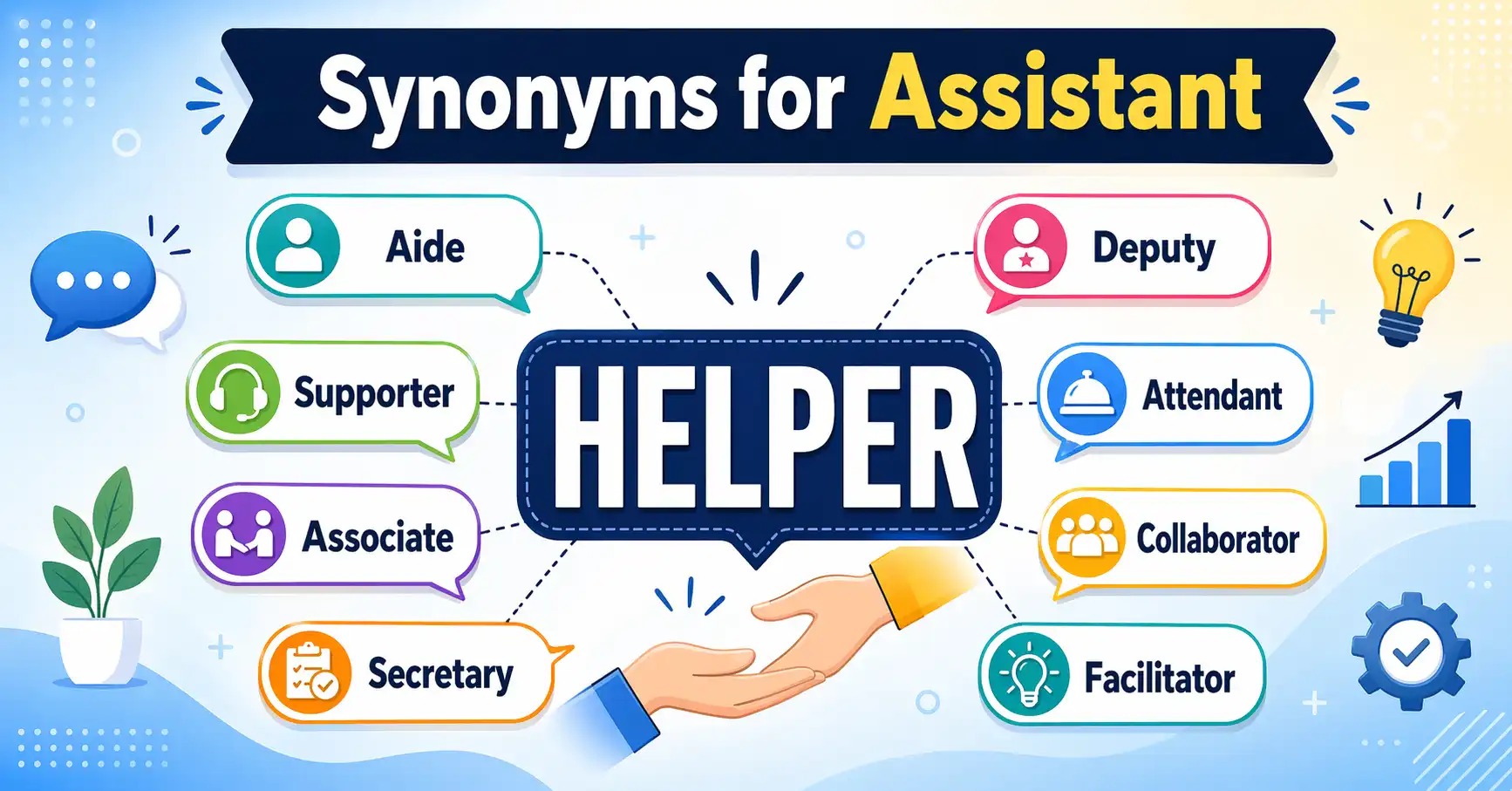
Have you ever tried to describe someone who helps you at work or school but felt stuck using the same word over and over? Think of a busy office where a helpful person schedules meetings and answers phone calls. You might call them an assistant. In very simple English, an assistant is a person who helps someone else do a job or a task.
Using the exact same word repeatedly can make your essays and blog posts feel boring. That is why learning synonyms for assistant is so helpful. For students, bloggers, content writers, and daily English users, changing up your vocabulary makes your work shine. It helps you express different roles clearly. Let us explore these wonderful synonyms for assistant to give your writing a massive boost today.
1. Helper
Meaning: A person who gives help or support to someone. Examples:
- My little helper did a great job cleaning the yard.
- She is looking for a helper to lift the heavy boxes.
2. Aide
Meaning: An assistant to an important person. Examples:
- The mayor’s aide answered all of my questions.
- He works as an aide at the local hospital.
3. Supporter
Meaning: Someone who helps a person or an idea. Examples:
- She is a strong supporter of our new school plan.
- He has been my best supporter since day one.
4. Deputy
Meaning: A person who takes charge when the leader is away. Examples:
- The sheriff’s deputy arrived to help with the traffic.
- She was appointed as the deputy of the department.
5. Associate
Meaning: A partner or coworker at a company. Examples:
- I need to speak with a sales associate about this price.
- He is a close associate of the head doctor.
6. Partner
Meaning: Someone who shares a task or business with you. Examples:
- My science partner helped me write the lab report.
- She found a great business partner to start the shop.
7. Co-worker
Meaning: A person who works at the same place as you. Examples:
- My co-worker brought donuts to the office today.
- I asked a friendly co-worker for help with the printer.
8. Ally
Meaning: A friend or group that helps you in a difficult time. Examples:
- She is a great ally when you need to solve a problem.
- The two companies became allies to win the project.
9. Backer
Meaning: Someone who gives money or help to make a plan work. Examples:
- The young artist found a rich backer for her show.
- Our team needs a strong backer to pay for the uniforms.
10. Colleague
Meaning: A person you work with in a professional job. Examples:
- My colleague is giving a presentation at noon.
- He invited his new colleague out for lunch.
11. Attendant
Meaning: A person who helps visitors or customers at a place. Examples:
- The parking attendant showed me where to park.
- Ask the flight attendant for a cup of water.
12. Advisor
Meaning: A person who gives you good choices or ideas. Examples:
- My school advisor helped me choose my classes.
- She hired a financial advisor to save money.
13. Coordinator
Meaning: A person who organizes people and events so things go well. Examples:
- The wedding coordinator made sure the flowers arrived.
- He is the new coordinator for our sports league.
14. Facilitator
Meaning: A person who helps a group work together easily. Examples:
- The meeting facilitator kept the discussion on track.
- She is a wonderful facilitator for our study group.
15. Guide
Meaning: A person who shows you the right way to go. Examples:
- Our tour guide showed us the old castle.
- Use this book as a guide for your project.
16. Second-in-command
Meaning: The person with the next highest power after the leader. Examples:
- The second-in-command took over when the boss retired.
- She is the second-in-command of the entire ship.
17. Apprentice
Meaning: A person who works to learn a trade from a master. Examples:
- The young apprentice learned how to fix pipes.
- He is an apprentice to a very famous baker.
18. Intern
Meaning: A student who works to get real job experience. Examples:
- Our summer intern is learning how to write code.
- She got a job as an intern at a news station.
19. Trainee
Meaning: A person who is learning how to do a new job. Examples:
- The new trainee is practicing on the cash register.
- Show the trainee where the break room is.
20. Understudy
Meaning: An actor who learns a role to help if the star gets sick. Examples:
- The understudy had to perform in the play tonight.
- She is the understudy for the main singer.
21. Secretary
Meaning: A person who writes letters and sets up meetings. Examples:
- The secretary typed up the notes from our meeting.
- Please leave your message with the school secretary.
22. Clerk
Meaning: An office worker who keeps records and does desk tasks. Examples:
- The court clerk filed the important papers.
- He works as a clerk at the post office.
23. Administrator
Meaning: A person who manages the daily tasks of a business. Examples:
- The system administrator fixed our computer network.
- She is the head administrator at the clinic.
24. Organizer
Meaning: A person who plans things and keeps everything neat. Examples:
- My sister is the main organizer of the family reunion.
- He is a great organizer of community events.
25. Agent
Meaning: A person who does business for someone else. Examples:
- The travel agent booked our trip to Hawaii.
- Our real estate agent found us a lovely house.
26. Representative
Meaning: A person who speaks or acts for a group of people. Examples:
- A customer service representative helped me on the phone.
- He is the sales representative for our state.
27. Sidekick
Meaning: A close friend who helps a main character. Examples:
- Robin is the famous sidekick of Batman.
- My dog is my favorite sidekick on hikes.
28. Companion
Meaning: A friend who travels or spends time with you. Examples:
- She is a wonderful travel companion on long trips.
- The old man has a cat as a companion.
29. Protégé
Meaning: A young person who is helped by an older, wiser teacher. Examples:
- The great cook taught his young protégé how to bake.
- She is the protégé of the famous piano player.
30. Co-pilot
Meaning: A pilot who helps the main pilot fly a plane. Examples:
- The co-pilot checked the map during the flight.
- My wife acts as my co-pilot when we drive.
31. Wingman
Meaning: A friend who helps you look good or find success. Examples:
- He asked his best friend to be his wingman at the party.
- Thank you for being my wingman during the presentation.
32. Backup
Meaning: A person who is ready to help if you need them. Examples:
- We have a backup ready if the singer gets tired.
- Call for backup if the task gets too hard.
33. Staffer
Meaning: A person who works for an organization or government office. Examples:
- A helpful staffer showed us where to sit.
- She is a key staffer for the political campaign.
34. Collaborator
Meaning: A person who works with others to make something. Examples:
- He is a frequent collaborator on my art projects.
- She found a great collaborator to write the song.
35. Right-hand
Meaning: Your most helpful and trusted assistant. Examples:
- My right-hand organized all my files today.
- She is the right-hand to the company president.
36. Number two
Meaning: The most important assistant to a boss. Examples:
- The manager’s number two is running the store today.
- He is proud to be the team’s number two.
37. Auxiliary
Meaning: A person who offers extra help when needed. Examples:
- The school hired auxiliary workers for the busy week.
- She joined the auxiliary police force to help her town.
38. Adjunct
Meaning: A helper or teacher who is added to a group temporarily. Examples:
- The college hired an adjunct teacher for the class.
- He works as an adjunct researcher at the lab.
39. Receptionist
Meaning: A person who greets visitors at the front desk. Examples:
- The dental receptionist scheduled my next visit.
- Speak to the receptionist when you enter the lobby.
40. Office hand
Meaning: A person who does small tasks around a workplace. Examples:
- We hired an office hand to file the old papers.
- The office hand kept the supply room very neat.
41. Handyman
Meaning: A person who does odd jobs and repairs. Examples:
- The handyman fixed the leaky faucet in the kitchen.
- We called a handyman to paint the fence.
42. Utility person
Meaning: A worker who can do many different helpful tasks. Examples:
- He is our utility person because he can fix anything.
- The theater hired a utility person to clean and repair.
43. Shadow
Meaning: A person who follows you to learn how you work. Examples:
- My shadow today is a high school student learning about my job.
- She acted as my shadow during my first week at the bank.
44. Messenger
Meaning: A person who carries notes or packages to others. Examples:
- The bike messenger delivered the contract on time.
- Don’t shoot the messenger if you dislike the news.
45. Cohort
Meaning: A companion or colleague who helps you with a task. Examples:
- My cohort and I finished the science poster.
- He walked into the classroom with his favorite cohort.
46. Team member
Meaning: A person who works with a group to win. Examples:
- Every team member played hard during the match.
- She is a highly valued team member at our company.
47. Chaperone
Meaning: An adult who watches over young people to keep them safe. Examples:
- My mom was a chaperone on our school field trip.
- The dance needs a chaperone to watch the students.
48. Handler
Meaning: A person who manages or guides someone else. Examples:
- The animal handler kept the dog calm during the show.
- His media handler prepared him for the tough questions.
49. Caretaker
Meaning: A person who looks after a house or a person. Examples:
- The caretaker keeps the garden looking beautiful.
- She works as a caretaker for her elderly neighbor.
50. Adjutant
Meaning: An officer who helps a commanding leader with paperwork. Examples:
- The general’s adjutant organized the morning reports.
- He serves as the adjutant for the local military group.
Conclusion
Learning different synonyms for assistant is a simple way to make your English much better. It helps bloggers, students, and content writers express themselves with clear, fresh words. Using the right terms in your essays and emails makes you sound more professional. Try practising these fifty helpful words in your daily conversations to see how much your communication improves!

Andrew Powell is a travel writer and nature journalist who has spent over a decade writing about places, landscapes, and the natural world — and thinking carefully about the words that do those subjects justice ( Biography ).