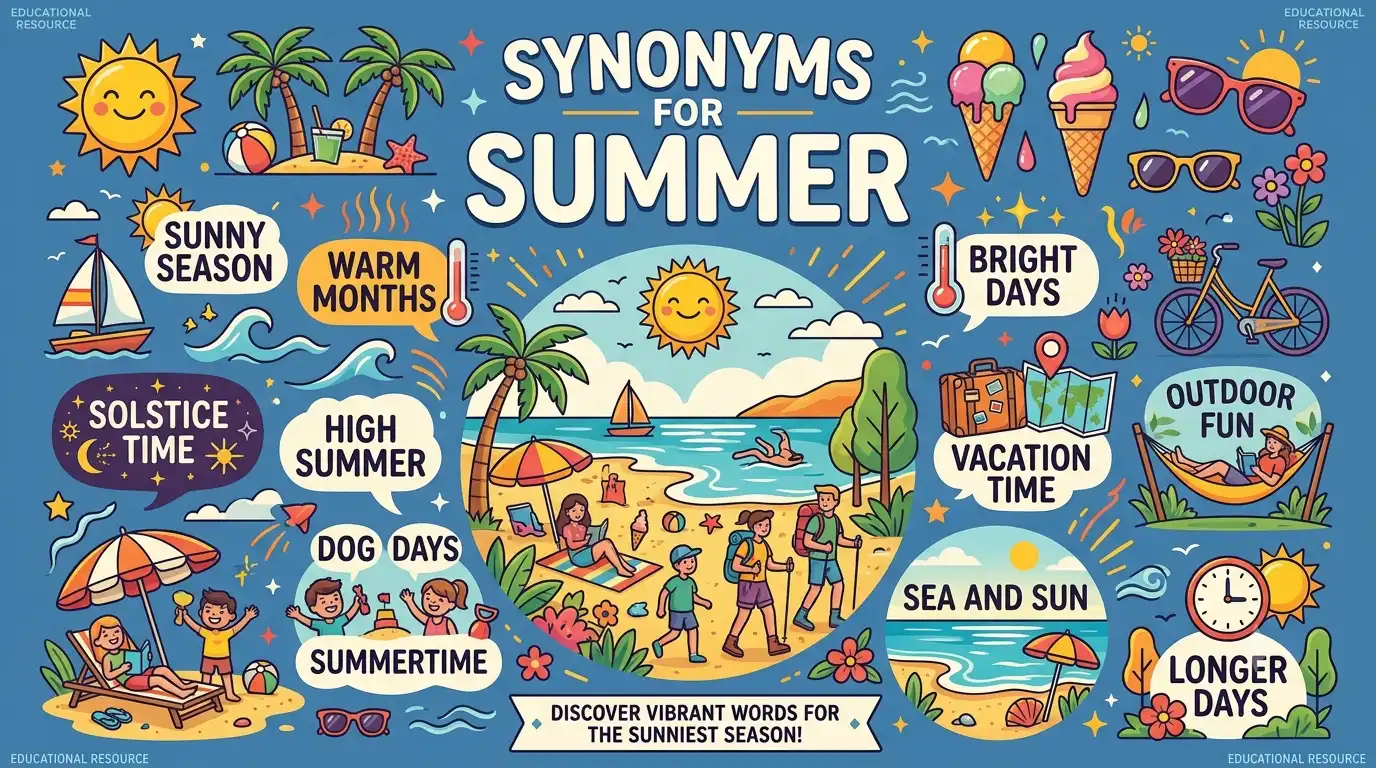
When you explore synonyms for summer, you discover words that describe the warmest season of the year, bright sunny days, and joyful outdoor activities. Understanding various synonyms for summer helps you capture the warmth, energy, and brightness of sunny months with vivid language. Using rich synonyms for summer allows you to describe sunny vacations, hot weather, and cheerful seasonal moments across essays, creative stories, and blog posts.
Celebrating Warmth and Sunshine in Daily Life
Picture walking along a quiet path under a clear sky while warm sunlight filters through full green trees and a gentle breeze cools the afternoon heat. Calling this bright time summertime, the sunny season, or estival months instantly paints a colorful picture of warmth, fun, and relaxation. Searching for synonyms for summer gives you descriptive words to talk about family trips, swimming outdoors, or enjoying cold drinks on the porch.
In very simple English, summer means the warmest season of the year when daylight stays long and nature reaches full growth.
Why Word Choice Matters for Communicators
Learning different terms for this bright season offers great benefits:
- For Students: It upgrades descriptive writing in school essays, nature stories, and creative poems without repeating simple words.
- For Bloggers: It makes travel reviews, holiday activity lists, and outdoor crafts sound vibrant and engaging for readers.
- For Content Writers: It helps you craft fresh marketing messages for summer camps, outdoor gear, and holiday events.
- For Daily English Users: It provides friendly, expressive terms for sharing holiday plans and daily weather chats.
“Summer is a cheerful state of mind filled with warmth, endless skies, and bright memories.”
“Choosing sunny and descriptive words brings the warmth of the season into your writing.”
Linguistic Breakdown: Etymology, Connotation, and Structure
Connotative Meaning of “Summer”
The word summer carries a bright, positive, and joyful connotation. It symbolizes growth, freedom, outdoor fun, light, and energy. Across literature and everyday speech, it evokes feelings of relaxation, warmth, and nature in full bloom.
Short Etymology
- Origin: Old English sumor.
- Root: Derived from Proto-Germanic *sumar- and Proto-Indo-European *sam- (meaning summer or together).
Pronunciation
- US IPA: /ˈsʌm.ɚ/
- UK IPA: /ˈsʌm.ə/
Syllables & Structure
- Syllables: 2 (sum – mer)
- Primary Stress: First syllable (sum)
- Affixation Pattern: Root word sum + Germanic noun suffix -er.
Comparison Table: Choosing the Right Synonym for Summer
| Keyword | Meaning | Usage Type | Context |
| Summer | The warmest season of the year | General / Casual | Daily life, weather, school breaks |
| Summertime | The full period or season of summer weather | Warm / Friendly | Family stories, songs, holidays |
| Estival | Belonging to or appearing in summer | Formal / Literary | Science, literature, formal essays |
| Solstice period | Days near the longest daylight of the year | Scientific / Formal | Astronomy, nature logs, geography |
| Sunny season | Months filled with clear sunshine | Casual / Enthusiastic | Travel writing, casual chats |
| Midsummer | The middle part of the summer season | Traditional / Festive | Festivals, folklore, outdoor events |
| Dog days | The hottest and sunniest days of summer | Informal / Idiomatic | Weather reports, casual blogs |
| High season | Peak period for travel and tourism | Professional | Tourism, hospitality, business |
| Warm season | Months with higher temperatures | Descriptive | Gardening, weather, agriculture |
| Beach season | Months ideal for outdoor water sports | Casual / Popular | Sports, fashion, recreation |
50 Synonyms for Summer
1. Summertime
- Pronunciation: US /ˈsʌm.ɚ.taɪm/ | UK /ˈsʌm.ə.taɪm/
- Meaning: The season or period of warm summer weather.
- Examples:
- Children love eating cold watermelon during summertime.
- Our neighborhood holds a fun block party every summertime.
2. Estival
- Pronunciation: US /ˈes.tə.vəl/ | UK /ˈiː.stɪ.vəl/
- Meaning: Relating to or happening in the summer season.
- Examples:
- The park looked beautiful during its peak estival bloom.
- Birds returned to the lake for their estival stay.
3. Solstice period
- Pronunciation: US /ˈsɑːl.stɪs ˈpɪr.i.əd/ | UK /ˈsɒl.stɪs ˈpɪə.ri.əd/
- Meaning: The days surrounding the longest daylight hours of the year.
- Examples:
- Families gathered in the garden to celebrate the solstice period.
- Long twilight hours made the solstice period feel magical.
4. Sunny season
- Pronunciation: US /ˈsʌn.i ˈsiː.zən/ | UK /ˈsʌn.i ˈsiː.zən/
- Meaning: The months characterized by bright sunshine and warmth.
- Examples:
- Farmers harvested sweet strawberries during the sunny season.
- We enjoy playing tennis outdoors throughout the sunny season.
5. Midsummer
- Pronunciation: US /ˌmɪdˈsʌm.ɚ/ | UK /ˌmɪdˈsʌm.ə/
- Meaning: The middle part of the summer season.
- Examples:
- We went camping in the quiet forest during midsummer.
- Wildflowers bloomed across the fields in midsummer.
6. Warm season
- Pronunciation: US /wɔːrm ˈsiː.zən/ | UK /wɔːm ˈsiː.zən/
- Meaning: The time of year with higher outdoor temperatures.
- Examples:
- Tomatoes and peppers grow best during the warm season.
- The botanical garden attracts many visitors in the warm season.
7. Dog days
- Pronunciation: US /dɑːɡ deɪz/ | UK /dɒɡ deɪz/
- Meaning: The hottest and muggiest period of the summer.
- Examples:
- We cooled off at the pool during the dog days of August.
- Sitting under a shady tree helps you survive the dog days.
8. High season
- Pronunciation: US /haɪ ˈsiː.zən/ | UK /haɪ ˈsiː.zən/
- Meaning: The peak period when warm weather attracts tourists.
- Examples:
- The coastal town welcomed thousands of visitors in high season.
- Hotel rooms were fully booked during the summer high season.
9. Beach season
- Pronunciation: US /biːtʃ ˈsiː.zən/ | UK /biːtʃ ˈsiː.zən/
- Meaning: The warm months when people visit oceans, lakes, and pools.
- Examples:
- Everyone packed sunscreen and towels for the start of beach season.
- Lifeguards watched the shore carefully throughout beach season.
10. Vacation season
- Pronunciation: US /veɪˈkeɪ.ʃən ˈsiː.zən/ | UK /vəˈkeɪ.ʃən ˈsiː.zən/
- Meaning: The summer break time when schools close and families travel.
- Examples:
- Airports were busy as the vacation season began in July.
- Our family loves visiting national parks during vacation season.
11. Sun-drenched months
- Pronunciation: US /sʌn drentʃt mʌnθs/ | UK /sʌn drentʃt mʌnθs/
- Meaning: The warm months filled with bright daylight.
- Examples:
- Sunflowers grew tall during the sun-drenched months.
- We spent the sun-drenched months exploring local hiking trails.
12. Hot season
- Pronunciation: US /hɑːt ˈsiː.zən/ | UK /hɒt ˈsiː.zən/
- Meaning: The time of year with high outdoor heat.
- Examples:
- Drinking plenty of water is important in the hot season.
- Fans kept the living room cool throughout the hot season.
13. Picnic weather
- Pronunciation: US /ˈpɪk.nɪk ˈweð.ɚ/ | UK /ˈpɪk.nɪk ˈweð.ə/
- Meaning: Warm, clear summer conditions perfect for eating outdoors.
- Examples:
- Clear skies gave us perfect picnic weather on Saturday.
- We spread our blanket on the grass to enjoy the picnic weather.
14. Bright season
- Pronunciation: US /braɪt ˈsiː.zən/ | UK /braɪt ˈsiː.zən/
- Meaning: The sunny and luminous months of the year.
- Examples:
- Birds sang in the trees during the early bright season.
- Children played outside until late in the bright season.
15. Sun season
- Pronunciation: US /sʌn ˈsiː.zən/ | UK /sʌn ˈsiː.zən/
- Meaning: The period of the year with maximum sunshine.
- Examples:
- Solar panels produced extra energy during the sun season.
- We wore hats to protect our skin during the sun season.
16. Aestival period
- Pronunciation: US /ˈes.tə.vəl ˈpɪr.i.əd/ | UK /ˈiː.stɪ.vəl ˈpɪə.ri.əd/
- Meaning: The formal or scientific period corresponding to summer.
- Examples:
- Researchers studied plant growth during the aestival period.
- Lake temperatures reached their peak in the late aestival period.
17. Fair-weather months
- Pronunciation: US /fer ˈweð.ɚ mʌnθs/ | UK /feə ˈweð.ə mʌnθs/
- Meaning: The summer months marked by pleasant, mild conditions.
- Examples:
- Cyclists rode their bikes every day through the fair-weather months.
- Outdoor markets flourished during the fair-weather months.
18. Heat wave days
- Pronunciation: US /hiːt weɪv deɪz/ | UK /hiːt weɪv deɪz/
- Meaning: Unusually hot summer days.
- Examples:
- Everyone stayed in the shade during the heat wave days.
- Ice cream shops sold out of treats on heat wave days.
19. Green season
- Pronunciation: US /ɡriːn ˈsiː.zən/ | UK /ɡriːn ˈsiː.zən/
- Meaning: The warm months when trees and plants are full and green.
- Examples:
- The mountains looked vibrant during the green season.
- Gentle rain kept gardens growing throughout the green season.
20. High summer
- Pronunciation: US /haɪ ˈsʌm.ɚ/ | UK /haɪ ˈsʌm.ə/
- Meaning: The middle period of summer when heat and growth peak.
- Examples:
- Sweet corn reached its full height in high summer.
- Bees buzzed busily through the garden in high summer.
“Sunlight fills the world with color, turning simple summer days into bright adventures.”
21. Basking season
- Pronunciation: US /ˈbæs.kɪŋ ˈsiː.zən/ | UK /ˈbɑː.skɪŋ ˈsiː.zən/
- Meaning: The warm period ideal for relaxing in the sun.
- Examples:
- Turtles sat on warm logs during the summer basking season.
- Tourists relaxed by the pool in the peak basking season.
22. Long days
- Pronunciation: US /lɑːŋ deɪz/ | UK /lɒŋ deɪz/
- Meaning: The summer period with extended daylight hours.
- Examples:
- We played outdoor games until late during the long days.
- The long days gave farmers extra time to work in the fields.
23. Solstice season
- Pronunciation: US /ˈsɑːl.stɪs ˈsiː.zən/ | UK /ˈsɒl.stɪs ˈsiː.zən/
- Meaning: The summer season centered on the June solstice.
- Examples:
- The town hosted a music parade for the solstice season.
- Bright evening skies made the solstice season special.
24. Swimming season
- Pronunciation: US /ˈswɪm.ɪŋ ˈsiː.zən/ | UK /ˈswɪm.ɪŋ ˈsiː.zən/
- Meaning: The warm months suitable for water activities and swimming.
- Examples:
- The city opened the public pool for swimming season.
- Kids learned how to dive during the fun swimming season.
25. Outdoor season
- Pronunciation: US /ˌaʊtˈdɔːr ˈsiː.zən/ | UK /ˌaʊtˈdɔː ˈsiː.zən/
- Meaning: The warm months favored for open-air activities.
- Examples:
- Camping enthusiasts prepared their gear for the outdoor season.
- The park service scheduled outdoor movies for the outdoor season.
26. Harvest warmth
- Pronunciation: US /ˈhɑːr.vɪst wɔːrmθ/ | UK /ˈhɑː.vɪst wɔːmθ/
- Meaning: The warm weather that helps fruits and crops ripen.
- Examples:
- Berries ripened quickly under the harvest warmth.
- The orchard smelled sweet in the summer harvest warmth.
27. Sunlit months
- Pronunciation: US /ˈsʌn.lɪt mʌnθs/ | UK /ˈsʌn.lɪt mʌnθs/
- Meaning: The summer months receiving extended sunlight.
- Examples:
- Artists painted landscapes throughout the sunlit months.
- We took long evening walks during the sunlit months.
28. Summer months
- Pronunciation: US /ˈsʌm.ɚ mʌnθs/ | UK /ˈsʌm.ə mʌnθs/
- Meaning: June, July, and August in the Northern Hemisphere.
- Examples:
- Libraries offer reading challenges in the summer months.
- Tropical fish swam close to shore during the summer months.
29. Clear-sky season
- Pronunciation: US /klɪr skaɪ ˈsiː.zən/ | UK /klɪə skaɪ ˈsiː.zən/
- Meaning: The weather period with few clouds and lots of sun.
- Examples:
- Stargazing was wonderful during the clear-sky season.
- Solar panels worked efficiently in the clear-sky season.
30. Sun-filled days
- Pronunciation: US /sʌn fɪld deɪz/ | UK /sʌn fɪld deɪz/
- Meaning: Summer days blessed with continuous sunshine.
- Examples:
- We made sweet memories across those sun-filled days.
- Fresh lemonade kept us cool on sun-filled days.
31. Sunshine season
- Pronunciation: US /ˈsʌn.ʃaɪn ˈsiː.zən/ | UK /ˈsʌn.ʃaɪn ˈsiː.zən/
- Meaning: The time of year known for bright sun.
- Examples:
- Everyone enjoys ice cream during the sunshine season.
- Flowers bloom in vibrant colors in the sunshine season.
32. Heat season
- Pronunciation: US /hiːt ˈsiː.zən/ | UK /hiːt ˈsiː.zən/
- Meaning: The time of year when temperature peaks.
- Examples:
- Animals rested under cool trees during the heat season.
- We drank cold fruit smoothies throughout the heat season.
33. Warm-weather period
- Pronunciation: US /wɔːrm ˈweð.ɚ ˈpɪr.i.əd/ | UK /wɔːm ˈweð.ə ˈpɪə.ri.əd/
- Meaning: A duration of warm, comfortable summer climate.
- Examples:
- The warm-weather period allowed for long bike rides.
- Outdoor festivals flourished during the warm-weather period.
34. Summer tide
- Pronunciation: US /ˈsʌm.ɚ taɪd/ | UK /ˈsʌm.ə taɪd/
- Meaning: A poetic or traditional term for the summer season.
- Examples:
- Poets often wrote songs praising the gentle summer tide.
- Green leaves rustled softly in the warm summer tide.
35. Golden season
- Pronunciation: US /ˈɡoʊl.dən ˈsiː.zən/ | UK /ˈɡəʊl.dən ˈsiː.zən/
- Meaning: The bright summer period filled with golden light.
- Examples:
- Fields of wheat turned yellow under the golden season.
- Photographers captured sunset views during the golden season.
36. High-sun period
- Pronunciation: US /haɪ sʌn ˈpɪr.i.əd/ | UK /haɪ sʌn ˈpɪə.ri.əd/
- Meaning: The time of year when the sun sits highest in the sky.
- Examples:
- Shadows stayed short during the high-sun period.
- Shadows lengthened slowly after the peak high-sun period.
37. Tropical season
- Pronunciation: US /ˈtrɑː.pɪ.kəl ˈsiː.zən/ | UK /ˈtrɒp.ɪ.kəl ˈsiː.zən/
- Meaning: A summer period marked by warm temperatures and rain showers.
- Examples:
- Palm trees swayed gently during the tropical season.
- Warm evening rain refreshed the air in the tropical season.
38. Outdoor months
- Pronunciation: US /ˌaʊtˈdɔːr mʌnθs/ | UK /ˌaʊtˈdɔː mʌnθs/
- Meaning: The summer time frame when outdoor activities peak.
- Examples:
- Families spent their weekends camping during the outdoor months.
- Parks organized soccer matches across the outdoor months.
39. Summer holiday season
- Pronunciation: US /ˈsʌm.ɚ ˈhɑː.lə.deɪ ˈsiː.zən/ | UK /ˈsʌm.ə ˈhɒl.ə.deɪ ˈsiː.zən/
- Meaning: The summer vacation period when families take trips.
- Examples:
- Hotels were filled with guests during the summer holiday season.
- Beaches remained crowded through the summer holiday season.
40. Summer break
- Pronunciation: US /ˈsʌm.ɚ breɪk/ | UK /ˈsʌm.ə breɪk/
- Meaning: The continuous summer recess from school classes.
- Examples:
- Students completed fun reading logs during summer break.
- I learned how to sail my boat over summer break.
41. Sun-shine days
- Pronunciation: US /sʌn ʃaɪn deɪz/ | UK /sʌn ʃaɪn deɪz/
- Meaning: Days characterized by bright, clear light.
- Examples:
- We flew colorful kites across the park on sun-shine days.
- Walking outside restored our mood on sun-shine days.
42. Warmest season
- Pronunciation: US /wɔːrm.əst ˈsiː.zən/ | UK /wɔːm.ɪst ˈsiː.zən/
- Meaning: The specific quarter of the year with the highest temperature.
- Examples:
- Summer is known everywhere as the warmest season.
- Cool lakes offer refreshing swims in the warmest season.
43. Solstice time
- Pronunciation: US /ˈsɑːl.stɪs taɪm/ | UK /ˈsɒl.stɪs taɪm/
- Meaning: The summer period surrounding the midsummer solstice.
- Examples:
- Towns organized evening fires to mark solstice time.
- The long twilight was beautiful during solstice time.
44. High-heat period
- Pronunciation: US /haɪ hiːt ˈpɪr.i.əd/ | UK /haɪ hiːt ˈpɪə.ri.əd/
- Meaning: The specific stretch of summer with peak heat levels.
- Examples:
- Plants required extra watering during the high-heat period.
- We rested indoors during the afternoon high-heat period.
45. Estival season
- Pronunciation: US /ˈes.tə.vəl ˈsiː.zən/ | UK /ˈiː.stɪ.vəl ˈsiː.zən/
- Meaning: The formal or literary term for the summer season.
- Examples:
- Naturalists recorded insect behavior in the estival season.
- Lush green foliage covered mountains in the estival season.
46. Bright months
- Pronunciation: US /braɪt mʌnθs/ | UK /braɪt mʌnθs/
- Meaning: The cheerful, sunlit months of midyear.
- Examples:
- We grew sunflowers in our garden through the bright months.
- Outdoor concerts brought music across the bright months.
47. Warm climate season
- Pronunciation: US /wɔːrm ˈklaɪ.mət ˈsiː.zən/ | UK /wɔːm ˈklaɪ.mət ˈsiː.zən/
- Meaning: The seasonal window offering warm weather conditions.
- Examples:
- Tourism increased everywhere during the warm climate season.
- Fruit orchards flourished in the warm climate season.
48. Meadow season
- Pronunciation: US /ˈmed.oʊ ˈsiː.zən/ | UK /ˈmed.əʊ ˈsiː.zən/
- Meaning: The summer months when fields bloom with flowers.
- Examples:
- Butterflies fluttered through flowers in meadow season.
- Bees gathered honey rapidly during meadow season.
49. Daylight-rich season
- Pronunciation: US /ˈdeɪ.laɪt rɪtʃ ˈsiː.zən/ | UK /ˈdeɪ.laɪt rɪtʃ ˈsiː.zən/
- Meaning: The time of year offering maximum daytime hours.
- Examples:
- Solar collectors stored extra energy in this daylight-rich season.
- We enjoyed evening walks during the daylight-rich season.
50. Midsummer season
- Pronunciation: US /ˌmɪdˈsʌm.ɚ ˈsiː.zən/ | UK /ˌmɪdˈsʌm.ə ˈsiː.zən/
- Meaning: The peak portion of the summer months.
- Examples:
- Sweet berries were picked during the midsummer season.
- Clear night skies welcomed stargazers in the midsummer season.
Antonyms of Summer
To understand a word completely, it helps to look at its direct opposites. Where summer represents warmth, light, and long days, its antonyms describe cold weather, short days, and winter conditions:
- Winter: The coldest season of the year with short daylight hours.
- Hibernal period: The formal or scientific term for the winter season.
- Cold season: The months marked by freezing temperatures and frost.
- Frosty months: The winter period characterized by ice, snow, and cold air.
- Midwinter: The central, coldest period of the winter season.
- Brumal season: A literary term referring to winter cold.
Prototype Meaning and Categorization of Summer
In cognitive linguistics, a prototype is the central, most typical model of a concept. The central prototype of summer is a bright, warm time of year filled with long daylight hours, green nature, outdoor recreation, and vacation relaxation. Depending on context, tone, and intent, synonyms for summer fall into three primary written categories:
1. Everyday and Popular Expressions This group includes warm, accessible terms used in daily conversation, family stories, and casual writing. Words such as summertime, sunny season, beach season, vacation season, summer break, and sun-filled days represent typical choices when sharing holiday experiences, weather updates, or friendly weekend plans.
2. Scientific, Formal, and Agricultural Terms This category covers structured vocabulary used in science articles, geography textbooks, nature logs, and farming guides. Terms such as estival, solstice period, warm season, aestival period, and daylight-rich season allow writers to describe temperature shifts, daylight patterns, and plant growth cycles with professional accuracy.
3. Literary, Poetic, and Seasonal Descriptions This category contains descriptive, evocative phrases suitable for creative stories, poems, travel articles, and nature blogs. Expressions like midsummer, golden season, sun-drenched months, summer tide, meadow season, and bright season add rich visual imagery and joyful tone to creative writing.
Frequently Asked Questions (FAQ)
1. What is the formal or literary synonym for summer?
The most common formal or literary synonyms for summer are estival and aestival. These words derive from Latin and are frequently used in scientific papers, botany, and classical poetry.
2. What does “dog days” mean as a summer synonym?
The term dog days refers to the hottest, most humid weeks of summer, typically in late July and August. The phrase originally connected to the rising of Sirius, the Dog Star, in the summer sky.
3. Can “midsummer” refer to the whole summer season?
While midsummer specifically marks the middle point of summer or the summer solstice, people often use it in storytelling to describe the height of the summer season when warmth and plant growth peak.
4. What is a good synonym for summer in travel writing?
In tourism and travel blogs, popular synonyms for summer include high season, sunny season, beach season, and vacation season. These terms highlight warm weather and holiday travel opportunities.
5. Why are there so many phrases for summer daylight?
Because summer is famous for extended sunshine, English has many descriptive phrases like sun-drenched months, daylight-rich season, and sunlit months to emphasize bright daylight hours.
Conclusion
Expanding your vocabulary with this rich selection of synonyms for summer is an easy and rewarding way to elevate your communication. Whether you select everyday terms like summertime and vacation season, formal expressions like estival and solstice period, or poetic phrases like golden season and sun-drenched months, picking the precise word makes your descriptions pop with warmth and life.
For students writing creative essays, using varied synonyms for summer prevents dull repetition and brings seasonal stories to life, bloggers and content creators, descriptive vocabulary keeps readers entertained and improves your search engine performance, daily English speakers, rich seasonal words allow you to share outdoor memories and travel plans with warmth and clarity.
Try practicing two or three of these vibrant terms in your emails, journal entries, or class discussions this week!
“A varied vocabulary opens new doors to creative thought and vivid storytelling.”
“Words carry the warmth of our experiences, allowing us to share joyful moments clearly.”

Andrew Powell is a travel writer and nature journalist who has spent over a decade writing about places, landscapes, and the natural world — and thinking carefully about the words that do those subjects justice ( Biography ).