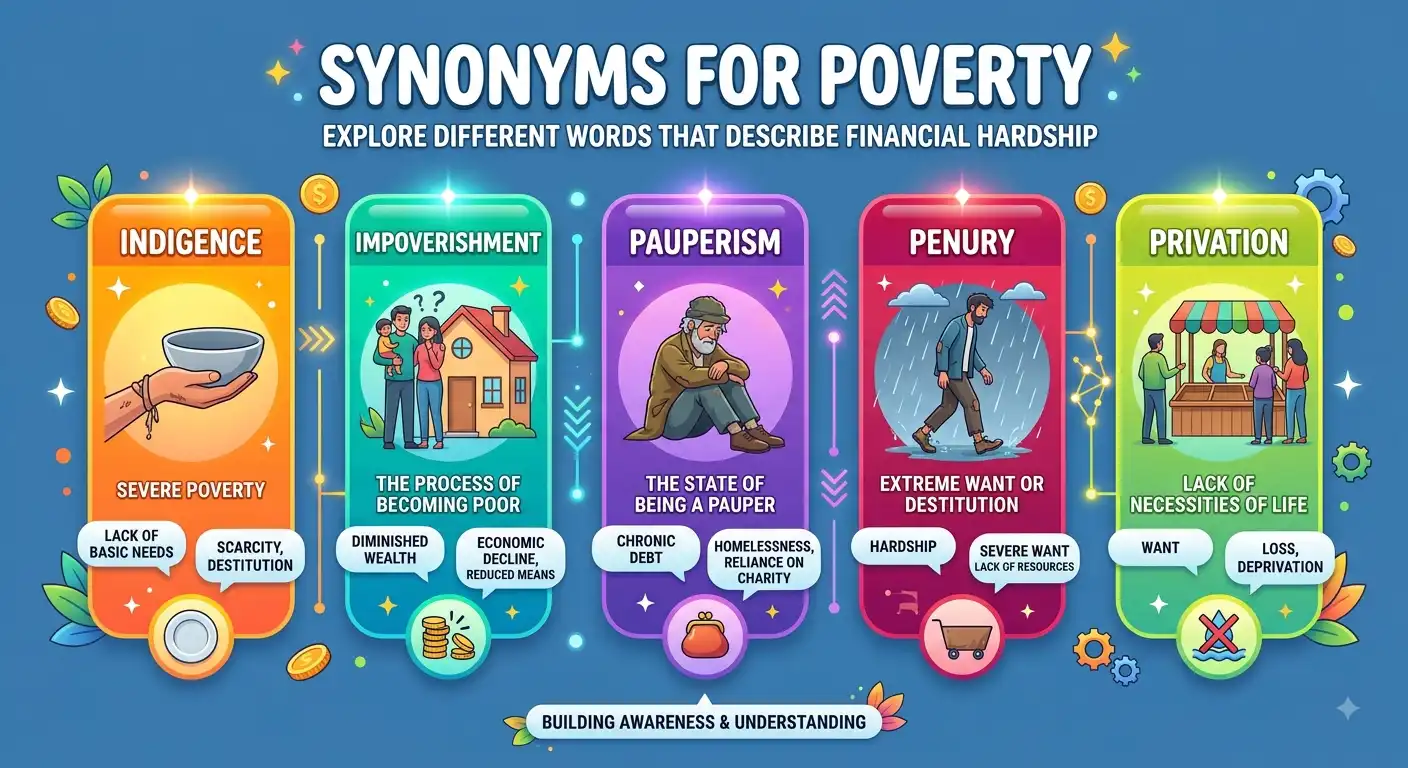
Exploring synonyms for poverty provides essential vocabulary to describe financial hardship, resource shortages, economic struggles, and social conditions accurately. Learning various synonyms for poverty helps you discuss social studies topics, economic challenges, and historical events with clear understanding. Understanding these synonyms for poverty allows you to express different levels of financial need, from temporary budget struggles to severe economic distress, across all forms of communication.
Understanding Financial Hardship in Society and Stories
Imagine reading a history textbook or analyzing a novel set during a tough economic era. Describing a community simply as poor gives a basic idea, but describing them as experiencing hardship, indigence, or scarcity provides a much clearer picture of their circumstances. Exploring synonyms for poverty equips you with respectful, precise words to discuss economic realities constructively.
In very simple English, poverty means not having enough money or resources to meet basic needs like food, housing, and clothing.
Why Word Choice Matters for Communicators
Expanding your vocabulary with these terms offers valuable benefits across many areas:
- For Students: It helps you write clear social studies papers, economics reports, and literature essays.
- For Bloggers: It improves your discussions on community issues, news analysis, and historical articles.
- For Content Writers: It allows you to craft thoughtful non-profit messaging, charity guides, and educational materials.
- For Daily English Users: It gives you respectful, clear words to express sympathy and discuss global challenges.
“Empathy begins with understanding, and precise language allows us to discuss human challenges with dignity.”
“Words shape our awareness of society, helping us express complex economic truths with clarity.”
Linguistic Breakdown: Etymology, Connotation, and Structure
Connotative Meaning of “Poverty”
The word poverty carries a serious, somber, and empathetic connotation. It highlights hardship, lack of vital resources, and difficulty meeting basic living needs. Depending on context, its tone can range from objective economic description to deep social concern.
Short Etymology
- Origin: Middle English (around 1200–1250).
- Root: Derived from Old French poverte, from Latin paupertas, from pauper (“poor”).
Pronunciation
- US IPA: /ˈpɑː.vɚ.t̬i/
- UK IPA: /ˈpɒv.ə.ti/
Syllables & Structure
- Syllables: 3 (pov – er – ty)
- Primary Stress: First syllable (pov)
- Affixation Pattern: Root poor (via Latin pauper) + Abstract noun suffix -ty (indicating a state or condition).
Comparison Table: Choosing the Right Synonym for Poverty
| Keyword | Meaning | Usage Type | Context |
| Poverty | The state of lacking sufficient money or basic resources | Formal / General | Economics, social studies, news |
| Hardship | Difficult conditions caused by lack of money or resources | General / Empathetic | Daily life, personal stories, news |
| Penury | Extreme poverty or total lack of money | Formal / Literary | History, formal essays, books |
| Need | A situation requiring urgent help or basic supplies | Casual / Friendly | Community work, charities, daily life |
| Indigence | Severe poverty requiring public or charitable aid | Formal / Legal | Government reports, legal studies |
| Scarcity | A small or insufficient supply of essential goods | Technical / Formal | Science, economics, resource management |
| Shortage | A lack of necessary goods or funds for a period | General / Practical | Budgeting, supply, household |
| Privation | The lack of basic necessities required for comfort | Literary / Historical | History books, documentaries |
| Destitution | Extreme poverty leaving one without food or shelter | Authoritative / Formal | Humanitarian efforts, global news |
| Tight budget | Having very limited money to spend | Informal / Casual | Family talks, personal finance |
50 Synonyms for Poverty
1. Hardship
- Pronunciation: US /ˈhɑːrd.ʃɪp/ | UK /ˈhɑːd.ʃɪp/
- Meaning: Difficult conditions in life caused by a lack of money or resources.
- Examples:
- Families faced great hardship during the severe winter storm.
- Community programs helped reduce financial hardship for neighborhood families.
2. Penury
- Pronunciation: US /ˈpen.jɚ.i/ | UK /ˈpen.jər.i/
- Meaning: A state of extreme poverty and lack of resources.
- Examples:
- The historical novel described the hero’s rise from penury to success.
- Many old castles fell into ruins as owners faced severe penury.
3. Need
- Pronunciation: US /niːd/ | UK /niːd/
- Meaning: A condition of lacking basic things required for daily life.
- Examples:
- The local shelter helps families in need by offering warm food.
- Generous donations helped cover the urgent need for school supplies.
4. Indigence
- Pronunciation: US /ˈɪn.dɪ.dʒəns/ | UK /ˈɪn.dɪ.dʒəns/
- Meaning: Severe poverty that requires financial assistance or charitable aid.
- Examples:
- Government programs were created to assist individuals living in indigence.
- The law provides free legal support to citizens suffering from indigence.
5. Destitution
- Pronunciation: US /ˌdes.təˈtuː.ʃən/ | UK /ˌdes.tɪˈtjuː.ʃən/
- Meaning: Extreme poverty that leaves someone without basic shelter, food, or care.
- Examples:
- Aid workers arrived quickly to prevent destitution after the flood.
- The charity works tirelessly to save families from destitution.
6. Scarcity
- Pronunciation: US /ˈsker.sə.t̬i/ | UK /ˈskeə.sə.ti/
- Meaning: A situation where there is not enough of something needed.
- Examples:
- Dry weather caused a severe scarcity of fresh vegetables in town.
- Careful management solved the temporary scarcity of paper supplies.
7. Shortage
- Pronunciation: US /ˈʃɔːr.t̬ɪdʒ/ | UK /ˈʃɔː.tɪdʒ/
- Meaning: A state where there is less of something than is required.
- Examples:
- The village faced a water shortage during the summer months.
- Extra funds were raised to address the classroom book shortage.
8. Privation
- Pronunciation: US /praɪˈveɪ.ʃən/ | UK /praɪˈveɪ.ʃən/
- Meaning: A lack of the basic comforts or necessities of life.
- Examples:
- Early settlers endured long months of privation in the new land.
- The documentary highlighted the privation faced by remote communities.
9. Impoverishment
- Pronunciation: US /ɪmˈpɑː.vɚ.ɪʃ.mənt/ | UK /ɪmˈpɒv.ər.ɪʃ.mənt/
- Meaning: The process or state of becoming very poor.
- Examples:
- Crop failures led to widespread impoverishment across the farming valley.
- Education programs help break the cycle of family impoverishment.
10. Want
- Pronunciation: US /wɑːnt/ | UK /wɒnt/
- Meaning: A state of lacking essential supplies or basic requirements.
- Examples:
- The relief group delivered packages to ensure no child suffered from want.
- During tough times, people learned to live simply without unnecessary want.
11. Deprivation
- Pronunciation: US /ˌdep.rəˈveɪ.ʃən/ | UK /ˌdep.rɪˈveɪ.ʃən/
- Meaning: Not having things that are necessary for a pleasant, healthy life.
- Examples:
- Getting adequate sleep prevents mental fatigue and health deprivation.
- The charity works to protect children from economic deprivation.
12. Distress
- Pronunciation: US /dɪˈstres/ | UK /dɪˈstres/
- Meaning: Trouble or suffering caused by hardship or difficulty.
- Examples:
- Financial counseling provided relief to families in distress.
- Neighbors offered assistance to help the family through their temporary distress.
13. Straitened-circumstances
- Pronunciation: US /ˈstreɪ.tənd ˈsɝː.kəm.stæn.səz/ | UK /ˈstreɪ.tənd ˈsɜː.kəm.stɑːn.səz/
- Meaning: Living with very little money and strict limits.
- Examples:
- The family lived in straitened-circumstances after the factory closed.
- Careful budgeting helped them navigate through straitened-circumstances.
14. Meagerness
- Pronunciation: US /ˈmiː.ɡɚ.nəs/ | UK /ˈmiː.ɡə.nəs/
- Meaning: Small size, quantity, or lack of richness in resources.
- Examples:
- The meagerness of the harvest meant everyone ate simple meals.
- Despite the meagerness of his savings, he managed to go to college.
15. Inadequacy
- Pronunciation: US /ɪnˈæd.ə.kwə.si/ | UK /ɪnˈæd.ɪ.kwə.si/
- Meaning: The state of not being enough in amount or quality.
- Examples:
- The report pointed out the inadequacy of old heating systems.
- New funding solved the inadequacy of community playground equipment.
16. Imbalance
- Pronunciation: US /ɪmˈbæl.əns/ | UK /ɪmˈbæl.əns/
- Meaning: An uneven distribution of wealth, resources, or supplies.
- Examples:
- Trade policies were created to correct the economic imbalance.
- Sharing supplies fairly reduced the imbalance between regions.
17. Deficit
- Pronunciation: US /ˈdef.ə.sɪt/ | UK /ˈdef.ɪ.sɪt/
- Meaning: The amount by which money or resources fall short.
- Examples:
- The school club managed to clear its budget deficit through a bake sale.
- Careful accounting prevented a trade deficit this quarter.
18. Tightness
- Pronunciation: US /ˈtaɪt.nəs/ | UK /ˈtaɪt.nəs/
- Meaning: A restricted or limited state in finances or supplies.
- Examples:
- The family experienced temporary tightness in their monthly budget.
- Careful planning helped overcome the tightness of project funds.
19. Squeeze
- Pronunciation: US /skwiːz/ | UK /skwiːz/
- Meaning: A financial pressure caused by high costs or limited income.
- Examples:
- Rising utility costs put a financial squeeze on small shops.
- Smart saving habits helped households manage the economic squeeze.
20. Insufficiency
- Pronunciation: US /ˌɪn.səˈfɪʃ.ən.si/ | UK /ˌɪn.səˈfɪʃ.ən.si/
- Meaning: The state of not having enough resources or funds.
- Examples:
- The project stalled due to an insufficiency of raw materials.
- Additional grants fixed the insufficiency of public library books.
“When we speak about economic challenges with clarity and respect, we foster constructive solutions.”
21. Bankruptcy
- Pronunciation: US /ˈbæŋk.rəpt.si/ | UK /ˈbæŋk.rəpt.si/
- Meaning: The state of being legally unable to pay debts.
- Examples:
- Restructuring rules helped the firm avoid complete bankruptcy.
- Financial education teaches students how to prevent personal bankruptcy.
22. Insolvency
- Pronunciation: US /ɪnˈsɑːl.vən.si/ | UK /ɪnˈsɒl.vən.si/
- Meaning: Being unable to pay debts as they become due.
- Examples:
- The advisor worked hard to save the enterprise from insolvency.
- Clear budget management protects small businesses from insolvency.
23. Neediest-state
- Pronunciation: US /ˈniː.di.əst steɪt/ | UK /ˈniː.di.ɪst steɪt/
- Meaning: Living in the condition of greatest financial requirement.
- Examples:
- Winter clothing drives focus on people in the neediest-state.
- Volunteers focused aid efforts on families in the neediest-state.
24. Paucities
- Pronunciation: US /ˈpɑː.sə.t̬i/ | UK /ˈpɔː.sə.ti/
- Meaning: Smallness of quantity or presence of very few resources.
- Examples:
- A paucity of rain led to dry fields across the farming region.
- Researchers noted a paucity of historical records from that century.
25. Slender-means
- Pronunciation: US /ˈslen.dɚ miːnz/ | UK /ˈslen.də miːnz/
- Meaning: Having a small or modest amount of money to live on.
- Examples:
- Despite living on slender-means, the artist created masterworks.
- She managed her household well on slender-means.
26. Limited-means
- Pronunciation: US /ˈlɪm.ɪ.t̬ɪd miːnz/ | UK /ˈlɪm.ɪ.tɪd miːnz/
- Meaning: Having a fixed, small income or restricted financial support.
- Examples:
- Scholarships offer assistance to talented students of limited-means.
- The community center offers free classes for individuals of limited-means.
27. Low-income
- Pronunciation: US /loʊ ˈɪn.kʌm/ | UK /ləʊ ˈɪn.kʌm/
- Meaning: Earning or having less money than average.
- Examples:
- The city built new affordable apartments for low-income residents.
- Free transit passes are available to low-income workers.
28. Underdevelopment
- Pronunciation: US /ˌʌn.dɚ.dɪˈvel.əp.mənt/ | UK /ˌʌn.də.dɪˈvel.əp.mənt/
- Meaning: A state of having fewer modern facilities, roads, or industries.
- Examples:
- New infrastructure investments reduced regional underdevelopment.
- Solar power projects helped solve energy underdevelopment in rural areas.
29. Hard-times
- Pronunciation: US /hɑːrd taɪmz/ | UK /hɑːd taɪmz/
- Meaning: A period of difficulty, lack of money, or job shortages.
- Examples:
- Neighbors supported each other during the hard-times of the past.
- Storybooks often feature heroes who stay positive during hard-times.
30. Economic-strain
- Pronunciation: US /ˌiː.kəˈnɑː.mɪk streɪn/ | UK /ˌiː.kəˈnɒm.ɪk streɪn/
- Meaning: Pressure caused by financial problems or high living costs.
- Examples:
- Rising costs caused economic-strain for small town markets.
- Careful savings helped the family handle temporary economic-strain.
31. Financial-struggle
- Pronunciation: US /faɪˈnæn.ʃəl ˈstrʌɡ.əl/ | UK /faɪˈnæn.ʃəl ˈstrʌɡ.əl/
- Meaning: Difficulty in earning or managing money to cover expenses.
- Examples:
- The scholarship eased the student’s financial-struggle during college.
- Budget apps help young adults overcome financial-struggle.
32. Money-trouble
- Pronunciation: US /ˈmʌn.i ˈtrʌb.əl/ | UK /ˈmʌn.i ˈtrʌb.əl/
- Meaning: Problems related to earning, paying, or managing funds.
- Examples:
- Open discussions helped the family resolve their money-trouble.
- Financial advice provided simple steps to avoid money-trouble.
33. Beggary
- Pronunciation: US /ˈbeɡ.ɚ.i/ | UK /ˈbeɡ.ər.i/
- Meaning: The state of living entirely by asking for help or charity.
- Examples:
- Job training programs helped reduce beggary in growing towns.
- Community efforts helped lift citizens out of beggary.
34. Reduced-circumstances
- Pronunciation: US /rɪˈduːst ˈsɝː.kəm.stæn.səz/ | UK /rɪˈdjuːst ˈsɜː.kəm.stɑːn.səz/
- Meaning: Living with less money than one used to have in the past.
- Examples:
- The family moved to a smaller cottage in reduced-circumstances.
- They adapted gracefully to their reduced-circumstances by saving carefully.
35. Scantiness
- Pronunciation: US /ˈskæn.ti.nəs/ | UK /ˈskæn.ti.nəs/
- Meaning: Smallness in quantity or shortage of necessary goods.
- Examples:
- The scantiness of winter rain affected the local reservoirs.
- Despite the scantiness of resources, the team built a working model.
36. Exiguity
- Pronunciation: US /ˌek.səˈɡjuː.ə.t̬i/ | UK /ˌek.sɪˈɡjuː.ə.ti/
- Meaning: The quality of being very small or limited in amount.
- Examples:
- The exiguity of their daily budget required careful grocery choices.
- Scholars noted the exiguity of historical documents on the topic.
37. Sparseness
- Pronunciation: US /ˈspɑːrs.nəs/ | UK /ˈspɑːs.nəs/
- Meaning: The state of being thin, scattered, or small in supply.
- Examples:
- The sparseness of trees in the desert makes shade precious.
- The sparseness of food supplies required quick restocking.
38. Bared-means
- Pronunciation: US /berd miːnz/ | UK /beəd miːnz/
- Meaning: Having only the absolute basic minimum needed to survive.
- Examples:
- They survived on bared-means until the next harvest arrived.
- Living on bared-means taught them the value of resourcefulness.
39. Resource-deficit
- Pronunciation: US /ˈriː.sɔːrs ˈdef.ə.sɪt/ | UK /ˈriː.sɔːs ˈdef.ɪ.sɪt/
- Meaning: A situation where needed supplies or energy are missing.
- Examples:
- Recycling programs help fix the town’s resource-deficit.
- Tech solutions addressed the resource-deficit in remote schools.
40. Budget-pressure
- Pronunciation: US /ˈbʌdʒ.ɪt ˈpreʃ.ɚ/ | UK /ˈbʌdʒ.ɪt ˈpreʃ.ər/
- Meaning: Financial stress caused by strict spending boundaries.
- Examples:
- High supply costs created temporary budget-pressure for the team.
- Careful planning helped reduce budget-pressure on the school project.
41. Economic-hardship
- Pronunciation: US /ˌiː.kəˈnɑː.mɪk ˈhɑːrd.ʃɪp/ | UK /ˌiː.kəˈnɒm.ɪk ˈhɑːd.ʃɪp/
- Meaning: Financial challenge caused by job shortages or rising prices.
- Examples:
- Community food drives relieve economic-hardship in winter.
- New job creation helped reduce economic-hardship across the region.
42. Financial-stress
- Pronunciation: US /faɪˈnæn.ʃəl stres/ | UK /faɪˈnæn.ʃəl stres/
- Meaning: Worry or difficulty caused by managing personal or family money.
- Examples:
- Setting up a savings goal reduces overall financial-stress.
- Clear budgeting guidance helps students manage financial-stress.
43. Cash-strapped-state
- Pronunciation: US /kæʃ stræpt steɪt/ | UK /kæʃ stræpt steɪt/
- Meaning: Lacking sufficient cash to cover current expenses.
- Examples:
- The club found sponsors to leave its cash-strapped-state.
- Smart management rescued the park from a cash-strapped-state.
44. Low-funds
- Pronunciation: US /loʊ fʌndz/ | UK /ləʊ fʌndz/
- Meaning: A situation of having very little money left in an account.
- Examples:
- The student warned the bank of her low-funds alert.
- Fundraisers helped top up the library’s low-funds balance.
45. Insolvent-condition
- Pronunciation: US /ɪnˈsɑːl.vənt kənˈdɪʃ.ən/ | UK /ɪnˈsɒl.vənt kənˈdɪʃ.ən/
- Meaning: Being in a situation where debts exceed available funds.
- Examples:
- Financial advisors worked to fix the company’s insolvent-condition.
- Careful budget cuts saved the city project from an insolvent-condition.
46. Financial-deficit
- Pronunciation: US /faɪˈnæn.ʃəl ˈdef.ə.sɪt/ | UK /faɪˈnæn.ʃəl ˈdef.ɪ.sɪt/
- Meaning: Spending more money than is coming in as income.
- Examples:
- Cutting unnecessary costs cleared the annual financial-deficit.
- The charity resolved its financial-deficit through community support.
47. Short-supply
- Pronunciation: US /ʃɔːrt səˈplaɪ/ | UK /ʃɔːt səˈplaɪ/
- Meaning: Having a small amount of essential items available for use.
- Examples:
- Fresh water was in short-supply after the summer heat.
- Paper goods were in short-supply during the shipping delay.
48. Narrow-means
- Pronunciation: US /ˈner.oʊ miːnz/ | UK /ˈnær.əʊ miːnz/
- Meaning: Having barely enough income to cover standard living costs.
- Examples:
- She managed her home expertly on narrow-means.
- Despite their narrow-means, they always helped neighbors in need.
49. Stringency
- Pronunciation: US /ˈstrɪn.dʒən.si/ | UK /ˈstrɪn.dʒən.si/
- Meaning: Strict tightness or lack of extra money in a budget.
- Examples:
- Budgetary stringency kept spending focused on essential needs.
- The school managed financial stringency by sharing equipment.
50. Paretic-means
- Pronunciation: US /pəˈret.ɪk miːnz/ | UK /pəˈret.ɪk miːnz/
- Meaning: A formal term for extremely weak or limited financial resources.
- Examples:
- The report examined communities operating under paretic-means.
- Grants provided support to institutions facing paretic-means.
Antonyms of Poverty
To understand economic concepts fully, it is helpful to explore direct opposites that describe abundance, wealth, and financial stability:
- Wealth: Having a large amount of money, property, or valuable resources.
- Affluence: The state of having plenty of money, comfort, and possessions.
- Prosperity: Being successful, thriving, and financially secure.
- Abundance: A very large, plentiful quantity of goods or resources.
- Riches: Valuable material possessions, funds, or assets.
- Solvency: The ability to pay all debts and meet financial duties easily.
Prototype Meaning and Categorization of Poverty
In cognitive linguistics, a prototype represents the central, most typical example of a category. The central prototype of the word poverty is a state of severe financial hardship where an individual or family lacks sufficient money to obtain basic human necessities like nutritious food, clean water, adequate clothing, and safe shelter. Depending on the writer’s intent and context, synonyms for poverty naturally fall into three primary written categories:
1. Severe or Critical Deprivation This category includes formal terms used when describing extreme lack of basic human necessities, humanitarian crises, or historical conditions. Words such as penury, destitution, indigence, privation, impoverishment, and beggary serve as prototype choices in academic history, formal essays, global news reporting, and charitable studies where severe economic distress is described.
2. Practical and Resource Shortages This group focuses on technical terms used in economics, science, and public policy to describe limited supplies of money, food, energy, or goods. Synonyms like scarcity, shortage, insufficiency, deficit, paucity, and resource-deficit are commonly used in business reports, environmental studies, and news analysis to describe supply challenges objectively.
3. General Financial Stress and Everyday Struggles This category consists of relatable, everyday terms well-suited for informal conversations, personal stories, fiction writing, and daily news. Descriptors such as hardship, need, limited-means, financial-struggle, hard-times, and tight budget allow speakers and writers to discuss personal budgeting, economic pressure, and community support respectfully without using overly clinical language.
Frequently Asked Questions (FAQ)
1. What is the difference between “poverty” and “destitution”?
While poverty is a broad term for lacking sufficient money or resources, destitution is a much more severe form of poverty where a person lacks basic survival necessities like food, clean water, or shelter.
2. What is a respectful synonym for poverty to use in academic essays?
In academic writing, top formal and respectful synonyms for poverty include economic-hardship, indigence, privation, limited-means, and impoverishment.
3. What is a casual, everyday way to express financial struggles?
In casual conversation, friendly ways to express financial limits include having a tight budget, experiencing hard-times, living on limited-means, or dealing with money-trouble.
4. Can “scarcity” be used as a synonym for poverty?
Yes! Scarcity works well as a synonym when discussing a lack of specific physical resources (such as food, water, or energy) rather than just money.
5. Why is learning synonyms for poverty important for students?
Learning varied synonyms for poverty enables students to discuss historical events, literature themes, and social studies topics with greater accuracy, empathy, and vocabulary depth.
Conclusion
Expanding your vocabulary with this comprehensive guide to synonyms for poverty is an excellent way to elevate your writing, reading comprehension, and discussions about social topics. Whether you choose formal terms like penury and indigence, practical words like scarcity and shortage, or empathetic everyday phrases like hardship and limited-means, selecting the precise term brings clarity and respect to your communication.
For students writing social studies papers or literature essays, using diverse synonyms for poverty demonstrates strong vocabulary skills and deep conceptual understanding, bloggers and content creators, replacing repetitive terms with exact alternatives makes your articles more informative, engaging, and professional, everyday English users, having a broad choice of words allows you to discuss economic realities and social issues with dignity and compassion.
Try practicing two or three of these new words this week in your class projects, essays, or educational reading!
“A rich vocabulary grants us the precision required to discuss human challenges with empathy and truth.”
“Understanding diverse words helps us build clearer bridges of communication across every subject.”
“Learning new synonyms empowers you to speak and write with lasting clarity and confidence.”

Andrew Powell is a travel writer and nature journalist who has spent over a decade writing about places, landscapes, and the natural world — and thinking carefully about the words that do those subjects justice ( Biography ).