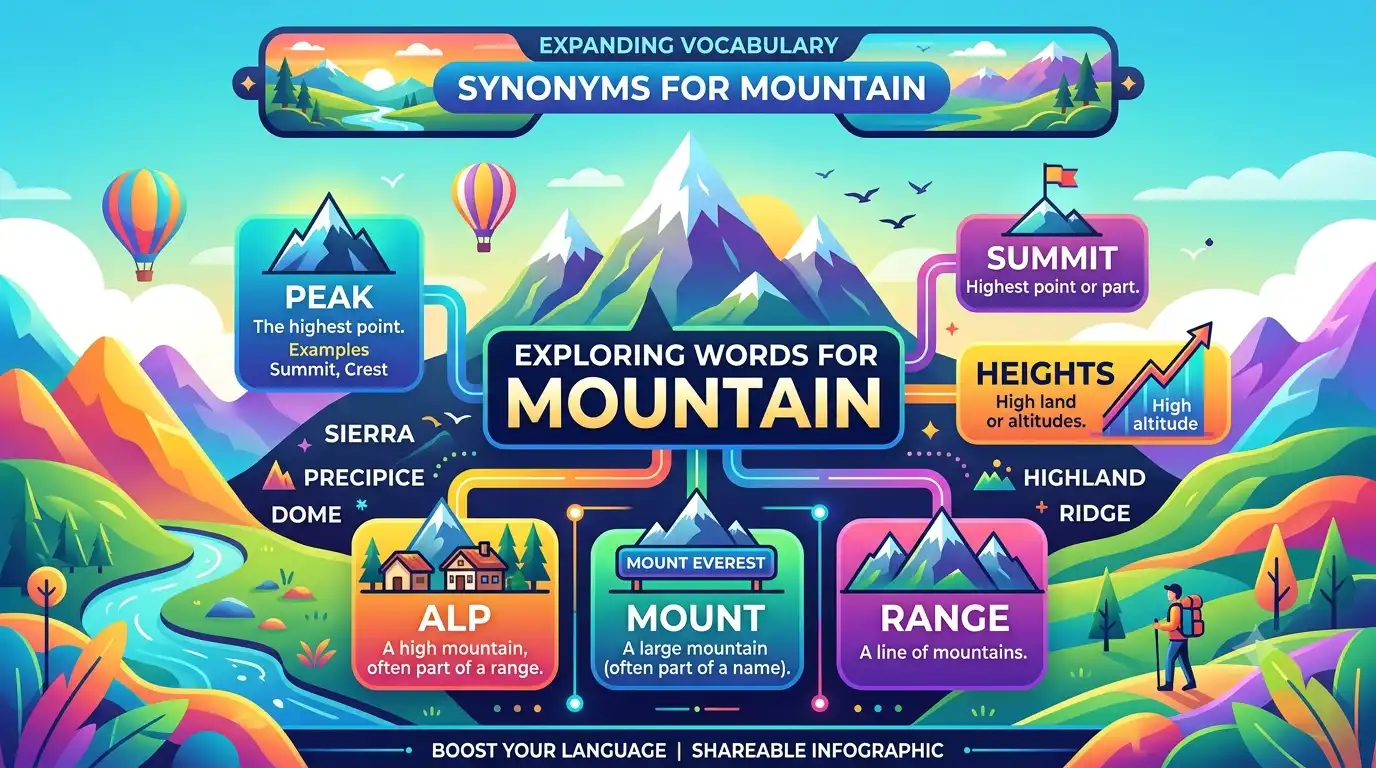
If you are writing a story about wild adventures, finding synonyms for mountain is a perfect way to make your sentences stand out. When you learn different synonyms for mountain, you can describe giant snowy peaks, steep hills, and beautiful climbing paths with perfect ease. Discovering high-quality synonyms for mountain helps your readers feel the immense height and rugged beauty of these giant rock formations.
Imagine standing at the base of a giant rock wall early in the morning. Cold mist wraps around your boots as you look up at the giant stone peak touching the clouds. That giant rock is a mountain. In very simple English, a mountain is a giant piece of land that rises high above everything around it. Think of a small hill in your backyard or the massive, snowy Mount Everest touching the sky.
“The mountains are calling and I must go.” — John Muir
“Climb the mountain not to plant your flag, but to embrace the challenge.” — Unknown
Expanding your range of expression is incredibly helpful for several groups of writers:
- For students: It helps you write engaging geography papers, describe landforms, and avoid repeating the same words.
- For bloggers: It keeps your readers hooked with fresh, active descriptions of hiking trips, ski adventures, and outdoor travel.
- For content writers: It boosts your search engine rankings by naturally using vocabulary variations that search algorithms love.
- For daily English users: It helps you describe your weekend hikes, talk about scenery, and share holiday stories with confidence.
Connotative Meaning of Mountain
The word “mountain” carries a strong, majestic, and highly permanent connotation. It suggests wild strength, challenges to overcome, and quiet wisdom. When used to describe a challenge, it highlights something huge and difficult. When used to describe a person or object, it represents structural stability, safety, and immense size.
Etymology of Mountain
- Mont- (Root): Derived from the Latin word mons or montis (meaning “mountain” or “hill”).
- -ain (Suffix): Formed from the Old French noun suffix -aigne.
- Evolution: Came into English from Old French montaigne, replacing the Old English word beorg (meaning a barrow or hill).
Linguistic Profile of Mountain
- US Pronunciation (IPA): /ˈmaʊn.tən/
- UK Pronunciation (IPA): /ˈmaʊn.tɪn/
- Syllables: 2 syllables (moun-tain)
- Affixation Pattern: Formed historically by joining the Latin root mont- with a noun-forming suffix to create a noun. It forms the adjective mountainous.
Comparison of Key Synonyms
To help you choose the right word instantly, here is a simple comparison of key synonyms:
| Keyword | Meaning | Usage Type | Context |
|---|---|---|---|
| Peak | The pointed top of a mountain or hill. | Visual & Descriptive | Hiking, climbing, photography |
| Summit | The absolute highest point of a mountain. | Formal & Achieved | Climbing victories, political meetings |
| Ridge | A long, narrow hilltop or mountain range. | Descriptive | Topography, trail maps, geology |
| Alp | A very high, snow-capped mountain. | Casual & Regional | Skiing, European travel, geography |
| Knoll | A small, low, and round hill. | Casual | Picnics, parks, garden design |
| Massif | A compact group of connected mountains. | Scientific | Geography class, geology reports, maps |
“It is not the mountain we conquer, but ourselves.” — Sir Edmund Hillary
50 Synonyms for Mountain
Here is your ultimate list of 50 synonyms to describe elevated landforms, high peaks, and rugged slopes.
1. Peak
- Pronunciation: US /piːk/ | UK /piːk/
- Meaning: This means the pointed top part of a mountain or hill.
- Examples:
- We could see the snowy peak of the mountain from our hotel.
- The climber smiled when she finally reached the highest peak.
2. Summit
- Pronunciation: US /ˈsʌm.ɪt/ | UK /ˈsʌm.ɪt/
- Meaning: This means the absolute highest point of a mountain or hill.
- Examples:
- It took the team five days to reach the mountain summit.
- Cold winds blew hard across the rocky summit of the hill.
3. Mount
- Pronunciation: US /maʊnt/ | UK /maʊnt/
- Meaning: This is a short word for mountain used before a specific name.
- Examples:
- They plan to climb Mount Rainier during their summer trip.
- Mount Fuji is a very beautiful place to visit in Japan.
4. Hill
- Pronunciation: US /hɪl/ | UK /hɪl/
- Meaning: This means a round piece of land that is lower than a mountain.
- Examples:
- The children ran down the grassy hill to play near the river.
- Our house sits on top of a steep hill in the city.
5. Ridge
- Pronunciation: US /rɪdʒ/ | UK /rɪdʒ/
- Meaning: This means a long, narrow path along the top of a mountain range.
- Examples:
- We walked carefully along the rocky ridge to see the valley below.
- The mountain ridge looked like a sleeping giant against the sky.
6. Highland
- Pronunciation: US /ˈhaɪ.lənd/ | UK /ˈhaɪ.lənd/
- Meaning: This means an area of high or mountainous land far above sea level.
- Examples:
- Wild deer run across the beautiful Scottish highland fields.
- The villagers love their simple lifestyle in the quiet highland country.
7. Elevation
- Pronunciation: US /ˌel.əˈveɪ.ʃən/ | UK /ˌel.ɪˈveɪ.ʃən/
- Meaning: This means the height of a place above the level of the sea.
- Examples:
- The sign showed that our mountain cabin was at a high elevation.
- It is hard to breathe at this extreme elevation because of thin air.
8. Pinnacle
- Pronunciation: US /ˈpɪn.ə.kəl/ | UK /ˈpɪn.ə.kəl/
- Meaning: This means a high, pointed piece of rock shaped like a tower.
- Examples:
- An eagle built its nest on a tall, rocky pinnacle.
- The castle sat on a steep pinnacle overlooking the deep forest.
9. Crest
- Pronunciation: US /krest/ | UK /krest/
- Meaning: This means the very top line of a mountain, wave, or hill.
- Examples:
- We watched the golden sun rise over the crest of the mountain.
- A line of tall pine trees grew along the mountain crest.
10. Range
- Pronunciation: US /reɪndʒ/ | UK /reɪndʒ/
- Meaning: This means a long row of mountains that are connected together.
- Examples:
- The Rocky Mountain range stretches across a very big distance.
- We flew over a beautiful mountain range covered in white snow.
11. Massif
- Pronunciation: US /mæˈsiːf/ | UK /mæˈsiːf/
- Meaning: This means a large, compact group of connected mountains.
- Examples:
- The hikers spent two weeks exploring the giant mountain massif.
- Heavy clouds covered the top of the massive stone massif.
12. Alp
- Pronunciation: US /ælp/ | UK /ælp/
- Meaning: This means a very high mountain, especially one that has snow on top.
- Examples:
- She wants to ski down a steep alp during her European holiday.
- The majestic alp looked bright and white under the winter sun.
13. Dome
- Pronunciation: US /doʊm/ | UK /dəʊm/
- Meaning: This means a mountain or hill that has a smooth, round shape.
- Examples:
- The granite dome was a popular place for rock climbers to practice.
- We hiked to the top of the grassy dome to watch the sunset.
14. Rise
- Pronunciation: US /raɪz/ | UK /raɪz/
- Meaning: This means an area of rising ground or a small hill.
- Examples:
- From the gentle rise, we could see the entire farm below.
- He built his wooden cabin on a small rise near the lake.
15. Height
- Pronunciation: US /haɪt/ | UK /haɪt/
- Meaning: This means a very high place or an area of high ground.
- Examples:
- The birds flew down from the rocky heights to catch fish.
- Looking down from the mountain heights made me feel a bit dizzy.
16. Plateau
- Pronunciation: US /plæˈtoʊ/ | UK /ˈplæt.əʊ/
- Meaning: This means a large, flat area of land that is high above sea level.
- Examples:
- The road went straight across the dry, rocky mountain plateau.
- Cows grazed on the green grass of the high plateau.
17. Mesa
- Pronunciation: US /ˈmeɪ.sə/ | UK /ˈmeɪ.sə/
- Meaning: This means a flat-topped hill with very steep sides in a dry area.
- Examples:
- The red rocks of the desert mesa looked beautiful at noon.
- We took a dirt trail to explore the top of the ancient mesa.
18. Butte
- Pronunciation: US /bjuːt/ | UK /bjuːt/
- Meaning: This means a small, flat-topped hill that stands alone in a flat area.
- Examples:
- A lonely butte rose out of the sandy desert floor.
- The photographer took a picture of the tall butte at sunset.
19. Knoll
- Pronunciation: US /noʊl/ | UK /nəʊl/
- Meaning: This means a small, round hill that is usually covered in grass.
- Examples:
- We sat on a soft, green knoll to have our lunch.
- A single oak tree grew on top of the grassy knoll.
20. Mound
- Pronunciation: US /maʊnd/ | UK /maʊnd/
- Meaning: This means a raised pile of earth, stones, or dirt.
- Examples:
- The kids built a giant mound of dirt in the backyard.
- An ancient burial mound sat near the edge of the forest.
21. Hillock
- Pronunciation: US /ˈhɪl.ək/ | UK /ˈhɪl.ək/
- Meaning: This means a very small hill or mound of green earth.
- Examples:
- The sheep walked slowly over the small hillocks in the field.
- I sat on a sunny hillock to read my favorite book.
22. Promontory
- Pronunciation: US /ˈfrɑː.mən.tɔːr/ | UK /ˈfrɒm.ən.tər.i/
- Meaning: This means a high point of land that sticks out into water.
- Examples:
- The old lighthouse sat on a rocky promontory above the ocean.
- We stood on the windy promontory and watched the big waves crash.
23. Escarpment
- Pronunciation: US /ɪˈskɑːrp.mənt/ | UK /ɪˈskɑːp.mənt/
- Meaning: This means a long, steep slope or cliff that separates flat areas.
- Examples:
- The waterfall fell down the side of the rocky escarpment.
- We carefully hiked along the edge of the high escarpment.
24. Cliff
- Pronunciation: US /klɪf/ | UK /klɪf/
- Meaning: This means a very steep, high rock wall next to the sea or land.
- Examples:
- The white cliffs of the island looked beautiful from the boat.
- Do not walk too close to the edge of the high cliff.
25. Precipice
- Pronunciation: US /ˈpres.ə.pɪs/ | UK /ˈpres.ɪ.pɪs/
- Meaning: This means a very steep side of a high rock or mountain.
- Examples:
- He looked over the edge of the deep mountain precipice with fear.
- The mountain goat stood safely on a narrow ledge of the precipice.
26. Bluff
- Pronunciation: US /blʌf/ | UK /blʌf/
- Meaning: This means a broad, rounded cliff next to a river or beach.
- Examples:
- We watched the boats sail by from the grassy river bluff.
- Many beautiful homes were built on top of the sandy bluff.
27. Spire
- Pronunciation: US /spaɪər/ | UK /spaɪər/
- Meaning: This means a tall, pointed rock formation that looks like a needle.
- Examples:
- The red rock spires of the canyon rose high into the sky.
- We saw a thin mountain spire sticking out above the green trees.
28. Crag
- Pronunciation: US /kræɡ/ | UK /kræɡ/
- Meaning: This means a steep, rough, and rocky part of a mountain.
- Examples:
- The bold climbers started their ascent up the dark, icy crag.
- A wild eagle landed on a high crag to watch for prey.
29. Tor
- Pronunciation: US /tɔːr/ | UK /tɔː/
- Meaning: This means a high, rocky hill, especially in southwestern England.
- Examples:
- The heavy mist rolled over the ancient granite tor in the afternoon.
- We hiked up the tor to see the wide green countryside.
30. Fell
- Pronunciation: US /fel/ | UK /fel/
- Meaning: This means a high, wild hill or mountain area in northern England.
- Examples:
- The sheep dogs ran across the windy fells to gather the flock.
- We spent the cold weekend walking through the snowy fells.
31. Hummock
- Pronunciation: US /ˈhʌm.ək/ | UK /ˈhʌm.ək/
- Meaning: This means a small, round hill or mound of earth or ice.
- Examples:
- The hikers walked slowly over the icy hummocks on the glacier.
- Soft green moss grew all over the muddy forest hummock.
32. Montane
- Pronunciation: US /mɑːnˈteɪn/ | UK /mɒnˈteɪn/
- Meaning: This describes things that belong to or live in mountainous areas.
- Examples:
- We studied the rare plants that grow in the cold montane forest.
- Many montane animals have thick fur to survive the freezing winters.
33. Alpine
- Pronunciation: US /ˈæl.paɪn/ | UK /ˈæl.paɪn/
- Meaning: This describes things relating to high mountains, especially above the trees.
- Examples:
- The alpine flowers only bloom for a short time in summer.
- We stayed in a cozy alpine chalet surrounded by pine trees.
34. Subalpine
- Pronunciation: US /sʌbˈæl.paɪn/ | UK /sʌbˈæl.paɪn/
- Meaning: This describes the high mountain area just below the tree line.
- Examples:
- We pitched our tents in a quiet subalpine meadow near the lake.
- Thick subalpine fir trees protected us from the cold wind.
35. Hilly
- Pronunciation: US /ˈhɪl.i/ | UK /ˈhɪl.i/
- Meaning: This describes a landscape that has a lot of hills.
- Examples:
- Riding a bicycle through this hilly town is very hard work.
- The green, hilly countryside was filled with beautiful dairy farms.
36. Mountainous
- Pronunciation: US /ˈmaʊn.tən.əs/ | UK /ˈmaʊn.tɪn.əs/
- Meaning: This describes an area that has many high mountains.
- Examples:
- Switzerland is a highly mountainous country with beautiful winter views.
- The bus traveled slowly along the dangerous, mountainous roads.
37. Steep
- Pronunciation: US /stiːp/ | UK /stiːp/
- Meaning: This means rising or falling very sharply like a straight wall.
- Examples:
- The hikers struggled to climb up the steep mountain path.
- The ski slope was far too steep for a beginner like me.
38. Sheer
- Pronunciation: US /ʃɪr/ | UK /ʃɪər/
- Meaning: This means rising straight up or down with no slope at all.
- Examples:
- The climbers faced a sheer rock wall of smooth grey granite.
- He looked down the sheer drop of the cliff into the ocean.
39. Towering
- Pronunciation: US /ˈtaʊ.ɚ.ɪŋ/ | UK /ˈtaʊ.ər.ɪŋ/
- Meaning: This means extremely tall and impressive compared to surroundings.
- Examples:
- The towering peak of the volcano was visible from miles away.
- We walked in the shadow of the towering stone mountains.
40. Lofty
- Pronunciation: US /ˈlɑːf.ti/ | UK /ˈlɒf.ti/
- Meaning: This means rising to a very great and noble height.
- Examples:
- The castle was built on a lofty peak to keep out enemies.
- We gazed up at the lofty summits covered in bright white snow.
41. Elevated
- Pronunciation: US /ˈel.ə.veɪ.t̬ɪd/ | UK /ˈel.ɪ.veɪ.tɪd/
- Meaning: This means raised up high above the surrounding ground.
- Examples:
- The mountain village is built on a highly elevated rock shelf.
- We enjoyed a clean, cool breeze on the elevated wooden deck.
42. High-reaching
- Pronunciation: US /ˌhaɪˈriː.tʃɪŋ/ | UK /ˌhaɪˈriː.tʃɪŋ/
- Meaning: This describes things that extend very far up into the sky.
- Examples:
- The high-reaching mountains looked like giant teeth touching the sky.
- Birds flew around the high-reaching peaks of the mountain range.
43. Snow-capped
- Pronunciation: US /ˈsnoʊ.kæpt/ | UK /ˈsnəʊ.kæpt/
- Meaning: This describes a mountain top that is covered in white snow.
- Examples:
- The snow-capped mountains looked beautiful in our travel photos.
- Even in hot summer, the high peaks remain completely snow-capped.
44. Rugged
- Pronunciation: US /ˈrʌɡ.ɪd/ | UK /ˈrʌɡ.ɪd/
- Meaning: This describes ground that is rough, rocky, and hard to walk on.
- Examples:
- We wore strong hiking boots to cross the rugged mountain terrain.
- The rugged landscape was shaped by thousands of years of cold ice.
45. Craggy
- Pronunciation: US /ˈkræɡ.i/ | UK /ˈkræɡ.i/
- Meaning: This describes a rock or mountain that is rough, steep, and uneven.
- Examples:
- The mountain goat climbed up the craggy slope with perfect ease.
- I love looking at the craggy cliffs along the wild coast.
46. Cloud-capped
- Pronunciation: US /ˈklaʊd.kæpt/ | UK /ˈklaʊd.kæpt/
- Meaning: This describes a high mountain summit that is hidden inside clouds.
- Examples:
- The cloud-capped peaks looked very mysterious in the early morning.
- We could not see the summit because it was completely cloud-capped.
47. Volcanic
- Pronunciation: US /vɑːlˈkæn.ɪk/ | UK /vɒlˈkæn.ɪk/
- Meaning: This describes a mountain that was made by hot lava and ash.
- Examples:
- The volcanic peak has a large, round crater at the very top.
- Scientists monitor the volcanic mountain for signs of activity.
48. Uplands
- Pronunciation: US /ˈʌp.ləndz/ | UK /ˈʌp.ləndz/
- Meaning: This means the higher parts of a country, state, or land.
- Examples:
- Farmers raise healthy sheep in the cool grassy uplands.
- We drove through the beautiful uplands to see the fall leaves.
49. Foothills
- Pronunciation: US /ˈfʊt.hɪlz/ | UK /ˈfʊt.hɪlz/
- Meaning: This means the low hills at the base of a mountain range.
- Examples:
- The trail starts in the quiet foothills and goes up to the peaks.
- We built our family home in the beautiful green foothills of the Alps.
50. Tableland
- Pronunciation: US /ˈteɪ.bəl.lænd/ | UK /ˈteɪ.bəl.lænd/
- Meaning: This means a broad, flat highland area that looks like a table.
- Examples:
- The sheep grazed across the wide tableland during the warm season.
- Strong desert winds swept across the barren tableland.
Antonyms of Mountain
To understand “mountain” completely, it is highly useful to look at its direct opposites. In daily communication, these words represent flat land, low ground, or deep valleys:
- Valley: A low area of land between hills or mountains, often with a river running through it.
- Plain: A large, flat area of land with very few trees or hills.
- Depression: A sunken place or low-lying area that is lower than the surrounding land.
- Basin: A low-lying bowl-shaped area of land often drained by a river system.
- Flatland: Land that is flat, level, and lacks any significant hills or mountains.
Prototype Meaning and Categorization of Synonyms for Mountain
The fifty synonyms for mountain can be easily divided into four main categories:
- High Peaks and Summits: Words like peak, summit, mount, pinnacle, crest, massif, alp, heights, spire, and cloud-capped that focus on the very highest, pointed parts of mountains.
- Hills, Mounds, and Minor Elevations: Terms like hill, rise, knoll, mound, hillock, hummock, elevated, foothills, uplands, and hilly that represent smaller, rounder, or lower areas of raised land.
- Steep, Rugged, and Scenic Cliffs: Words like ridge, promontory, escarpment, cliff, precipice, bluff, crag, tor, fell, steep, sheer, rugged, and craggy that show the vertical, rough, and sharp rocky sides of mountain landforms.
- Mountain Zones and Regional Adjectives: Terms like highland, elevation, range, dome, plateau, mesa, butte, montane, alpine, subalpine, mountainous, towering, lofty, high-reaching, snow-capped, volcanic, and tableland that represent larger mountain ecosystems or geological shapes.
FAQ about Synonyms for Mountain
1. What is the difference between “mountain” and “hill”?
A mountain is a massive landform that rises sharply above its surroundings, typically reaching a height of over 1,000 feet (300 meters). A hill is much smaller, has a more rounded shape, and is easier to climb.
2. Can “craggy” be used to describe any mountain?
Yes, but it has a specific connotation. Craggy is best used for mountains that are rough, uneven, and covered in sharp, exposed rocks. It would not fit a smooth, grassy, dome-shaped hill.
3. What is a highly formal synonym for mountain to use in a geology report?
In formal academic or scientific papers, terms like massif (for a group of connected mountains), elevation (to describe height), or escarpment (for steep slopes) sound much more professional and authoritative.
4. Is “alpine” the same as “montane”?
Not exactly. Alpine refers to very high mountain areas that sit above the tree line where trees cannot grow due to the cold. Montane is a broader term that refers to any mountainous region, including forested slopes.
5. How does using diverse synonyms for mountain benefit my blog’s SEO?
Using diverse synonyms prevents search engines from penalizing your writing for “keyword stuffing.” It builds a rich semantic profile that helps search algorithms connect your article with hikers, travelers, and students.
6. What is the root origin of the word “mountain”?
The word comes from the Latin root mons or montis, which means “mountain.” It travelled through Old French before becoming an established word in the English language.
Conclusion
Expanding your vocabulary with fifty unique synonyms for mountain is a powerful way to make your communication much more engaging. When you select the exact word that fits your situation, your writing gains immediate clarity and professional polish. Rather than repeating the same common words, bloggers can craft highly active articles, students can write persuasive essays, and business professionals can make their marketing messages clear and professional. Using active vocabulary keeps your readers curious and ensures that your unique voice sounds completely authentic.
We encourage you to practice using these terms as you write your school papers, draft work emails, or chat with your friends. By paying attention to the small differences in these words, you can match your tone to your specific audience perfectly. Do not be afraid to experiment with new terms in your next conversation. With regular practice, choosing the right synonym will become completely natural, helping you share your thoughts, connections, and system structures with confidence. Every time you swap a repetitive word for a dynamic one, you take a big step forward as a writer. Your voice will sound brighter, and your ideas will carry much more weight. Keep exploring the beauty of the English language, and watch how quickly your sentences begin to shine.
“Every mountain top is within reach if you just keep climbing.” — Barry Finlay
“Chasing mountains teaches us that the best views come after the hardest climb.” — Unknown

Andrew Powell is a travel writer and nature journalist who has spent over a decade writing about places, landscapes, and the natural world — and thinking carefully about the words that do those subjects justice ( Biography ).