
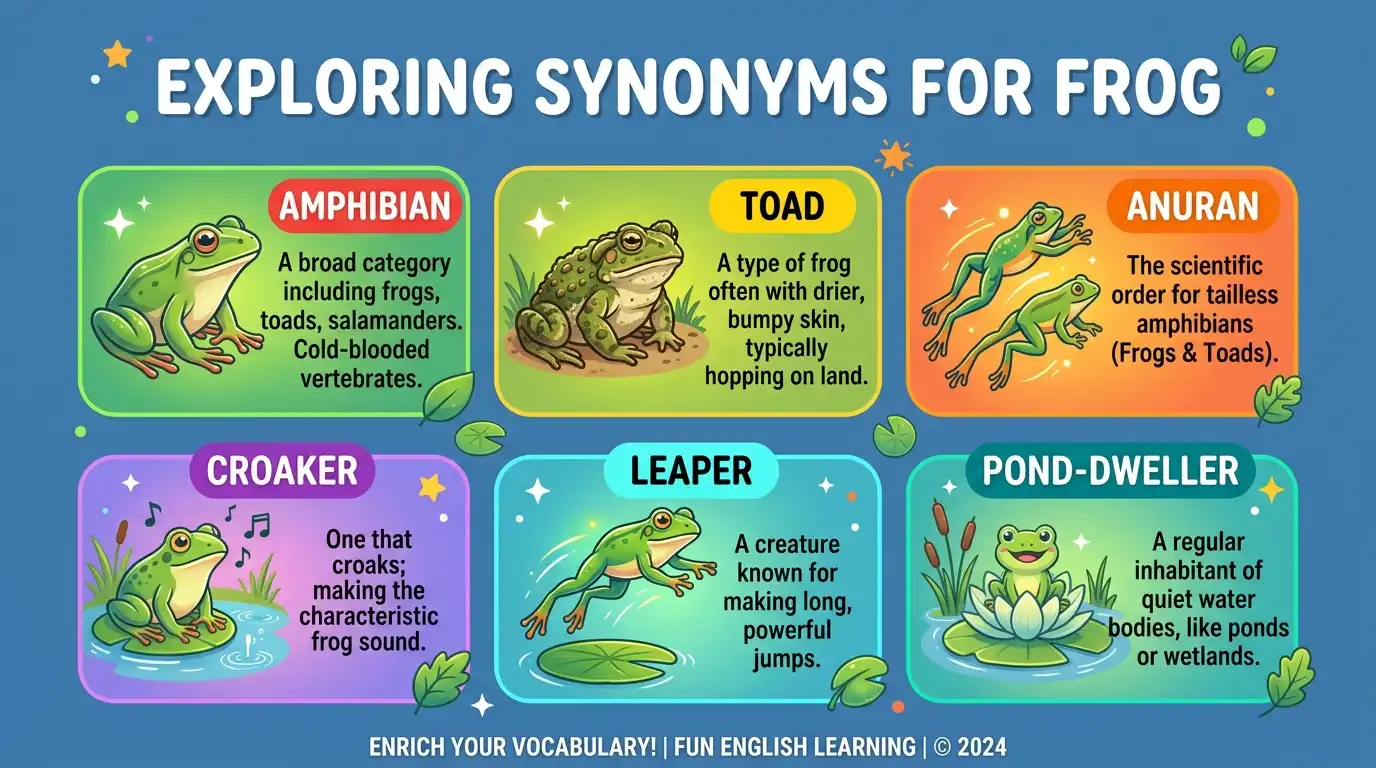
Finding the best synonyms for frog helps you write better stories, essays, and biological descriptions. Learning synonyms for frog gives you fresh words to replace repetitive language in your draft. When you discover varied synonyms for frog, your writing becomes vivid, clear, and far more exciting for your readers.
Imagine walking near a quiet pond on a warm summer evening. You hear a loud sound in the tall grass, but repeating the same basic word five times in one paragraph makes your story boring. Using different terms for this hopping amphibian keeps your audience engaged from start to finish.
A frog is a small, tailless animal with smooth, moist skin and strong back legs made for jumping. Searching for alternative words gives students, bloggers, content writers, and daily English speakers the exact terms needed for any context. Students can improve their science reports, bloggers can craft engaging nature articles, content writers can expand their creative vocabulary, and daily speakers can express themselves with precision.
“Language is the dress of thought, and choosing the right word brings every picture to life.” — Samuel Johnson
“To learn a new word is to open a new window on the world around us.” — Traditional Proverb
Linguistic Attributes and Overview of “Frog”
Connotative Meaning
The word “frog” carries diverse connotations across literature and everyday speech. In fairy tales, it often connotes transformation, magic, or hidden beauty (e.g., the frog prince). In nature writing, it symbolizes environmental health, moist ecosystems, and the arrival of spring.
Etymology
- Origin: Old English frogga or frox.
- Proto-Germanic: Derived from *froscaz (meaning jumper or hopper).
- Cognates: Related to Dutch kikvors and German Frosch.
Pronunciation
- US IPA: /frɑːɡ/ or /frɔːɡ/
- UK IPA: /frɒɡ/
Syllable & Affixation Pattern
- Syllables: 1 (monosyllabic word).
- Root: Base noun frog.
- Derived Forms: Froglike (adjective), Froglet (diminutive noun), Frogging (verb/noun).
Comparison Table of Key Frog Terms
| Keyword / Term | Meaning | Usage Type | Context |
| Frog | Smooth-skinned, tailless leaping amphibian | Neutral / Common | General speech, science, storytelling |
| Toad | Rough, dry-skinned terrestrial amphibian | Neutral / Specific | Biology, garden contexts |
| Amphibian | Cold-blooded vertebrate living on land and water | Formal / Scientific | Academic essays, textbook articles |
| Anuran | Member of the tailless amphibian order | Formal / Technical | Zoology, professional biology papers |
| Polliwog | Early aquatic larval stage with a tail | Casual / Regional | Children’s books, casual nature talk |
| Tadpole | Young larval frog living entirely in water | Common / Educational | Primary education, science lessons |
| Croaker | Creature that produces a deep throat sound | Informal / Descriptive | Creative writing, poetry |
| Hopper | Creature characterized by jumping movements | Informal / Casual | Children’s stories, informal speech |
50 Detailed Synonyms for Frog
1. Toad
- Pronunciation: US: /toʊd/ | UK: /təʊd/
- Meaning: A small amphibian that usually has dry, bumpy skin and lives mainly on land.
- Examples:
- The small toad sat quietly under the garden shade.
- A brown toad hopped across the damp pathway.
2. Amphibian
- Pronunciation: US: /æmˈfɪb.i.ən/ | UK: /æmˈfɪb.i.ən/
- Meaning: A cold-blooded animal that lives both in water and on land.
- Examples:
- Every frog is a cold-blooded amphibian.
- Students studied the life cycle of a freshwater amphibian.
3. Anuran
- Pronunciation: US: /əˈnʊr.ən/ | UK: /æˈnjʊə.rən/
- Meaning: A tailless amphibian belonging to the scientific order that includes frogs and toads.
- Examples:
- The scientist classified the rare species as a native anuran.
- An anuran relies on moist skin to absorb oxygen.
4. Polliwog
- Pronunciation: US: /ˈpɑː.li.wɑːɡ/ | UK: /ˈpɒl.i.wɒɡ/
- Meaning: A young frog at the stage when it has a tail and lives in water.
- Examples:
- Children watched the tiny polliwog swim in the jar.
- The polliwog slowly grew back legs over two weeks.
5. Tadpole
- Pronunciation: US: /ˈtæd.poʊl/ | UK: /ˈtæd.pəʊl/
- Meaning: The swimming larval form of a frog before it grows legs.
- Examples:
- We saw a swarm of black tadpoles near the lake shore.
- A tadpole breathes through gills before developing lungs.
6. Froglet
- Pronunciation: US: /ˈfrɑːɡ.lət/ | UK: /ˈfrɒɡ.lət/
- Meaning: A young frog that has just completed its growth from a tadpole.
- Examples:
- A tiny froglet crawled out of the shallow water onto a leaf.
- The green froglet still had a tiny stub of a tail.
7. Bullfrog
- Pronunciation: US: /ˈbʊl.frɑːɡ/ | UK: /ˈbʊl.frɒɡ/
- Meaning: A very large frog known for its deep, booming croak.
- Examples:
- The heavy bullfrog made a deep noise in the swamp.
- A bullfrog waited near the water lily for insects.
8. Treefrog
- Pronunciation: US: /ˈtriː.frɑːɡ/ | UK: /ˈtriː.frɒɡ/
- Meaning: A small frog that lives in trees and bushes.
- Examples:
- A bright green treefrog stuck to the bathroom window.
- The treefrog climbed higher into the wet leaves.
9. Croaker
- Pronunciation: US: /ˈkroʊ.kɚ/ | UK: /ˈkrəʊ.kər/
- Meaning: A creature that makes a low, rough throat noise.
- Examples:
- Night fell and every croaker in the pond began to sing.
- The old croaker leaped off the log into the stream.
10. Hopper
- Pronunciation: US: /ˈhɑː.pɚ/ | UK: /ˈhɒp.ər/
- Meaning: An animal or creature that moves by jumping on two or four legs.
- Examples:
- The little green hopper jumped right into the grass.
- Watch out for that fast hopper near your shoes!
11. Salientian
- Pronunciation: US: /ˌsæ.liˈɛn.ʃən/ | UK: /ˌsæ.liˈɛn.ʃən/
- Meaning: A formal term for leaping tailless amphibians.
- Examples:
- Biology textbooks group these jumping creatures as a salientian group.
- The museum displayed a fossil of an ancient salientian.
12. Peeper
- Pronunciation: US: /ˈpiː.pɚ/ | UK: /ˈpiː.pər/
- Meaning: A small frog that makes a high whistling sound in early spring.
- Examples:
- We listened to the lonely peeper singing near the ditch.
- A spring peeper signals that warm weather is coming.
13. Pond-dweller
- Pronunciation: US: /ˈpɑːnd.dwɛl.ɚ/ | UK: /ˈpɒnd.dwel.ər/
- Meaning: An animal that lives in or around a small body of still water.
- Examples:
- The green pond-dweller rested quietly on a floating wood slice.
- Many a pond-dweller hides beneath dense duckweed.
14. Web-foot
- Pronunciation: US: /ˈwɛb.fʊt/ | UK: /ˈweb.fʊt/
- Meaning: A creature having skin connecting its toes for fast swimming.
- Examples:
- The little web-foot swam across the muddy stream effortlessly.
- Long hind legs make this web-foot an amazing jumper.
15. Greenback
- Pronunciation: US: /ˈɡriːn.bæk/ | UK: /ˈɡriːn.bæk/
- Meaning: An informal descriptive term for a creature with a green back.
- Examples:
- A curious greenback blended into the bright grass.
- The greenback vanished beneath the water surface in a second.
16. Leapfrogger
- Pronunciation: US: /ˈliːp.frɑː.ɡɚ/ | UK: /ˈliːp.frɒ.ɡər/
- Meaning: A playful term for an animal that leaps over obstacles.
- Examples:
- That tiny leapfrogger jumped clear across the stone path.
- Kids cheered for the fast leapfrogger in the garden.
17. Water-jumper
- Pronunciation: US: /ˈwɑː.tɚ.dʒʌm.pɚ/ | UK: /ˈwɔː.tər.dʒʌm.pər/
- Meaning: A creature that jumps out of or into bodies of water.
- Examples:
- The agile water-jumper splashed happily into the cool lake.
- A water-jumper rested on the damp riverbank.
18. Ranid
- Pronunciation: US: /ˈræ.nɪd/ | UK: /ˈræ.nɪd/
- Meaning: Any true frog belonging to the scientific family Ranidae.
- Examples:
- The field guide identifies this species as a true ranid.
- Every wild ranid requires clean water to survive.
19. Hylid
- Pronunciation: US: /ˈhaɪ.lɪd/ | UK: /ˈhaɪ.lɪd/
- Meaning: Any tree frog belonging to the scientific family Hylidae.
- Examples:
- A small hylid uses sticky toe pads to cling to smooth leaves.
- Researchers found a rare hylid deep inside the rainforest.
20. Batrachian
- Pronunciation: US: /bəˈtreɪ.ki.ən/ | UK: /bəˈtreɪ.ki.ən/
- Meaning: An older term used to describe frogs, toads, and related amphibians.
- Examples:
- Ancient books described every batrachian as a creature of water and earth.
- The naturalist collected notes on local batrachian species.
21. Mud-hopper
- Pronunciation: US: /ˈmʌd.hɑː.pɚ/ | UK: /ˈmʌd.hɒp.ər/
- Meaning: A creature that leaps around muddy edges of ponds and riverbanks.
- Examples:
- A brown mud-hopper disappeared quickly into the wet soil.
- We spotted a mud-hopper near the edge of the creek.
22. Lily-pad Squatter
- Pronunciation: US: /ˈlɪl.i.pæd skwɑː.tɚ/ | UK: /ˈlɪl.i.pæd skwɒt.ər/
- Meaning: A playful name for a frog sitting on floating water leaves.
- Examples:
- The lily-pad squatter sunned itself under the warm afternoon skies.
- That quiet lily-pad squatter sat perfectly still for an hour.
23. Marsh-dweller
- Pronunciation: US: /ˈmɑːrʃ.dwɛl.ɚ/ | UK: /ˈmɑːʃ.dwel.ər/
- Meaning: An animal that lives in soft wet lowlands or marshes.
- Examples:
- The marsh-dweller hid behind tall cattail reeds.
- Sound carried far as every marsh-dweller called out at sunset.
24. Croaking Amphibian
- Pronunciation: US: /ˈkroʊ.kɪŋ æmˈfɪb.i.ən/ | UK: /ˈkrəʊ.kɪŋ æmˈfɪb.i.ən/
- Meaning: An amphibian that communicates using croaking vocal sounds.
- Examples:
- A croaking amphibian echoed across the quiet night valley.
- We recorded the voice of a rare croaking amphibian.
25. Pond Frog
- Pronunciation: US: /pɑːnd frɑːɡ/ | UK: /pɒnd frɒɡ/
- Meaning: A common frog species that spends its life around calm pond waters.
- Examples:
- The green pond frog jumped into the water when I walked past.
- A wild pond frog eats small flies and mosquito larvae.
26. Meadow Frog
- Pronunciation: US: /ˈmɛd.oʊ frɑːɡ/ | UK: /ˈmed.əʊ frɒɡ/
- Meaning: A frog that inhabits damp fields and tall grassy meadows.
- Examples:
- A spotted meadow frog hopped through the damp farm fields.
- We found a small meadow frog sitting near the water pipe.
27. Wood Frog
- Pronunciation: US: /wʊd frɑːɡ/ | UK: /wʊd frɒɡ/
- Meaning: A land-adapted frog known for surviving cold forest winters.
- Examples:
- The brown wood frog blends in perfectly with fallen autumn leaves.
- A wood frog can survive freezing temperatures during winter.
28. Dart Frog
- Pronunciation: US: /dɑːrt frɑːɡ/ | UK: /dɑːt frɒɡ/
- Meaning: A small, brightly colored tropical frog known for toxic skin secretions.
- Examples:
- The poisonous dart frog displays vivid blue and black stripes.
- Photographers admire the bright colors of the tiny dart frog.
29. Toadlet
- Pronunciation: US: /ˈtoʊd.lət/ | UK: /ˈtəʊd.lət/
- Meaning: A very small or young toad.
- Examples:
- A tiny toadlet hopped across the garden soil during the rain.
- We carefully moved the tiny toadlet off the sidewalk.
30. Spring Peeper
- Pronunciation: US: /sprɪŋ ˈpiː.pɚ/ | UK: /sprɪŋ ˈpiː.pər/
- Meaning: A tiny treefrog famous for singing during early spring nights.
- Examples:
- The call of the spring peeper fills the forest every April.
- You can hear a spring peeper long before you actually see it.
31. Swamp Hopper
- Pronunciation: US: /swɑːmp ˈhɑː.pɚ/ | UK: /swɒmp ˈhɒp.ər/
- Meaning: An informal name for an amphibian dwelling in muddy swamps.
- Examples:
- The swamp hopper leaped off a mossy branch into black water.
- A quick swamp hopper avoids predatory water birds.
32. Green Frog
- Pronunciation: US: /ɡriːn frɑːɡ/ | UK: /ɡriːn frɒɡ/
- Meaning: A common North American frog species with green upper lips and backs.
- Examples:
- A green frog sat quietly by the edge of the swimming pool.
- The sound of a green frog resembles a plucked banjo string.
33. Leopard Frog
- Pronunciation: US: /ˈlɛp.ɚd frɑːɡ/ | UK: /ˈlep.əd frɒɡ/
- Meaning: A frog with dark spots resembling the patterns of a leopard.
- Examples:
- The spotted leopard frog jumped quickly into the tall weeds.
- A northern leopard frog lives near lakes, rivers, and marshes.
34. Barking Frog
- Pronunciation: US: /ˈbɑːr.kɪŋ frɑːɡ/ | UK: /ˈbɑː.kɪŋ frɒɡ/
- Meaning: A species of frog whose call sounds remarkably like a dog barking.
- Examples:
- We heard a barking frog making noise behind the wooden fence.
- The desert barking frog hides under rocks during dry days.
35. Chorus Frog
- Pronunciation: US: /ˈkɔːr.əs frɑːɡ/ | UK: /ˈkɔː.rəs frɒɡ/
- Meaning: A small frog that sings in large group groups at night.
- Examples:
- Every chorus frog in the marsh sang together at sunset.
- The tiny chorus frog can make a loud sound for its small size.
36. Glass Frog
- Pronunciation: US: /ɡlæs frɑːɡ/ | UK: /ɡlɑːs frɒɡ/
- Meaning: A tropical frog with translucent skin on its underside.
- Examples:
- You can see the heart of a glass frog right through its clear skin.
- A glass frog lays its eggs on leaves overhanging clear streams.
37. Horned Frog
- Pronunciation: US: /hɔːrnd frɑːɡ/ | UK: /hɔːnd frɒɡ/
- Meaning: A wide-mouthed frog with horn-like skin projections above its eyes.
- Examples:
- The South American horned frog sits buried in leaf litter waiting for food.
- A horned frog has an extremely wide mouth and large appetite.
38. Cricket Frog
- Pronunciation: US: /ˈkrɪk.ɪt frɑːɡ/ | UK: /ˈkrɪk.ɪt frɒɡ/
- Meaning: A tiny treefrog whose sharp call sounds like clicking stones.
- Examples:
- A tiny cricket frog hopped past my outdoor hiking boots.
- We heard the sharp clicking noise of a northern cricket frog.
39. Pickerel Frog
- Pronunciation: US: /ˈpɪk.ɚ.əl frɑːɡ/ | UK: /ˈpɪk.ər.əl frɒɡ/
- Meaning: A spotted frog native to eastern North America with square spots.
- Examples:
- A pickerel frog has two rows of rectangular spots on its back.
- Skin secretions from a pickerel frog can irritate tiny predators.
40. Goliath Frog
- Pronunciation: US: /ɡəˈlaɪ.əθ frɑːɡ/ | UK: /ɡəˈlaɪ.əθ frɒɡ/
- Meaning: The largest living frog species on Earth, native to West Africa.
- Examples:
- The massive goliath frog can grow up to thirteen inches long.
- Scientists traveled to West Africa to observe the rare goliath frog.
41. Clawed Frog
- Pronunciation: US: /klɔːd frɑːɡ/ | UK: /klɔːd frɒɡ/
- Meaning: An aquatic frog possessing short claws on its hind toes.
- Examples:
- The African clawed frog lives its entire adult life underwater.
- Laboratories often study the development of the clawed frog.
42. Bush Frog
- Pronunciation: US: /bʊʃ frɑːɡ/ | UK: /bʊʃ frɒɡ/
- Meaning: A small treefrog species that inhabits low forest bushes.
- Examples:
- A tiny bush frog rested silently on a shiny leaf surface.
- Researchers discovered a new bush frog in the tropical hills.
43. Reed Frog
- Pronunciation: US: /riːd frɑːɡ/ | UK: /riːd frɒɡ/
- Meaning: A colorful African frog that lives on reeds near water.
- Examples:
- The shiny reed frog clung to a tall grass stem in the swamp.
- A bright reed frog changes color depending on temperature.
44. Flying Frog
- Pronunciation: US: /ˈflaɪ.ɪŋ frɑːɡ/ | UK: /ˈflaɪ.ɪŋ frɒɡ/
- Meaning: A treefrog with webbed feet allowing it to glide between trees.
- Examples:
- The Wallace’s flying frog glides smoothly through the rainforest canopy.
- Large webbed feet help the flying frog land safely on distant leaves.
45. Toadstool Sitter
- Pronunciation: US: /ˈtoʊd.stuːl sɪt.ɚ/ | UK: /ˈtəʊd.stuːl sɪt.ər/
- Meaning: A descriptive literary term for a small frog perched on a mushroom.
- Examples:
- Fairy tales often illustrate a tiny toadstool sitter in the forest.
- The painter painted a cute toadstool sitter surrounded by glowing fireflies.
46. Wetland Jumper
- Pronunciation: US: /ˈwɛt.lænd dʒʌm.pɚ/ | UK: /ˈwet.lænd dʒʌm.pər/
- Meaning: An animal inhabiting wet habitats that moves by leaping.
- Examples:
- A quick wetland jumper dodged the hungry bird in the marsh.
- Every wetland jumper relies on high humidity to stay healthy.
47. Lilypad Croaker
- Pronunciation: US: /ˈlɪl.i.pæd kroʊ.kɚ/ | UK: /ˈlɪl.i.pæd krəʊ.kər/
- Meaning: An informal, poetic name for a frog calling from a water lily leaf.
- Examples:
- The sound of a lilypad croaker echoes across the calm park lake.
- Photographers captured a gorgeous picture of a lilypad croaker.
48. Night Croaker
- Pronunciation: US: /naɪt kroʊ.kɚ/ | UK: /naɪt krəʊ.kər/
- Meaning: An amphibian that makes noisy croaking sounds exclusively after dusk.
- Examples:
- A persistent night croaker kept us awake near our campsite tent.
- The chorus of every night croaker creates a relaxing bedtime soundscape.
49. Mud-dweller
- Pronunciation: US: /ˈmʌd.dwɛl.ɚ/ | UK: /ˈmʌd.dwel.ər/
- Meaning: A creature that burrows into or lives in moist mud near water.
- Examples:
- During hot summer days, this tiny mud-dweller buries itself to stay cool.
- The mud-dweller popped its eyes above the thick, dark sludge.
50. Bog Hopper
- Pronunciation: US: /bɑːɡ hɑː.pɚ/ | UK: /bɒɡ hɒp.ər/
- Meaning: An amphibian that leaps through acidic, wet bog landscapes.
- Examples:
- A solitary bog hopper navigated through the mossy wetland peat.
- We observed a green bog hopper jumping across the spongy ground.
“Words give wings to your imagination, allowing everyday thoughts to leap higher.” — Creative Writing Maxim
Antonyms of Frog
While “frog” represents a specific biological creature, direct linguistic antonyms based on habitat, classification, and body traits include:
- Dry-land Mammal: Warm-blooded animals living entirely on land without aquatic larval stages.
- Reptile: Cold-blooded animals with scaly, dry skin (e.g., lizard, snake) as opposed to smooth, moist amphibian skin.
- Bird: Feathered, egg-laying warm-blooded vertebrates adapted for air rather than amphibious leaping.
- Fish: Fully aquatic gill-breathing animals that lack legs for land movement.
Prototype Meaning and Categorization
In cognitive linguistics, the prototype model of a “frog” includes:
- Core Category: Amphibian / Anuran.
- Prototypical Traits:
- Color: Bright green or olive brown.
- Skin: Smooth, moist, and scaleless.
- Locomotion: Leaping with long, powerful hind legs.
- Habitat: Freshwater ponds, wetlands, and lily pads.
- Sound: Croaking or peeping sound.
- Non-Prototypical Members: Dry-skinned toads, legless caecilians, or treefrogs that live high in dry desert trees.
Frequently Asked Questions (FAQs)
1. What is the most common synonym for frog?
The most common casual synonym for frog is amphibian (scientific/general) or croaker/hopper (informal/literary).
2. Is “toad” an exact synonym for frog?
No, “toad” is not an exact scientific synonym. While all toads are technically frogs, toads typically have dry, bumpy skin and live primarily on land, whereas true frogs have smooth, wet skin and live near water.
3. What is a young frog called?
A young frog is called a tadpole, polliwog, or froglet depending on its stage of growth.
4. What is the scientific term for the frog family?
The scientific term for true frogs is Ranid (belonging to the family Ranidae), and the broader order of all frogs and toads is Anura.
5. Why should writers use synonyms for frog?
Using varied terms prevents repetitive phrasing in stories and articles, helps match tone (scientific vs. poetic), and builds rich imagery for readers.
Conclusion
Mastering various synonyms for frog gives you the vocabulary needed to transform simple sentences into descriptive stories. Expanding your word bank improves every area of language, including academic writing, blogging, public speaking, and everyday communication. Using rich terms makes your essays far more informative and gives your blog posts higher creative value.
When you practice these words in your daily life, your expression becomes clear and engaging. Try adding terms like anuran, hopper, or pond-dweller into your next essay, work email, or storytelling session. Building a strong vocabulary opens doors to clearer thought and more powerful connection.
“The difference between the almost right word and the right word is the difference between the lightning bug and the lightning.” — Mark Twain
“A rich vocabulary is the ultimate toolbox for an articulate mind.” — Writing Coach Insight

Andrew Powell is a travel writer and nature journalist who has spent over a decade writing about places, landscapes, and the natural world — and thinking carefully about the words that do those subjects justice ( Biography ).