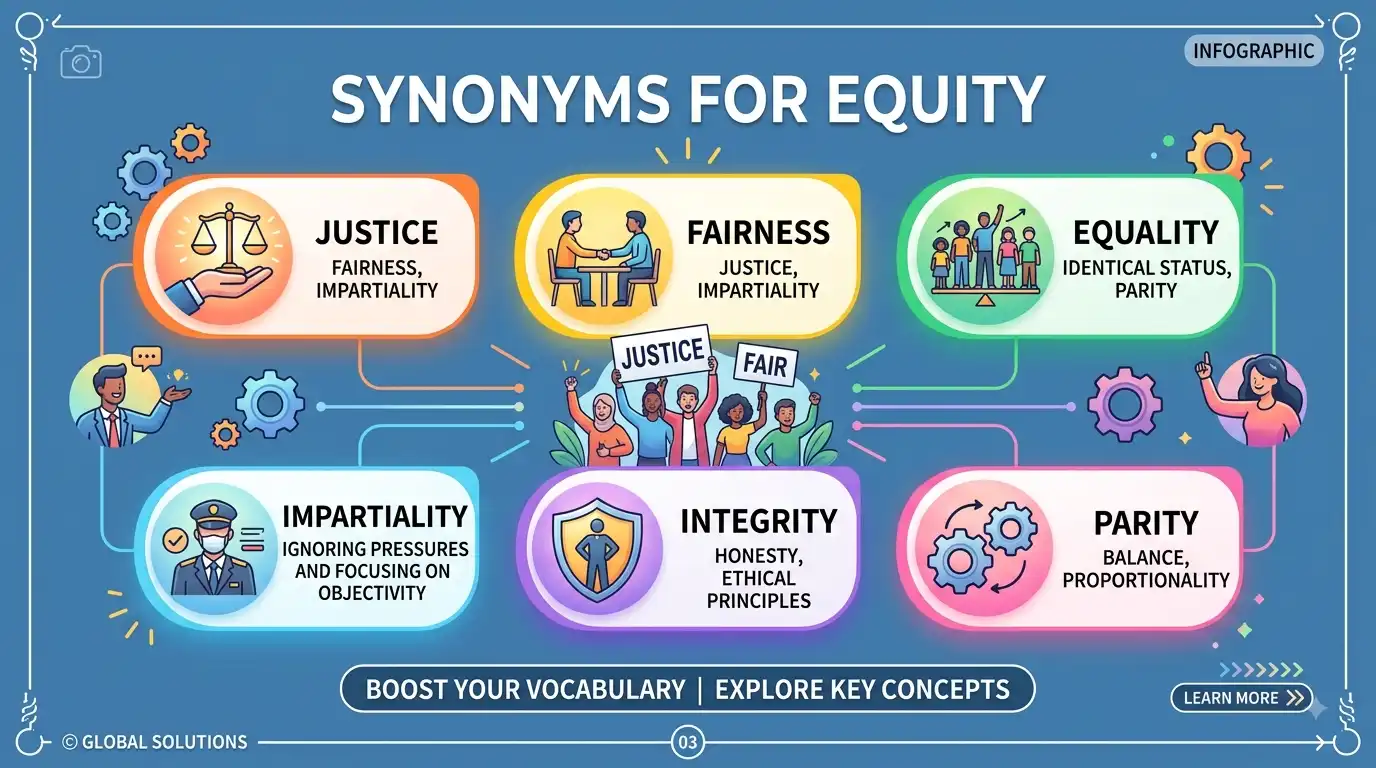
Learning diverse synonyms for equity allows you to express ideas about fairness, justice, equal opportunities, and financial value with clear precision. When you explore synonyms for equity, you gain powerful vocabulary to discuss moral fairness, school rules, law, and business ownership. Understanding different synonyms for equity helps you choose the exact right word whether you are writing an academic essay, drafting a blog post, or engaging in everyday conversations about justice.
Understanding Fairness and Value in Everyday Life
Imagine a teacher dividing group project resources among students with different learning needs. Giving every single student the exact same tool might leave some behind, but providing each student with what they specifically need to succeed creates true fairness, justice, and balance. Exploring synonyms for equity gives you precise words to describe both moral fairness in society and financial ownership in business.
In very simple English, equity means treating people fairly and giving everyone what they need to succeed, or owning a fair share of something valuable.
Why Word Choice Matters for Communicators
Expanding your vocabulary with these terms offers valuable benefits across many key areas:
- For Students: It helps you analyze social themes, civics topics, and legal concepts clearly in school essays.
- For Bloggers: It makes your articles about community issues, education, business, and ethics engaging and clear.
- For Content Writers: It allows you to write professional brand values, diversity statements, and financial articles with confidence.
- For Daily English Users: It gives you clear, respectful words to discuss rights, shared decisions, and fairness in daily life.
“Fairness is not giving everyone the exact same thing, but giving everyone what they need to thrive.”
“Choosing the precise word for justice strengthens our arguments and elevates our shared human conversation.”
Linguistic Breakdown: Etymology, Connotation, and Structure
Connotative Meaning of “Equity”
The word equity carries a strong, positive, honorable, and balanced connotation. It conveys moral rightness, unbiased decision-making, social justice, and legitimate ownership value.
Short Etymology
- Origin: Late 14th century (Middle English).
- Root: Derived from Old French equite and Latin aequitas (equality, fairness, impartiality), from aequus (even, equal, fair).
Pronunciation
- US IPA: /ˈek.wə.t̬i/
- UK IPA: /ˈek.wɪ.ti/
Syllables & Structure
- Syllables: 3 (eq – ui – ty)
- Primary Stress: First syllable (eq)
- Affixation Pattern: Root equi (equal/even) + Suffix -ty (noun suffix indicating state or quality).
Comparison Table: Choosing the Right Synonym for Equity
| Keyword | Meaning | Usage Type | Context |
| Equity | Fair treatment based on needs, or share ownership | Formal / Professional | Civics, law, finance, society |
| Fairness | Treating people without favor or judgment | General / Casual | School, games, daily life |
| Justice | Moral rightness and lawful fairness | Authoritative / Formal | Legal systems, ethics, society |
| Impartiality | Making choices without picking sides | Professional / Formal | Judges, referees, teachers |
| Equality | Giving everyone the exact same treatment | General / Formal | Rights, rules, group tasks |
| Ownership | Holding a legal right or share in property | Professional / Business | Finance, business, housing |
| Integrity | Being honest and having strong moral principles | Personal / Professional | Leadership, character, workplace |
| Balance | An even distribution of weight or fairness | General / Casual | Life, decisions, team effort |
| Honesty | Being truthful and free of deceit | General / Personal | Relationships, school, work |
| Righteousness | The quality of being morally right and fair | Traditional / Literary | Storytelling, moral debates |
50 Synonyms for Equity
1. Fairness
- Pronunciation: US /ˈfer.nəs/ | UK /ˈfeə.nəs/
- Meaning: Treating people in a way that is right and reasonable.
- Examples:
- The referee showed great fairness during the entire match.
- Our teacher insists on total fairness when grading projects.
2. Justice
- Pronunciation: US /ˈdʒʌs.tɪs/ | UK /ˈdʒʌs.tɪs/
- Meaning: Treating people according to what is morally right and fair.
- Examples:
- Everyone deserves justice regardless of their background.
- The court works daily to uphold justice for all citizens.
3. Impartiality
- Pronunciation: US /ˌɪm.pɑːrˈʃæl.ə.t̬i/ | UK /ˌɪm.pɑːˈʃæl.ə.ti/
- Meaning: Making fair decisions without picking a favorite side.
- Examples:
- A good judge must maintain strict impartiality in every case.
- We respect our monitor for her complete impartiality in disputes.
4. Objectivity
- Pronunciation: US /ˌɑːb.dʒekˈtɪv.ə.t̬i/ | UK /ˌɒb.dʒekˈtɪv.ə.ti/
- Meaning: Looking at facts without letting personal feelings interfere.
- Examples:
- Journalists should strive for objectivity when reporting news.
- Science experiments require clear objectivity to get accurate results.
5. Equality
- Pronunciation: US /iˈkwɑː.lə.t̬i/ | UK /iˈkwɒl.ə.ti/
- Meaning: Giving everyone the same rights, status, and opportunities.
- Examples:
- Our school constitution promotes equality among all students.
- They marched peacefully to demand social equality for everyone.
6. Ownership
- Pronunciation: US /ˈoʊ.nɚ.ʃɪp/ | UK /ˈəʊ.nə.ʃɪp/
- Meaning: The legal state of owning a share or piece of property.
- Examples:
- She built a strong sense of ownership in her new business.
- Home ownership gives families stability and pride.
7. Stake
- Pronunciation: US /steɪk/ | UK /steɪk/
- Meaning: A financial share or personal interest in a plan or business.
- Examples:
- He bought a ten percent stake in the local tech company.
- Every team member has a personal stake in this project’s success.
8. Share
- Pronunciation: US /ʃer/ | UK /ʃeə/
- Meaning: A portion of property or business belonging to a person.
- Examples:
- She saved her money to buy a share in the community garden.
- Everyone received a fair share of the project praise.
9. Righteousness
- Pronunciation: US /ˈraɪ.tʃəs.nəs/ | UK /ˈraɪ.tʃəs.nəs/
- Meaning: The quality of acting in a morally fair and good way.
- Examples:
- The story hero stood up for righteousness and truth.
- Acting with righteousness earns long-term respect from peers.
10. Integrity
- Pronunciation: US /ɪnˈteɡ.rə.t̬i/ | UK /ɪnˈteg.rə.ti/
- Meaning: The quality of being honest and having strong moral rules.
- Examples:
- She is trusted by all because of her high personal integrity.
- Returning the lost wallet demonstrated remarkable integrity.
11. Balance
- Pronunciation: US /ˈbæl.əns/ | UK /ˈbæl.əns/
- Meaning: A state where things are equal and evenly distributed.
- Examples:
- The coach created a perfect balance of practice and rest.
- We need a fair balance between work and outdoor play.
12. Unbiasedness
- Pronunciation: US /ʌnˈbaɪ.əst.nəs/ | UK /ʌnˈbaɪ.əst.nəs/
- Meaning: The state of not favoring one person or group over another.
- Examples:
- The survey results rely on the total unbiasedness of the questions.
- Her unbiasedness made her the perfect person to lead the debate.
13. Fair-mindedness
- Pronunciation: US /ˌferˈmaɪn.dɪd.nəs/ | UK /ˌfeəˈmaɪn.dɪd.nəs/
- Meaning: The habit of treating people fairly and listening to all sides.
- Examples:
- His fair-mindedness helped resolve the conflict smoothly.
- We appreciate the principal for her constant fair-mindedness.
14. Justness
- Pronunciation: US /ˈdʒʌst.nəs/ | UK /ˈdʒʌst.nəs/
- Meaning: The quality of being reasonable, right, and fair.
- Examples:
- No one doubted the justness of the teacher’s decision.
- The justness of the law protects innocent citizens.
15. Honesty
- Pronunciation: US /ˈɑː.nə.sti/ | UK /ˈɒn.ə.sti/
- Meaning: The quality of being truthful, sincere, and fair.
- Examples:
- Honesty is always the best foundation for friendship.
- He answered all the interview questions with complete honesty.
16. Rightness
- Pronunciation: US /ˈraɪt.nəs/ | UK /ˈraɪt.nəs/
- Meaning: The condition of being morally correct and fair.
- Examples:
- She felt a deep conviction about the rightness of her choice.
- History remembers leaders who fought for moral rightness.
17. Fair play
- Pronunciation: US /ˌfer ˈpleɪ/ | UK /ˌfeə ˈpleɪ/
- Meaning: Following rules and treating opponents fairly in games or life.
- Examples:
- Both teams received awards for demonstrating fair play.
- Respecting rules creates a culture of fair play for everyone.
18. Neutrality
- Pronunciation: US /nuːˈtræl.ə.t̬i/ | UK /njuːˈtræl.ə.ti/
- Meaning: Not supporting either side in a disagreement or war.
- Examples:
- The country maintained strict neutrality during the conflict.
- The mediator spoke with absolute neutrality to help both sides.
19. Open-mindedness
- Pronunciation: US /ˌoʊ.pənˈmaɪn.dɪd.nəs/ | UK /ˌəʊ.pənˈmaɪn.dɪd.nəs/
- Meaning: Willingness to consider new ideas and fair viewpoints.
- Examples:
- Learning requires open-mindedness and curiosity.
- Her open-mindedness allowed her to understand different perspectives.
20. Reasonableness
- Pronunciation: US /ˈriː.zən.ə.bəl.nəs/ | UK /ˈriː.zən.ə.bəl.nəs/
- Meaning: The quality of being fair, practical, and sensible.
- Examples:
- The manager showed great reasonableness regarding deadline extensions.
- Everyone agreed on the reasonableness of the new library rules.
“When we build systems rooted in genuine fairness, everyone gains the opportunity to succeed.”
21. Evenhandedness
- Pronunciation: US /ˌiː.vənˈhæn.dɪd.nəs/ | UK /ˌiː.vənˈhæn.dɪd.nəs/
- Meaning: Treating everyone equally and without bias.
- Examples:
- Her evenhandedness in settling classroom disputes earned praise.
- The captain guided the team with calm evenhandedness.
22. Disinterest
- Pronunciation: US /dɪsˈɪn.trɪst/ | UK /dɪsˈɪn.trest/
- Meaning: Freedom from self-interest or personal bias in a choice.
- Examples:
- A judge must act with total disinterest regarding the trial’s outcome.
- Her professional disinterest allowed her to audit the accounts fairly.
23. Proportion
- Pronunciation: US /prəˈpɔːr.ʃən/ | UK /prəˈpɔː.ʃən/
- Meaning: A fair or correct relationship between parts of a whole.
- Examples:
- Each worker received a reward in direct proportion to their effort.
- Keeping things in proper proportion prevents minor problems from growing.
24. Symmetry
- Pronunciation: US /ˈsɪm.ə.tri/ | UK /ˈsɪm.ə.tri/
- Meaning: Having equal, balanced, and harmonious parts on all sides.
- Examples:
- The design showed a beautiful symmetry in its balanced shapes.
- There is a pleasant symmetry in sharing tasks equally.
25. Parity
- Pronunciation: US /ˈpær.ə.t̬i/ | UK /ˈpær.ə.ti/
- Meaning: The state of being equal, especially in pay, status, or power.
- Examples:
- The athletes trained hard to achieve pay parity in sports.
- Both teams reached skill parity after months of practice.
26. Propriety
- Pronunciation: US /prəˈpraɪə.t̬i/ | UK /prəˈpraɪə.ti/
- Meaning: Following correct, polite, and morally proper behavior.
- Examples:
- She behaved with complete propriety during the formal ceremony.
- The board maintained high standards of professional propriety.
27. Uprightness
- Pronunciation: US /ˈʌp.raɪt.nəs/ | UK /ˈʌp.raɪt.nəs/
- Meaning: Honest and moral behavior that earns respect.
- Examples:
- His personal uprightness made him a great community role model.
- She was rewarded for her continuous moral uprightness.
28. Truthfulness
- Pronunciation: US /ˈtruːθ.fəl.nəs/ | UK /ˈtruːθ.fəl.nəs/
- Meaning: The habit of speaking and acting according to truth.
- Examples:
- Her truthfulness made her testimony convincing to the jury.
- Always practice truthfulness in your school assignments.
29. Candor
- Pronunciation: US /ˈkæn.dɚ/ | UK /ˈkæn.də/
- Meaning: Honest, open, and sincere expression without hiding facts.
- Examples:
- We appreciated her helpful candor during the team review.
- He answered our questions with refreshing candor.
30. Moral sense
- Pronunciation: US /ˈmɔːr.əl sens/ | UK /ˈmɒr.əl sens/
- Meaning: The inner ability to know right from wrong and act fairly.
- Examples:
- A strong moral sense guides her decisions as a leader.
- Reading good stories helps children develop a healthy moral sense.
31. Rectitude
- Pronunciation: US /ˈrek.tə.tuːd/ | UK /ˈrek.tɪ.tjuːd/
- Meaning: Correctness of judgment and strong moral character.
- Examples:
- The judge was famous for his absolute moral rectitude.
- She handled the difficult choice with remarkable rectitude.
32. Properness
- Pronunciation: US /ˈprɑː.pɚ.nəs/ | UK /ˈprɒp.ə.nəs/
- Meaning: Being correct, suitable, and strictly fair according to rules.
- Examples:
- The committee verified the properness of the voting process.
- He paid attention to the properness of his formal uniform.
33. Legitimacy
- Pronunciation: US /ləˈdʒɪt̬.ə.mə.si/ | UK /ləˈdʒɪt.ə.mə.si/
- Meaning: The quality of being lawful, fair, and accepted as right.
- Examples:
- The fair election proved the legitimacy of the new government.
- Evidence was presented to support the legitimacy of their claim.
34. Due process
- Pronunciation: US /duː ˈprɑː.ses/ | UK /djuː ˈprəʊ.ses/
- Meaning: Fair and proper treatment through established legal systems.
- Examples:
- Every accused person has a constitutional right to due process.
- Following due process guarantees that everyone gets a fair hearing.
35. Investment
- Pronunciation: US /ɪnˈvest.mənt/ | UK /ɪnˈvest.mənt/
- Meaning: Putting effort, money, or time into something to gain value.
- Examples:
- Education is the best investment you can make for your future.
- They put time and financial investment into their new home.
36. Title
- Pronunciation: US /ˈtaɪ.t̬əl/ | UK /ˈtaɪ.təl/
- Meaning: The legal right of ownership to a piece of property.
- Examples:
- They received the official title after paying off the house loan.
- He holds the title to the family farm.
37. Assets
- Pronunciation: US /ˈæs.ets/ | UK /ˈæs.ets/
- Meaning: Valuable items, property, or resources owned by a person or firm.
- Examples:
- The bank evaluated all the company assets before approving the loan.
- Knowledge and teamwork are valuable assets in any school group.
38. Capital
- Pronunciation: US /ˈkæp.ə.t̬əl/ | UK /ˈkæp.ɪ.təl/
- Meaning: Wealth or property used to start a project or business.
- Examples:
- The young entrepreneurs raised capital to start their green business.
- Investing capital in local parks benefits the whole community.
39. Net worth
- Pronunciation: US /net wɝːθ/ | UK /net wɜːθ/
- Meaning: The total value of assets owned minus debts owed.
- Examples:
- Owning a home contributed directly to their family net worth.
- Financial planning helps people manage and grow their net worth.
40. Holding
- Pronunciation: US /ˈhoʊl.dɪŋ/ | UK /ˈhəʊl.dɪŋ/
- Meaning: Land or property shares legally owned by a person or group.
- Examples:
- The family maintained a small land holding in the valley.
- Her main financial holding was a share in the organic bakery.
41. Principal
- Pronunciation: US /ˈprɪn.sə.pəl/ | UK /ˈprɪn.sə.pəl/
- Meaning: The original sum of money invested or owned, excluding interest.
- Examples:
- She paid off part of the principal balance on her loan.
- Protecting your principal is important when managing savings.
42. Valuation
- Pronunciation: US /ˌvæl.juˈeɪ.ʃən/ | UK /ˌvæl.juˈeɪ.ʃən/
- Meaning: An estimation of how much something is worth in money.
- Examples:
- An expert came to perform an official valuation of the house.
- The tech startup achieved a high valuation after launching its app.
43. Measure
- Pronunciation: US /ˈmeʒ.ɚ/ | UK /ˈmeʒ.ə/
- Meaning: A fair and balanced standard used to judge or assess things.
- Examples:
- Kindness is a true measure of a person’s character.
- We need a fair measure to evaluate everyone’s effort equally.
44. Distribution
- Pronunciation: US /ˌdɪs.trəˈbjuː.ʃən/ | UK /ˌdɪs.trɪˈbjuː.ʃən/
- Meaning: The act of sharing or dividing resources among a group.
- Examples:
- The fair distribution of books ensured every student had one.
- Volunteers managed the distribution of warm coats during winter.
45. Shareholding
- Pronunciation: US /ˈʃerˌhoʊl.dɪŋ/ | UK /ˈʃeəˌhəʊl.dɪŋ/
- Meaning: Ownership of shares in a company or cooperative organization.
- Examples:
- Workers received a small shareholding in the growing farm cooperative.
- She expanded her shareholding by investing her savings wisely.
46. Good faith
- Pronunciation: US /ɡʊd ˈfeɪθ/ | UK /ɡʊd ˈfeɪθ/
- Meaning: Honest intention and fairness without any plan to deceive.
- Examples:
- Both sides signed the agreement in complete good faith.
- Showing good faith helps settle disagreements quickly.
47. Non-partisanship
- Pronunciation: US /nɑːnˈpɑːr.t̬ə.zən.ʃɪp/ | UK /nɒnˈpɑː.tɪ.zæn.ʃɪp/
- Meaning: The state of not being biased toward any political party or group.
- Examples:
- The election committee maintained strict non-partisanship.
- School councils function best when guided by non-partisanship.
48. Level playing field
- Pronunciation: US /ˈlev.əl ˈpleɪ.ɪŋ fiːld/ | UK /ˈlev.əl ˈpleɪ.ɪŋ fiːld/
- Meaning: A situation where everyone has the same fair opportunities to succeed.
- Examples:
- Providing free study materials creates a level playing field for students.
- Clear rules ensure a level playing field for all competitors.
49. Reasonable treatment
- Pronunciation: US /ˈriː.zən.ə.bəl ˈtriːt.mənt/ | UK /ˈriː.zən.ə.bəl ˈtriːt.mənt/
- Meaning: Fair, sensible, and respectful care shown to everyone.
- Examples:
- Every worker has the right to receive reasonable treatment.
- Kindness and reasonable treatment make every classroom welcoming.
50. Evenness
- Pronunciation: US /ˈiː.vən.nəs/ | UK /ˈiː.vən.nəs/
- Meaning: The quality of being equal, steady, smooth, and fair.
- Examples:
- Her evenness of temper kept the discussion calm and peaceful.
- The referee managed the game with steady evenness.
Antonyms of Equity
To understand a concept completely, it is equally helpful to examine its direct opposites. Where equity means fairness, justice, and balanced value, its antonyms represent unfairness, bias, and harm:
- Inequity: Lack of fairness or justice in treatment or distribution.
- Unfairness: Treatment that is biased, unequal, or unjust.
- Bias: An unfair preference for or against one person or group.
- Injustice: A violation of rights or an unfair, harmful action.
- Partiality: Favoring one side or person over another unfairly.
- Discrimination: Unfair treatment of people based on categories rather than character.
Prototype Meaning and Categorization of Equity
In cognitive linguistics, a prototype represents the central, most typical example of a category. The central prototype of the word equity is the practice of treating people fairly by giving everyone what they specifically need to thrive, or holding a legitimate, fair share of value. Depending on the speaker’s tone, context, and intention, synonyms for equity naturally fall into three primary written categories:
1. Social and Moral Fairness This category includes terms used when discussing human rights, ethical choices, and community balance. Words such as fairness, justice, impartiality, evenhandedness, fair play, and level playing field represent prototype choices in civics classes, community discussions, and essays about social justice.
2. Legal and Ethical Standards This group focuses on formal words used in rules, governance, and institutional decision-making. Synonyms like objectivity, neutrality, rectitude, legitimacy, due process, and propriety are typically used in courtroom settings, official policies, academic research, and legal documentation to emphasize formal adherence to law and ethics.
3. Financial Share and Property Ownership This category consists of business and economic terms describing ownership, value, and shared assets. Descriptors such as ownership, stake, share, assets, capital, and net worth allow writers to discuss financial planning, business growth, home buying, and investment strategies with clear commercial accuracy.
Frequently Asked Questions (FAQ)
1. What is the main difference between “equity” and “equality”?
While equality means giving everyone the exact same resources or treatment, equity means distributing resources fairly based on what each person specifically needs to achieve an equal outcome.
2. What does “equity” mean in business and finance?
In business, equity represents the financial value of ownership in a company, house, or property after subtracting all debts and liabilities owed.
3. What is a good formal synonym for equity in legal writing?
In legal documents and formal essays, effective synonyms for equity include justice, impartiality, due process, legitimacy, and rectitude.
4. What are casual synonyms for equity to use in daily conversation?
In daily speech, simple and relatable synonyms for equity include fairness, fair play, honesty, balance, and open-mindedness.
5. Can “stake” be used as a synonym for equity?
Yes! In business and team contexts, having a stake means owning a share, interest, or direct involvement in the success of a business or project.
Conclusion
Expanding your vocabulary with this comprehensive collection of synonyms for equity is a wonderful way to elevate your writing, public speaking, and everyday communication. Whether you choose moral terms like fairness and justice, formal words like impartiality and due process, or business terms like ownership and stake, selecting the precise word makes your meaning clear, persuasive, and memorable.
For students writing social studies papers or literature essays, using diverse synonyms for equity prevents repetitive phrasing and shows a mature understanding of fairness and community values, bloggers and content writers, replacing generic words with vivid alternatives keeps your readers engaged and enriches your commentary, everyday speakers, having a broad vocabulary of fairness helps you advocate for yourself and others with respect and confidence.
Try practicing two or three of these meaningful new words this week in your class discussions, school essays, or personal journal entries!
“A rich vocabulary empowers us to stand up for justice and express fairness with clarity.”
“Words shape our understanding of fairness, helping us build more balanced communities.”
“Exploring synonyms turns simple statements into thoughtful, impactful expression.”

Andrew Powell is a travel writer and nature journalist who has spent over a decade writing about places, landscapes, and the natural world — and thinking carefully about the words that do those subjects justice ( Biography ).