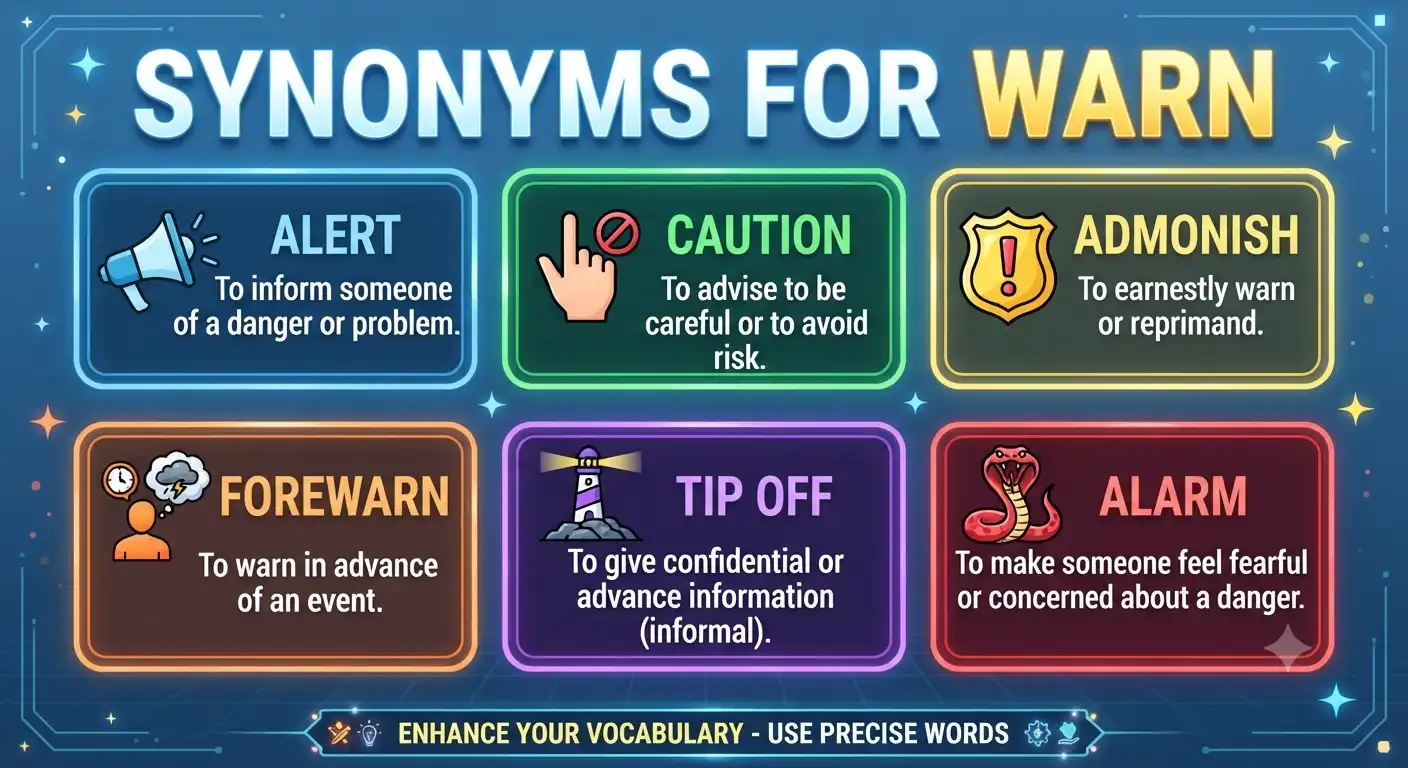
When you need to stop someone from making a big mistake, discovering the best synonyms for warn helps you speak with clear power. Learning synonyms for warn gives you fresh ways to talk about safety, danger, and friendly advice. Using different synonyms for warn keeps your writing active, sharp, and exciting to read.
Imagine you are walking down a quiet forest path with a friend. Suddenly, you see a deep, hidden hole right in front of them. You pull their arm and tell them to stop. That quick action is a simple way to warn them. In very simple English, to warn someone means to tell them about a danger or a problem that might happen soon so they can stay safe.
This vocabulary guide is highly useful. Students can write better papers and creative stories. Bloggers can keep readers hooked with strong, emotional advice. Content writers can build professional copy that gets trust from readers. Daily English users can speak with greater confidence in any conversation. Changing your words helps you share your thoughts with clarity and power.
“The best way to warn people is to show them the path of safety.” — Unknown
“He who warns us is our true friend on the journey of life.” — Proverb
Linguistic Overview of “Warn”
To help you fully master this concept, let us look closely at the linguistic background and structure of our focus keyword.
- Connotative Meaning: Evokes safety, care, protection, urgency, and helpful guidance.
- Etymology:
- Origin: From Old English warnian (meaning “to take heed” or “to guard”).
- Evolution: Connected to the Proto-Germanic word warōną (meaning “to watch out”) before entering Middle English.
- Pronunciation:
- US IPA: /wɔːrn/
- UK IPA: /wɔːn/
- Syllables: warn (1 syllable)
- Affixation Pattern:
- Prefix: None.
- Root: warn.
- Suffix: None.
Comparison Table
| Keyword | Meaning | Usage Type | Context |
|---|---|---|---|
| Warn | To tell someone about a danger before it happens. | Casual/Professional | Safety signs, family advice, and weather alerts. |
| Caution | To advise someone to be very careful. | Formal/Professional | Traffic signs, laboratory rules, and money advice. |
| Alert | To make someone ready for sudden action. | Formal/Professional | Emergency situations, storms, and security updates. |
| Admonish | To gently scold or advise someone about a mistake. | Formal/Emotional | School classrooms, parenting, and deep personal talks. |
| Forewarn | To warn someone a long time before an event. | Formal | Travel plans, storm preparation, and big business changes. |
| Threaten | To warn that you will hurt or punish someone. | Casual/Emotional | Angry arguments, strict rules, and physical danger. |
50 Synonyms for Warn
1. Caution
- Pronunciation: US: /ˈkɑː.ʃən/ | UK: /ˈkɔː.ʃən/
- Meaning: To advise someone to be very careful so they do not make a mistake.
- Examples:
- The school teacher wanted to caution us about the wet floor.
- I must caution you before you buy that cheap car.
2. Alert
- Pronunciation: US: /əˈlɝːt/ | UK: /əˈlɜːt/
- Meaning: To tell someone about a sudden danger or new problem.
- Examples:
- The loud siren will alert the town if a storm comes.
- Please alert the police if you see anything strange.
3. Advise
- Pronunciation: US: /ədˈvaɪz/ | UK: /ədˈvaɪz/
- Meaning: To give good ideas to help someone make a choice.
- Examples:
- My doctor did advise me to eat fresh green apples.
- I advise you to study hard for your science test.
4. Admonish
- Pronunciation: US: /ædˈmɑː.nɪʃ/ | UK: /ədˈmɒn.ɪʃ/
- Meaning: To tell someone gently that they did something wrong.
- Examples:
- Parents often admonish their kids for running in the house.
- The coach will admonish any player who is late.
5. Forewarn
- Pronunciation: US: /fɔːrˈwɔːrn/ | UK: /fɔːˈwɔːn/
- Meaning: To warn someone about a problem before it actually happens.
- Examples:
- The news did forewarn us about the heavy winter snow.
- I want to forewarn you that the test is hard.
6. Tip off
- Pronunciation: US: /tɪp ɔːf/ | UK: /tɪp ɒf/
- Meaning: To give secret information to help someone prepare.
- Examples:
- A friendly clerk did tip off the shoppers about the big sale.
- Someone will tip off the police about the bank thief.
7. Remind
- Pronunciation: US: /rɪˈmaɪnd/ | UK: /rɪˈmaɪnd/
- Meaning: To help someone remember a duty or a safety rule.
- Examples:
- Please remind me to lock the back door tonight.
- I must remind you that our homework is due tomorrow.
8. Notify
- Pronunciation: US: /ˈnoʊ.t̬ə.faɪ/ | UK: /ˈnəʊ.tɪ.faɪ/
- Meaning: To send an official message about a fact or event.
- Examples:
- The company will notify you when your package arrives.
- You must notify the school if you are sick.
9. Counsel
- Pronunciation: US: /ˈkaʊn.səl/ | UK: /ˈkaʊn.səl/
- Meaning: To talk with someone to give them wise advice.
- Examples:
- Wise leaders counsel their followers during tough times.
- My parents counsel me when I feel very sad.
10. Threaten
- Pronunciation: US: /ˈθretn/ | UK: /ˈθretn/
- Meaning: To say you will cause harm if someone does not listen.
- Examples:
- Dark clouds threaten to bring a cold rain storm.
- Do not threaten to leave if you want to help.
11. Signal
- Pronunciation: US: /ˈsɪɡ.nəl/ | UK: /ˈsɪɡ.nəl/
- Meaning: To make a movement or sound that shows danger.
- Examples:
- The lighthouse will signal to ships near the rocks.
- Wave your hands to signal that you need help.
12. Flag
- Pronunciation: US: /flæɡ/ | UK: /flæɡ/
- Meaning: To point out a mistake or problem so people notice it.
- Examples:
- The computer will flag any words that are spelled wrong.
- Please flag the broken chairs in the classroom.
13. Apprise
- Pronunciation: US: /əˈpraɪz/ | UK: /əˈpraɪz/
- Meaning: To tell someone the latest news about a situation.
- Examples:
- Keep me near so you can apprise me of changes.
- The captain will apprise the crew about the wind.
14. Wave off
- Pronunciation: US: /weɪv ɔːf/ | UK: /weɪv ɒf/
- Meaning: To use hand motions to stop someone from coming near.
- Examples:
- The guard will wave off cars at the closed gate.
- I tried to wave off my sister before she fell.
15. Alarm
- Pronunciation: US: /əˈlɑːrm/ | UK: /əˈlɑːm/
- Meaning: To make someone feel worried about a sudden danger.
- Examples:
- The loud smoke detector will alarm the sleeping family.
- Do not alarm the baby with that loud noise.
16. Reprimand
- Pronunciation: US: /ˈrep.rə.mænd/ | UK: /ˈrep.rɪ.mɑːnd/
- Meaning: To speak in a sharp way to someone who broke a rule.
- Examples:
- The boss will reprimand workers who do not finish tasks.
- Do not make me reprimand you in front of friends.
17. Chide
- Pronunciation: US: /tʃaɪd/ | UK: /tʃaɪd/
- Meaning: To find fault with someone in a gentle way.
- Examples:
- She will chide her cat for jumping on the table.
- My friends chide me when I forget my keys.
18. Scold
- Pronunciation: US: /skoʊld/ | UK: /skəʊld/
- Meaning: To speak angrily to a child or animal for bad behavior.
- Examples:
- My grandmother will scold us if we muddy the carpet.
- The gardener had to scold the kids for picking flowers.
19. Deter
- Pronunciation: US: /dɪˈtɝː/ | UK: /dɪˈtɜː/
- Meaning: To make someone stop an action by showing the danger.
- Examples:
- A tall fence will deter dogs from entering the yard.
- High prices deter people from buying expensive toys.
20. Discourage
- Pronunciation: US: /dɪˈskɝː.ɪdʒ/ | UK: /dɪˈskʌr.ɪdʒ/
- Meaning: To advise someone against doing a bad or risky plan.
- Examples:
- I want to discourage you from walking in the dark.
- The teachers discourage students from skipping their lunch.
21. Forebode
- Pronunciation: US: /fɔːrˈboʊd/ | UK: /fɔːˈbəʊd/
- Meaning: To act as a sign that something bad is coming.
- Examples:
- Those dry leaves forebode a long and hot summer.
- Her sad eyes forebode that bad news is coming.
22. Portend
- Pronunciation: US: /pɔːrˈtend/ | UK: /pɔːˈtend/
- Meaning: To show a warning sign of an upcoming dark event.
- Examples:
- Heavy black clouds portend a very bad storm tonight.
- These quiet streets portend trouble for our small town.
23. Presage
- Pronunciation: US: /ˈpres.ɪdʒ/ | UK: /ˈpres.ɪdʒ/
- Meaning: To show or warn about a future event before it happens.
- Examples:
- Cold winds presage the arrival of winter weather.
- Wild bird calls presage a change in the forest.
24. Hint
- Pronunciation: US: /hɪnt/ | UK: /hɪnt/
- Meaning: To say something in an indirect way to give a warning.
- Examples:
- She tried to hint that the boss was very angry.
- The dark sky did hint that we should go home.
25. Suggest
- Pronunciation: US: /səɡˈdʒest/ | UK: /səˈdʒest/
- Meaning: To mention an idea softly so someone can avoid trouble.
- Examples:
- I suggest you take an umbrella with you today.
- The map did suggest that we turn left here.
“To forewarn a friend is to arm them against the storm.” — Classic Saying
26. Prompt
- Pronunciation: US: /prɑːmpt/ | UK: /prɒmpt/
- Meaning: To help someone act quickly to avoid making a mistake.
- Examples:
- A quiet look from mom will prompt us to behave.
- Clear signs prompt drivers to slow down at curves.
27. Remonstrate
- Pronunciation: US: /rɪˈmɑːn.streɪt/ | UK: /rɪˈmɒn.streɪt/
- Meaning: To present strong reasons against an action someone is doing.
- Examples:
- The angry crowd did remonstrate against the new high tax.
- I had to remonstrate with him about his wild driving.
28. Exhort
- Pronunciation: US: /ɪɡˈzɔːrt/ | UK: /ɪɡˈzɔːt/
- Meaning: To urge someone strongly to do the right, safe thing.
- Examples:
- The coaches exhort the players to play fair games.
- I exhort you to keep working on your goals.
29. Prepare
- Pronunciation: US: /prɪˈper/ | UK: /prɪˈpeər/
- Meaning: To make someone ready for a coming danger or task.
- Examples:
- This quick class will prepare you for the road test.
- We must prepare the house before the big wind comes.
30. Safeguard
- Pronunciation: US: /ˈseɪf.ɡɑːrd/ | UK: /ˈseɪf.ɡɑːd/
- Meaning: To protect someone or something from a known danger.
- Examples:
- Good locks will safeguard your house from sneaky thieves.
- We must safeguard our young pets from the cold night.
31. Disabuse
- Pronunciation: US: /ˌdɪs.əˈbjuːz/ | UK: /ˌdɪs.əˈbjuːz/
- Meaning: To tell someone the truth to free them from a bad idea.
- Examples:
- Let me disabuse you of the idea that this is easy.
- The teacher will disabuse the kids of their silly myths.
32. Highlight
- Pronunciation: US: /ˈhaɪ.laɪt/ | UK: /ˈhaɪ.laɪt/
- Meaning: To draw special attention to a risk or bad point.
- Examples:
- The bright red sign will highlight the deep pit.
- I want to highlight the dangers of eating bad meat.
33. Urge
- Pronunciation: US: /ɝːdʒ/ | UK: /ɜːdʒ/
- Meaning: To advise someone with great passion and strong words.
- Examples:
- Doctors urge patients to drink fresh water every single day.
- My parents urge me to drive slowly on icy roads.
34. Call out
- Pronunciation: US: /kɔːl aʊt/ | UK: /kɔːl aʊt/
- Meaning: To say a warning loudly so someone hears you.
- Examples:
- Be sure to call out if you see a big snake.
- The workers call out when heavy boxes are falling.
35. Point out
- Pronunciation: US: /pɔɪnt aʊt/ | UK: /pɔɪnt aʊt/
- Meaning: To show someone a danger that they did not see yet.
- Examples:
- He was kind to point out the ice on the sidewalk.
- Let me point out the mistakes in your essay draft.
36. Inform
- Pronunciation: US: /ɪnˈfɔːrm/ | UK: /ɪnˈfɔːm/
- Meaning: To give useful facts or news about a dangerous situation.
- Examples:
- Please inform us if the forest trail is blocked.
- We must inform the family about the approaching storm.
37. Guide
- Pronunciation: US: /ɡaɪd/ | UK: /ɡaɪd/
- Meaning: To lead someone safely past bad spots on a path.
- Examples:
- This map will guide you away from the busy streets.
- Let me guide you so you do not get lost.
38. Direct
- Pronunciation: US: /daɪˈrekt/ | UK: /daɪˈrekt/
- Meaning: To give clear orders that keep someone out of danger.
- Examples:
- Officers direct cars away from the bad road crash.
- The sign will direct walkers to the safe bridge.
39. Prevent
- Pronunciation: US: /prɪˈvent/ | UK: /prɪˈvent/
- Meaning: To stop a bad thing or accident from happening.
- Examples:
- Salt on the steps will prevent you from falling.
- Good food can prevent you from getting very sick.
40. Scare
- Pronunciation: US: /sker/ | UK: /skeər/
- Meaning: To make someone afraid so they do not do something bad.
- Examples:
- The hot stove will scare the baby from touching it.
- Loud thunder can scare hikers off the mountain top.
41. Signpost
- Pronunciation: US: /ˈsaɪn.poʊst/ | UK: /ˈsaɪn.pəʊst/
- Meaning: To provide clear markers that show an upcoming problem.
- Examples:
- Authors signpost the scary parts of their book early.
- We must signpost the muddy parts of the path.
42. Foreshadow
- Pronunciation: US: /fɔːrˈʃæd.oʊ/ | UK: /fɔːˈbəʊd/
- Meaning: To show a quiet hint of trouble that comes later.
- Examples:
- Dark music in the movie did foreshadow the monster.
- These minor issues foreshadow a bigger problem for us.
43. Wake up
- Pronunciation: US: /weɪk ʌp/ | UK: /weɪk ʌp/
- Meaning: To tell someone to pay close attention to reality.
- Examples:
- You need to wake up and see that he is lying.
- Wake up before you lose all your hard-earned money!
44. Enlighten
- Pronunciation: US: /ɪnˈlaɪ.t̬ən/ | UK: /ɪnˈlaɪ.tən/
- Meaning: To give someone the true facts to save them from a trap.
- Examples:
- Please enlighten me about the risks of this deal.
- The wise speaker will enlighten us about the scam.
45. Correct
- Pronunciation: US: /kəˈrekt/ | UK: /kəˈrekt/
- Meaning: To show someone their error before they get into trouble.
- Examples:
- I want to correct your form before you hurt your back.
- The editor will correct your writing before it prints.
46. Underline
- Pronunciation: US: /ˌʌn.dɚˈlaɪn/ | UK: /ˌʌn.dəˈlaɪn/
- Meaning: To show that a point or warning is very important.
- Examples:
- I must underline the safety rules of this pool.
- The news reports underline the danger of the rising river.
47. Sound
- Pronunciation: US: /saʊnd/ | UK: /saʊnd/
- Meaning: To make a loud noise to tell everyone about a danger.
- Examples:
- The guards will sound the horn if they see a fire.
- You must sound the alarm when the system fails.
48. Forbid
- Pronunciation: US: /fɚˈbɪd/ | UK: /fəˈbɪd/
- Meaning: To tell someone in a strict way that they cannot do a thing.
- Examples:
- My parents forbid us from playing near the busy highway.
- Doctors forbid patients with heart issues from drinking coffee.
49. Block
- Pronunciation: US: /blɑːk/ | UK: /blɒk/
- Meaning: To stand in the way to stop someone from going into danger.
- Examples:
- Fallen trees block cars from driving up the high mountain.
- The guard will block you from entering the hot room.
50. Scream
- Pronunciation: US: /skriːm/ | UK: /skriːm/
- Meaning: To cry out in a loud, sharp voice during a scary moment.
- Examples:
- I had to scream when the car came too close to us.
- Scream if you need me to come help you in the yard.
Antonyms of “Warn”
To help you understand the full range of this vocabulary, here are the most common antonyms for our focus term:
- Encourage: To tell someone to do something with hope and joy.
- Approve: To agree that an action is good and should happen.
- Neglect: To fail to care for, watch, or tell someone about danger.
- Mislead: To give wrong information on purpose to trick someone.
- Condone: To allow bad behavior to happen without stopping it.
Prototype Meaning and Categorization
At its core, warn describes the act of looking out for others to keep them safe. Linguists place this word under categories of social protection, safety alerting, and guiding correction.
It is split into three main categories:
- Gentle & Caring Warnings: Words that represent soft advice or friendly reminders, such as caution, advise, remind, counsel, hint, suggest, and prompt.
- Official & Urgent Warnings: Words for professional, immediate, or serious situations, such as alert, notify, signal, flag, apprise, alarm, and prepare.
- Strong & Corrective Warnings: Words for stopping bad behavior or serious threats, such as admonish, threaten, reprimand, chide, scold, deter, and discourage.
Frequently Asked Questions
What is the best synonym for warn in a formal business report?
The best formal terms to use in a professional report are advise, notify, or apprise. These terms keep your writing smart, clean, and highly professional.
Can “warn” be used in a positive way?
Yes, absolutely. Warning someone shows that you care about their safety. Using gentle words like caution or guide shows deep care and support.
Is “threaten” always a bad synonym for warn?
Usually, yes. While warning protects someone from a separate danger, threaten means you are the one who will cause the trouble if they do not obey.
What is an old-fashioned word for warn?
In classic books, words like forewarn, presage, and admonish are beautiful, classic choices to show characters receiving timely advice.
How do I warn someone without sounding rude?
You should use soft words like suggest, remind, or point out. These words feel like friendly help rather than strict commands.
Why do we use different synonyms for warn?
Using different words helps you show the exact level of danger. Saying a storm will “alert” a town sounds much more urgent than saying it will “hint” at rain.
Conclusion
Learning to use different synonyms for warn is one of the easiest ways to improve your general writing, blogging, public speaking, and daily communication. When you swap out repetitive words for precise, engaging terms, you paint a vivid, colorful picture for your audience. Your words instantly become more exciting to read and listen to.
We highly encourage you to start practicing these new words today. Try using words like “caution,” “admonish,” or “forewarn” in your business emails, school essays, and daily conversations. You will quickly notice how much more professional, confident, and warm you sound to others, helping you build deeper bridges of safety and trust wherever you go.
“A word of warning spoken in love is a shield for the soul.” — Unknown
“He who listens to a timely warning builds a safe house.” — African Proverb

Andrew Powell is a travel writer and nature journalist who has spent over a decade writing about places, landscapes, and the natural world — and thinking carefully about the words that do those subjects justice ( Biography ).