Have you ever watched a colorful leaf float slowly down a quiet stream? It goes wherever the water takes it. This easy, floating movement is a perfect example of how things drift. But using the same word over and over can make your writing feel very boring. Are you looking for the best synonyms for drift to boost your writing skills?
To drift simply means to move slowly with no clear direction. Learning synonyms for drift is highly useful for everyone. Students can get better grades on school essays. Bloggers and content writers can make their articles much more exciting. Daily English users can express themselves clearly in chat. Let us explore these fifty amazing words!
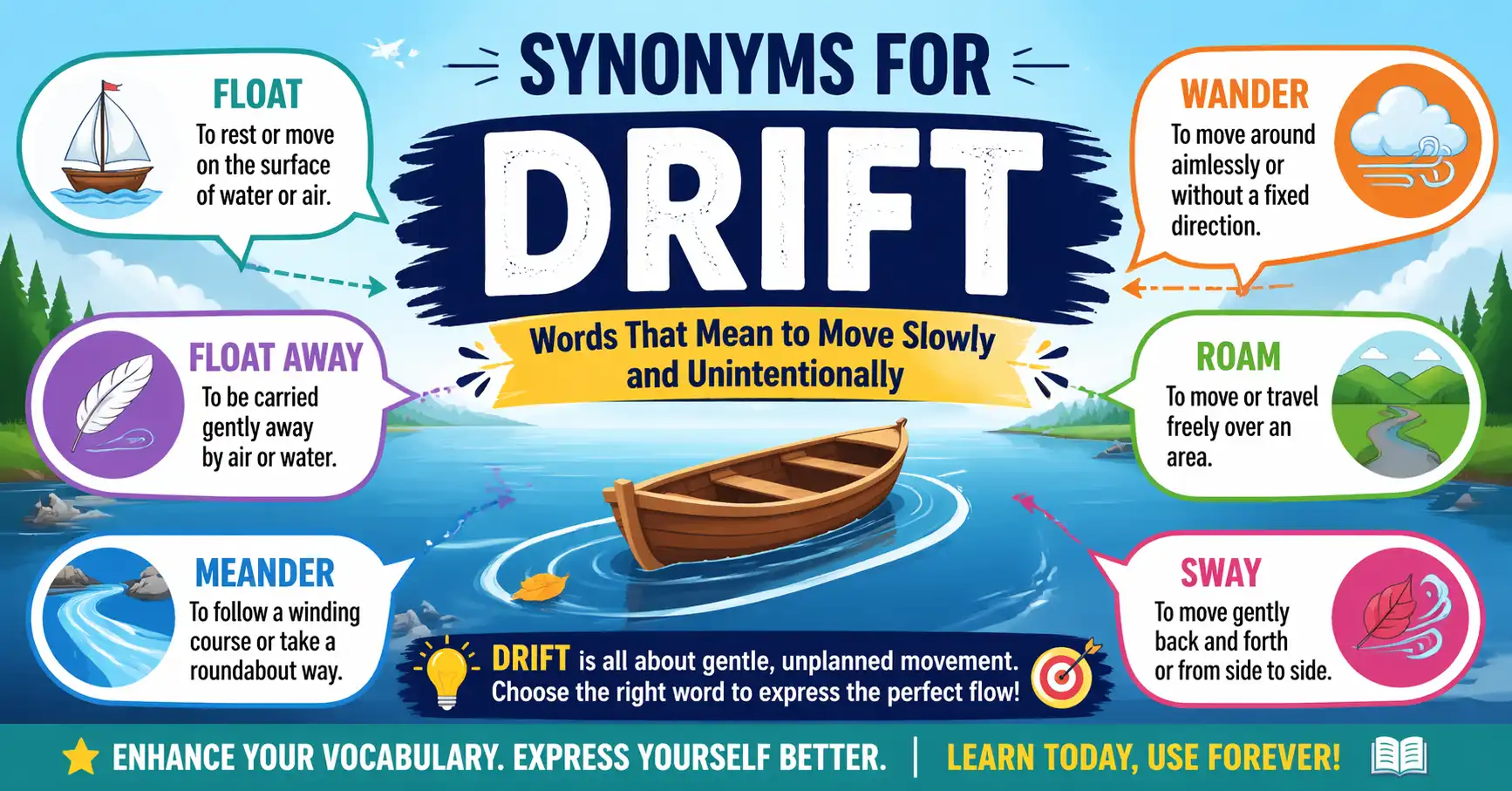
1. Float
Meaning: To move slowly through the air or on top of water.
Examples:
- The red balloon began to float up into the blue sky.
- Wood logs can float on the cold lake water.
2. Wander
Meaning: To walk around slowly without any clear direction or goal.
Examples:
- We like to wander through the quiet woods on Sundays.
- The sheep wander across the green grassy hills.
3. Stray
Meaning: To move away from the correct path or group.
Examples:
- Do not stray too far from the hiking trail.
- A few cows often stray from the main herd.
4. Meander
Meaning: To follow a winding path with many twists and turns.
Examples:
- The small river tends to meander through the valley.
- We watched the path meander up the high mountain.
5. Roam
Meaning: To travel widely over a large area without a plan.
Examples:
- Wild horses roam free across the open plains.
- I love to roam around new cities on vacation.
6. Glide
Meaning: To move in a smooth and easy way without effort.
Examples:
- The ice skater can glide across the ice quickly.
- Large birds glide silently through the warm air.
7. Coast
Meaning: To move along easily without using any power or fuel.
Examples:
- We can coast down the steep hill on our bikes.
- The boat will coast to a stop near the dock.
8. Sail
Meaning: To travel across water or move smoothly like a boat.
Examples:
- White clouds sail across the sunny sky.
- We want to sail around the beautiful islands.
9. Cruise
Meaning: To travel along at a steady and comfortable speed.
Examples:
- We like to cruise down the highway with the music playing.
- The ship will cruise to the warm southern seas.
10. Amble
Meaning: To walk at a very slow and relaxed pace.
Examples:
- The old friends amble along the sandy beach.
- We decided to amble through the park after dinner.
11. Saunter
Meaning: To walk in a slow, confident, and proud way.
Examples:
- He would saunter into the room with a big smile.
- They saunter down the street on sunny afternoons.
12. Stroll
Meaning: To take a slow and pleasant walk for fun.
Examples:
- Let us take a short stroll around the garden.
- Families stroll through the market to buy fresh food.
13. Ramble
Meaning: To walk for pleasure or talk for a long time without a clear point.
Examples:
- They ramble through the countryside every weekend.
- Sometimes my uncle will ramble on about his childhood.
14. Veer
Meaning: To change direction very quickly.
Examples:
- The car had to veer left to miss the pothole.
- The wind will veer to the north tonight.
15. Swerve
Meaning: To turn aside sharply to avoid hitting something.
Examples:
- I had to swerve my bike to miss the cat.
- The driver did swerve when the deer ran out.
16. Shift
Meaning: To move or change from one position to another.
Examples:
- You need to shift your weight to stay balanced.
- The sands shift constantly in the dry desert.
17. Deviate
Meaning: To do something different from the usual path or rule.
Examples:
- We should not deviate from our original plan.
- The plane had to deviate from its flight path.
18. Diverge
Meaning: To go in different directions from a single point.
Examples:
- The two paths diverge near the old oak tree.
- Our opinions on the movie began to diverge.
19. Skew
Meaning: To turn or twist out of a straight line.
Examples:
- Do not skew the picture frame on the wall.
- Bad data can skew the results of the science test.
20. Bend
Meaning: To curve or turn away from a straight shape.
Examples:
- The road will bend sharply to the right ahead.
- Strong winds can bend the branches of the trees.
21. Heap
Meaning: A large pile of things lying on top of each other.
Examples:
- There is a big heap of dirty laundry on the floor.
- He swept the dry leaves into a neat heap.
22. Pile
Meaning: A collection of objects put one on top of another.
Examples:
- She has a giant pile of books on her desk.
- The children made a pile of stones near the river.
23. Mound
Meaning: A small hill or heap of dirt, sand, or stones.
Examples:
- The ants built a large mound in the backyard.
- There is a mound of sweet potatoes on the plate.
24. Dune
Meaning: A hill of sand formed by the blowing wind.
Examples:
- We ran down the tall sand dune near the ocean.
- The wind shapes each dune in the wide desert.
25. Bank
Meaning: A high pile of earth, snow, or sand.
Examples:
- The plow made a huge bank of snow by the road.
- We sat on the grassy bank of the river to fish.
26. Stack
Meaning: A neat pile of things arranged in an orderly way.
Examples:
- Please put this stack of clean plates in the kitchen.
- He has a stack of wood ready for the winter fire.
27. Gather
Meaning: To come together or bring things into one place.
Examples:
- The clouds gather in the sky before the storm.
- We love to gather around the table for dinner.
28. Accumulate
Meaning: To collect or build up slowly over time.
Examples:
- Dust will accumulate on shelves if you do not clean.
- We watch snow accumulate on the ground during winter.
29. Gist
Meaning: The general or main meaning of what someone says.
Examples:
- I did not hear every word, but I got the gist of it.
- Can you give me the gist of the story?
30. Meaning
Meaning: The idea or message that a word or action expresses.
Examples:
- Look up the meaning of this word in the book.
- Her smile has a very warm and happy meaning.
31. Sense
Meaning: The general feeling or understanding of something.
Examples:
- I got the sense that she was very tired.
- His words made a lot of sense to me.
32. Essence
Meaning: The most important quality or feature of something.
Examples:
- Trust is the true essence of a good friendship.
- The artist captured the essence of the quiet lake.
33. Substance
Meaning: The most important part or core truth of an idea.
Examples:
- His speech had a lot of substance and great ideas.
- There is no substance to these silly rumors.
34. Tenor
Meaning: The general character, mood, or direction of something.
Examples:
- The tenor of the meeting was very positive and friendly.
- She kept her calm tenor despite the loud noise.
35. Trend
Meaning: A general direction in which something is developing or changing.
Examples:
- There is a clear trend toward healthier eating.
- The latest fashion trend is very colorful.
36. Direction
Meaning: The line or path along which something moves or points.
Examples:
- Which direction should we walk to find the town?
- The wind changed direction in the middle of the night.
37. Tendency
Meaning: A habit of moving or acting in a certain way.
Examples:
- He has a tendency to talk very fast when excited.
- This old car has a tendency to break down.
38. Course
Meaning: The path or route that something follows.
Examples:
- The ship stayed on its course across the ocean.
- We must let nature take its own course.
39. Movement
Meaning: The act of changing place or position.
Examples:
- I saw a sudden movement in the dark bushes.
- The slow movement of the clock hand was quiet.
40. Tide
Meaning: The regular rise and fall of the sea.
Examples:
- The high tide covered the wet sand completely.
- We walked along the shore as the tide went out.
41. Current
Meaning: A continuous flow of water or air in one direction.
Examples:
- The river current is very strong and fast today.
- Birds use the warm air current to fly high.
42. Flow
Meaning: To move smoothly like water in a stream.
Examples:
- Tears began to flow down her happy face.
- We watched the water flow over the smooth stones.
43. Slide
Meaning: To move smoothly along a wet or icy surface.
Examples:
- The kids love to slide down the snowy hill.
- Watch the plate slide across the slippery table.
44. Slip
Meaning: To slide accidentally and lose your balance.
Examples:
- Be careful not to slip on the wet floor.
- I felt my foot slip on the icy path.
45. Skitter
Meaning: To move quickly and lightly over a surface.
Examples:
- Small crabs skitter across the sandy beach.
- We saw dry leaves skitter across the driveway.
46. Slither
Meaning: To slide along the ground with a twisting motion.
Examples:
- The green snake began to slither through the grass.
- We watched the worms slither in the wet mud.
47. Prowl
Meaning: To move around quietly and secretly.
Examples:
- Cats like to prowl around the garden at night.
- The hungry wolves prowl through the deep forest.
48. Loiter
Meaning: To stand or wait around without a clear reason.
Examples:
- Please do not loiter near the store entrance.
- The teens like to loiter by the park gates.
49. Breeze
Meaning: To move quickly and easily in a cheerful way.
Examples:
- She will breeze through her homework tonight.
- He likes to breeze into the room and greet everyone.
50. Sway
Meaning: To move slowly from side to side.
Examples:
- The tall trees sway gently in the soft wind.
- The dancers began to sway to the slow music.
Conclusion
Learning different synonyms for drift is a fantastic way to improve your writing, blogging, and speaking. When you use a variety of words, your communication becomes much stronger and more interesting. We encourage you to practice these fifty words in your next school essays, work emails, and daily conversations. The more you use them, the more natural they will feel. Keep practicing and watch your English skills grow!

Andrew Powell is a travel writer and nature journalist who has spent over a decade writing about places, landscapes, and the natural world — and thinking carefully about the words that do those subjects justice ( Biography ).