The word uncomfortable appears in daily speech, writing, and emotional expression. People use it to describe physical pain, awkward feelings, or uneasy situations. Learning synonyms helps you sound clearer and more precise in English.
Direct Answer
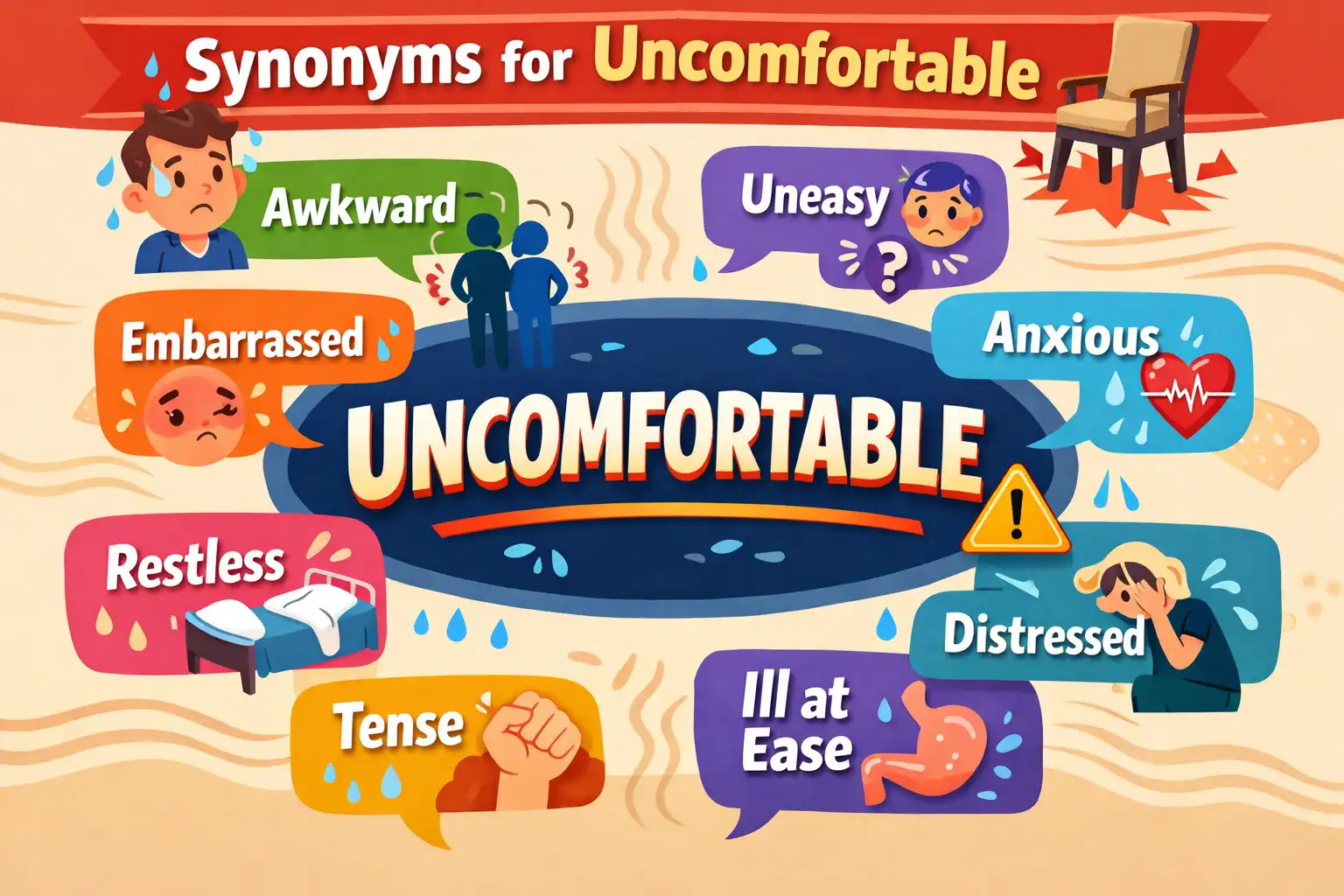
Common synonyms for uncomfortable describe physical pain, emotional unease, or social awkwardness. Choosing the right word helps express exactly what kind of discomfort you feel.
- uneasy
- awkward
- tense
- distressed
- restless
- bothered
- embarrassed
- sore
Meaning of Uncomfortable
Uncomfortable means feeling physical pain, emotional unease, or social awkwardness.
Example:
I felt uncomfortable sitting in that hard chair.
Categories of Synonyms
Physical discomfort
Words in this group describe body pain or lack of comfort. They are used when something hurts or feels unpleasant physically.
Emotional discomfort
These synonyms describe mental stress, worry, or inner tension. They focus on feelings, not the body.
Social discomfort
These words describe awkward or embarrassing situations with other people.
Synonyms Table
| Word | Simple Meaning | Example Sentence |
| uneasy | not calm or relaxed | She felt uneasy in the dark room. |
| awkward | socially strange | The silence felt awkward. |
| tense | full of stress | The meeting became tense quickly. |
| restless | unable to relax | He felt restless all night. |
| sore | physically painful | My back is sore today. |
| embarrassed | socially uncomfortable | She was embarrassed by the mistake. |
| distressed | emotionally upset | He looked distressed after the news. |
| bothered | slightly annoyed | I felt bothered by the noise. |
Master Synonyms List (Grouped by Level)
Beginner / Simple
Uneasy – not calm or comfortable
Example: I felt uneasy walking alone at night. (Neutral)
Awkward – socially uncomfortable
Example: The joke made everyone awkward. (Informal)
Sore – painful in the body
Example: My legs are sore after running. (Neutral)
Intermediate
Restless – unable to relax
Example: She felt restless during the long flight. (Neutral)
Bothered – slightly annoyed or uncomfortable
Example: He seemed bothered by the question. (Informal)
Embarrassed – socially ashamed
Example: She felt embarrassed after tripping. (Neutral)
Advanced / Formal
Tense – full of emotional pressure
Example: The room grew tense before the decision. (Formal)
Distressed – deeply upset
Example: He sounded distressed on the phone. (Formal)
Formal vs Informal Synonyms
Some synonyms work better in formal writing. Words like tense and distressed suit academic or professional contexts. Informal speech prefers awkward or bothered. Choose based on audience and setting.
Real-Life Usage Examples
Conversation:
I felt awkward at the party.
Academic writing:
Participants reported feeling tense during the test.
Business writing:
The client seemed uneasy about the proposal.
Blogging:
Travel seats can feel sore after long trips.
Emotional expression:
She felt distressed by the sudden change.
Similar Words Comparison
Uncomfortable vs Awkward
Uncomfortable is general.
Awkward focuses on social situations.
Example:
I felt uncomfortable in the chair.
I felt awkward meeting his parents.
Uncomfortable vs Uneasy
Uncomfortable can be physical or emotional.
Uneasy mainly describes emotional worry.
Example:
The bed was uncomfortable.
I felt uneasy about the decision.
Example Sentences
- The shoes were uncomfortable after an hour.
- He felt uneasy about the silence.
- The chair made my back sore.
- The conversation turned awkward quickly.
- She felt restless during the delay.
- I felt bothered by the loud music.
- The news left him distressed.
- The room felt tense before the speech.
- He looked embarrassed after slipping.
- The air felt uncomfortable and hot.
- She felt uneasy around strangers.
- The meeting created a tense mood.
- My neck is sore from sleeping wrong.
- The silence was awkward.
Common Mistakes
- Using awkward for physical pain
→ Say sore or painful instead. - Using formal words in casual talk
→ Distressed sounds too serious for small problems. - Confusing emotional and physical meanings
→ Choose based on context. - Repeating the same synonym
→ Vary words for clarity.
Tips / Best Practices
- Match tone to the situation
- Check emotional vs physical meaning
- Use formal words in writing, casual words in speech
- Choose the clearest option
- Avoid overusing one synonym
When NOT to Use Uncomfortable
Do not use uncomfortable words for strong pain or medical problems. Use specific words like painful or injured instead.
Opposite Words (Antonyms)
- comfortable
- relaxed
- calm
- at ease
- pleasant
FAQs
What does uncomfortable mean?
It means feeling physical pain or emotional unease.
Is uncomfortable formal or informal?
It is neutral and works in most situations.
How can I use it in conversation?
Say: “This chair is uncomfortable.”
What is the best synonym?
It depends on context. Uneasy works for emotions.
Can uncomfortable be replaced with awkward?
Yes, but only in social situations.
Conclusion
Learning synonyms for uncomfortable improves both writing and speaking. It helps you describe feelings more precisely and naturally. Clear word choice leads to better communication.
Try using 3 new synonyms in your next sentence.

Andrew Powell is a research-focused editorial writer specializing in word meanings, semantic distinctions, and language accuracy. With a professional background in research-based informational writing, he has built his work around careful analysis of how words function in context and how subtle variations in meaning influence communication.
Andrew’s expertise lies in word comparison and semantic precision. His work examines closely related terms, clarifies usage differences, and explains how context shapes interpretation. Rather than offering surface-level definitions, he approaches language with a structured methodology—reviewing usage patterns, consulting authoritative dictionaries, analyzing corpus data, and evaluating real-world examples. This research-driven process ensures that readers receive clear, reliable explanations grounded in linguistic evidence.
A core focus of his writing is helping readers understand meaning differences that are often overlooked. Whether distinguishing between near-synonyms, exploring formal versus informal usage, or clarifying nuanced grammatical structures, Andrew aims to remove ambiguity. His explanations are designed to support students, writers, educators, and professionals who rely on precise language in academic, business, or creative contexts.
Andrew contributes to the Word Synonyms niche with an emphasis on clarity, neutrality, and factual accuracy. He prioritizes language accuracy over simplification and avoids unsupported claims. Each piece is structured to answer specific user queries while maintaining contextual depth, aligning with current search quality standards and semantic SEO principles.
By combining research-based writing with careful editorial standards, Andrew Powell helps readers develop stronger vocabulary awareness and make informed word choices. His work reflects a commitment to trustworthy information, thoughtful analysis, and practical value for anyone seeking a deeper understanding of English semantics.