Quick Intro
The word uncertain is common in daily conversation, academic writing, and professional communication. It describes situations where something is not clear, predictable, or fully known. Learning synonyms for uncertain helps improve vocabulary, writing clarity, and communication accuracy.
Understanding alternative words also helps ESL learners express ideas more precisely in different contexts.
Direct Answer
Meaning of uncertain:
Uncertain means something is not known, not decided, or not predictable.
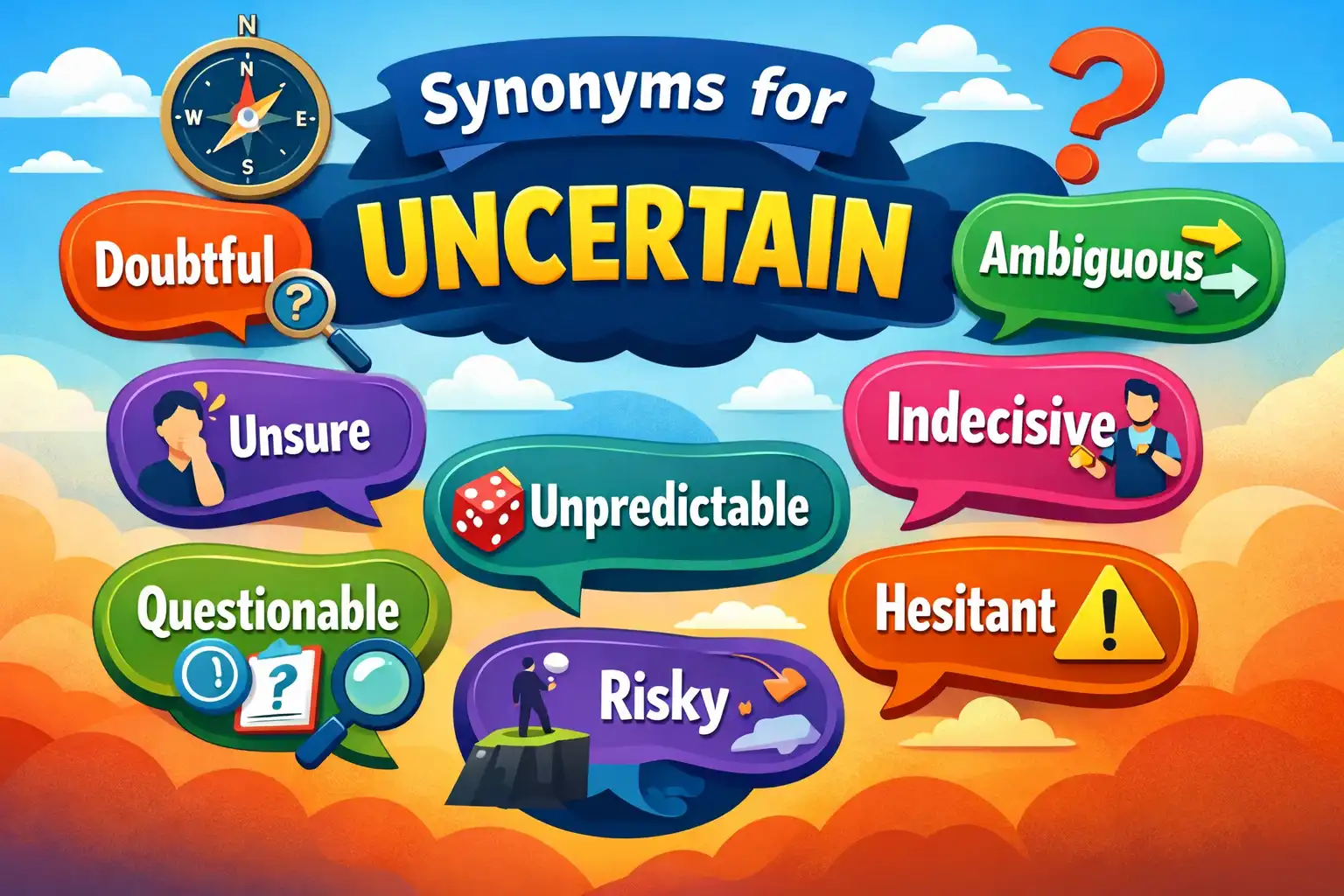
Common synonyms for uncertain include:
- unsure
- doubtful
- unclear
- unpredictable
- questionable
- hesitant
- tentative
- ambiguous
- indecisive
- skeptical
Categories of Synonyms
Physical Discomfort (Situational Uncertainty)
Some words describe uncertainty caused by unclear situations or unstable conditions.
Examples include unpredictable and questionable, which often describe events or outcomes that may change or cannot be trusted.
Emotional Discomfort
Certain synonyms express personal feelings of doubt or lack of confidence.
Words like unsure, doubtful, and hesitant often describe emotional reactions when someone cannot make a decision.
Social Discomfort
Some synonyms appear in social or communication contexts when ideas or meanings are unclear.
Words such as ambiguous or indecisive describe unclear communication or difficulty making choices.
Synonyms Table
| Word | Simple Meaning | Example Sentence |
| unsure | not confident about something | She felt unsure about the final answer. |
| doubtful | not believing something completely | He was doubtful about the project’s success. |
| unclear | not easy to understand | The instructions were unclear. |
| unpredictable | difficult to guess or control | The weather here is unpredictable. |
| questionable | possibly wrong or doubtful | That explanation sounds questionable. |
| hesitant | slow to act because of doubt | She was hesitant to accept the offer. |
| tentative | not final or fully decided | They made a tentative plan for next week. |
| ambiguous | having more than one meaning | The message was ambiguous. |
| indecisive | unable to make a decision | He seemed indecisive about the job choice. |
| skeptical | not easily convinced | She was skeptical of the advertisement. |
Master Synonyms List (Grouped by Level)
Beginner / Simple Synonyms
Unsure
Meaning: not confident or certain.
Example: I am unsure if the meeting starts at 9 or 10.
Doubtful
Meaning: feeling that something may not be true.
Example: He was doubtful about the company’s promise.
Unclear
Meaning: difficult to understand or not obvious.
Example: The teacher said the question was unclear.
Hesitant
Meaning: slow to act because of doubt.
Example: She felt hesitant before signing the contract.
Intermediate Synonyms
Tentative
Meaning: not final and open to change.
Example: We made a tentative decision about the travel date.
Questionable
Meaning: something that may not be reliable or correct.
Example: The report contains questionable data.
Indecisive
Meaning: unable to choose between options.
Example: The manager seemed indecisive during the discussion.
Advanced / Formal Synonyms
Ambiguous (Formal)
Meaning: open to more than one interpretation.
Example: The contract wording is ambiguous.
Skeptical (Formal)
Meaning: not easily convinced something is true.
Example: Many investors are skeptical about the proposal.
Unpredictable (Neutral/Formal)
Meaning: impossible to forecast accurately.
Example: Market trends remain unpredictable this year.
Formal vs Informal Synonyms
Choosing the right synonym depends on context and formality.
Informal or casual synonyms include:
- unsure
- doubtful
- hesitant
These are common in everyday conversation.
Example:
“I’m unsure about the answer.”
Formal or professional synonyms include:
- ambiguous
- tentative
- skeptical
These appear more often in academic, legal, or professional writing.
Example:
“The results remain tentative until further testing.”
Understanding this difference helps writers choose words that match tone and audience.
Real-Life Usage Examples
Conversation
“I’m unsure if the restaurant is open today.”
Academic Writing
“The results remain tentative due to limited sample size.”
Business Writing
“The timeline is still uncertain, so final delivery dates may change.”
Blogging
“Travel plans can be unpredictable, especially during the rainy season.”
Emotional Expression
“She felt doubtful about her decision after hearing the news.”
Similar Words Comparison
Uncertain vs Unsure
Both describe doubt, but unsure usually refers to personal feelings.
Example:
“I’m unsure about the answer.”
Uncertain can refer to situations or outcomes.
Example:
“The future remains uncertain.”
Uncertain vs Ambiguous
Uncertain means something is not known.
Example:
“The result is uncertain.”
Ambiguous means something has more than one possible meaning.
Example:
“The message was ambiguous.”
Example Sentences
Here are natural examples using synonyms of uncertain:
- She felt unsure about the final decision.
- The outcome of the election remains uncertain.
- He sounded doubtful during the interview.
- The instructions were unclear to many students.
- Their travel plans are still tentative.
- The company’s future seems unpredictable.
- She was hesitant to share her opinion.
- The explanation seemed questionable.
- The contract language is ambiguous.
- He appeared indecisive about the offer.
- Many experts remain skeptical of the claim.
- The timeline for completion is uncertain.
- The situation felt unpredictable.
- I was unsure how to respond.
- Their response sounded doubtful.
Common Mistakes
Using Rare or Incorrect Synonyms
Some learners choose unusual words that native speakers rarely use. Stick to common synonyms like unsure or doubtful.
Confusing Ambiguous with Uncertain
Ambiguous refers to unclear meaning, while uncertain refers to unknown outcomes.
Overusing One Synonym
Repeating the same word reduces writing quality. Use alternatives like tentative or hesitant to vary language.
Using Formal Words in Casual Speech
Words like ambiguous may sound too formal in everyday conversation.
Example:
Instead of “Your message is ambiguous,” say “Your message is unclear.”
Tips / Best Practices
Choose synonyms carefully by considering:
Tone
Formal writing may require words like tentative or skeptical.
Context
Use unsure for personal feelings and unpredictable for situations.
Formality
Academic writing often prefers ambiguous or questionable.
Clarity
Always choose the word that clearly communicates the idea.
Avoid repeating the same word too often, as this weakens writing quality and can harm SEO readability.
When NOT to Use “Uncertain”
Avoid using uncertain when the situation is actually clear or decided.
Incorrect example:
“The meeting time is uncertain at 9 AM.”
Correct example:
“The meeting time is confirmed at 9 AM.”
Also avoid using uncertain when you mean confusing or ambiguous. Each word has a specific meaning.
Opposite Words (Antonyms)
Common antonyms for uncertain include:
- certain
- confident
- definite
- sure
- predictable
- confirmed
Example:
“She felt confident about the exam result.”
FAQs
What does uncertain mean?
Uncertain means something is not known, not clear, or not decided.
Is uncertain formal or informal?
The word is neutral and can be used in both casual conversation and formal writing.
How can I use uncertain in conversation?
Example: “I’m uncertain about the meeting schedule.”
What is the best synonym for uncertain?
Common alternatives include unsure, doubtful, and unclear.
Can uncertain be replaced with unsure?
Yes. Both describe doubt, but unsure usually refers to personal feelings.
Is uncertain negative?
Not always. It simply means something is unknown or not decided yet.
What synonym works best in academic writing?
Words like tentative, ambiguous, or questionable often fit academic contexts.
Can uncertain describe emotions?
Yes. It can describe feelings when someone is unsure about a decision or situation.
What is a stronger word than uncertain?
Words like ambiguous or questionable can sound stronger depending on context.
How can I improve vocabulary using synonyms?
Practice using new words in sentences and try replacing common words in writing exercises.
Conclusion
Learning synonyms for uncertain helps improve both writing and speaking. It allows you to describe doubt, unclear situations, and unpredictable outcomes more precisely.
Using different synonyms also makes writing more natural and engaging. Try using three new synonyms from this guide in your next sentence to strengthen your vocabulary.

Andrew Powell is a research-focused editorial writer specializing in word meanings, semantic distinctions, and language accuracy. With a professional background in research-based informational writing, he has built his work around careful analysis of how words function in context and how subtle variations in meaning influence communication.
Andrew’s expertise lies in word comparison and semantic precision. His work examines closely related terms, clarifies usage differences, and explains how context shapes interpretation. Rather than offering surface-level definitions, he approaches language with a structured methodology—reviewing usage patterns, consulting authoritative dictionaries, analyzing corpus data, and evaluating real-world examples. This research-driven process ensures that readers receive clear, reliable explanations grounded in linguistic evidence.
A core focus of his writing is helping readers understand meaning differences that are often overlooked. Whether distinguishing between near-synonyms, exploring formal versus informal usage, or clarifying nuanced grammatical structures, Andrew aims to remove ambiguity. His explanations are designed to support students, writers, educators, and professionals who rely on precise language in academic, business, or creative contexts.
Andrew contributes to the Word Synonyms niche with an emphasis on clarity, neutrality, and factual accuracy. He prioritizes language accuracy over simplification and avoids unsupported claims. Each piece is structured to answer specific user queries while maintaining contextual depth, aligning with current search quality standards and semantic SEO principles.
By combining research-based writing with careful editorial standards, Andrew Powell helps readers develop stronger vocabulary awareness and make informed word choices. His work reflects a commitment to trustworthy information, thoughtful analysis, and practical value for anyone seeking a deeper understanding of English semantics.