Quick Intro
The word restless appears often in daily conversations, books, and emotional descriptions. It describes a state where a person cannot relax or stay still. Learning synonyms for restless helps improve writing clarity and makes speech more expressive.
Understanding different alternatives also helps ESL learners choose the most accurate word for each situation.
Direct Answer
Meaning of restless
Restless means feeling unable to relax, stay still, or feel calm. It often describes physical movement, emotional uneasiness, or impatience.
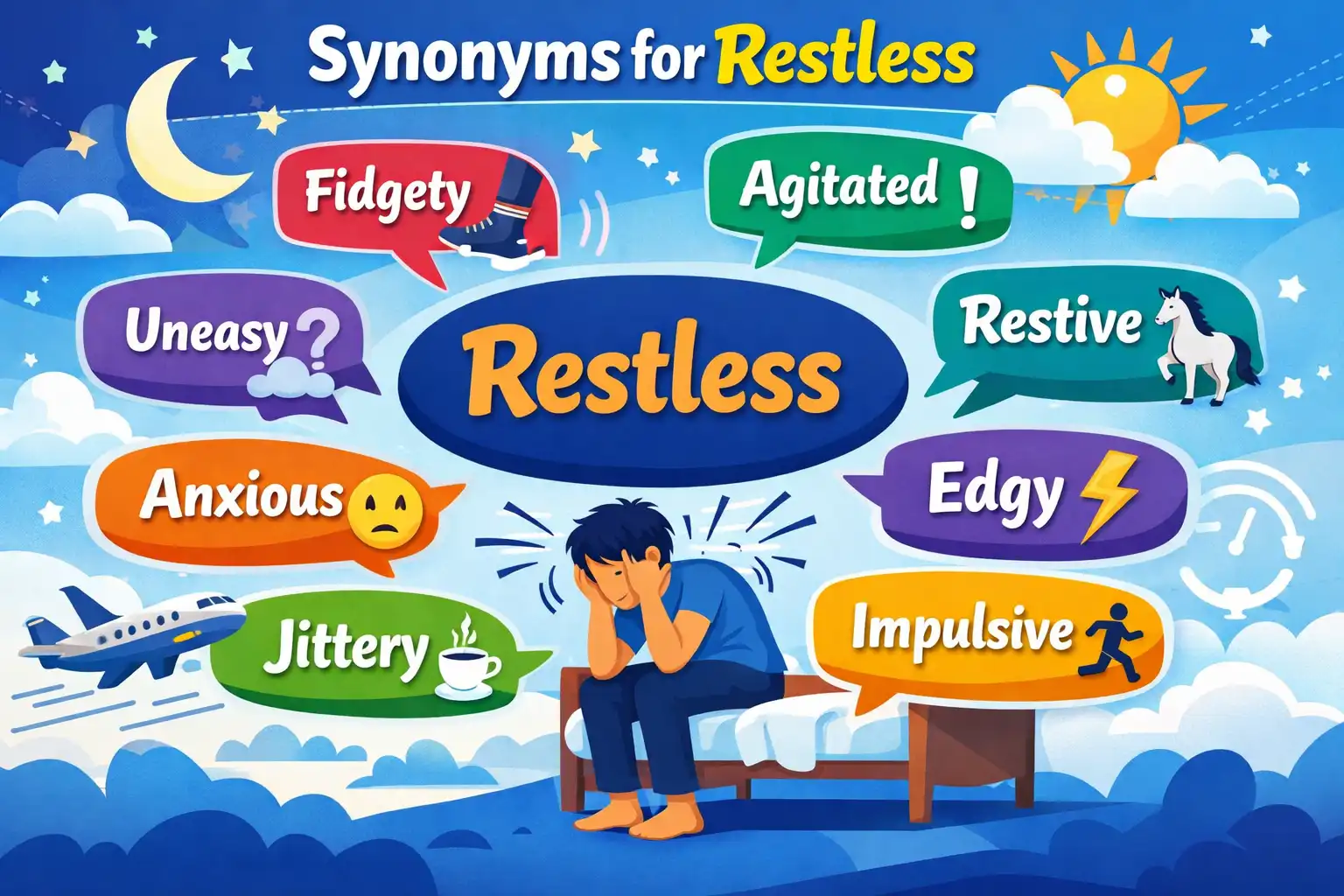
Common synonyms for restless:
- uneasy
- fidgety
- anxious
- agitated
- impatient
- unsettled
- jittery
- nervous
- tense
- on edge
Categories of Synonyms
Physical Discomfort
These synonyms describe body movement or inability to sit still.
Examples include fidgety, jittery, and tense. These words often appear when someone moves constantly or feels physical tension.
Emotional Discomfort
Some synonyms focus on mental or emotional unease.
Words like anxious, uneasy, and nervous describe internal worry or discomfort rather than physical movement.
Social Discomfort
These synonyms describe irritation or impatience in social situations.
Examples include impatient, agitated, and on edge, which often appear when people feel uncomfortable or irritated around others.
Synonyms Table
| Word | Simple Meaning | Example Sentence |
| uneasy | feeling slightly worried or uncomfortable | She felt uneasy before the interview. |
| fidgety | unable to sit still | The child became fidgety during the long meeting. |
| anxious | worried or nervous about something | He felt anxious before the exam results. |
| agitated | very nervous or disturbed | The crowd became agitated after the announcement. |
| impatient | unable to wait calmly | She grew impatient during the delay. |
| unsettled | feeling disturbed or unsure | The strange news left him unsettled. |
| jittery | nervous and shaky | Too much coffee made him jittery. |
| nervous | worried or afraid | She felt nervous before giving her speech. |
| tense | tight or stressed | The room felt tense during the discussion. |
| on edge | easily irritated or nervous | He seemed on edge all day. |
Master Synonyms List (Grouped by Level)
Beginner / Simple Synonyms
Uneasy
Simple meaning: feeling slightly worried or uncomfortable
Example: She felt uneasy walking alone at night.
Nervous
Simple meaning: worried or afraid about something
Example: He looked nervous before the presentation.
Fidgety
Simple meaning: unable to stay still
Example: The student became fidgety during the long lecture.
Intermediate Synonyms
Anxious
Simple meaning: worried or expecting something stressful
Example: She felt anxious about the upcoming test.
Impatient
Simple meaning: unable to wait calmly
Example: The customers became impatient in the long line.
Unsettled
Simple meaning: feeling disturbed or unsure
Example: The news made everyone feel unsettled.
Advanced / Formal Synonyms
Agitated (Formal)
Simple meaning: very disturbed or upset
Example: The manager sounded agitated during the meeting.
Jittery (Informal)
Simple meaning: extremely nervous or shaky
Example: Too much caffeine made him jittery.
Tense
Simple meaning: stressed or mentally tight
Example: She felt tense during the negotiation.
On edge (Informal)
Simple meaning: easily irritated or nervous
Example: He seemed on edge before the interview.
Formal vs Informal Synonyms
Some synonyms for restless are more suitable for formal writing, while others fit casual speech.
Formal options such as agitated or tense work well in academic or professional writing.
Informal options like jittery or on edge appear more frequently in conversation and personal writing.
Choosing the right synonym depends on context and audience. Formal contexts require neutral or professional language.
Real-Life Usage Examples
Conversation
“I feel restless today. I can’t focus on anything.”
Academic Writing
The participants appeared restless during the long experimental session.
Business Writing
Employees may become restless if projects lack clear direction.
Blogging
Many travelers feel restless when they stay in one place too long.
Emotional Expression
He felt restless because he was waiting for important news.
Similar Words Comparison
Restless vs Anxious
Restless often refers to physical movement or inability to relax.
Anxious focuses more on worry or fear about something.
Example:
She felt restless during the long meeting.
She felt anxious about the exam results.
Restless vs Impatient
Restless describes discomfort or inability to stay calm.
Impatient specifically means difficulty waiting.
Example:
He felt restless during the quiet afternoon.
He felt impatient waiting for the bus.
Example Sentences
She felt restless after sitting all day.
The students grew restless during the long lecture.
He became restless while waiting for the phone call.
Travelers sometimes feel restless during long flights.
Children often become restless in boring situations.
The audience looked restless during the delay.
She felt restless and decided to go for a walk.
The baby became restless late at night.
Workers grew restless after hours of discussion.
He felt restless before the big decision.
Many people feel restless during stressful periods.
The patient seemed restless in the hospital room.
Teenagers often feel restless during long classes.
She felt restless and checked her phone repeatedly.
Common Mistakes
Using restless instead of anxious
Many learners confuse these words. Restless often refers to movement, while anxious relates to worry.
Overusing one synonym
Repeating the same synonym reduces clarity. Try different words depending on context.
Using informal synonyms in formal writing
Words like jittery may sound too casual in academic writing.
Ignoring context
Not every synonym fits every situation. Some describe emotion, while others describe physical movement.
Tips / Best Practices
Choose synonyms based on tone and context.
- Use simple synonyms for everyday conversation.
- Use formal synonyms for academic writing.
- Avoid repeating the same word too often.
- Select synonyms that match the emotion or situation.
Clear word choice improves writing quality and readability.
When NOT to Use Restless
Do not use restless when describing simple tiredness.
Restless also does not mean sadness or depression. It mainly refers to discomfort, movement, or inability to relax.
Use more precise words when describing specific emotions.
Opposite Words (Antonyms)
Common antonyms of restless include:
- calm
- relaxed
- peaceful
- content
- still
- composed
These words describe emotional stability or physical stillness.
FAQs
What does restless mean?
Restless means feeling unable to relax or stay still due to discomfort, boredom, or anxiety.
Is restless formal or informal?
Restless is a neutral word used in both casual conversation and formal writing.
How can I use restless in conversation?
You can say, “I feel restless today. I need to go outside.”
What is the best synonym for restless?
Common alternatives include uneasy, anxious, fidgety, and impatient.
Can restless be replaced with nervous?
Sometimes yes. However, nervous focuses more on fear or worry.
Is restless a negative word?
Not always. It can describe energy, boredom, or emotional discomfort.
Can restless describe children?
Yes. Children often become restless when bored or tired.
What part of speech is restless?
Restless is an adjective used to describe feelings or behavior.
Why do people feel restless?
People may feel restless because of stress, boredom, excitement, or anxiety.
Is restless used in writing?
Yes. Writers often use it to describe emotions or behavior.
Conclusion
Understanding synonyms for restless helps improve vocabulary, writing clarity, and everyday communication. Different alternatives allow you to describe emotions and situations more precisely.
Try using three new synonyms from this guide in your next sentence to strengthen your vocabulary.

Andrew Powell is a research-focused editorial writer specializing in word meanings, semantic distinctions, and language accuracy. With a professional background in research-based informational writing, he has built his work around careful analysis of how words function in context and how subtle variations in meaning influence communication.
Andrew’s expertise lies in word comparison and semantic precision. His work examines closely related terms, clarifies usage differences, and explains how context shapes interpretation. Rather than offering surface-level definitions, he approaches language with a structured methodology—reviewing usage patterns, consulting authoritative dictionaries, analyzing corpus data, and evaluating real-world examples. This research-driven process ensures that readers receive clear, reliable explanations grounded in linguistic evidence.
A core focus of his writing is helping readers understand meaning differences that are often overlooked. Whether distinguishing between near-synonyms, exploring formal versus informal usage, or clarifying nuanced grammatical structures, Andrew aims to remove ambiguity. His explanations are designed to support students, writers, educators, and professionals who rely on precise language in academic, business, or creative contexts.
Andrew contributes to the Word Synonyms niche with an emphasis on clarity, neutrality, and factual accuracy. He prioritizes language accuracy over simplification and avoids unsupported claims. Each piece is structured to answer specific user queries while maintaining contextual depth, aligning with current search quality standards and semantic SEO principles.
By combining research-based writing with careful editorial standards, Andrew Powell helps readers develop stronger vocabulary awareness and make informed word choices. His work reflects a commitment to trustworthy information, thoughtful analysis, and practical value for anyone seeking a deeper understanding of English semantics.