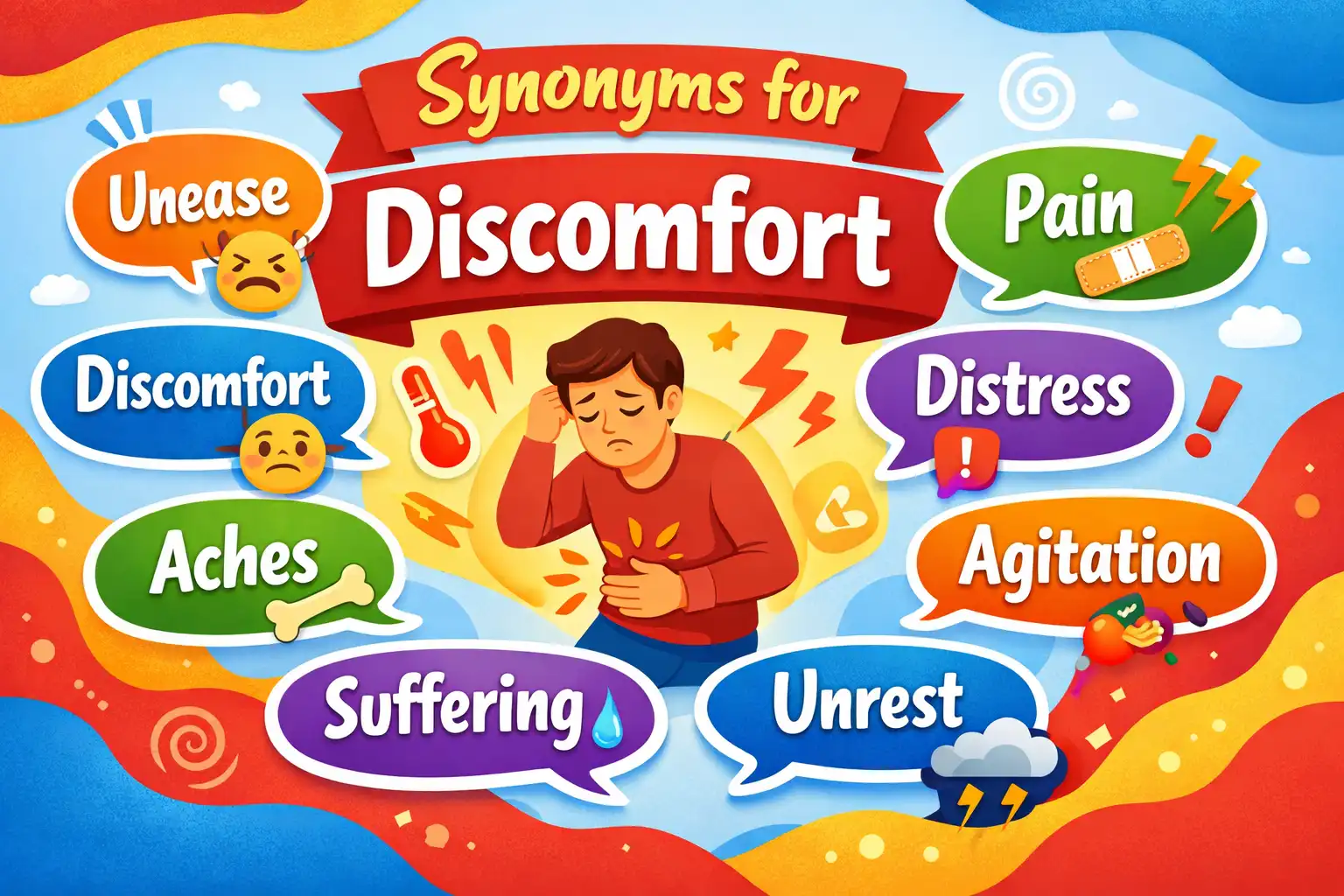
Common synonyms for “discomfort” include:
- Unease
- Pain
- Distress
- Agony
- Inconvenience
- Soreness
- Affliction
- Trouble
Meaning of Discomfort
Discomfort refers to a feeling of physical or mental unease, distress, or slight pain. It is often a result of an unpleasant situation or condition, causing temporary suffering or inconvenience.
Example sentences:
- After running for an hour, she felt a mild discomfort in her knees.
- The discomfort from the sunburn lasted for several days.
Synonyms Table
| Word | Meaning | Example |
| Unease | A feeling of anxiety or slight discomfort. | He felt a sense of unease as he entered the dark room. |
| Pain | Physical or emotional suffering, often sharp or intense. | The pain in his back made it difficult to move. |
| Distress | A state of great pain, worry, or sadness. | The news of the accident caused her a great deal of distress. |
| Agony | Extreme physical or mental pain or suffering. | She was in agony after the surgery. |
| Inconvenience | A mild form of discomfort, often related to situations. | The delay was an inconvenience, but we managed. |
| Soreness | The feeling of pain or tenderness in a part of the body. | His muscles were sore after the intense workout. |
| Affliction | A cause of pain or suffering, often a condition. | He dealt with the affliction of a chronic illness. |
| Trouble | Difficulty or problems that cause discomfort or distress. | She had trouble sleeping due to the noise outside. |
| Bother | A slight annoyance or discomfort. | The loud music was a bother during the meeting. |
| Displeasure | A feeling of dissatisfaction or discomfort. | His constant complaints caused much displeasure in the team. |
| Annoyance | A feeling of slight anger or irritation. | Her constant tapping on the desk was an annoyance. |
| Exasperation | Extreme frustration or irritation. | He sighed in exasperation after the long wait. |
| Torment | Extreme pain or suffering, often emotionally. | The loss of her childhood pet was a torment for years. |
| Misery | A state of great discomfort, suffering, or unhappiness. | The miserable weather kept everyone indoors. |
Formal and Informal Synonyms
In formal writing, words like distress, affliction, agony, and misery are often used to convey deeper or more serious forms of discomfort, particularly in professional or academic contexts.
Informal synonyms, like bother, trouble, and unease, are more common in casual conversations and everyday situations. These words are typically used when discussing mild discomforts, either physical or emotional.
Context Usage Section
1. Conversations:
Synonyms for “discomfort” are often used in casual conversations to express mild inconvenience or pain. For instance, one might say, “I’m feeling a bit of discomfort in my back after sitting for too long,” or, “The noise outside is giving me a little bother.”
2. Writing:
In written texts, synonyms like distress, agony, and affliction are commonly found in both fiction and non-fiction. For example, a story might describe a character in “excruciating agony” or “deep distress” due to a personal loss.
3. Emotional Expression:
When talking about emotional or mental discomfort, words like unease, distress, and torment are frequently used. They help to convey the degree of discomfort a person feels, such as, “Her mind was in turmoil, and she felt constant emotional distress.”
Comparison Section
Discomfort vs. Pain
While both “discomfort” and “pain” imply unpleasant sensations, pain is typically more intense and physical. Pain refers to severe physical or emotional suffering, whereas discomfort can refer to a broader range of milder, more temporary unpleasant feelings.
Example:
- “He felt discomfort in his stomach after eating the spicy food” (mild, temporary).
- “The pain in his chest was unbearable and required immediate medical attention” (severe and intense).
Discomfort vs. Unease
Unease specifically refers to a feeling of nervousness or anxiety. It is a more psychological or emotional form of discomfort, often linked to situations that make a person feel uneasy, such as social interactions or uncertain circumstances.
Example:
- “She felt a slight unease walking into the meeting” (psychological, related to anxiety).
- “The discomfort from the blisters on his feet was worse than he expected” (physical).
Example Sentences
- His back was sore, and the discomfort made it hard to stand for long periods.
- She couldn’t hide her unease when she noticed the suspicious behavior.
- After the accident, he experienced a great deal of physical pain and emotional distress.
- The agony of waiting for the results was almost too much to bear.
- The delay was a minor inconvenience, but they were still able to proceed.
- She rubbed her shoulders to relieve the soreness from lifting heavy boxes.
- The chronic affliction in his legs made walking a struggle.
- He had trouble concentrating because of the noise from outside.
- The loud voices in the hallway caused her annoyance throughout the lecture.
- The displeasure of the customers was evident after the product recall.
- The exasperation on her face was clear after the repeated mistakes.
- The torment of remembering her lost loved one kept her awake at night.
- His misery increased as the days passed without any good news.
- The loud banging on the door was an annoyance I couldn’t ignore.
- The discomfort of sitting for so long was relieved when he stood up.
Common Mistakes
- Confusing discomfort with pain: “Discomfort” often refers to mild or temporary unease, while “pain” is usually more intense and severe.
- Using formal words in casual contexts: Words like agony, affliction, and misery should be reserved for serious situations, not for everyday, minor discomforts.
- Overusing synonyms: Using too many different synonyms for discomfort in the same sentence can make the writing sound repetitive and unclear. Choose one synonym to convey your message clearly.
FAQ
Q: What is the difference between discomfort and pain?
A: “Discomfort” refers to mild or temporary unease, while “pain” is more intense and often related to physical injury or deep emotional suffering.
Q: Can discomfort be emotional?
A: Yes, discomfort can be both physical and emotional. Emotional discomfort may involve feelings of unease, distress, or anxiety.
Q: How can I use the word “distress” instead of discomfort?
A: Use “distress” to convey a stronger sense of suffering or emotional difficulty. For example, “The news of the loss caused her great distress.”
Conclusion
In conclusion, understanding the nuances of synonyms for “discomfort” can help express a range of physical and emotional experiences more precisely. Whether you’re referring to physical pain, emotional unease, or minor inconveniences, choosing the right synonym can make your communication more accurate and impactful.

Andrew Powell is a research-focused editorial writer specializing in word meanings, semantic distinctions, and language accuracy. With a professional background in research-based informational writing, he has built his work around careful analysis of how words function in context and how subtle variations in meaning influence communication.
Andrew’s expertise lies in word comparison and semantic precision. His work examines closely related terms, clarifies usage differences, and explains how context shapes interpretation. Rather than offering surface-level definitions, he approaches language with a structured methodology—reviewing usage patterns, consulting authoritative dictionaries, analyzing corpus data, and evaluating real-world examples. This research-driven process ensures that readers receive clear, reliable explanations grounded in linguistic evidence.
A core focus of his writing is helping readers understand meaning differences that are often overlooked. Whether distinguishing between near-synonyms, exploring formal versus informal usage, or clarifying nuanced grammatical structures, Andrew aims to remove ambiguity. His explanations are designed to support students, writers, educators, and professionals who rely on precise language in academic, business, or creative contexts.
Andrew contributes to the Word Synonyms niche with an emphasis on clarity, neutrality, and factual accuracy. He prioritizes language accuracy over simplification and avoids unsupported claims. Each piece is structured to answer specific user queries while maintaining contextual depth, aligning with current search quality standards and semantic SEO principles.
By combining research-based writing with careful editorial standards, Andrew Powell helps readers develop stronger vocabulary awareness and make informed word choices. His work reflects a commitment to trustworthy information, thoughtful analysis, and practical value for anyone seeking a deeper understanding of English semantics.