The word confident is common in daily conversation, school writing, and professional communication. It describes strong belief in yourself or in a result. Learning synonyms helps you sound clearer and more precise.
Direct Answer
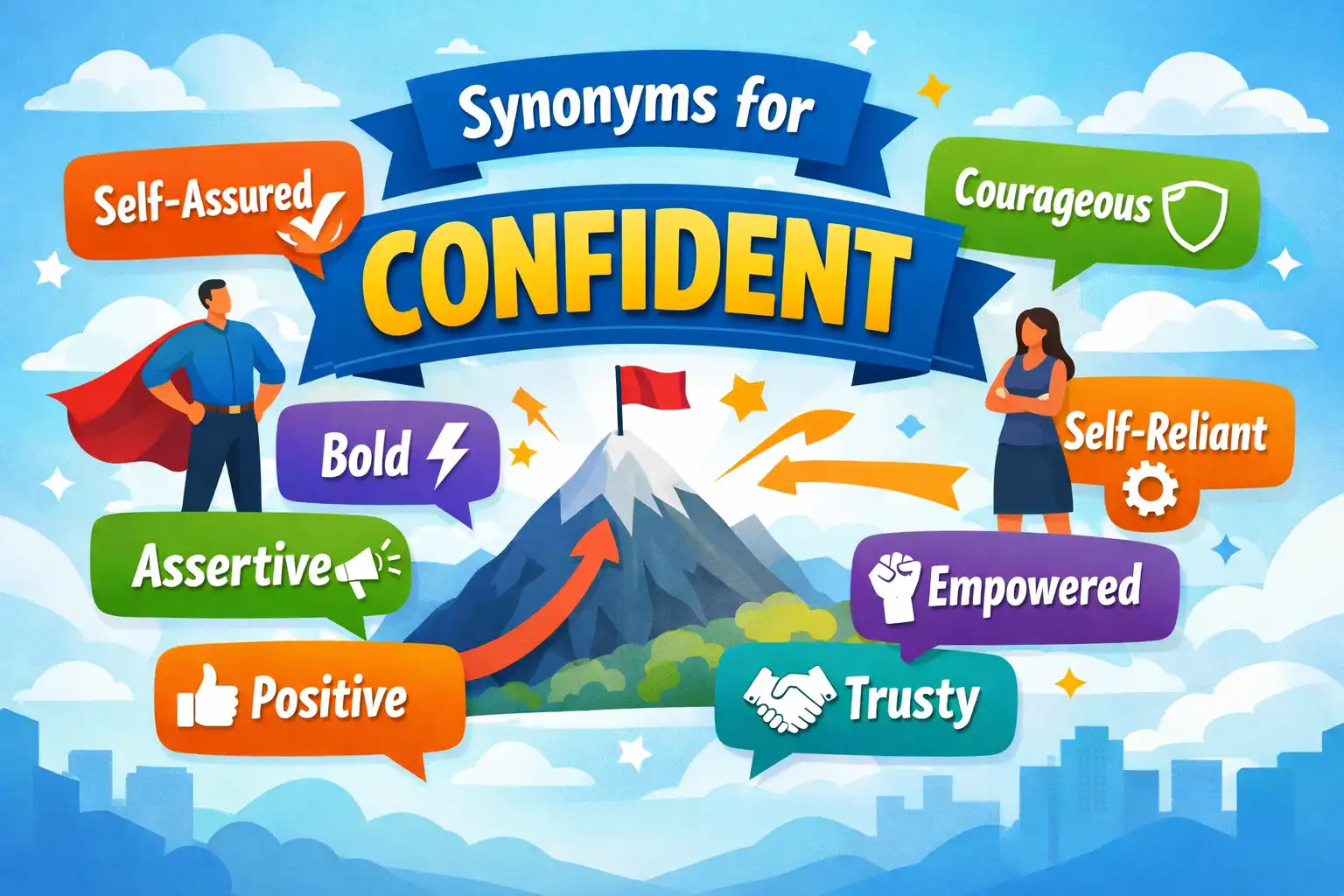
Confident means feeling sure about your ability or certain about an outcome. Common synonyms include:
- self-assured
- certain
- assured
- bold
- secure
- positive
- fearless
- assertive
Meaning of Confident
Confident means feeling strong trust in yourself or being sure something will happen.
Example: She felt confident before her final exam.
Categories of Synonyms
Personal Confidence
Words that describe belief in your own ability or character.
Emotional Strength
Words that show courage and emotional steadiness.
Social or Communication Confidence
Words that describe how someone speaks or acts around others.
Synonyms Table
| Word | Simple Meaning | Example Sentence |
| self-assured | sure of yourself | She sounded self-assured during the speech. |
| certain | without doubt | He was certain about his decision. |
| assured | calm and confident | Her voice was assured and steady. |
| bold | willing to take risks | She made a bold choice. |
| secure | feeling safe and sure | He felt secure in his skills. |
| positive | believing strongly | She was positive she would succeed. |
| fearless | without fear | The fearless athlete led the team. |
| assertive | confident in expressing ideas | He was assertive in the meeting. |
Master Synonyms List (Grouped by Level)
Beginner / Simple
Certain
Meaning: sure about something
Example: She is certain she locked the door.
(Formal/Neutral)
Positive
Meaning: strongly believing
Example: He is positive the plan will work.
(Informal)
Secure
Meaning: feeling safe and sure
Example: She feels secure in her new job.
(Neutral)
Intermediate
Self-assured
Meaning: confident in yourself
Example: He sounded self–assured during the interview.
(Formal)
Assured
Meaning: calm and certain
Example: Her answer was assured and clear.
(Formal)
Assertive
Meaning: confidently expressing views
Example: She was assertive about her goals.
(Professional)
Advanced / Formal
Bold
Meaning: brave and confident
Example: The leader made a bold decision.
(Formal)
Fearless
Meaning: not afraid
Example: The fearless speaker addressed the crowd.
(Formal)
Formal vs Informal Synonyms
Synonyms like assured and self-assured fit academic or business writing are formal . Informal options like positive work better in conversation. Choose based on audience and setting.
Real-Life Usage Examples
Conversation: I feel confident about tomorrow.
Academic Writing: The researcher was confident in the results.
Business Writing: We are confident this strategy will succeed.
Blogging: Stay confident and trust your journey.
Emotional Expression: He finally felt confident in himself.
Similar Words Comparison
Confident vs Certain
Confident is about belief in yourself.
Certain focuses on belief in facts.
Example:
She is confident speaking.
She is certain about the date.
Confident vs Bold
Confident is inner belief.
Bold adds risk and bravery.
Example:
He feels confident.
He made a bold move.
Example Sentences
- She felt confident entering the room.
- He spoke in a confident voice.
- I am confident about the outcome.
- Her confident smile impressed everyone.
- He gave a confident reply.
- She walked with confident steps.
- The manager sounded confident.
- He felt confident after practice.
- A confident attitude helps success.
- She stayed confident under pressure.
- His confident tone was reassuring.
Common Mistakes
- Using confident when you mean certain about facts
- Repeating the same synonym too often
- Choosing overly formal words in casual speech
- Confusing bold with rude behavior
- Using advanced words without understanding tone
Tips / Best Practices
- Match the synonym to tone
- Check the social context
- Choose proper formality
- Focus on clarity
- Avoid overusing the same word
When NOT to Use Confident
Do not use confident when describing guaranteed facts. Use certain or sure instead. Confidence is belief, not proof.
Opposite Words (Antonyms)
- unsure
- doubtful
- insecure
- nervous
- uncertain
FAQs
What does confident mean?
It means believing strongly in yourself or a result.
Is confident formal or informal?
It works in both settings.
How can I use it in conversation?
Say: “I feel confident about this.”
What is the best synonym for confident?
Self-assured is a strong neutral choice.
Can confident be replaced with certain?
Only when talking about facts, not personal belief.
Conclusion
Learning synonyms for confident improves both writing and speaking. It helps you express emotion and certainty more clearly. Strong vocabulary builds better communication.
Try using 3 new synonyms in your next sentence.

Andrew Powell is a research-focused editorial writer specializing in word meanings, semantic distinctions, and language accuracy. With a professional background in research-based informational writing, he has built his work around careful analysis of how words function in context and how subtle variations in meaning influence communication.
Andrew’s expertise lies in word comparison and semantic precision. His work examines closely related terms, clarifies usage differences, and explains how context shapes interpretation. Rather than offering surface-level definitions, he approaches language with a structured methodology—reviewing usage patterns, consulting authoritative dictionaries, analyzing corpus data, and evaluating real-world examples. This research-driven process ensures that readers receive clear, reliable explanations grounded in linguistic evidence.
A core focus of his writing is helping readers understand meaning differences that are often overlooked. Whether distinguishing between near-synonyms, exploring formal versus informal usage, or clarifying nuanced grammatical structures, Andrew aims to remove ambiguity. His explanations are designed to support students, writers, educators, and professionals who rely on precise language in academic, business, or creative contexts.
Andrew contributes to the Word Synonyms niche with an emphasis on clarity, neutrality, and factual accuracy. He prioritizes language accuracy over simplification and avoids unsupported claims. Each piece is structured to answer specific user queries while maintaining contextual depth, aligning with current search quality standards and semantic SEO principles.
By combining research-based writing with careful editorial standards, Andrew Powell helps readers develop stronger vocabulary awareness and make informed word choices. His work reflects a commitment to trustworthy information, thoughtful analysis, and practical value for anyone seeking a deeper understanding of English semantics.